


Grey Doffin
-
Posts
4,182 -
Joined
-
Last visited
-
Days Won
31
Content Type
Profiles
Forums
Events
Store
Downloads
Gallery
Everything posted by Grey Doffin
-
Bob, Like I said before, there will be no correct ID unless someone who knows sees it in person. Best you can get online and with pictures is a good guess. Grey
-

Kawachi (no) Kami Minamoto Nagakuni Saku
Grey Doffin replied to SwordGuyJoe's topic in General Nihonto Related Discussion
Hi Joe, Here's an oshigata from Shinto Taikan. Grey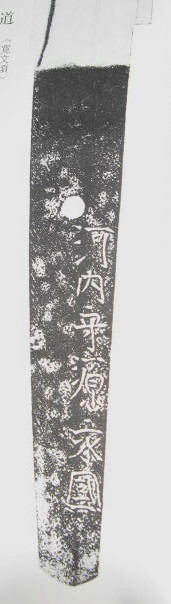
-
Peter, If you crop the picture a higher resolution might fit. Grey
-
Here's more. Dates for the various Daido range from late 16th century to mid 19th century. Because it looks like your sword had an O-kissaki (long point) before someone took steel wool to it, I would guess the more recent part of that range, perhaps 19th century. O-kissaki are often seen on long swords form this period. The number of holes in the nakago correspond to different blades lengths (likely it was shortened more than once) and different handles (it definitely was mounted in more than one set of koshirae). The reason slightly recessed gold inlay corresponds to older inlay is that steel corrodes and expands with age, while gold does neither. Can you give us the length of the edge, from the tip to the notch at the back of the blade in a straight line? What is the curvature, from that straight line to the back of the blade at its greatest gap? Grey
-
Hi Bob, I don't know the small inlaid character but the 2 larger ones read, "Daido", which is a swordsmith's name. The fact that the name is inlaid in gold and not simply carved into the nakago of the sword is because the sword has been shortened, the original signature, if there was one, has been lost to the shortening, and someone later has done the inlay as an attribution. There were about 40 smiths who signed this name; maybe someone else has an idea which Daido this might be. The attribution can be an honest attribution or it can be done solely to increase the value of the sword and have no relation to honesty. Hard to tell from pictures. Run your fingernail over the gold inlay. Is it slightly recessed below the surrounding steel or is it flush? If recessed it has some age; if flush, the inlay was done relatively recently and may be spurious. The patina of the nakago (tang) looks like a good piece. Someone who has knowledge and is honest will have to see the sword in hand before you'll know very much about it. Make sure you know how to handle and care for this sword. Here's a care and etiquette brochure at the NMBTH American Branch website: http://www.nbthk-ab.org/Etiquette.htm Hope this helps. Grey
-
It doesn't seem likely that a Mantetsu-to wouldn't be signed as such, and I doubt anyone would be able to state with certainty that it is Mantetsu (Manchurian steel) without the signature. It does look like WWII vintage, and the kesho yasuri (style of file work on the nakago) suggests more of a hand made blade than machine made. Probably not true Nihonto (made of tamahagane) but probably water quenched. The blade needs a proper polish, which will cost more than it is worth, probably. Now that you've satisfied the itch to buy a sword, spend serious time in study. Read and reread books and get to see in hand every sword you can. Knowledge will lead to smart buys. Grey
-
Stephen, If you get the fishing pole don't try to glue the cracks. They are natural cracks from shrinkage in the bamboo and nothing will make them close up. If you put filler in the cracks you will only succeed in opening new cracks elsewhere, and then your filler will chip out and fall away. Best leave well enough alone. Grey
-
What you have as Yoshihiro is Fujiwara. The picture with 4 Kanji reads Bizen Osafune. The signature on the Fuchi reads Munenaga with a Kao (personal seal). I can't read anything else because the photos are poorly lit and too grainy. Try a slanted (raking) light to make the Kanji show better. Grey
-
Two shin gunto (or so it seems) in UK
Grey Doffin replied to MrJones's topic in Military Swords of Japan
While we're on the subject, the patinas on Japnaese sword kodogu have a practical component as well as aesthetic. In many cases they serve to protect the metal from corrosion. The deep black finish on old iron tsuba is a good example. The tsuba are much less likely to rust in a damp environment with the patina than they are without. Grey -
Hi Rain, The sword is signed, "Bushu Ju Fujiwara Masanaga." Resident of Bushu (Musahsi Province) Fujiwara Masanaga. Fujiwara is often termed "clan" in English and Masanaga is the smith's name. The only reference included in my Index that has oshigata from this smith is the Shinto Taikan, page 676-7. Hawley's has him working at 1648. Other than that there isn't much I can tell you. Maybe others will have more and better information. Looks like a nice sword; congratulations. Grey
-
Two shin gunto (or so it seems) in UK
Grey Doffin replied to MrJones's topic in Military Swords of Japan
Mr. Jones, Thank you. Grey -
Nikoly, The other side is the date, "Showa Ju Ku Nen Ju Ichi Gatsu". Showa 19 year, 11 month. November of 1944. I don't think you will be able to learn anything about Fujifusa. Unless he was one the few important smiths who worked during WWII, nothing of his work has been recorded. Grey
-
Two shin gunto (or so it seems) in UK
Grey Doffin replied to MrJones's topic in Military Swords of Japan
Mr. Jones, So let's say, for instance, that you were in charge of the care of old oil paintings. If you weren't trained to properly fix oil paintings, would your museum tell you to do what made sense with them? How about bronze sculptures? Would you be given free reign to do as you think best? Of course not; you would be instructed to get them to a properly trained conservator. Why should Japanese swords be any different? My point isn't that Japanese sword parts should never be cleaned, it is that Japanese sword parts, blade and kodogu, if needing a cleaning, should be cleaned by someone who has proper training, which you don't have. I know you don't have proper training because you polished the parts, something someone with proper training would not have done. The patina on Japanese sword kodogu is somewhat indicative of age but, much more important, it is what the maker of the part chose for it. Shakudo is an alloy of copper & gold, which, with proper patination, is a jet black color. Polish it a bit and it looks like a new copper pipe. The same with shibuichi, yamagane, and all the other great alloys and patinas that kodogu artists used; they are very easily ruined by well meaning amateurs with brillo pads. I'm not saying that you're wholly ignorant or an imbecile, but you need to understand that if you are given art objects and historical artifacts into your care, you need to know, for sure, how best to care for them. No qualified authority on Japanese swords told you to polish those pieces; you made that up yourself. Please don't do it again. Grey -
Two shin gunto (or so it seems) in UK
Grey Doffin replied to MrJones's topic in Military Swords of Japan
I have often said, if you want to destroy a Japanese sword, donate it to a museum. If you don't know what you're doing, and you don't, do not clean or polish any part of the sword. Probably, this time, you have only destroyed the patina on mass produced WWII Miliray sword pieces, which isn't a great shame. Next time you might do much worse. Leave stuff alone if you're not qualified to fix it. Grey -
Hi guys, I sold a sword to someone in France last month and today it came back to me. The buyer never received it; the French post office marked it return but gave no reason why. Do any of you know why? Didn't think swords were banned in France. Thanks, Grey
-
Where are these objects now? If predominately in the West, most likely made for export. If predominately in Japan, not so. I understand that much time has passed between when they were made and now, and that art has continually flowed back and forth across borders, but if these were made with a Western aesthetic and exported to the West, it seems likely that they would have stayed where they were to be appreciated, rather than to have returned to Japan where they wouldn't be. Does that make any sense? Grey
-
Florida Sword Show
Grey Doffin replied to Ed's topic in Sword Shows, Events, Community News and Legislation Issues
Al told me that the only guns allowed at the show will be pre-cartridge era. Matchlocks, black powder, flintlock, etc. will be allowed but nothing that accepts a cartridge. Grey -
Something like this would be OK for iado, I guess, but if any of you are looking for a blade to use in tameshigiri (cutting) be very careful who you buy from. A friend had a Chinese blade snap in half during a cut. The loose half came flying back at him and cut him badly. Grey
-
Close but no cigar. It's a fake. Why would you want to buy this, Bruno? Grey
-
I think 120 is about usual. Grey
-
The tanto is signed Suishinshi Masahide with a Kao (personal seal). Looks to be gimei (forgery). The other side is the date, "Bun ... Ju Ni Nen Hachi Gatsu Hi". Bunka or Bunsei? Somebody help me here. Grey
-
Hi Todd, Against my better judgment (told myself I was done trying to help you after my last post), one final attempt. I told you in 3 separate posts to NMB that you need help. Unless knowledge of what you have comes to play in the sale of this collection, you won't get a fair price for what you sell. Since you don't have the knowledge yourself, you need someone who does. I sent you an email offering to put you in touch with someone who I consider honest and knowledgeable. Other members of NMB have tried to help also. So far all we see from you is slap dash 3 day ebay auctions. Not only is this a lousy way to sell the collection (on ebay you'll get fair price or better on low to mid level items and 50 cents on the dollar or less for good to great items) but you're now splitting sets that should never be split (bad business for you and terrible for art preservation). I have no hostility towards you; I don't know you. I'm feeling frustration, however, that you've asked for advice, been offered advice by people who know much more about the subject than you do, and you've chosen to ignore that advice. I can't force you to follow this advice; that's up to you. But I can tell you that you're costing yourself money and damaging the art your Grandfather collected. Grey
-
goinlower's items of interest
Grey Doffin replied to John A Stuart's topic in Auctions and Online Sales or Sellers
Todd, If you're selling fuchi & kashira that belong together in 2 separate sales it is the same as selling a pair of shoes in 2 sales. Stop the sales. No one will bid what they're worth unless he can be sure he'll get both halves of a set, which he can't with 2 sales. GET SOME HELP! Grey -
Having difficulty identifying the school and design.
Grey Doffin replied to Ford Hallam's topic in Tosogu
I think a clue is to be had from the unique treatment of the knocker go ana, also known as the poon tang. Grey note to mods: Ford started it. -
goinlower's items of interest
Grey Doffin replied to John A Stuart's topic in Auctions and Online Sales or Sellers
Todd, The trouble with a large auction house like Christie's is that they don't want to bother much with anything other than very high value items. If they were to let you drive down to NYC with 200 swords, they'd end up spending a day with you, giving you appraisals, and maybe getting to sell a few high end items. Anything else (lower value) they will shunt over to a secondary auction, not advertised very well, and not likely to bring you a good price. They will also take a significant bite out of anything they sell for you regardless of how well or poorly it sells. They would rather you get the appraisals from someone else first and then bring them to you so they can cherry pick the best of the lot. At least that's my understanding of how it would work; correct me if I'm wrong. If you want a fair price for what you have you need to find an honest and knowledgeable person who...... Never mind; I told you that twice already. Grey
