

Nobody
-
Posts
4,065 -
Joined
-
Last visited
-
Days Won
66
Content Type
Profiles
Forums
Events
Store
Downloads
Gallery
Everything posted by Nobody
-
 An exhibition and sale will be held by Token Shibata (刀剣柴田) at 10th floor of Daimaru Dept. Store in Tokyo, from Oct. 11th to 17th.
 -
reads Gokoku (護国), which means "to defend the country".
-
This is a Tanto made by Inoue Shinkai (井上真改) in 1675 (延宝三年). Ref. http://www.nona.dti.ne.jp/~sword/hpbs%2 ... hinkai.htm
-
1. Shuku Nyuei (祝入営) congratulations on joining the services 2. Nakamura ?? (中村?江) Nakamura is a family name. I am not sure about the last two kanj.
-
I agree with Nigel. That looks like a squid to me. As for the shark, I thought it was a shark at first, but now I think it might be a sturgeon.
-
I cannot understand on one point. How can he specify the era as such a narrow span without identifing the specific smith? This is a mere question of a beginner. :? Some shapes clearly point to a specific era based on the appraisers experience. The remainder of kantei then moves on to other factors such as jigane, jitetsu, hamon, and finally boshi. So, its quite possible to pinpoint the era without reaching a conclusion. In the end it's an educated opinion. fd Thank you fd. I generally understand the Kantei procedures. But I still wonder if it is possible to specify only 17 years span of 500 years before only from physical appearances. :?
-
reads Kaneyoshi (兼吉).
-
oo-wakizashi means long wakizashi. oo-wakizashi is identical with o-wakizashi. The kanji for that are 大脇差. The reading of the kanji is usually written as o-wakizashi practically in English. But actually, correct reading/writing is oo-wakizashi based upon Japanese exact pronunciation.
-
This is the answer. The picture is a calendar for 1859 (安政六巳未年). The calendar shows hollow months and full months of the specific year. A lunar calendar (actually luni-solar calendar) had been used until 1872 (明治五年) in Japan. The average length of a month was about 29.53 days. The actual length of a month was 29 (hollow month) or 30 (full month) days. The first day of the month was determined by dtermining the day during which the moment of new moon arrives. As a result, a leap month was necessary to be added every two or three years. Also, the permutation of hollow and full months was not fixed for each year. So, it was necessary to show the order of hollow and full months for every specific year. The upper right on the picture reads 大小鍔 (large tsuba and small tsuba). On the picture, small tsuba are expressed as tsuba with double Hitsuana. The small tsuba represent hollow months and the large tsuba represent full months. Each month can be identified with its unique motif as well as the order from upper right to lower left. Ref. National Diet Library http://www.ndl.go.jp/koyomi/nazo/01_bsall_c.html FYI http://en.wikipedia.org/wiki/Lunar_calendar
-
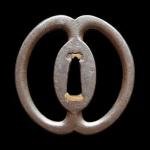
So, each Tsuba represents each month of the year. There are two types of Tsuba. As for one type, Nakago-ana and double Hitsu-ana look like a Kanji 小 (sho) which means small. BTW, lunar calendar (actually luni-solar calendar) had been used until 1872 in Japan.
-
Hi Bungo, Bingo! Almost correct. :D Further, the picture had a specific practical purpose. Does anyone realize?
-
Hi, Catalog is not a bad guess, but it is not the right answer. Here are big hints. There are two types of Tsuba on the picture. The motifs of Tsuba have common characteristics. There are twelve Tsuba(s).
-
Hi Mike, It is unrelated to Ukiyo-e.
-
my sony point and shoot digital camera went kaput
Nobody replied to Bungo's topic in General Nihonto Related Discussion
Ah, maybe I understand your problem. I do not know the latest model such as D80. But I assume that you cannot edit saved pictures with your camera. You can only view enlarged picture on the monitor of the camera, I think. If that is the problem, it is the specification of the product. -
my sony point and shoot digital camera went kaput
Nobody replied to Bungo's topic in General Nihonto Related Discussion
Hi Milt, Check the current focus mode and read manual. Ordinary auto focus mode does not allow shutter to work when focus is not gained. -
my sony point and shoot digital camera went kaput
Nobody replied to Bungo's topic in General Nihonto Related Discussion
I only know two points. 1. Generally, micro (macro?) lenses can take a close-up at shorter distance compared with ordinary lenses of the same focal length. 2. The optical design of micro lenses are optimized at relatively short distance for close-up. -
The point of my question is the purpose of the picture. English is always difficult.
-
The following picture of Tsuba can be seen on the site of National Died Library. The picture was drawn before 1859. Do you know what the sheet is? I know the answer.
-
This is not the info on CD's. But there are too many categories of traditional music. http://jtrad.columbia.jp/eng/index.html