Nobody
-
Posts
4,164 -
Joined
-
Last visited
-
Days Won
70
Content Type
Profiles
Forums
Events
Store
Downloads
Gallery
Everything posted by Nobody
-
Also that could be a reproduction using a broken tip of katana, I think.
-
Hi, I modified your photo a little to see clearer image. I think that the first two kanji might be Fukumoto (福本). Ref: Fukumoto Kanemune http://home.earthlink.net/~ttstein/kanemune.jpg

-
I am totaly unsure, but the mei could be Yoshikata ( 義方 ).
-
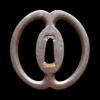
Hi, This is not always true but the shape of Nakago for mete-zashi was Furisode (振袖). The shape makes it easy to draw it with your right hand when the blade is worn on the right side of your body with point facing forwards. And also there were some mete-zashi whose blade shape were Uchi-zori (内反り) or Takenoko-zori (筍反り) to stick easier. As for the naming, mete-zashi is written as 馬手差, and mete (馬手 = literally a hand for a horse) means right hand because the reins of a horse were usually handled with right hand by samurai while his left hand grasped a bow. notes; the following photo is attached only to show Furisode and I do not know if it is actually a mete-zashi or not.

-
Getting an appraisal of an antique scroll in Japan
Nobody replied to Brian's topic in General Nihonto Related Discussion
The man in the scroll is Shoki (鍾馗). http://en.wikipedia.org/wiki/Zhong_Kui The mei looks Buko (武江) to me, though I am unsure about the name. But if it is Buko, he could be Kikuzawa Buko (菊沢武江). http://www.pref.saitama.lg.jp/A02/BP00/ ... sai-88.htm http://www.pref.saitama.lg.jp/A02/BA22/ ... utu.html#菊沢 武江 -
See 鍔(7): http://www.mizusumashi.com/17/index.php?page=9 http://mizusumashi.com/DSCF0128-3.html
-
Actually, as the amulet with the prayer paper inside is a ready-made product, its specific purpose depends on your wishes (if you believe ).
-
広 and 廣 are the same. However, 廣 is a kanji of old style.
-
That is an amulet of Naritasan Shinshoji Temple (成田山新勝寺). The first one says as follows; 成田山 (Naritasan) - Naritasan Shinshoji Temple 盗難除御守 (tônan yoke omamori) - amulet against robbery http://www.naritasan.or.jp/english/goma.html http://www.naritasan.or.jp/benefit/omamori.html The Bonji are words of wishes to Fudô-Myôô (不動明王). http://www.naritasan.or.jp/benefit/honzon.html
-
BTW, I do not understand why you referred the first photo. Do you know what it is and do you really want to know what it says?
-
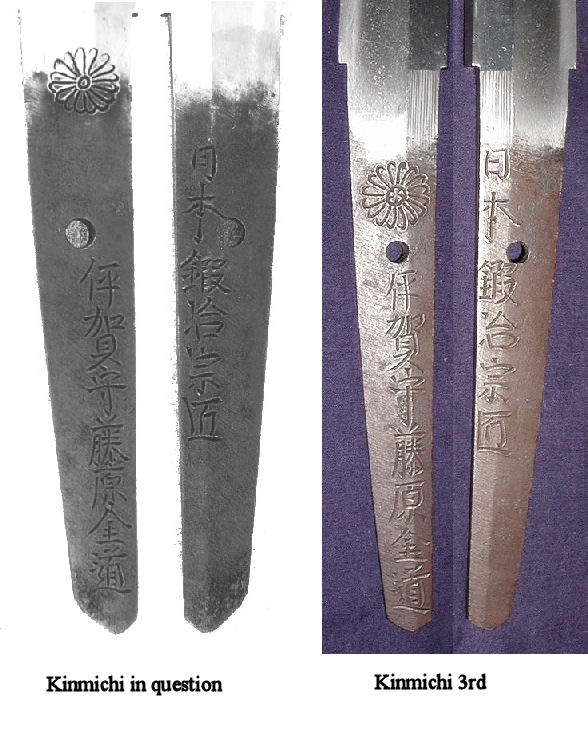
I also think that there are several differences with the mei of Kinmichi 3rd. - The laps of the petals, - writing of 鍛, - Nakago-jiri, ...... etc. Ref. http://sinogi.ddo.jp/syasin/katarogu/17 ... 23073.html

-
Hi, I think that the mei is 和泉守包久 (Izumi no kami Kanehisa).
-
Hi, The specific descriptions on the paper are as follows; 生ぶ無銘 (ubu mumei) – originally unsigned 傳 寶壽 (den Hôju) – (attribution) thought to be Hôju “藤田長太郎 (Fujita Chotaro)†on the left side is the owner’s name to whom the paper was issued. As for the other parts, I agree with Jos.
-
Hi, Someone wrote the sayagaki in 2004 and he claims that he copied the original sayagaki written in Meiji period by Honami Heijiro. 相州住綱廣 (Soshu ju Tsunahiro) 時代天文 – Era: Tembun (1532-1555) 錵付互ノ目乱皆焼 – with Nie, Gunome midare, Hitatsura 刃長長サ九寸参分有 – Blade length is 9 sun 3 bu (= 28.2 cm) 明治 ? ? 春日 - a day in spring of Meiji ? ? 本阿弥平十郎師極写書之也 – this is a copy of Honami Heijuro’s appraisal 平成拾六年五月吉日 – a lucky day in the 5th month of the 16th year of Heisei (May, 2004)
-
You can get general info about papers from the following site. That is a good site, although there are several misunderstandings. http://www.nihontocraft.com/japanese_sword_papers.html
-
Check the following thread. Valuable info as well as the answer are included. http://militaria.co.za/nihontomessagebo ... ht=shikami
-
Maybe needless to say, Brian's reading is correct. :lol: 関住不破兼若作 - Seki ju Fuwa Kanewaka saku
-
Hi, The first kanji might look similar, however; 永田 - Nagata 水田 - Mizuta 永 (= long) and 水 (= water) are quite distinct from each other. FYI: http://home.earthlink.net/~ttstein/sukenori.jpg
-
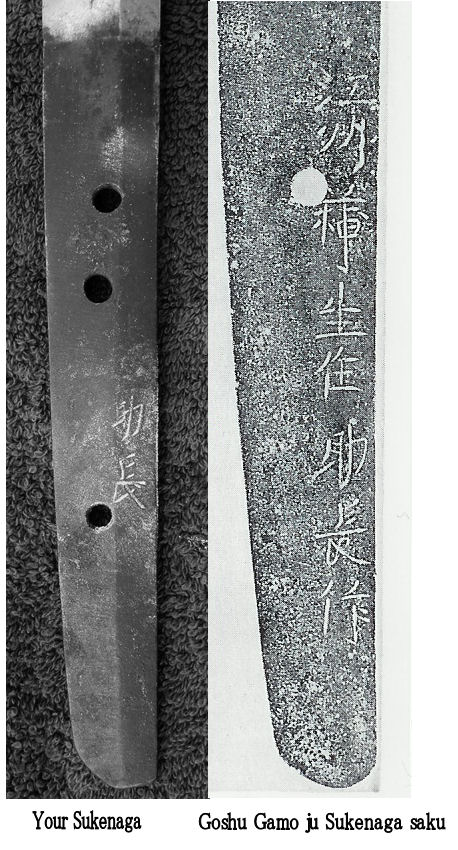
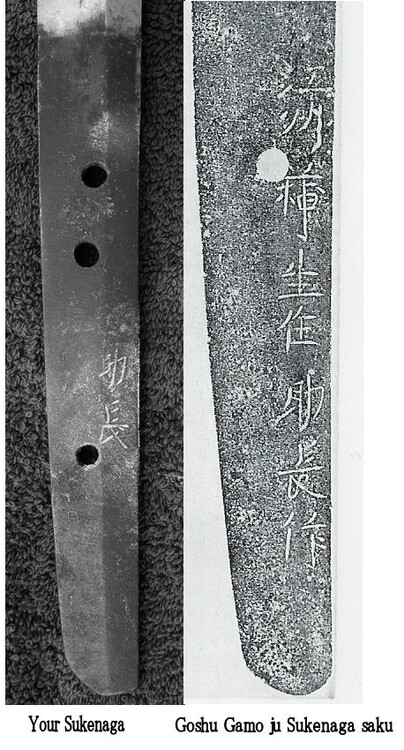
Hi, Although I have not seen oshigata of other Sukenaga, one Sukenaga of Goshu looks similar to your Sukenaga. The oshigata on the right shows a mei of Goshu Gamo ju Sukenaga (江州蒲生住助長) in Meio (明応) period.
-
Not exactly. Frogs are called Kaeru (蛙) and toads are usually called Gama (蝦蟇; actually Gama-gaeru) or Hiki-gaeru. Of course they are called Kaeru in a broad sense.
-
三角槍 Sankaku (triangle) yari 無銘越前 時代江戸寛文頃 Mumei: Echizen, Era: Edo period ca. Kanbun 刃長十五センチ 直刃匂口深い Blade length: 15 cm, Suguha, Nioiguchi fukai (Wide nioi line in the hamon)
-
Hi, The mei does not look Tadaiye but Tadatsugu (忠次) to me.
-
That kind of names are not so strange at ancient times at least. http://en.wikipedia.org/wiki/Kibi_Makibi
-
Thanks John, but I could not reach a result. The characters are as follows; 四ッ胴截断 (yotsu do setsudan) ------[notes]截断[/size] (setsudan)=cutting with a blade, 裁断 (saidan)=usually cutting with scissors] 吉備眞金為佩 (Kibi (no) Makane ? ?) 重郷誠之 (Shigesato Masayuki) ------ seems to be a family name and a given name I cannot grasp the exact meaning of the 2nd line. I guess two possibilities related to the shortening of the blade, but I could be totally wrong. (a) to bear iron of Kibi In this case, Kibi (吉備) is an ancient name of the province which included Bizen, Bichu, Bingo, and Mimasaka. Makane (眞金) is an ancient word and it means iron. (b) to be borne by Kibi (no) Makane In this case, Kibi is a clan name and Makane is a given name.
-
My guess is that the mei reads Yoshisada saku (義定作), although 義 is not clear. FYI: http://www.militaria.co.za/nihontomessa ... b26d353faf http://home.earthlink.net/~ttstein/yoshsad2.jpg