Nobody
-
Posts
4,121 -
Joined
-
Last visited
-
Days Won
68
Content Type
Profiles
Forums
Events
Store
Downloads
Gallery
Everything posted by Nobody
-
Maybe needless to say, Brian's reading is correct. :lol: 関住不破兼若作 - Seki ju Fuwa Kanewaka saku
-
Hi, The first kanji might look similar, however; 永田 - Nagata 水田 - Mizuta 永 (= long) and 水 (= water) are quite distinct from each other. FYI: http://home.earthlink.net/~ttstein/sukenori.jpg
-
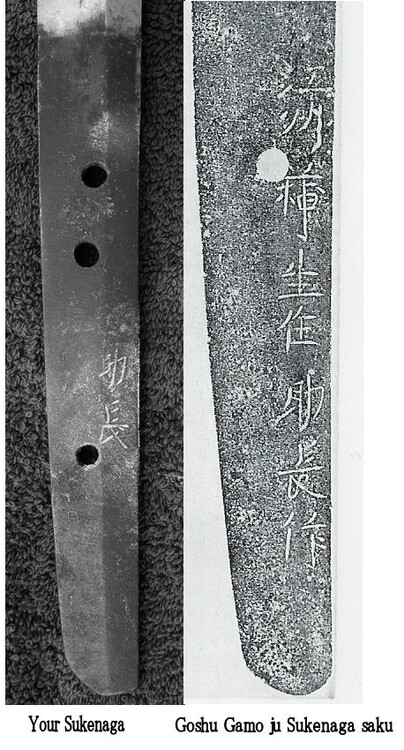
Hi, Although I have not seen oshigata of other Sukenaga, one Sukenaga of Goshu looks similar to your Sukenaga. The oshigata on the right shows a mei of Goshu Gamo ju Sukenaga (江州蒲生住助長) in Meio (明応) period.
-
Not exactly. Frogs are called Kaeru (蛙) and toads are usually called Gama (蝦蟇; actually Gama-gaeru) or Hiki-gaeru. Of course they are called Kaeru in a broad sense.
-
三角槍 Sankaku (triangle) yari 無銘越前 時代江戸寛文頃 Mumei: Echizen, Era: Edo period ca. Kanbun 刃長十五センチ 直刃匂口深い Blade length: 15 cm, Suguha, Nioiguchi fukai (Wide nioi line in the hamon)
-
Hi, The mei does not look Tadaiye but Tadatsugu (忠次) to me.
-
That kind of names are not so strange at ancient times at least. http://en.wikipedia.org/wiki/Kibi_Makibi
-
Thanks John, but I could not reach a result. The characters are as follows; 四ッ胴截断 (yotsu do setsudan) ------[notes]截断[/size] (setsudan)=cutting with a blade, 裁断 (saidan)=usually cutting with scissors] 吉備眞金為佩 (Kibi (no) Makane ? ?) 重郷誠之 (Shigesato Masayuki) ------ seems to be a family name and a given name I cannot grasp the exact meaning of the 2nd line. I guess two possibilities related to the shortening of the blade, but I could be totally wrong. (a) to bear iron of Kibi In this case, Kibi (吉備) is an ancient name of the province which included Bizen, Bichu, Bingo, and Mimasaka. Makane (眞金) is an ancient word and it means iron. (b) to be borne by Kibi (no) Makane In this case, Kibi is a clan name and Makane is a given name.
-
My guess is that the mei reads Yoshisada saku (義定作), although 義 is not clear. FYI: http://www.militaria.co.za/nihontomessa ... b26d353faf http://home.earthlink.net/~ttstein/yoshsad2.jpg
-
I can identify most characters on the nakago. But I waver in grasping the real meaning of the description. Does it also have a mei on its omote side? If so, what is the omote mei? And I also want to see a clearer pic of the last four kanji to make sure of my identification.
-
Hi, At least the last two kanji are 定作. I think that I could recognize the smith. I will post my guess later if there will be no answer.
-
濃刕陸奥守兼信 Noshu Mutsu no kami Kanenobu 時代明暦頃 同工得意ノ三本杉ノ焼刃而 其本領ヲ發揮シ典型的也 Era: ca. Meireki (1655-1658), this smith had a forte for Sambonsugi yakiba and this work is typical showing his real ability. 刃長 貳尺四厘有之 Blade length: 2 shaku 4 rin (= 60.72 cm) 惟時平成乙酉暦如月上浣 探山識(花押) At the beginning of Feb. in 2005, Tanzan wrote this.
-
Hi, I think that the mei reads Kanemoto (兼元). But I do not know if it is genuine or not.
-
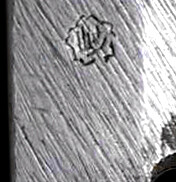
桜に岐 (Gi and a cherry) Ref. http://www.h4.dion.ne.jp/~t-ohmura/gunto_118.htm
-
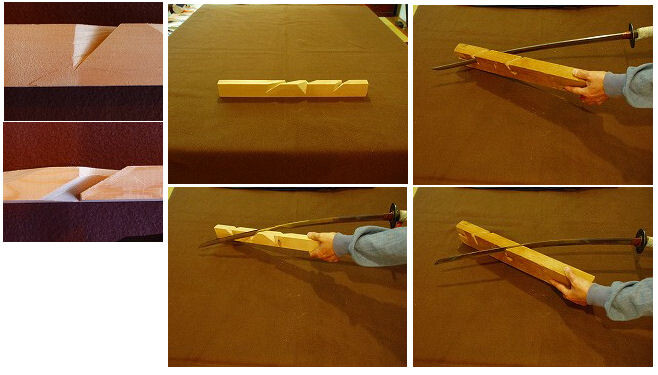
A simple DIY tool
-
Hi Dan, Sorry but I think that there is something suspicious about the tanto. 1. The mei on the blade is ridiculous. The characters are 粟田田吉光, which might be a bad joke. The name is similar to 粟田口吉光 (Awataguchi Yoshimitsu) which is a BIG name. 2. A mei generally is not chiseled on a blade but on a tang, though there are exceptions. 3. The carving on the scabbard is upside-down. 4. The blade itself might be a broken tip of a katana or a genuine tanto.
-
Hi, I cannot say that your Yasutoku is gimei. But the writing of the mei is a little different from another mei on the following page. http://www.geocities.jp/kanetoyo2666/ya ... igata.html BTW, the correct reading of 靖徳 might be Yasunori.
-
That sheet seems to be a memorandum for communication. The printed formats to be filled are as follows; The time and date of the Dispatch: The time and date of the Reception: Recipient: Place of dispatch: Sender:
-
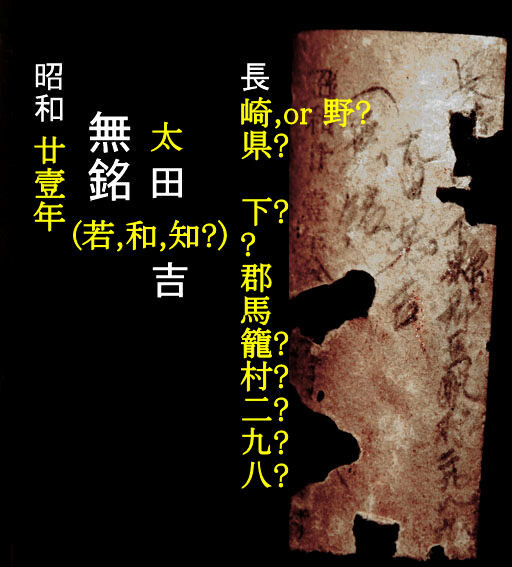
If the name is 若吉, it may generally be read as one of the combinations below. We cannot know the true reading. 若 (nao, masa, yori, waka) 吉 (kichi, yoshi) BTW, the family name may be Ohta (太田).
-
Hi, I am almost sure that they are previous owner's address and name. The date is Showa 21st year. The format reminds me of something like a surrender tag.
-
Ido Hidetoshi (井戸秀俊) is listed on the following table as both Chuge-saku and Ge-saku ranks. http://home.earthlink.net/~ttstein/tosho.htm
-
 Obviously the same smith. Matsui, Meiji 3 nen; http://militaria.co.za/nihontomessagebo ... php?t=1919
 -
Thanks Erol, Yes, I also know the Nobumitsu of eary Kamakura. That must be a bargain, though that is still too expensive for me.
-
I will give it a try. :lol: The score may be less than 60 %, as I know very little about the orthodox Japanese readings for classical Chinese. 虎為群獣尊 (tora wa gunju no son wo nasu) :?: 誰敢触其怒 (tare ga aete sono ikari ni fureyouka) 唯有父子情 (tada fushi no jo aru nomi) 一歩一回顧 (ippo ikkai kaerimiru)
-
Hi Nigel, That is a traditional type of ordinary Japanese Scissors usually used for sewing, not for bonsai. home: http://www.misuzu-hasami.co.jp/ similar type: http://www.misuzu-hasami.co.jp/501.html