Ford Hallam
-
Posts
3,091 -
Joined
-
Days Won
78
Content Type
Profiles
Forums
Events
Store
Downloads
Gallery
Everything posted by Ford Hallam
-
I thought some of our members here might find this short film of interest. It details the cleaning and conservation of an ancient bronze that was unearthed in what is today Georgia. Archaeology has revealed evidence of advanced an metalwork technology and culture as far back as 2700 years ago. The painstaking process of conserving this particular bronze raises a question we've discussed on this forum before. We watch as the piece is loving cleaned and are satisfied with the eventual result yet without any explanation for the rationale behind it the conserved piece displays a beautiful blue/green patina that almost certainly was not how it was made. The point I'm making is that in this decision to halt the removal of grime, dirt and corrosion before all the corrosion has been removed an aesthetic decision was taken regarding how it would best look. We could argue that our love of 'the patina of age' is something we have developed over time and that the aesthetic, as displayed in the way the piece was restored, actually has no place in the way we attempt to show what ancient artefacts may have looked like. The preservation of patina like this actually significantly alters our own emotional response to the object and misrepresent the original work. Now I, like most of you I imagine, would shudder at the thought of stripping this ancient bronze back to bright metal however I think it worth making the point that what we see and evaluate is not really what was originally made. There are times when it might be worth bearing this in mind when evaluating certain items in our own field of interest.
-
You're welcome gents glad to be able to offer something of use
-
Gents, The Shibayama label is a clue to the odd patterning you can see. It's made of ivory, 'zoge' means ivory :D and those lines are called Schrager lines. My brother, Clive, explains a bit more about them here on our forum. Staining Ivory like this is not particularly difficult. Typically, a warm solution of fabric dye is used. This is not Shibayama though and I reckon I have shoes older then this. Kevin, To help get an idea of what real/decent tsuba look like the MFA on-line collection is a useful resource. All the images are in high resolution and have a 'zoom-in' function to allow closer study. Here's a link to search their collections. Just type in 'tsuba' in the search box and you'll have access to more than 1800 items and all pretty decent examples of their type and some even excellent.
-
It's an abstracted design element, Mark. It never works to try and read Japanese art like this too literally. Actually this is a fundamental 'mistake' most art fanciers make. Because they are not educated in the peculiarities of different aesthetic expressions that were prevalent in different periods and the actual artistic concerns of the artists of those times they tend to judge, or asses, works from a modern literal/realism perspective. But I suppose it's all in the eyes of the beholder.
-

Toshinaga Tsuba authenticity
Ford Hallam replied to joel's topic in Auctions and Online Sales or Sellers
Just for reference here a genuine example of Toshinaga's work that is designated an Important Cultural Property. You can zoom in to really get a close view of the carving, ground treatment and appearance of the patina. -
Mark, yes, I'm aware of that. :D It isn't my photo, I simply searched on-line to illustrate the form and to make a comparison to the design in the tsuba.
-
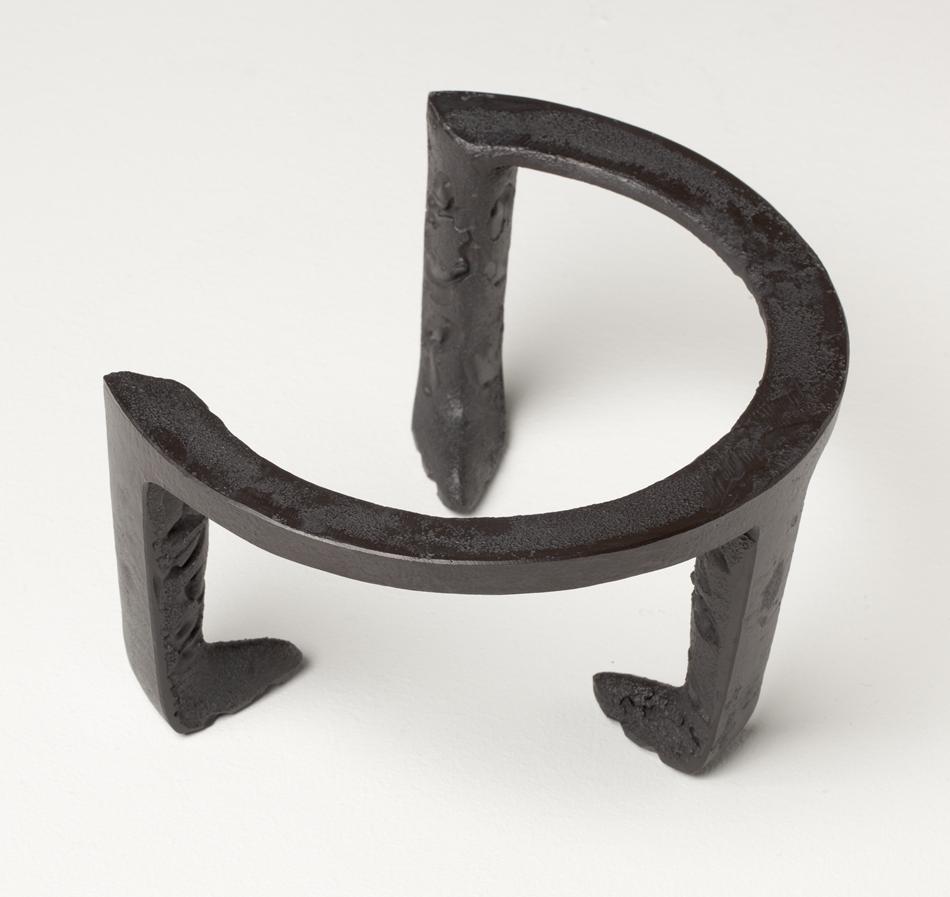
Hi Peter, that circular motif immediately struck me as a trivet, the metal stand used to support the hot tea kettle in the tea ceremony. A sprig of plum blossom and a cup suggests cha-no-yu to me

-
Toshinaga Tsuba authenticity
Ford Hallam replied to joel's topic in Auctions and Online Sales or Sellers
I don't see any reason to doubt that this a perfectly genuine antique tsuba, myself. As to the authenticity of the mei, that's a whole other thing Nara Toshinaga (1667 - 1736) is considered to be one of the REALLY BIG names in the field. To think that an un-papered and legibly signed example of his work would be offered for sale on ebay is a bit like expecting to buy genuine signed Rembrandt there too. But more importantly, the workmanship and metal finish looks absolutely nothing like that of the master. The work is neat and tidy but close examination reveals it to be merely workman-like and it lacks any of the sophistication and refined finishing one would expect to see on the masterpieces of the great masters. It's a perfectly pleasant example of mid-Edo steel chiselling in my opinion but not an example of the finest of tsuba art such as Nara Toshinaga is famous for. regards, Ford -
I have to agree with Guido ...as much as it pains me This is modern amateur work and I'd hesitate to call it a tsuba.
-
Another theft, teppo and blades in Okayama
Ford Hallam replied to Ford Hallam's topic in General Nihonto Related Discussion
Thanks Piers -
I was recently informed that some family heirlooms were stolen from the Tsuji Family (good friends of mine) in Katsuyama, Okayama Ken. It probably a long shot but in case anyone encounters any of the following items please let me know the details. thanks, ford
-
Very nice Owari piece!
Ford Hallam replied to christianmalterre's topic in Auctions and Online Sales or Sellers
The subject is an oar and river reeds/leaves I don't know if these motifs allude to the story depicted in this painting but it's an intriguing thought. Dōgen Zenji (19 January 1200 – 22 September 1253) was a Japanese Zen Buddhist teacher born in Kyōto, and the founder of the Sōtō school of Zen in Japan Painted by Kawanabe Kyosai (1831-1889)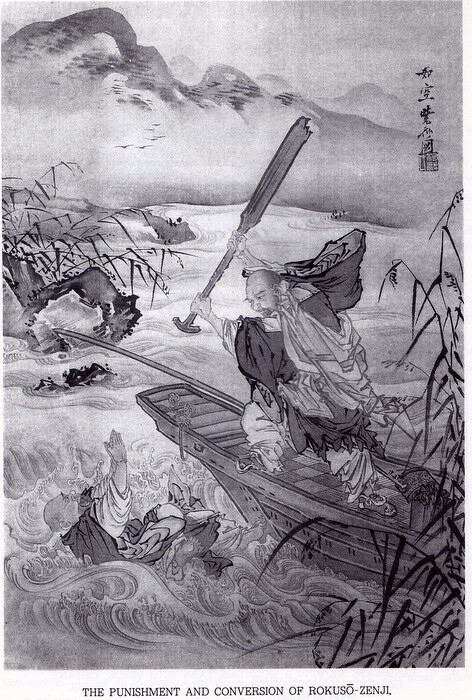
-
Very nice Owari piece!
Ford Hallam replied to christianmalterre's topic in Auctions and Online Sales or Sellers
Speaking personally (not that I know how to do anything else ) I don't think the price was excessive at all. In fact I'd suggest whoever bought it got a real bargain. As a very appealing and well made period Owari tsuba, with papers, I would suggest this is an absolute bargain. I have to reiterate that I think the design is one of the more elegant and accomplished I've seen from this 'school'. It deserves to be well published, in my opinion. Provenance only matters in this field if present 'connoisseurs' don't trust their own eyes and instincts. That such a premium is placed on the provenance (in terms of collections they've come from) of pieces today is, to me, something of an anomaly and would appear to indicate an lack of confidence in the present market. The implication that a given piece is more 'valuable' than another because it once belonged to a revered scholar/connoisseur of the past is easily seen to be absurd when one recognises that the comparison is meaningless. We have no idea how the 'other' piece would have been judged had the revered connoisseur seen it. In my opinion this example is at least as good as most in Sasano's publications. If we begin to actually look at the works themselves perhaps we'll begin to see the qualities the connoisseurs and scholars of the past saw. Focussing on provenance and papers blinds us to what the objects themselves embody. Historical provenance is an entirely different matter, of course. -
Very nice Owari piece!
Ford Hallam replied to christianmalterre's topic in Auctions and Online Sales or Sellers
Very nice piece indeed, congratulations...and with papers also The design is very appealing and for me seems to hint at Ko-Akasaka sensibilities quite strongly too. regards, Ford -
Much appreciated John thanks.
-
I have some opinions.....but I haven't written a book or got any degrees in the arts of tsuba though I do have to agree with Brian that expressions of personal preferences in terms of what one might appreciate are really somewhat irrelevant in these sorts of discussions. As regards this admission though; I trust you've been duly advised to treat with caution and/or if encountered to ply with copious amounts of the good stuff :lol: ...as it goes the same would apply to me I'd love to read the article that was published in the NTK catalogue....If any kind soul would be good enough to scan in a copy for me. I sense an opportunity to write a 'review'
-
Higo koshirae with a tsuba that has an anna for a bashin
Ford Hallam replied to b.hennick's topic in Tosogu
Hi Barry, thanks for sharing those images. That's a very nicely preserved koshirae and a helpful reference. regards, Ford -
Adam, David, actually the raised rim doesn't really present much difficulty to an experienced artisan at all. It's no different to applying inlay to any uneven surface. What is really impressive about the work is the fluidity and delicacy of the inlaid elements. Consider for a moment how you'd go about cutting out those undulating ribbons from sheet metal that's around 0.5mm thick and there's very little room to file up the shapes after they've been cut out. The whole effect of a very fluid painting is completely dependant of these little pieces being perfect before the inlay work even begins. If you're interesting in seeing some images that illustrate this process you can see some here. There's a "forward" button at top right to advance the images and see the rest of the sequence.
-
Hi David, it is a beautiful example, isn't it? Looks to me to be a shakudo ground with 2 colours of gold, silver and copper inlay. Those inalys are actually hellishly convoluted and complex shapes and bear in mind that image is about twice the size of the actual work.
-
merci bien Jean.
-
Hi David, anything is possible...just cross my palm with silver :D Glad you enjoyed the conversation, Peter
-
Hi David, here's a link to a collection of images of Myoju works that I used as the basis of my own study. The one I based my version is there, as is the one you posted What I felt was that Myoju's own "technique" developed in subtle ways but that also there are some quite significant general differences in a few of the samples that made me feel they were not by the same hand. I know the work of Taihei Yonemitsu very well and they really are pieces that need to seen "in hand" to truly experience the workmanship. Really breathtaking I have a 30 min film of him, that's a terrible 3rd generation copy of a copy, yet is one of my most precious bit of archival film. He died more than 30 years ago so I don't think we can point to him as an example of the best of what's being made in Japan today I'm afraid. I understand what you mean about using his work to contrast the piece you recently acquired though. Here's a link to some more images of his work and of him working etc. If you're interested to see some short films, in Japanese unfortunately, of another 2 modern era kinko-shi you find some on my YouTube channel. was a professional and was trained in the classical manner in a direct link with the past. on the other hand was a dilettante (I mean this in the original sense of the word and not at all in a negative way) and had a regular job as president of the Mikimoto Pearls Co. To my eyes there difference in the way the work and their technique is quite striking. Sadly both men are now long ago gone from this world. Hi Curtis, thanks so much, glad to heat the work is having such a positive impact. And just to add some more background for those of you who may not have seen this before that shows copper (actually shakudo in this instance but it looks the same) being water cast and the subsequent forging to a basic tsuba form. This is essentially how it was done in per-industrial Japan.
-
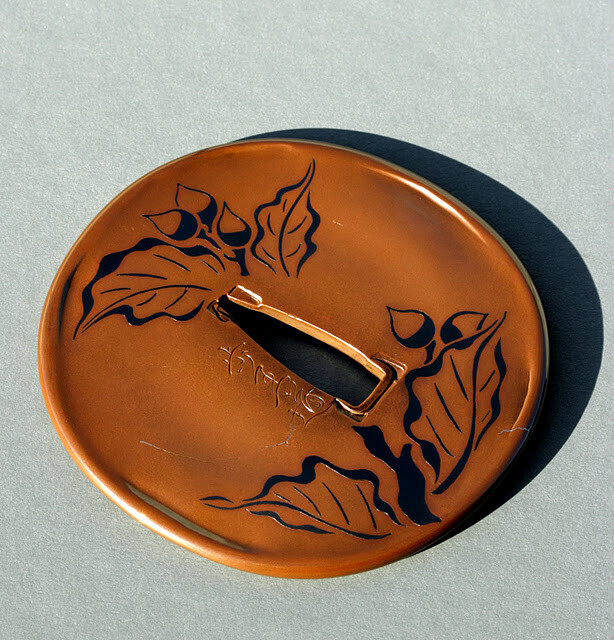
Thank you very much, gentlemen, for you very generous appreciation. and a very happy and prosperous New Year to you all too. John, I hope it doesn't come to that...doing a Keating , although it's always a temptation :D Hi David, I'll add a scan of the original later when I get a chance. You may be surprised to learn that the biggest difference in the way I go about making utsushi studies and how the subject is approached in Japan to day has to do with the fact I actually make all my own alloys and work from water cast ingots. Modern makers tend to use a very limited range of commercially produced plate. (Standard copper, shakudo and 3 different grades of shibuichi) The second issue would be the whole subject of patination and the development of tonal subtlety and variegation. You simply don't see much, if any, today. Part of the problem is a poor education in the entirety of the tradition. There are no extant old schools so we're left trying to teach ourselves what constitutes the art of tsuba making and what the essential values and qualities might be. In this I follow 2 distinct approaches, on the one hand I conduct technical and artistic analysis and utsushi studies and one the other hand I attempt to find my own aesthetic voice within the continuum of tsuba making as an art-form. In this I'm pretty much in the wilderness. You mentioned the Myoju style, today no-one in Japan is able to replicate the shakudo into shinchu look because they are stuck using commercailly produced brass and this combination simply doesn't work. I was able to achieve it when I did my version (as shown below) because I had a suitable piece analysed and I recreated the alloy myself. The slightly raised inlay is also a technique that, as far as I'm aware, has not been reproduced in shinchu by anyone else. When we talk about technique generally we mean the specific technical process but a very major aspect of the application of technique is the skill and sensitivity with which it is used. Sadly, these aspects that are what are most important in keeping a tradition alive cannot be maintained by hobbyists who make one tsuba a year...and the same style at that. As for the characteristic finish of much Higo kinko work I'm afraid it's all gone and now remains for us to try and understand how and what they did, as I'm attempting to do, by means of careful utsushi study. Hope that helps explain where the art form is at today.
-
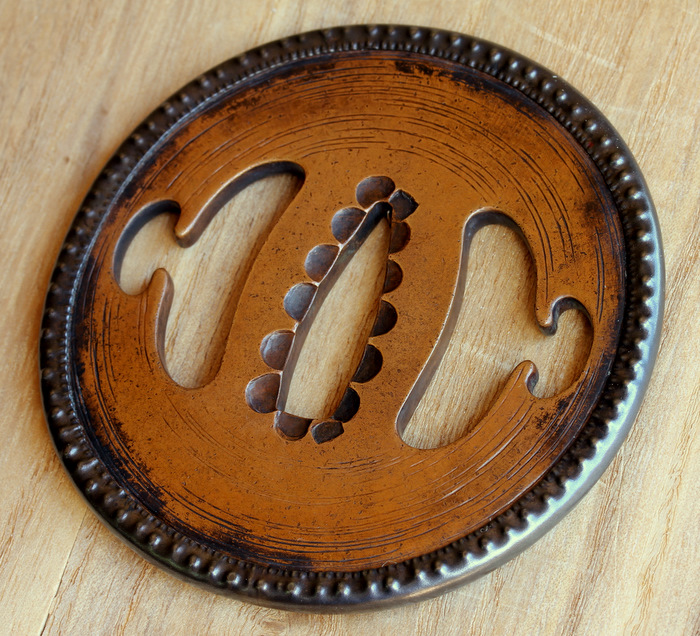
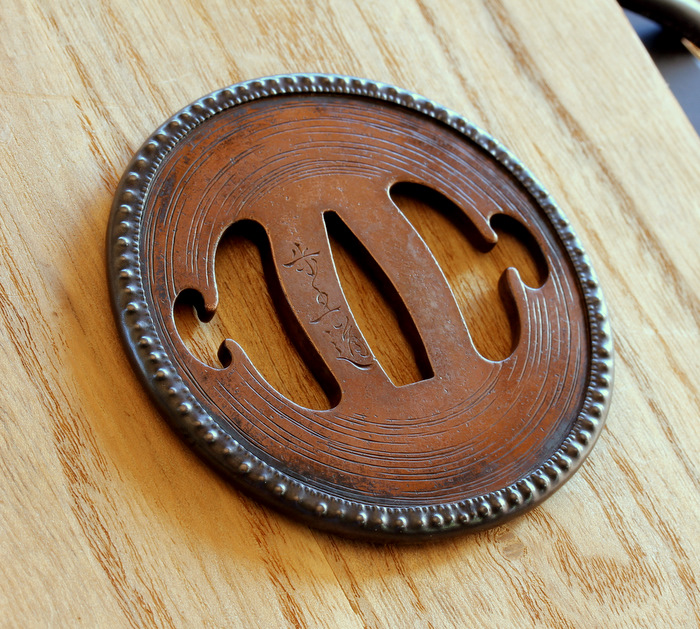
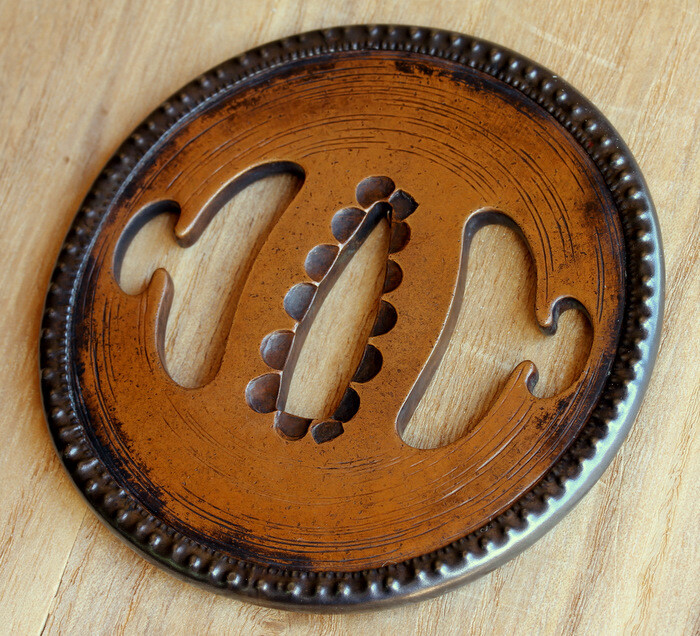
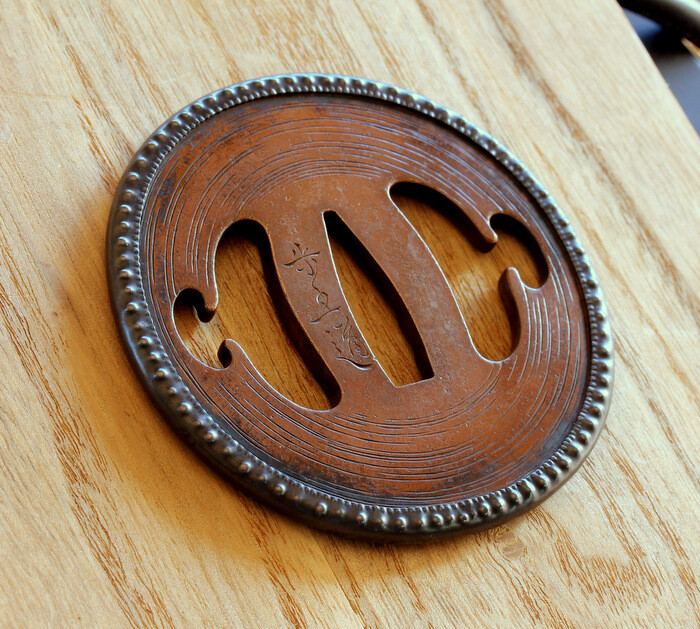
As some of you will know I've been having something of a love affair with the work of various Higo artists over the past year or so. The overall aesthetic as expressed by artists like Hirata Hikozo has had a particularly strong impact on my own work and one way, for me, to delve ever deeper into his mindset is to recreate these pieces. These study pieces are generally termed utsushi and the point of the exercise is to better understand why and how the original artists did what they did. I find this sort of investigation invaluable in terms of better understanding the guiding principles and spirit of the tradition...at least from my own subjective point of view. This is a tsuba I've just completed. It's a pretty faithful copy of a well know piece and incorporates many of the traits that Hirata Hikozo is most celebrated for. As a rule I don't attempt to simulate age on my work in any overt way but after studying the work of Hikozo and others in that group I've come to the conclusion that certain effects that might be seen as a consequence of age were in fact deliberately affected when the pieces were first made. This piece incorporates the results of some of my experiments into this sort of finish, details of which I may elaborate on some time in the future...so don't ask me to reveal all my hard won secrets just yet The body of the tsuba was forged down from a water cast ingot and is roughly 4mm thick in the centre and 2.5mm thick at the edge. The rim is an applied yamagane based shakudo in the Odawara style. These are not soldered to the body but worked into place cold....it's just more magic :-) I thought about not signing these sorts of works but I'd hate to see them being misrepresented at some point in the future. The circular punch marks (kuchi-beni) around the tang opening (nakago-ana) are considered a sort of signature of Hirata's but also add a great deal to the overall composition so I felt it important to incorporate a similar effect into my version. Putting my signature on the front as well would have simply crowded the design. These images are only the first ones I've taken and don't actually show the full range of tone in the patina. As I achieve better images I'll be adding them to an on-line gallery and will add a link here. The piece is available for sale and at a fraction of the price you'd expect to pay for a second hand one Thanks for looking, Ford


-
Cheers John :D , very kind of you to say so....I think