Ford Hallam
-
Posts
3,091 -
Joined
-
Days Won
78
Content Type
Profiles
Forums
Events
Store
Downloads
Gallery
Everything posted by Ford Hallam
-

Chemical analysis results
Ford Hallam replied to Adrian S's topic in General Nihonto Related Discussion
Hi Adrian, I'm wondering how a material composition analysis was able to prove where a hamon started, as in this case. I would have thought that the essential composition of the steel was similar in both a hamon and the adjacent non-hardened steel. The difference being one of structure. I'm obviously missing something so I'd be interested to learn how the HHXRF test was able to provide you with such definitive proof to overturn the conclusions of a panel of experienced shinsa judges. regards, Ford -
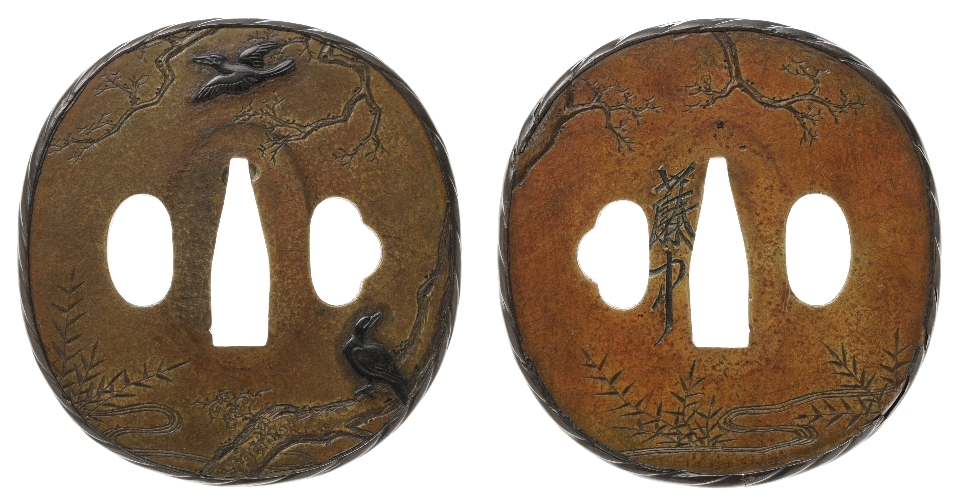
Pete's tsuba looks to me to have been a steel plate that has had the front face excavated to receive the shinchu plate into it. This suggests the shinchu is an addition the the original steel tsuba, either to hide some severe damage or the render the piece more interesting. It may have been conceived in this form from the beginning but I doubt it myself. If the steel tsuba in it's original form had a similarly decorated front to the back it may have appeared a bit too "rustic". By in-setting the contrasting the slightly more sophisticated shinchu plate with it's chiselled dragon what otherwise might have simply been a fairly rough tsuba is elevated to something perhaps inspired by the aesthetics of the tea ceremony in the way the rough is juxtaposed with the more considered additional decoration. I still think this final form we now see was done by a Hizen artisan though
-
oops, sorry Pete. Pic now added
-
Thank you all very kindly, Gentlemen It always very gratifying to feel so appreciated. Brian, Good to hear our mutual friend is enjoying sharing the koshirae. :D The ninja's were spotted earlier today....not so clever to try and sneak up on me when I've got a bloody big Rhodesian Ridge-back who is my constant shadow. I won't have to feed him for days now. Sneaking around in black pj's in this heat wave was never going to end well
-
This one strikes me as being Hizen too. My reasoning would be the shapes of the ryo-hitsu. To my eyes this speaks of a Higo influence (Higo neighbouring Hizen Province) and I tend to see this Higo-esque flavour as being indicative of much Hizen work as opposed the Hirado-Kunishige or Namban-esque work. This is a Hizen tsuba (one that eluded my grasp :? ) that was on Ginza-Choshuya a little while ago. While the ryo-hitsu in this case are the more usual shapes I think there is some similarity in the way the plate is worked and the engraving with your example's front, Pete. His personal name was Bensuke. He lived and worked in Nagasaki, in Hizen prov. He died c. 1800 The mei reads Tokin or Tohaba. The family are said to be swordsmiths (but not recorded) and as kinko fittings makers. Comparing these two now it seems the nakago ana is very similar and there a similarity in the fullness of the kogai hitsu shape too, at least to my eyes.

-
:lol:
-
He he, Pete and I in hell...reckon we could stage a coup d'état. Then there'll be some changes around here
-
Hmmm...very subtle and nuanced poetry but I think I've managed to glimpse the hidden meaning. Following from Koichi San's translation; The limp sword ( the inference is clear ) is unmoved... frostiness descends. This must be the saddest haiku ever. It also cleverly explains the "Senior Citizen" honorific, don't you think.
-
I have to second that ...and he has huge hands too, compared to mine anyway
-
Chemical analysis results
Ford Hallam replied to Adrian S's topic in General Nihonto Related Discussion
he he...fair enough, I certainly wouldn't trust a word I say...I may have been drinking Still, I get away with it most of the time -
Chemical analysis results
Ford Hallam replied to Adrian S's topic in General Nihonto Related Discussion
Hi Adrian yes, I was aware of that bit of data on the Hitachi site (I thought Chris suggested that site was too old to take as a relaible source though ) but the reason I mentioned the negui was to eliminate it as a possible contamination of the underlying material. Hence the need for samples from blades prior to finish polishing. I think it would also be helpful to see what the tamahagane analysis looks like after the iron sand has been processed in the tatara. This would give an indication of the sort of change the raw material undergoes at this early stage. I'm sure there are some published analysis' of tamahagane around. If memory serves there are some in past issues of the NBTHK journals. I'll see what I can uncover. -
Chemical analysis results
Ford Hallam replied to Adrian S's topic in General Nihonto Related Discussion
Hi Adrian Apologies if I missed a reference to it but where there are no results, as indicted by an asterix, I'm assuming the element in that location below detection level? I ask because it makes a difference in terms of getting an idea of average values. It might also be prudent to try and eliminate any contaminants that may be present in the steel surface as a result of the application of nugui. After all, nugui is applied to effect a very visible change in the steel's appearance so one would assume that there is a material change on the metal's surface. Also; Chromium, Titanium and Aluminium oxides, are common polishing powders and can be used very effectively to polish a burnished surface. It might be of interest to compare similar a series of analysis' from blades that are in the process of being polished, ie; before the final finished processes are carried out. thanks and kind regards, Ford -
he he...I know exactly how to excite you, Brian But I'll try harder to be nice in future ....as if
-
You're more than welcome Dr John. Only too happy to help where I can.
-
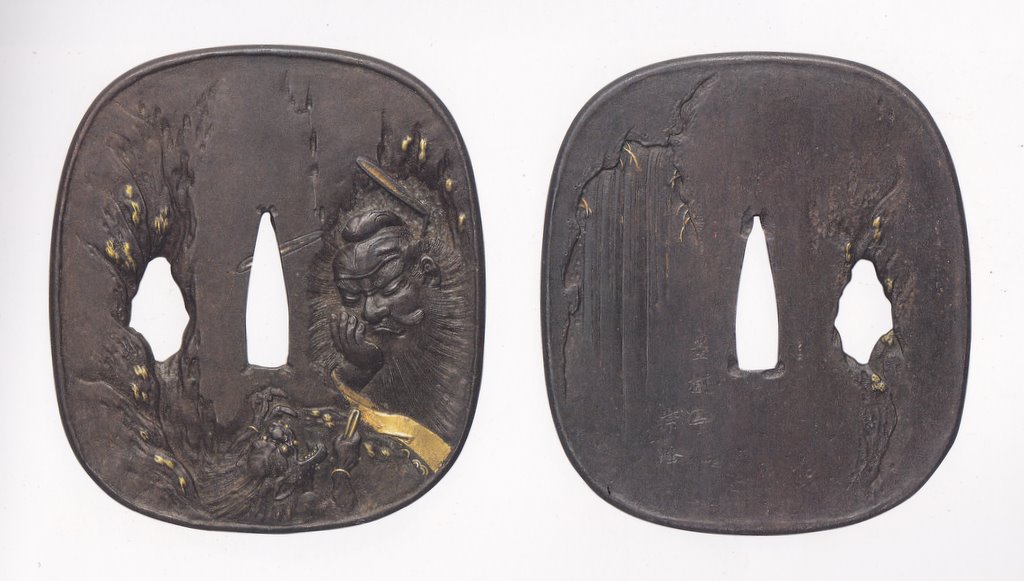
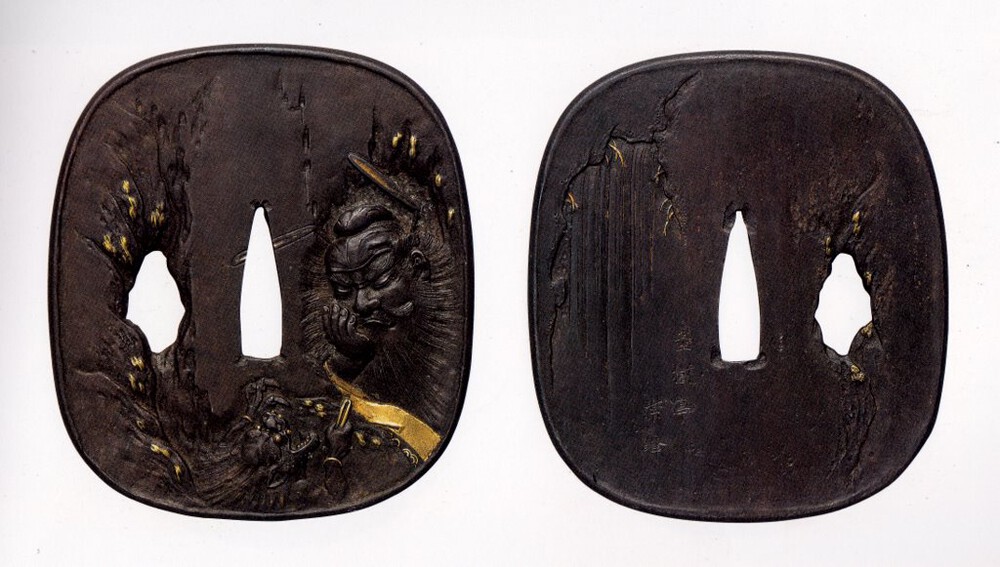
Sorry about the image quality, here's a lighter scan.

-
Hi Dr John, Ludolf's example No 3 (the sentoku one with sage) is from the Sannenzaka Museum collection as is this one. regards, Ford
-
Don't get all excited at the though of me apologising for anything serious :D I've just learned that someone had previously tried to contact me via email from this forum and had not received any response from. I always reply to emails and this missed one causes me some embarrassment. It's my fault as I hadn't changed my email address here when I moved to a new server some months ago. So if you're emailed me recently and not have been irritated by my lack of response please accept my apologies. I've now updated my email address here. Thanks for your time. regards, Ford
-
Hi Adam The practice of head taking and presentation to one's commanders is well documented and recounted in a number of historical documents and period accounts. The need to take the head really only applied to higher ranking warriors. The head of a common footsoldier was not going to earn any points. As for ears, well they simply would not have been adequate to identify the rank or identity of the slain foe. And that was very important in terms of the reward the victor would expect. There are accounts of warriors getting into battle to claim just one head and then to withdraw, or even taking the head of a fallen warrior that they'd not personally dispatched. So it appears it was seen by some to be adequate to simply do the bare minimum and not to risk getting killed unnecessarily. For many warriors it was just a business and loyalties were apt to change as better prospects of advancement and reward presented themselves. The practice derives from the early times, before the introduction of firearms and massed peasant conscripts armed with spears, but it does seem to have endured to some extent into the Momoyama period up until the unification of Japan in1603. There's a fairly good summary of the changing nature of warfare in Early Japan on Wikipedia, here. If you're interested to learn ore about Samurai warfare the books of the English historian, Stephen Turnbull, are a good start. Here's an on-line review of one of his books that acatually discusses some more complex aspects surrounding head taking.
-
The presentation of the heads a warrior had taken, to one's Lord/master, was a formal occasion and a form of accounting by which rewards/pay/spoils of war were allocated. It was just business, in a macabre way.
-
Hello Ian, I tend to actually consciously apply that strategy myself; boring people to death....it's very effective in a debate I had a little further input on the "kubi-kiri" question from Greg Irvine of the V&A. He offered this web-site
-
Hello Dr John you probably already know but there are a few examples of his work in the Boston museum. Excellent images available on their on-line data-base. It's believed he was also responsible for many fine forgeries of older works when his own, contemporary work wasn't selling. The truth of that assertion has not been tested, to my knowledge though, so it may merely be another of those "inventions" we so frequently stumble over. :D regards, Ford
-
The Digital Shinsa...its around the corner
Ford Hallam replied to Adrian S's topic in General Nihonto Related Discussion
Well, Chris.....as you've now suggested no answer from Japanese authorities can be trusted we may as well just stop with the pretence of trying to gain a better understanding of the truth. For every example you care to offer I may now also fairly counter by suggesting that what we see it not necessarily the truth but merely what we are supposed to see. Well played :D You've effectively denied any and all contradictions to your views by invoking honne and tatemae. No matter what I might present as evidence from even the most august authorities you can will claim they are not being honest. I have my own personal observations also...informed by 30 years as a practising craftsman. Honne and tatamae, aside I know the conversations I've had with various craftsmen (frequently not entirely sober....) were expressions of mutual respect and honesty. I happen to trust the words of the men who've welcomed me into their world. In any reasonable scholarly debate your tactic would now render your argument utterly invalid...but play your game as you see fit. I tire of your pathetic contortions. good night all, fh That's Don Fogg btw...not Dan. Evidently not so well known to you then. "the Inhabitants don t think it worth their while to pick them up" So NO...it seems unlikely that the inhabitants recognised their possible use.... And 1690 is a long time after the mid 16th cent. I fact there's a reliable analysis of a ceramic glaze that reveals the use of borax around 1690 in Japan also ( it's quite a rare bit of evidence however)....this doesn't in any way prove a widespread uptake of borax by swordsmiths though. -
The Digital Shinsa...its around the corner
Ford Hallam replied to Adrian S's topic in General Nihonto Related Discussion
What I said was that we have no actual evidence that borax was used in the past. I also demonstrated that the Portuguese hypothesis has no basis in any evidence either. I did point out when I quoted Pierre that borax is used in various forges for some jobs but that it use with tamahagane was avoided. The reasons for that Pierre also described. I may well have to concede that in fact borax has become a part of contemporary swordsmithing practice in some circles but, as I've said, in my experience and understanding from conversations with smiths borax simply doesn't feature in their approach. We clearly mix in different circles. But you'll forgive me, I hope, if I wait a little while before conceding the point until I get some sort of statement from the Japanese Swordsmith's association on the use of borax in traditional processes. I'm sure we can take the opinions of a handful of Mukansa and Ningen Kokuho has being reasonably reliable, don't you? That there is an undeniable change in the appearance of blades from the Koto to Shinto periods is understood. However, if it was a simple matter of the adoption of borax that would account for this wouldn't it be the very first thing contemporary smiths would stop using if they were intent on recreating Kamakura steel jigane? On a slight tangent to steel making I might point out that borax was certainly being used by one family of metalworkers at the start of the Edo period. I refer to the Hirata family and their enamel work. Borax is an essential ingredient of vitreous enamel. that the "secret" of shippoyaki stayed with this one family for almost the whole of the Edo period is perhaps revealing. -
The Digital Shinsa...its around the corner
Ford Hallam replied to Adrian S's topic in General Nihonto Related Discussion
Hi Chris, apart from the obvious fact that WWII manufacturing processes are not really going to tell us much about pre-1600 sword forging technique doesn't the fact that Omura says it's essential to use borax (when we know tamahagane doesn't actually need it) rather imply he's talking about steel other than the traditionally produced stuff? How did the discussion shift to WWII sword manufacture anyway? -
The Digital Shinsa...its around the corner
Ford Hallam replied to Adrian S's topic in General Nihonto Related Discussion
Gee Brian, why lock the thread? We're not the girl guides and no blood has been spilt. It's just been an "enthusiastic" debate is all. I'm surprised that you feel sword collectors are such a delicate lot. But I can take a hint. If it's considered bad form to challenge crap ideas here I'm happy to deride them from the safety of my own forum