Ford Hallam
-
Posts
3,091 -
Joined
-
Days Won
78
Content Type
Profiles
Forums
Events
Store
Downloads
Gallery
Everything posted by Ford Hallam
-
Sorry Edward, Gents... I've been amiss in not acknowledging your kind comments. Thank you all. kind regards, Ford
-
Hello Ian, thank for that input, it does add a little to the picture, I think When you sat ferrite I assume you mean essentially iron with very low levels of carbon? The 18th cent. steel/iron laminate neck guard is very interesting too.
-
Exactly, Lorenzo :D Until we know exactly what these appealing lumps and striations are made of, and how thay are formed in the steel, all we can say is we might be able to simulate a similar effect. As I see it there are a number of problems with the 'lumps of high carbon' theory. This idea is a bit like raisins in a cake but in practice one wonders how these lumps retain their 'roundness/lumpiness' when the forging process to process these lumps into the plate would by necessity flatten them out. Similarly, even the most limited amount of working of bloom steel will result in a thin linear structure. Consider also that high carbon steel corrodes more easily than low carbon steel and iron. So it the lumps are a result of various acid etching, forced oxidising or corrosion processes over time then it's probable the 'lumps' are lower carbon areas. But, as has been pointed out, we enjoy the effect, however it was produced. :D Until we know what they are, though, we're just guessing in the dark. Thinking about it....I may have an idea or three to test
-
There is no real 'tekkotsu' discussion until we know what it really is. Until then we're just making stuff up....
-
Mariusz, you're a very naughty man I've read Andy M.'s article and wasn't particularly impressed I'm afraid. He then illustrates this principle by reference to a laminated compound which is quite different to the material that results from simply folding and forging steel to refine it. I'd suggest that this point is therefore unfounded with reference to the subject he is writing about. His next assertion; It may well be defined in this way by some people but as yet we have no actual scientific analysis to corroborate this notion. So this point is just another guess. I actually don't think tekkotsu are higher carbon content at all but lower carbon. His conclusion; is therefore unwarranted and not proven. I assume here he means iron-like in appearance and feeling (?) as opposed to steel -like in appearance and feeling. Bear in mind we're generally talking about patinated or rusted material. How exactly do they differ in appearance? From my own experience of sourcing both from scrap yards I can assure anyone that merely looking and feeling the stuff is not helpful in identifying either material. So, another meaningless point. He describes a menpo thus; Unfortunately, and to the detriment of the article's credibility, he doesn't cite any evidence or analysis' for this though. he adds; but we have no way of knowing how he actually knows this. It is merely another guess based on absolutely no evidence. Surely assertions like this need to be qualified with some evidence. And how has it been established that tekkotsu (which itself hasn't even been accurately defined as yet) has "energy absorptive qualities" ? The article then passes to a discussion on the quality and production of plate used in the manufacture of armour. Here Andy is on firmer ground with his explanations of the types of battle damage that is often seen, particularly underneath later additions. Unfortunately he soon reverts to making unsubstantiated assertions about steel. How does one distinguish a very dense plate from a less dense plate if they both have similar physical dimensions? ie; both the same thickness. For this statement to have any meaning we'd need to compare the actual weight of this apparently very dense plate with a similar plate that had the same thickness but was less dense. I can't imagine how Andy has managed this tricky operation so that he can make this claim. In the absence of any analysis of the steel this is yet again merely guessing, especially as he has no comparative steel of known composition and properties to make his comparison to. And there's that word 'dense' again. Sounds serious but is actually meaningless in this context. One might compare Haruta hachi steel to stainless steel but as there are so many types of stainless steel it's all a bit vague. And once again not really making a comparison of any know qualities of either material. A pointless statement. The following paragraph begins thus; If this has been proven by means of some actual analysis or materials strength testing we're not made aware of it. As it stands it's just another of those unsubstantiated assertions, or guesses. Notice, though, how each new point builds on the previous unsubstantiated guesses. Another kabuto is described thus; but sadly no reference for this analysis is provided so I'm forced to assume it is not verifiable. Certainly, as it stands it must be dismissed as heresay. His next supposition is the following; This deduction is apparently based on his interpretation of various bits of damage to Myochin kabuto he's seen. Frankly, I don't know that anyone could be all that sure of something so specific based on such variable evidence. The next kabuto is described like this; Here he seems uncertain as to whether his previous assumption about Myochin kabuto being softer iron rather than steel is always applicable. That this one is much heavier also tells us nothing meaningful about the material's qualities only that there is more of it. But again we have a claim about the material composition and it's material qualities neither of which have been proven. I have to agree wholeheartedly with this comment of his though; If such a study were made and the results made available he might be able to base his ideas and theories on some actual evidence. And the references cited at the end don't do much to inspire a great deal of confidence in this article as a piece of useful research, in my opinion. Rather, it simply adds more unverifiable assertions to an already confused area of study, namely the qualities and composition of early armour and tsuba. There may well be useful research available that does provide the sort of data we would need to see but by not accessing it nor referring to it he has undermined the credibility of his article, I feel.
-
David, I think we agree then, that in essence much of what is taken at face value in the various 'technical' descriptions of ferrous tsuba is merely guesswork and not based on any empirical data. This being so I suggest we dispense with them entirely until such time as we can reasonably say we actually have a vague idea of what we're talking about. :D The real problem with the continued use of these sorts of unexamined ideas is that they stand in the way of any real investigation in that they seem to define the territory in advance. In essence, the entire subject is built on unverified guesswork. As you say, this would make a very interesting and valuable basis for some serious scientific analysis. As has been pointed out, we don't know exactly what methods old masters used but we do have a pretty good idea about how metal behave under certain conditions. One being that steel doesn't reach melting point and begin to soften like butter or wax :D that much I'm pretty certain about. That there may be all sorts of other possibilities is self evident but that also shouldn't open the door to speculations that are not based on any empirical or physical evidence. And don't get me started on 'tekkotsu'.... edit to add; Yes, Lee is correct when he points out I was referring to steel tsuba in general and not specifically to your Yamakichibei.
-
That's a very appealing piece, Henry. Very careful work too. Hard to be definite but it does seem to have the same sort of feel about as that ascribed to Ono work. Funny you should reference that particular tsuba too. It just sold in NY at Bonhams. It was described as Tosa-Myochin and no mention of it being ex-Sasano. I wasn't apparently noticed by any serious collectors....but one Quite a bargain.
-
Thanks Chris, for the details on annealing vs normalising. I was just thinking in terms of workshop practice as would have been usual practice 'back in the day' using forge and where such distinctions are more generalised. David, Thanks for the image of the Yamakichibei. It illustrates exactly part of the problem Torigoe's ideas create. We actually don't know that this type of surface was really created by means of melting at all. Just because it looks a bit like melted butter doesn't convince me it was. In fact when you raise steel to the sort of temperature where the surface begins to melt you get carbon burn-out and a resulting coarse surface. I'll post some images of the effect tomorrow. In my view 'yakishitate' is a term best used to describe the appearance but not necessarily the actual process used. This sort of 'poetic' terminology s fairly common in Japanese art. But just as a mental experiment can you imagine how a tsuba-ko might have actually gone about melting the surface of a tsuba to create this soft melted appearance. Bear in mind the melting point of steel is more than 14oo degrees C and the smith would need to ensure that however the tsuba was manipulated or held didn't leave any marks on the melting surface. In addition, consider how risky such a procedure might be in terms of melting the whole piece because keeping just the surface at melting temperature might be a bit tricky. Again, references to hardness, "Very close in hardness to Yamakichibei tsuba are the Saotome school tsuba", are not as yet supported by scientific testing, nor is the supposed carbon content. This is merely an unsubstantiated assertion. As for your Yamakichibei tsuba, if it was indeed hardened would that not have posed something of a problem when sekigane was added later? This type of alteration work and the addition of ryo-hitsu, after the initial making, is quite commonplace after all.
-
Yes, Adam is quite right....however we might define this term the ability to discern it by means of hand and eye is beyond us mere mortals. Perhaps Mr Torigoe was a Jedi... Annealing, however is only correctly applied to non-ferrous metals.. When we speak of ferrous metals the correct term is 'normalising' as it's not quite the same result nor process.
-
I'm reading the translated version, I don't have a copy of the original Japanese. I'd appreciate a scan of a few pages if that was possible....anyone? Having said that, the problem remains that for most non-Japanese students this particular book is quite heavily referred to and if this is a mistranslation it's a pretty serious one.
-
I'm not a fan of 'Tsuba - An Aesthetic Study', as some of you gentlemen will know . However, I do occasionally try to tease out reliable material. Last night I was struck but how frequently Torigoe refers to the quality of the the temper of a tsuba's steel. What puzzles me is what he actually means by this. In technical terms 'temper' is result of relieving the absolute harness initially created (by quenching) so that a better balance of toughness and hardness is obtained. Essentially the steel is reheated very gently to relieve some of the internal stresses and thereby restore some flexibility and toughness in the structure. Is Torigoe implying that it's possible to discern this state by eye and touch, through a patina? And, does anyone know of any scientific analysis' that provide any data relating to either carbon content or harness of the sort of tsuba Torigoe most recommends? I ask about the analysis because he offers some very specific details of carbon content and the corresponding hardness. (pp21 'aesthetic study) I think this is a very important detail to examine because if it is actually not technically accurate we are merely left with Torigoe's subjective feeling about the material qualities of the objects he's thus describing. Subjective descriptions can be quite useful but we need to ensure we don't accord them the same status as verifiable facts. I look forward to hearing other thoughts on the matter. kind regards, Ford
-
And an experienced eye can easily distinguish between a casting flaw and a forging flaw.
-
I would have to concur with Lorenzo and David, in particular David's advice. regards, Ford
-
I'd suggest late Edo period Higo province work but of much higher quality than most similar works. Pleasing example and in pretty good condition With a bit of study it might actually be possible to make an attribution as to maker as this is not generic work.
-
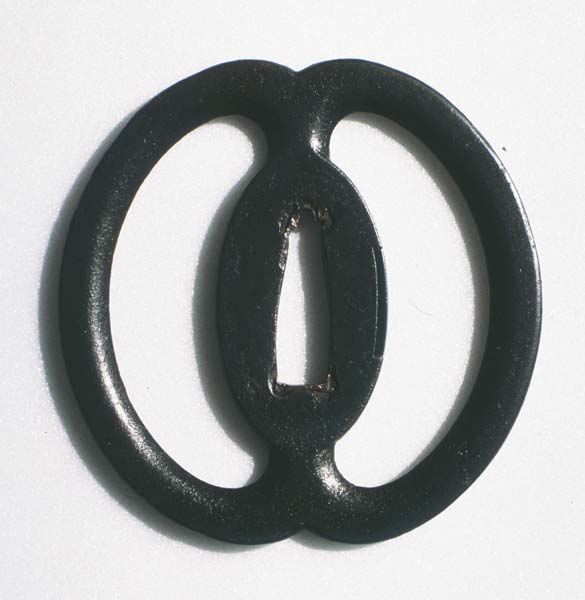
The tsuba appears to be constructed from 2 separate elements. The rim and the inner square. The tips of the square part seem to stick into the outer rim. This is a rather 'unorthodox' approach.
-
I have some scans of BNTHK published Hagia Katsuhira work here. The workmanship of his dragon tsuba is the same, in my opinion. And this example has a similar inscription to Mikes example. There's no question in my mind about Mike's Katsuhira, it's quite magnificent. My image of the same tsuba.


-

Just when you thought it was safe to go back in the water...
Ford Hallam replied to Ford Hallam's topic in Tosogu
Thanks Guido, it does raise the problem, then, of what other examples the attribution was based on. And does anyone else have any thoughts as to why none of these supposed Musashi pieces don't appear in the official list of National Juyo Bunkazai. I also wonder whether there are any Edo period texts that mention any specific Musashi-made tosogu. I ask because in the absence of any signed authenticated examples or even a vague set of kantei point by which to distinguish his work perhaps the provenance of some examples might prove more revealing. -
Just when you thought it was safe to go back in the water...
Ford Hallam replied to Ford Hallam's topic in Tosogu
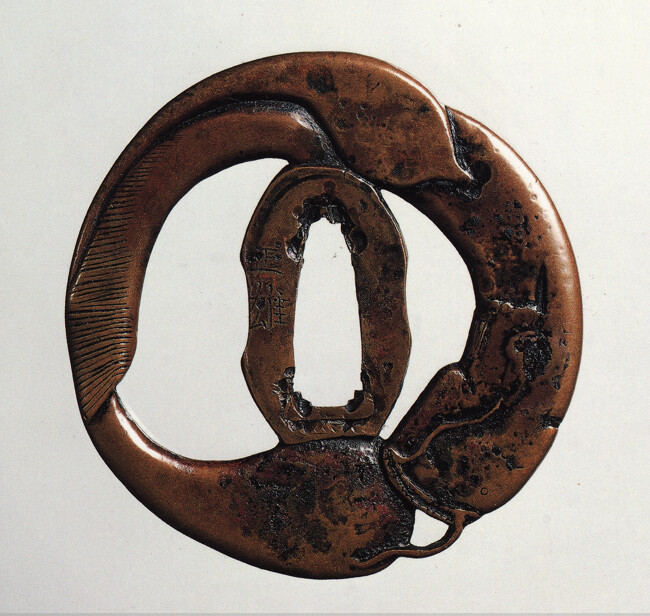
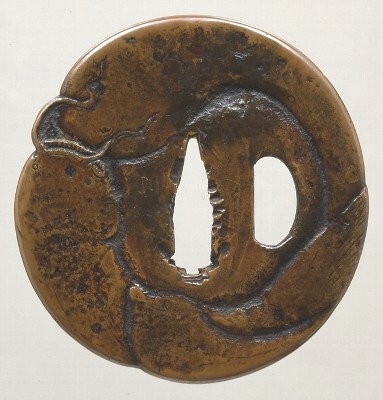
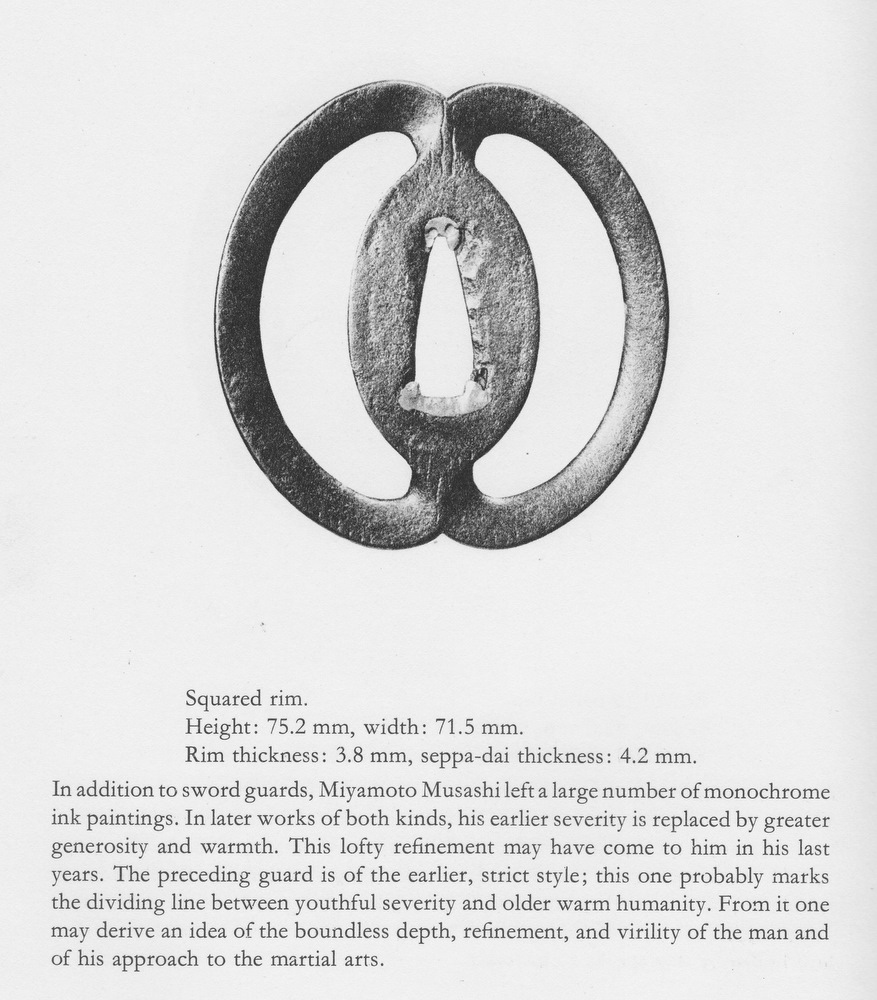
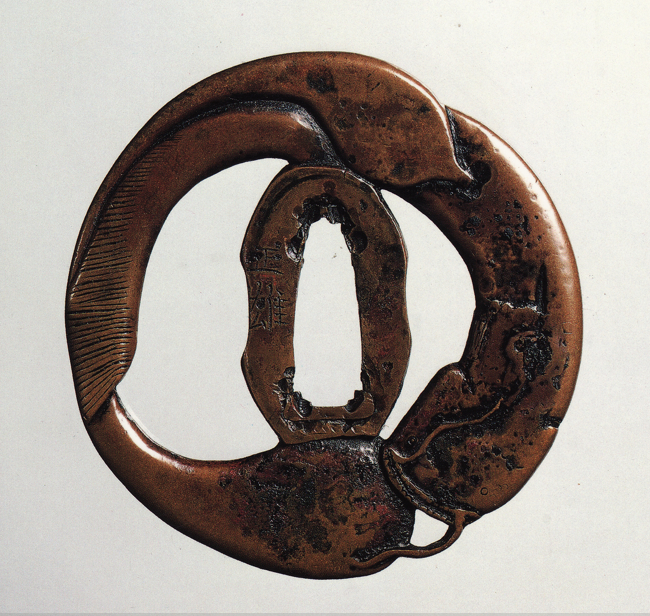
Miyamoto Musashi
-
Just when you thought it was safe to go back in the water...
Ford Hallam replied to Ford Hallam's topic in Tosogu
Does anyone know of any Musashi attributed pieces that are supported by either NBTHK or NTHK papers? -
Just when you thought it was safe to go back in the water...
Ford Hallam replied to Ford Hallam's topic in Tosogu
I would hope, as did the potter Shoji Hamada when asked why he didn't sign his work, in the future my poorer work would be attributed to a 'follower' or be judged a fake while better work be credited to me And that's not taking into account all the Musashi versions I've made.... I only hope mine aren't attributed to him and I get lumped with his dodgy bits -
Just when you thought it was safe to go back in the water...
Ford Hallam replied to Ford Hallam's topic in Tosogu
Rigorous reasoning from inapplicable assumptions yields the world's most durable nonsense. Any attribution of a work of art or craft can only be made based on comparisons to other known genuine pieces. A group of works all attributed to the same individual needs to exhibit at least some relationship in terms of style, workmanship and aesthetic. These requirements are not bypassed by means of mystical 'revealed knowledge' available to only a select few in the right lineage. The validity of any opinion rests on the evidence that is presented to support it, not unsubstantiated claims to higher, more learned authorities. Convoluted speculations as to how Musashi might have been able to produce metalwork are irrelevant until we can reasonably show that in fact he did. It's putting the cart before the horse. -
Cheers Mike That's pretty impressive. His versatility and the expressiveness of his compositions are inevitably brilliant. I did actually have a single image of this piece but it's very poorly focussed. These are really great and allow his workmanship and artistry to be properly appreciated. In hand would be preferable though ...hint, hint :D
-
Just when you thought it was safe to go back in the water...
Ford Hallam replied to Ford Hallam's topic in Tosogu
Hi Henk, I fully agree with your professional view...my question was slightly rhetorical. I'm also very well aware that by voicing doubt I will not be doing myself any favours :? but I'm afraid I'm really not very good at being a "believer" -
Just when you thought it was safe to go back in the water...
Ford Hallam replied to Ford Hallam's topic in Tosogu
Hi Chris, sorry, I've edited my previous post to add some details that explain my scepticism. Personally, no, I can't see any connection between all the various pieces he's supposed to have made, either from a purely technical point of view or, if we allow for the possibility such an amateur might be able to express something of their own character in metal (which I very much doubt), any sort of aesthetic relationship. I used to, long ago when every text from Japan was gospel, think that at least one of the 2 attributed to him by Sasano was genuine. I read somewhere that it was supposed to have been handed down in the family of one of his disciples, Terao Magonojo. It is, in my opinion, the most accomplished of all the attributed 'Musashi tsuba'...and I now think it to be the work of one of the the other Higo masters, Hirata Hikozo I being my feeling. Incidentally, we see Shoami examples of the namako tsuba design that pre-date Musashi so he cannot be credited with the form. And he was very unlikely to have even met Hirata Hikozo I as he died 11 years before Musashi reached Kumamoto in 1640. Possible contemporaries might have been Hayashi Matashichi, Nishigaki Kanshiro, Shimizu Jingu I or Hirata Hikozo II. All of these men about 20 or more years younger than Musashi. Would he humble himself to study metalwork, a dirty job, under such younger men?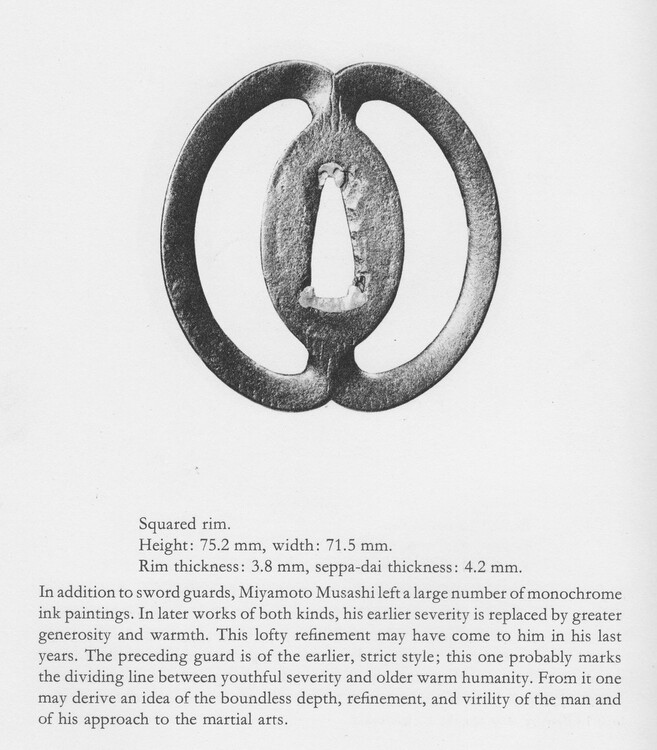
-
Just when you thought it was safe to go back in the water...
Ford Hallam replied to Ford Hallam's topic in Tosogu
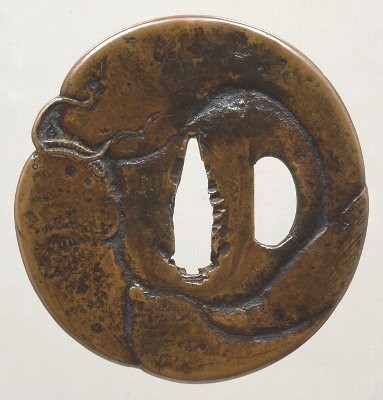
Some more works attributed to Musashi. This one supposedly 'den'...? This one held by the Kumamoto Prefectural museum What has always bothered me about his supposed metalworking sideline was when he's supposed to have found the time. The most authoritative account of his life is probably 'Miyamoto Musashi - His life and writings' by Kenji Tokitsu. There are a few other worth reading but Tokitsu provides far more detail and background than the other works, in my opinion. His book is also very well illustrated with many of Musashi's painting and calligraphies. That he was a very credible painter and calligrapher is undeniable and there is no need in this respect for attributions as his works are signed and at least one bears his personal seal. Artistically speaking they all share a very distinct character. We learn, from Tokitsu's book, that Musashi was an extremely proud man and was very concerned with how he was regarded by others in terms of status. The various issues surrounding his employment make all of this plain. His attainments in the martial arts were not always as highly regarded as he would have liked and he struggled to find a suitably elevated position as an official retainer. From Tokitsu's; "Three years after the Shimabara insurrection was crushed, Musashi left Ogasawara to go to the fief of Hosokawa in Higo, where he passed the last five years of his life." pp119 on pp124 a quote from the Tanji Hokin hikki tells the following; "Musashi had a taste for sculpture and the art of casting metals He also made a great number of bokuto." But no mention of calligraphy or painting, both arts we know for certain he did practice. Musashi arrived in Kumamoto, Higo, in the first month of 1640. He retired to the cave at Reigando in 1643 and died on the 19th of the 5th month 1645. Also quoted by Tokitsu is the following passage from the "Anecdotes about the Deceased Master" (Musashi being the master in point) "The master fell sick after arriving in Higo. Especially from the beginning of 1645" It seem therefore improbable to me that this, already ailing, man produced all the paintings and calligraphies (and bear in mind no-one simply starts painting and produces fuly fledged art works from day one...not even a sword saint ) AND an impressive array of tsuba and other fittings in metal....all in less than 3 years.