Ford Hallam
-
Posts
3,091 -
Joined
-
Days Won
78
Content Type
Profiles
Forums
Events
Store
Downloads
Gallery
Everything posted by Ford Hallam
-
Those are from the 2010 NBSK competition. Here are all of the entries, the images may be a little better as you can click on them to see larger versions.
-
... :D Jean, I've always been quite independent but my relationship with my teacher is very close so it's only natural for me defer to him always. Having said that Izumi Sensei has never imposed his own ideas on how I've chosen to approach my work and in fact now we share ideas and techniques back and forth. If I need to ask him something he always offers what he can. It's very much like a father/son relationship in that, although I am on my own and have my own family and career to tend to, my behaviour towards him is governed by respect, courtesy and affection. I think he feels the same way as he has named me his successor and has left me his tools in his will. So the bond is permanent.
-
Hi Jean, I think the results will be made public by the end of next week. At least by then the notification letter will have been sent out.
-
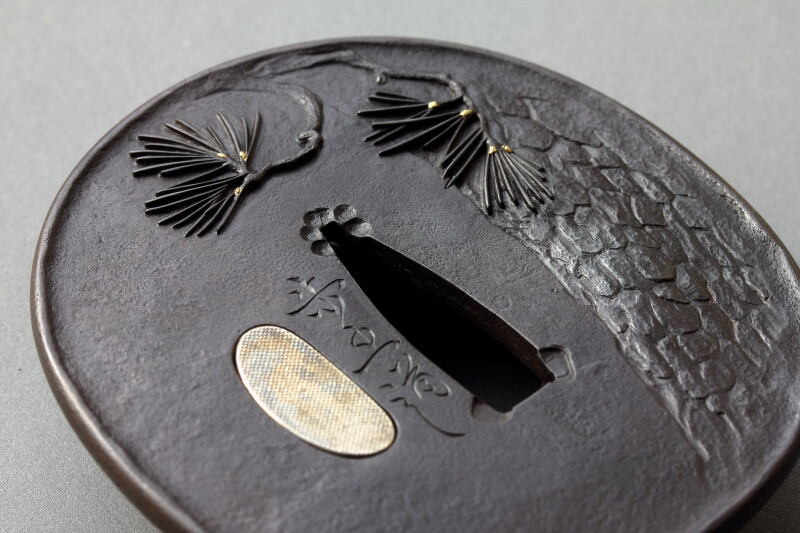
Hi Roy, ok, glad we cleared that up...you had me puzzled for a while I'll keep my fingers crossed for that lottery win for you but if you think I was an awkward bugger to commission last time I think it only fair to warn you that nowadays I tend to only listen to my own opinions :D And thanks for the kind words on the tsuba itself. I hope now that the 2 sides are shown together as one composition it makes more sense in aesthetic terms. Thanks Gents, for the other generous comments, I really do need to tighten my 'shinobi-no-O' Lorenzo, Kevin did the photoshop work for me...I'll stick to what I know
-
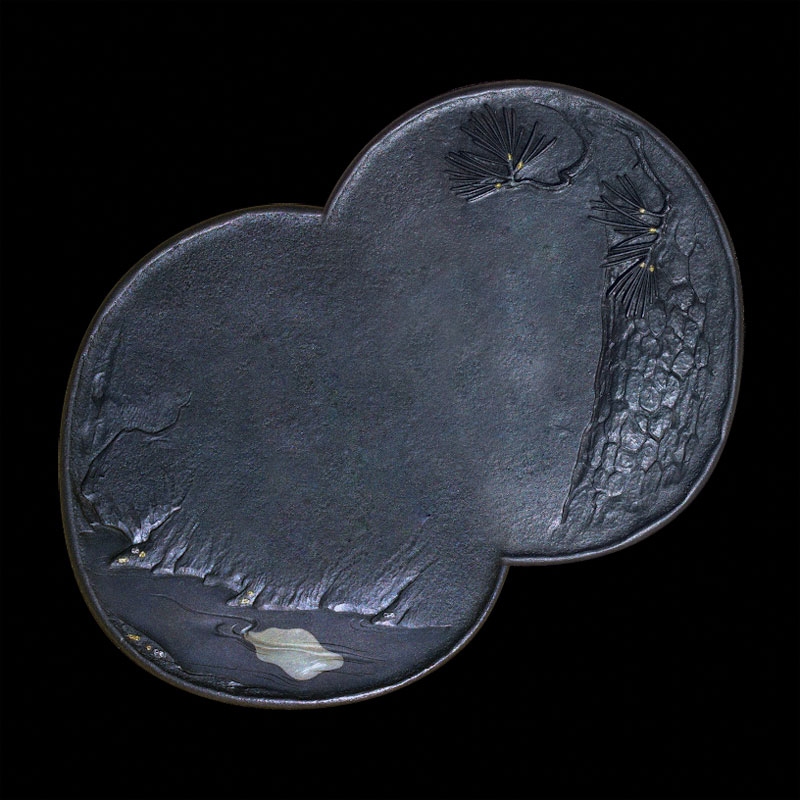
Not sure if this will help clarify things but here's a composite view of both sides together. In a sense this is how I often conceive of compositions.

-
Thanks Gents, I appreciate the votes of confidence :D The reason I've asked Roy to clarify his critique is not so much because it might have offended me (it doesn't at all) but because I'm honestly intrigued as how the work is seen by others. On my own forum we deal with critique as a part and parcel of our ongoing discussions, but all critique must be made clear and be well articulated or it's essentially meaningless. As I hope is clear I go to a great deal of trouble in creating my work so when someone makes a comment like Roy did it leaves me a bit bewildered as what they are seeing because I don't see the front as being weaker at all. If what I'm spending countless hours on is not 'understood' then my aesthetic language is either failing or my audience is illiterate. Either way I need to know if I care about how my work is received. What I'm getting at is; was Roy's view actually based on an assessment of the work, which is what implied when he wrote " much better work", or is it really just his personal aesthetic preference being expressed? The distinction is important because one purports to evaluate the work itself while the other tells us about Roy's own aesthetic taste. Both equally valid views but both very different things.
-
ok Roy... You made your comments/critique 12 hours ago and I know you've been back to read the responses so I think it only polite to explain your disquiet in respect to how you judge my work. To be blunt, you've thrown out an oblique criticism but not actually defined it. In fact you asked me to explain your dissatisfaction....which is quite a liberty really. So, having publicly judged the reverse of my tsuba as being 'better work' than the front would you please explain what you mean by this? I only ask because while for most readers this is just a past-time this pursuit it is, for me, a life-time commitment. respectfully,. fh
-
How would I know why you think that? I'm not a mind reader Depends what you mean by 'better work' so I really can't say why you would feel that the back is 'better' You'd have to explain how you and Les evaluate Japanese metalwork and what your criteria are.
-
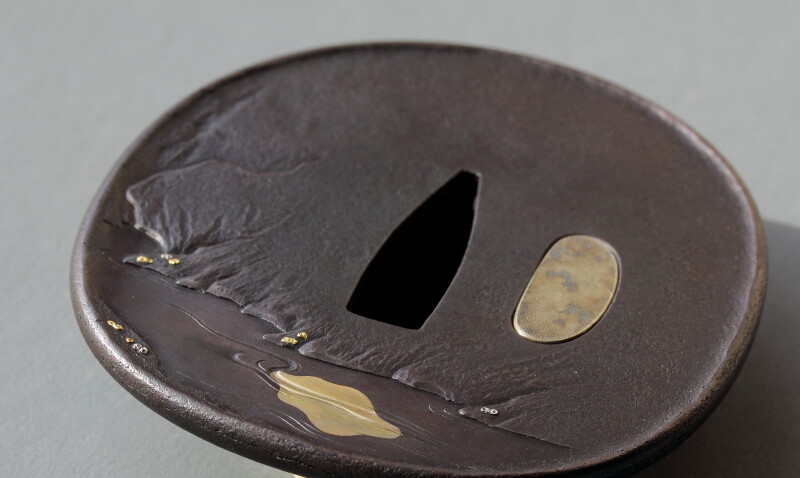
Hi Uwe, the hitsu-ana plugs don't represent the moon. That would be far too literal for Japanese art It's enough that the moon is present merely as a reflection. It's actually Buddhist imagery. "Enlightenment is like the moon reflected on the water. The moon does not get wet, nor is the water broken. Although its light is wide and great, The moon is reflected even in a puddle an inch wide. " Dogen
-
Thanks all, for your kind compliments Ruben, no, I don't use arsenic in the patination process. I could tell you how I create my patina but then everyone would be able to do it so I won't, sorry. Uwe, Chris is absolutely correct :D ...it's the moon's reflection.
-
It has been known to happen There's no question that Geraint's example is not particularly close to the examples in the NBTHK article but as I've mentioned here before, we simply don't have enough samples from all periods of most artists working lives to discount a variant like this on the basis of it not being hitherto recorded.
-
Thanks very much, gents. I'll keep doing my best until my eyes fail me, Roy
-
Thanks Gents, you're very kind Brian, nope, that is a particularly garish, mid Meiji, electro-plated piece of tat. :-)
-
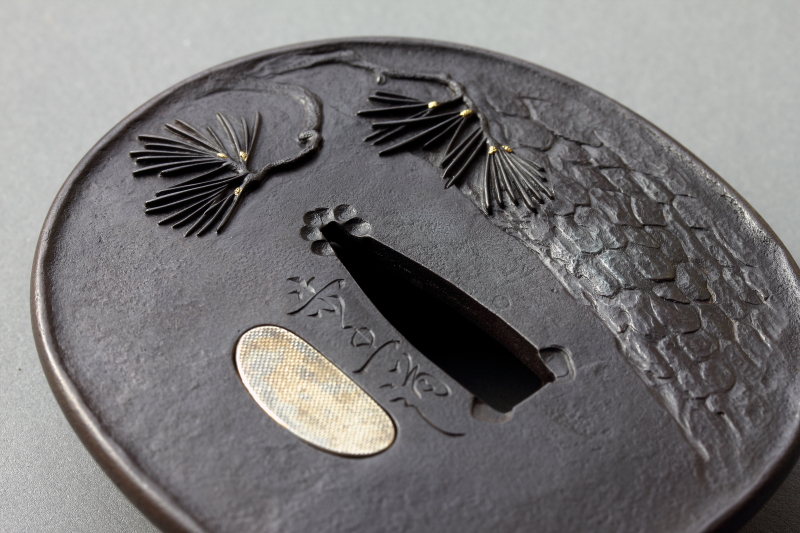
This is this years entry in the NBSK Shinsaku competition. My teacher is happy with the workmanship and he feels I've achieved a composition and aesthetic that might please the judges....we'll see. Handmade steel, inlays of gold and silver. If you're interested you can see some more images here. and some images I took while making the piece are to be seen here. As the title of the second album suggests I was influenced by the work of Matsuo Gassan although that probably only applies to the back. The front takes something from Natsuo but is essentially my own take on the subject. regards, Ford p.s. It is available but it is quite expensive....although, if it does well in Japan it'll be cheaper now
-
The kao looks to have the general form and strokes of the one used by the first master, the father. Funada Ikkin (TB N48_1991).pdf
-
Hi David, We don't actually know where the makers of Onin tsuba were based or even if it was only one closely affiliated group. It all just speculation, as usual. They might have been at Kyoto, but they might have been working for the other side too. We just don't have any real evidence either way. that's what I wrote :? I note Robert Haynes (in "Tsuba - An Aesthetic Study) makes the same claim as Mr Berta . I can only assume this is a printing error as the opposite is so self evidently the case. I was disputing what you wrote here, when you cited John Berta's article; " It goes on to say that the origin of the Onin tsuba is with Katchushi tsuba makers" You have an Onin type guard that has subsequently had a kozuka hitsu cut in. I don't see any evidence that these guards might have been considered suitable for formal wear...now that we've discounted the 'astronomically expensive' brass story.
-
The notion that the Japanese would have imported brass that cost them more than gold seems highly improbable. Gold formed the basis of trade as a fairly universal unit of 'money'. If brass cost more than gold at that time it would have completely messed up the balance of trade with the mainland. It would also have made a significant impact on Japanese coinage. I think this is just another of those tid-bits that someone made up without any basis in fact or without any reference to any evidence. And Onin guards actually appear to be Ko-tosho guards with applied decoration, not Ko-katchushi.
-
The Umetada piece David posted is in fact a type of brass. It's called Shinchu in Japanese and contains about 15% Zn compared to 30 ~ 40% Zn in modern commercial brasses. The tsuba you linked to on ebay is merely plain copper and not yamagane.
-
David, can you cite some source for your comment? As far as I know it was never common practice for kinko workers to enhance katakiri, or other types of engraves lines for that matter, with black lacquer. The black appearance of the chiselled lines is nothing more than oxide and grime build up compacted with wax. The tsuba in question is a fairly generic bit of very late Edo or possibly Meiji work. The mei is 'optimistic' regards, Ford
-
:? oooh er, Brian! I do love it when you're strict.

-
Yes, the date does seem to read Showa 15, 1940. On the left hand side on the rear (bottom pic)
-
Dear Andy, you're quite right, I've been remiss in not apportioning some criticism for the omissions (as I see them) from your article to your collaborator. Here I will now 'officially' direct my comments to both of you. I can assure you there is nothing personal behind my opinion of the validity, or lack thereof, of the article. My point was simply that you made repeated assertion regarding the composition of the metal but failed to provide any evidence that you'd done any analysis' nor did you cite any relevant work that would substantiate your claims. That fact alone, in my view, renders the article relatively worthless. In addition, and this is the point I was making in this thread, articles like yours, that provide no evidence or sound reasoning for the ideas they present, simply add to the overall confusion that we are forced to wade though. The fact that Mariusz referred to your article in good faith proves that particular point. He assumed it was a reliable bit of work. I demonstrated quite clearly why it is not. You claim you "wanted to throw out some new info. and get brains working." But you didn't really presnent any new information at all, did you? You just made a load of unsubstantiated assertions. Could you elaborate on the nature and exact relevance of this data? , because unless you established scientifically the carbon content of the sample pieces you were writing about I fail to see the connection or relevance. No, I don't see any merit in the work I'm afraid. I regard it as yet more muddying of the water. How is it you would even claim to know what I think now? As for presenting my own 'research' or theories most regular readers of this forum will be well aware of my contributions here. I'm more than willing to debate or argue my points with anyone who cares to challenge them. On occasion I've even changed my view or at least altered my initial ideas as a result. I'm not sure which words I used are supposed to be so intimidating but this is just pathetic nonsense. If ideas can't stand up to scrutiny then perhaps they are best kept out of a public discussion forum. I will remind you that I have kept my comments directed firmly on the issue of metal composition and the articles failure to provide any evidence to validate those claims. I don't have to contradict anything at all in this case. I merely have to point out you have not proven anything but merely asserted without evidence your ideas. "That which is asserted without evidence can be dismissed without evidence." You may well think this...but can you prove it? :lol: Even if every single member of this board secretly agreed with you ( ) it would still leave you (and you army of secret admirers ) without a shred of evidence to support your assertions regarding the composition of the armours you discussed in your article. As for me being more constructive in my criticism, I thought I was. I pointed out very clearly where the weaknesses in your article were and why, as a consequence, I regarded the piece as unreliable. This is only my opinion, of course, others may be happy to simply go along with your train of speculation just because you say it's so. regards, Ford
-
Dear Andy, I'm pleased you've decided to respond to my, some-what 'ad hoc' critique of your article. What you seem unwilling, or unable, to recognise is that I don't need to do any new research to offer my contradictions to the points I highlighted is a bit disconcerting though. These are not matters of speculation. I was merely speaking from the point of view of established metallurgical/scientific understanding. If you wish to offer a substantive riposte to my criticisms then I suggest you do so by citing some relevant evidence or established scientific facts that effectively dismiss the specific points I made. Your characterisation of my commentary as a "rather verbose attack" is revealing. All I offered was my differing view on what you proposed, with the difference I offered some rationale. If I was verbose, in that I used a lot of words, I hope they were well employed to illustrate my objections. I can appreciate why you'd see that as objectionable. Why even raise the childish notion of internet bullying? You published an article that purported to be serious research....I critiqued it. This is usual practice in every field of academic research. Rather disappointingly you have chosen not to respond to a single specific criticism I made but rather to make some sort of vague objection that has absolutely no intellectual basis. To imply that this forum doesn't want to go in the direction my criticism inevitably suggests is a very sinister aspect of your comment. Frankly, if my commentary is considered to be 'unacceptable' , as you seem to think it is, I await some indication from the admin here. If the consensus is with you that my critique and objections to you article are unpalatable I will happily remove myself from this arena. But you are absolutely correct, articles like the one you published will confuse new comers to the field. All the more reason for speculative and poorly argued articles to be critiqued. If you disagree with my critique don't get overly verbose critiquing me....rather concentrate on supporting your thesis and demonstrating where and how I am wrong. As for your 'escape clause' of context I'd like to see a single example in what I wrote that is distorted by me taking it out of context. Please show me a specific point I referred that is made correct by a change of context. Ford
-
Chris, my point was that the diffusion of carbon though iron is something that pretty well documented and understood...to the point data sheets exist in industry that detail the variables. Your suspicions may wall be correct but we should perhaps stick to what we can say with some degree of certainty, don't you think? We are already labouring under the confusion resulting from years of unsubstantiated supposition...we don't need any more And no, forge welding is still forge welding but working bloom steel/iron from a tatara is in no way analogous to working a billet of modern processed steels that have been piled up and arc welded together at the ends. Nor can we draw any parallels in terms of how carbon might distribute. I haven't read the paper you cite but I'd be interested to see a copy... I do have all of Verhoeven and Pendray's papers though. Fascinating stuff, I personally regard Al Pendray as a true pioneer in his field, a real gentleman and extremely generous with his knowledge to boot.
-
I'd have to suggest that the notion that "carbon diffuses rather rapidly and homogeneously throughout the workpiece." is unreliable by reference to the well observed and documented practice of case hardening. This is a procedure specifically designed to impart carbon into the surface of a piece of low carbon steel yet despite the best current procedures this process only produces a relatively shallow penetration by the carbon. References to 'Modern Pattern Welded Damascus Blades' are, realistically speaking, not really relevant to the discussion with respect to what steel makers and tsuba-ko were doing 500 years ago...I feel.