Ford Hallam
-
Posts
3,091 -
Joined
-
Days Won
78
Content Type
Profiles
Forums
Events
Store
Downloads
Gallery
Everything posted by Ford Hallam
-

Father and Son set, study only I will not answer qustions
Ford Hallam replied to raiden's topic in Tosogu
:D ...whenever possible. -
Father and Son set, study only I will not answer qustions
Ford Hallam replied to raiden's topic in Tosogu
And let that be a warning to you all I know Brian well and what he may be capable of
-
Father and Son set, study only I will not answer qustions
Ford Hallam replied to raiden's topic in Tosogu
At this point I must side with Mike. What answers about these 2 tsuba will actually help anyone 'see' them any more clearly? There is nothing more to be said that will reveal to you what is in front of your eyes. We live in a world where labels and information pretend to be understanding but perhaps by simply keeping quite and looking and thinking most of what you initially need to ask becomes irrelevant. One of the most frequently asked questions we hear; " who made it?" really means nothing at all because we know so very little about the real person behind the name. For myself, there's very little I need to ask, if anything, to fully appreciate the opportunity Mike has very graciously given us to enjoy and study really fine work. And I sympathise wholeheartedly with him when he feels his efforts to share are so ungraciously criticised by people who actually give nothing to our community. Ford -
The workmanship looks quite late to me, good quality though, and stylistically it appears to me to be Hamano school.
-
Having read through the various opinions on this issue I was inclined to keep my nose out of it but it would be churlish of me to ignore Franco's amusing 'invitation' to add my own take on the matter. :D The first point that needs to be made is that generally speaking prior to the modern period Japanese decorative metal artists did not use sulphide solutions to develop black/gray 'oxidized' patina on silver. Certainly, the sulphur rich water from hot springs (motohap) was known but an artificially created silver sulphide layer (as this solution readily creates) is a very short term finish. When silver sulphides (note that silver doesn't oxidise very easily at all so, 'oxidised silver' is a misnomer) develop they are not stable and once initiated will continue unabated. Silver alloys, like Sterling etc, seem to be far more resistant to this sort of conversion so sulphide finishes were used and at times 'de rigueur' in various European silverware traditions. In those cases the silver was darkened and then 'relieved' on the high points to accentuate the modelling of the chased surface decoration. The action of sulphides on pure silver is essentially a form of rusting where the silver is gradually consumed. The silver sulphide layer is harder and more brittle than the underlying pure silver so it will inevitably flake off at some point, to reveal fresh, corroded, white silver and the process of breakdown will continue. Incidentally this is why silver nunome on Higo work is so fugitive, it's more often than not simply been eaten away by sulphide conversion. Having said all that the traditional metalwork artisan had a number of another processes for toning and colouring pure silver. Perfectly white and bright silver being generally regarded as an anathema, to paraphrase B W Robinson. and risk rabid condemnation from the book-burning brigade. The most common, Kin-furubi, is a process that leaves a molecule thin layer of gold on the surface of fine silver. The gold molecules absorb the same spectrum of light as when in shakudo and the light that is reflected (from the rest of the metal) appears black for the same reason. Used on it's own kin-furubi produces a very gentle and subtle 'pewter-like' patina that will gradually darken with age. It will, though, depending on the presence of atmospheric pollutants, eventually turn black also. It's common practice to speed up the kin-furubi patina by applying iodine. This tends to produce blue, purple and yellow interference colours and further exposure to sunlight hastens the overall darkening. The last point I'd make would be the about the degree of polish. A perfect mirror finish is only one extreme on a continuum of possible finishes. Simply polishing tarnished silver with a metal polish will produce a very hard (in appearance) and garish finish. It's possible to produce a far more diffused finish that is both less 'hade' (flashy and loud) and provides a more subtle ground for gentle colouring. So, traditional metalworkers had available a range of finishes for pure silver and, in my opinion, a completely bright mirror finish would have been regarded as being 'a bit much' and far too obvious. Regards to all, fh
-
-
I was looking for this quote with that 'chocolate biscuit' tsuba in mind, someone just posted it on facebook today, bit slow but thought it a reasonable maxim for us all to bear in mind. It's usually attributed to John Ruskin....but that's not correct.
-
don't take that tone with me
-
Hi Chris, I'd describe this alloy as a sentoku type. This means there is about 5% Zn in the mix. What happens over 100 years is that the Zn present in the surface tends to oxidise more readily that the copper matrix and this inevitably results in a lighter patina that the one it started out with. This pale yellow/ochre is typical. If the surface is now repolished, to remove scratches for example, the original aged surface is removed and fresh metal exposed. When it is then repatriated this fresh metal develops a much darker colour than the surrounding untouched ground. To an extent this is true of most non-ferrous alloys but with the brass/ sentoku and bronze type alloys the effect is very marked. It makes proper restoration a real headache. Anyway, that was why I felt the ground was untouched, at least in modern times. regards, Ford
-
Jean, yes the original is about that size and I think you may have a point.
-
David, don't get me wrong I actually would tend to agree with your assessment as Ko-Shoami. The Katchushi label does seem tenuous. And we should remember that Tosho and Katchushi are only conceptual labels created for convenience and not defined schools. regards, Ford
-
Hi David, glad to add what I can It's actually pegged as Katchushi by Japanese authorities, which might seem a bit surprising I suppose.
-
Kunitaro San :D
-
I don't think this is a late Edo/early meiji revival piece myself. To my eyes it looks like a modern hobby work. Here's the original, it's quite well published. As Henry said, Muromachi Period. 'Hachiman Dai Bosatsu and 5 sectioned Buddhist stupa, a 'Gorin' And David, that modern copy you linked to is terrible It looks like a chocolate biscuit that was dunked in hot coffee for too long. It is just a sloppy mess.

-
heh, you never say that to me, Brian
-
you're welcome, Brian glad to help.
-
Based on what I can discern from the image I can't see anything that suggests a mei has been removed.
-
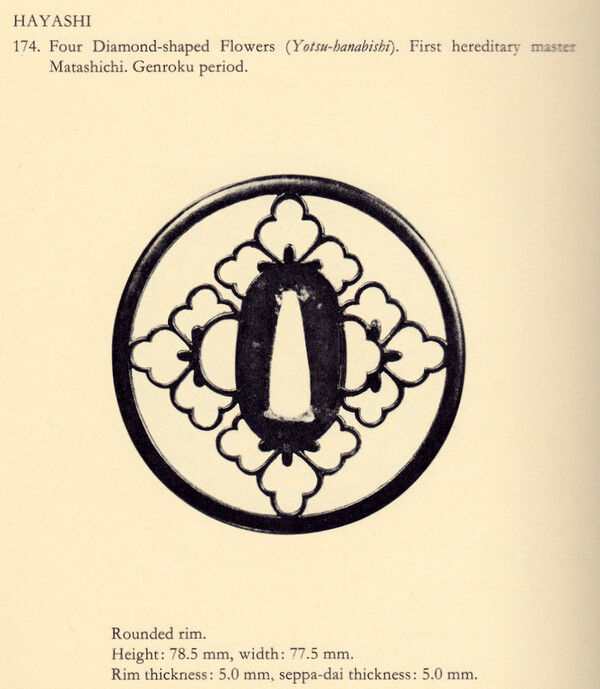
Gentlemen, don't let the weight of an individual tsuba lead you astray. There is no way this measurement means anything of relevance in terms of judging a tsuba. It won't tell you anything about metal quality, density (a ridiculous bit of nonsense that is routinely trotted out ) nor composition. It weighs what it must for its volume that's all. As for this tsuba it looks to me to be a perfectly honest modern utsushi of the original design by Matashichi Hayashi I. The patina is a bit weak but it's a reasonably tidy bit of work. Interestingly enough the original has a much finer finish and is in remarkably good condition. regards, Ford
-
Hi Andi B When Bob Morrisson first got the wakizashi tsuba he tried to find the dai tsuba also. It was only after about 2 years that he approached me with the idea to make an utsushi. We were pretty sure the original was still around but we didn't know where so it wasn't available to us. But it wasn't just about making a copy it was also about creating a detailed film that would serve as a teaching documentary to help collectors better understand how these work were made in the past. With Bob's backing we were able to produce something unique that will last forever as an introduction to kinko-work. Hello Dimitri I'm sure that I Bob was ok with you taking photographs in Leeds then it will be fine to post close ups here
-
You are very welcome Kunitaro San I think the main point is that both approaches are possible but within certain conditions. For example the example you posted where the hamon clearly passes through the edge of the horimono must have been cut before yaki-ire. I do wonder though if in the past doing the horimono before the hardening wasn't more common than we now think. Very interesting topic. regards, Ford
-
Thanks Chris, for that link and the photo. Actually, this sale and the images came to light about a year ago but it would have have made my life so much easier if I'd had them at the beginning Someone else also sent me another black and white photo of the back. We're hoping that at some stage we might reunite the pair, along with my copy, if only for a photo opportunity. It would make a nice conclusion to the film. And co-incidentally the sale date, 8th June, is my birthday :D
-
I had a chat with Brian last evening and he mentioned this thread. I'd missed it previously but have now had a quick read though and will offer some observations of my own that are based on my experience of carving steel and also doing repair work to blades. I haven't thought about the whole issue of 'before/after' horimono carving before but perhaps some empirical observations will help to clarify matters. The first point to be very clear about is that the hardness of the chisel is only half of the equation. Prior to modern high performance steels craftsman were limited to well forged high carbon steel. Having said that this material is capable of being hardened to what we call 'glass hardness'. In that state, though, it's not much use as a cutting tool because it is generally very brittle (just like glass) and the acute edge of the chisel will very easily chip, even when carving very soft steel. The pressure of being forced through soft iron is enough shatter the fine edge. So what we really need to understand is the balance of hardness and toughness that a carbon steel chisel must have to perform well. This toughness is created by tempering, this is a post hardening process designed to relieve some of the absolute hardness and to restore a degree of 'give' in the metal's make up. In practical terms this means that a tempered high carbon steel chisel cannot cut into nioi or nie. In fact on one occasion I had to inlay some umegane into a blade quite near the hamon. I was able to carve the recess for the plug quite easily with no damage to my chisels except for where I needed to get closest to the hamon. I was about 1 mm away and simply hit steel that could not be chiseled without chipping the edge of the chisel and merely roughly tearing away/chipping at the steel. And I was using a HSS chisel. The abrupt change in hardness from hamon to ji was quite dramatic. I eventually overcame the problem by using diamond tipped grinding burrs to shape an undercut in the hard steel against the hamon. The second point to consider is that even with the hardest and toughest chisels available we still have to think about the material we've carving. To control the carving and to create even and smooth surfaces requires a degree of softness in the steel because if it's not flexible/malleable enough it will simply chip and tear. From a practical point of view it's simply not viable to chisel hardened steel, with even harder tools. It is possible to use various grinding processes like modern jade carvers do but that doesn't seem to be an approach that modern smiths have embraced, thankfully To summarize, horimono have to be cut either before hardening is performed or on areas of sufficiently soft steel. As I understand it, from conversation with modern smiths, areas that are to receive a horimono after yaki-ire are given an extra thick coating of clay to help preserve the softness of the steel where it's most needed. I think that if carvings were done before yaki-ire they would best have been very shallow, and even on each side, so as not to cause warping when quenched. At least one example posted by Kunitaro San shows a carving that crosses into the hamon. It's worth re-emphasising that these horimono by Nobuhide are very shallow. They are more like the shishiai-bori or sukidashi-bori technique of Sugiura Joi than typical deep horimono. The finest horimono I've ever seen was by Honjo Yoshitane and was on a magnificent Kiyomaro blade. An absolutely superb dragon that, for me, is the gold standard of dragons in swords. Anyway, that's my 2 cents worth. Regards all, Ford
-
thanks Ford, you're more than welcome Tobias, always happy to spend my time helping others where I can
-
I'm not much of a Noh play aficionado so I don't have a clue :D The double meaning of motifs and subtle allusions are, of course, central to Japanese Poetry. My take on this tsuba would be that the wearer would be displaying a degree of cultural refinement and literary awareness intended to override the notion the warrior class were boorish and uneducated bully boys.
-
Hi Malcolm, The actual pairing of ax and pine, while used in Kamon, derives originally from a Noh play (sasano makes reference to one in his description of this tsuba) So I'd suggest that in this case the Play gave rise to the tsuba. This makes sense to me also because the Akasaka school was very much a product of early urban art scene in Edo with most of their designs being drawn from artistic developments around them.