Ford Hallam
-
Posts
3,091 -
Joined
-
Days Won
78
Content Type
Profiles
Forums
Events
Store
Downloads
Gallery
Everything posted by Ford Hallam
-
But nothing of what you've now written proves that in "old Heianjo types-the Zogan was already executed to finnish". The idea that the piece to be inlaid (mon-gane) is carved and engraved to completion before actual inlay into the steel plate reveals a lack of understanding of the actual process of inlay. That's all I'm talking about.
-
I don't know why this old idea is still around. There is absolutely no evidence that it's accurate nor does it make much sense from a metalworking point of view.
-
Keith, Pat, you've both touched on a central point of connoisseurship. To train our eyes to more accurately asses things it's important to try and be a little detached from the actual subject matter. A simple example would be a poorly carved tiger or a superbly rendered spray of flowers. The fact that a person might find tigers more 'manly' than some girly flowers will unconsciously sway that person's judgement. The trick is to learn to be a little more systematic or organised in terms of how we look and judge. I would say that of the 2 the MFA tsuba is a fair example of it's type. It's important that different types/styles of work are judged within the context of their specific genre so it's is not helpful to judge, for example, Akasaka work against Ko-mino, apples and oranges One might reasonably say that the carving on these Bizen Shoami pieces isn't as controlled and refined as that we see on Kinai (for example) but that would miss the point of the aesthetic the Bizen work is obviously expressing. It's not trying to be extremely refined, it's a deliberately naive and bold/gestural style. Of course, different individuals will be drawn to different style and aesthetic expressions but that would be applying ones subjective, personal taste. Pat, it's true to a certain extent that better tsuba do cost more BUT not all very expensive tsuba are necessarily good. Big names command high price tags but not each work by the same artist is equally great. Conversely, great work is sometimes seen that was perhaps a lesser known artist's masterpiece. Discernment is a matter of seeing the difference. Also, and this is something I frequently see, there are actually many very reasonable (to fine) examples of tsuba out there that are very reasonably priced. The game is to really learn to spot those unseen sleepers. You'd be surprised how many really excellent pieces are floating around unrecognized because they don't have big names on them or over hyped descriptive labels.
-
Interesting, :? the rim appears to have been laid out by a drunk man as does the seppa-dai. :lol: It would be helpful to see a full frontal of this one but judging from the other images it seems to me the maker didn't really 'get' the original design. It's a bit like doing a tracing of the original version and then doing a tracing on that copy etc. After a few such reworks the essential qualities that enliven the original are lost and the design becomes a vague representation. If you examine the lines and textures on the MFA version and how they work with the lines of the composition compared to the arbitrary marks on this version I think the difference becomes even more clear.
-
Happy to add what I can, David
-
David, that "organic wood bark texture along the rim" is of course one of the defining characteristics of this type of tsuba but I wouldn't say it's reminiscent of Higo styling really. With regard to the openwork composition allow me to challenge your assessment. :-) With all such openwork designs, and in fact any such positive/negative sort of design, equal attention ought to be given to both the 'black' and the 'white', as it were. The interplay of these negative shapes with themselves and in contrast with the solid parts is how a designer would judge the success of the work. All artists make use of pattern, repeating (echoing) shapes and rhythm to create lively and interesting compositions. If you compare these 2 versions and bear these ideas in mind you may begin to see them a little differently. Just take the actual negative shapes that each tsuba presents. I think it's quite evident the MFA tsuba is far more interesting and that the lines that describe the negative shapes create a very lively and dynamic rhythm around the whole piece. These traits are for the most part missing in the Holbrook example. imo
-
For starters I'd suggest the MFA attribution is wrong. Theres almost nothing other than that wavy rim to link that example with Higo work. The workmanship and stylistic similarities between the 2 tsuba illustrated are so close as to make it almost certain they came for the same studio or group. I have to disagree with Keith and David and say that in my opinion the MFA example is a finer and more expressive work. The Holbrook example lacks real vitality as far as I'm concerned and this is a fundamental trait one ought to look for in strong examples of country work (or more accurately work done in a naive style) , as exemplified by the Bizen Shoami. The actual design in the MFA version also seems to be better interpreted whereas the Holbrook version seems uninspired.
-
Hi David, no, not one of mine. The colour in the photo is way off. The Canon 400D I used to use threw the colour decidedly red. To be honest I don't recall the true colour. I took that image about 3 years ago. That grey back ground ought to be a mid tone grey, to give you an idea how skewed the colours are. The image of the reverse is a bit more true I suspect.

-
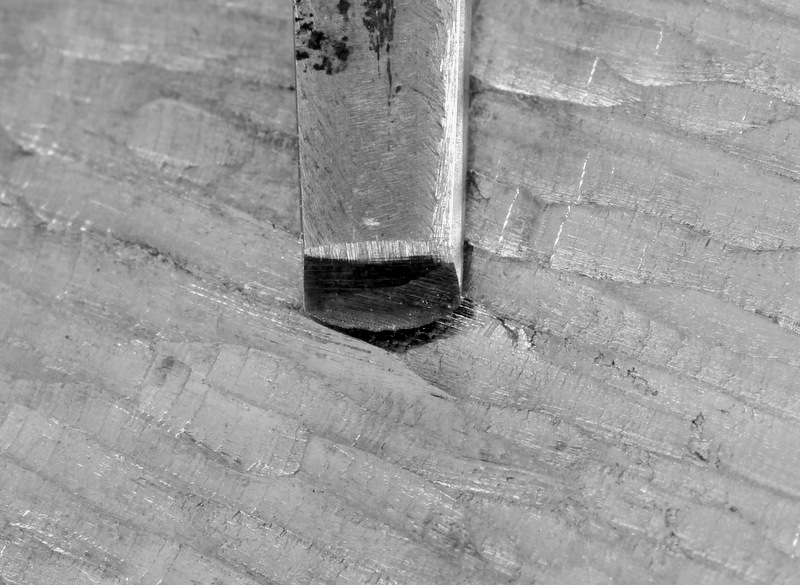
close up of a the sort of battering a chisel takes when carving hand made steel. The face of the chisel is 4mm across. and a close up of the carving and modelling technique on a famous Yasuchika. This image taken hand held recently when in Tokyo. I use a Canon 60D. It's got brilliant HD filming capabilities too and a handy flip out high resolution screen with the capability to focus by hand on a hugely magnified image and I use a Canon 60mm f 2.8 macro lens. A tripod and remote shutter release cable are essential for really sharp close up images.


-
and another, sorry about the poor photo, taken before my upgrade

-
Here you go, a photo tutorial on how to do it properly.
-
these are an excellent example of 'sue-mon' zogan. I actually wrote a little bit about the technique on my forum a short while ago, I re-post it below.
-
Jean, steel patina can be created exactly like any of those on my own work if I'm doing a full repatination. It's much harder when I'm trying to retain what remains of the original patina and not effect the rust etc inside any sukashi. But it all really depends on the actual piece and the condition of the metal. There are two basic types of ferrous patination that were used, depending on the period and type/school of guard.
-
 Keith, you raise an interesting point It seems to me that the "shift in focus" is absolutely appropriate and that 'the craft' is evolving in ways that are driven by a healthy evolution. A craft only remains relevant if it, in however small a way, meets the needs of a society. Swords are no longer required as weapons, not even most dedicated martial arts practitioners can genuinely claim to use their swords in the same way as 16th cent. battlefield veterans might have, and we don't even really know what that would have properly entailed. Certainly there are swords being made today, especially in America, that are highly regarded for their cutting ability but it's revealing how their overall form differs from classical models. Revealing perhaps yet a further re-imagining of the swords original function, but we're seen that sort of 're-imagining'/redesign before, as a response to Edo period dojo based training. Slicing bamboo and tatami mats not at all the same as hacking at a bloke in amour who's also trying to hack at you However, as an art-form and with the concomitant shift in emphasis on aesthetics, the sword is now 'performing' a very different function in the way aficionado's regard them. Modern art swords easily meet the essential requirements of a weapon, qualitative assessments of that fitness aside, merely by adhering to good classic models that reflect the attributes practicing warriors admired and avoiding overly showy construction that is intended solely to produce 'bling'. The real artistry is more subtle, I would argue, and is intensely focused on the varieties of ji-hada, manipulation of the structure of and activities within the hamon, and further features that may be coaxed from the ji. They are still the same swords, made the same way but with a keener eye on beauty. Personally speaking, I don't see the craft as having suffered by this new emphasis, it's merely adapted to meet the demands and interests of it's contemporary audience. As Chris pointed out, it does rather depend on when you see the last old style 'real'(practical) swords having been made. Wasn't 'Osaka Shinto' a significant shift in emphasis away from the essentially functional also? Yet those blades served a very real and significant 'function' too, within the society that required them. Just some musings over my first cuppa. I'll be interested to hear other views. No doubt certain 'sword swingers' may have some objections to my rejection of modern day romantic illusions of warrior training regards all, fh
 -
Henk, As has already been pointed out, tools are merely a means to an end. Powered or not is less important than what you can do with them. Many Japanese potters use electric wheels for throwing while others still prefer a kick wheel. It would be wrong to suggest that those using an electric wheel were somehow not making real Japanese pottery. As Chris suggests, it also rather depends on how you define 'traditional'. To my mind there is no single fixed entity that is this thing called 'traditional'. When we speak of traditional Japanese crafts are we speaking about something that can really be defined by specifics? I don't think we can. It's really something far more elusive and to do with guiding principles and spirit that informs each age and the practitioners of the various crafts. Traditions by their very nature are an ongoing process. Once they stop evolving they become merely a mindless repetition of form, the true significance and meaning of which is soon lost. I actually wrote a little piece about the hand vs power tool question in an on-line interview I did a while back. You can read it in it's entirety here but the relevant piece is this;
-
Thanks very much Gentlemen, it's always nice to know one's efforts are appreciated.
-
Ron, this sequence of images should illustrate the process of forming both kashira and kojiri in steel. The procedure for non-ferrous metal is essentially the same but doesn't require that the metal be red hot. https://picasaweb.google.com/102920321260461207557/JohnSFuchiKashiraTheMakingOf#5350915403291840530 hope that helps, fh
-
Samurai rank by tsuba
Ford Hallam replied to Ken-Hawaii's topic in General Nihonto Related Discussion
Really enjoyed reading your commentary, Steve but I have to award the 'golden sake cup of appreciation' to Mr Bowen for his witty parody. :D -
Not that it helps much in regard to identification but the actual technique used in both cases to decorate the plate is actually resist etching and not carving. We see the same technique being used in Higo pieces from the late 17th cent. already. The pattern is painted directly onto the prepared plate, probably using urushi, and then etched in an acid. The resist (urushi) would then subsequently be ground off using a fine stone and charcoal to bring the raised pattern back to a fine finish. Compared to carving such a dense and complex pattern etching is relatively quick and easy, for a skilled artisan Lorenzo Amati recently did an utsushi of an old example and followed exactly the procedure I've described. On copper and shinchu examples it's common to see the recessed (etched) area darkened by the application of baked ki-urushi.
-
Shakudo is black, if it's properly patinated, not badly rubbed and if brown then it's probably copper with some minor alloying addition. These menuki don't look like shakudo to me. The design is after Yokoya Somin (1670–1733), he was the first artist to do a 'full frontal' view of a horse in metal, and the rear view as shown. Probably late Edo/early Meiji period. Definitely not made in the last 60 years. imo.
-
Hi David, yes, that's the book; Nobuiye Tsuba Shu by Nakamura Kakudaiyu. Thanks for adding those details, I was just being lazy and not bothering to look though my notes For swordsmiths and tsuba-ko seeing these rubbings of previously unknown tsuba and from nearly 250 years earlier must have seemed quite magical, a time capsule suddenly unearthed.
-
Brian, I can see Shakudo, copper, silver and 2 shades of gold and on a shakudo ground of course.
-
ah, my mistake , sorry. As you say, that mark is probably merely a minor blemish. And most likely invisible to the naked eye 'in the hand'
-
What is also interesting to note is that at the time swordsmiths were making these Nobuie inspired pieces the first publication of rubbing of the originals came out. Prior to this the genuine works seem to have been relatively unknown so I think it fair to suggest the book was the catalyst for this type of work. Worth remembering, also, that it was Suishinshi Masahide who was largely responsible for the attempt to revive older methods of sword making and one can easily see this interest in Nobuie tsuba at the time to be a part of this 'looking back to past glories' so to speak.
-
Grey, it's the moon, inlaid in silver, and depicted as being partially obscured by drifting clouds.