Ford Hallam
-
Posts
3,091 -
Joined
-
Days Won
78
Content Type
Profiles
Forums
Events
Store
Downloads
Gallery
Everything posted by Ford Hallam
-
Hi David, sorry to hear that the shinsa was disappointed and that this has been a costly learning curve. I do hope, though, that by working together as a community to learn more such painful lessons might be reduced to a bare minimum. Thanks for the link to the Shinsa details. Kaigunair also helpfully sent me a link to the biographies of the panel members. A highly qualified panel by any reckoning, I think. Here's the direct link. regards, Ford
-
Dear David thank you for taking my rather direct comments in the way they were intended, merely as impersonal observations and opinion. And I would agree with you that the discussion about the piece does have value as you suggest, it's just the tsuba itself that I feel is less worthy of appreciation. I don't see any reason to delete this discussion either, I think readers ought to be free to examine the differing opinions and judge for themselves based on what evidence and/or rationale is on offer. I await with interest the Shinsa panels opinions also. Do we know who they were and what their qualifications might be ? regards, Ford
-
For what it's worth I'd like to throw me 2 yens worth into the discussion. I'm afraid I have to agree with Mariusz and Kevin in their critique of the workmanship. I think Kevin is absolutely spot on when he writes; The 'flawless iron' , as it's been described, appears to me to be uninteresting modern mild steel plate. When did featureless steel become desirable in any tsuba? The work of the Kamiyoshi group, while often quite precise and the steel very refined simply does not exhibit the sort of overly crisp and hard look this example has. Genuine handmade steel of any reasonable age has a subtle, soft looking, textural quality that's almost velvety (but wet ), this is in large part a result of the way the metal was refined through the forging of the tatara bloom and it never having been fully molten. Modern steels start off being totally molten and this results in a very different internal structure that is inevitably visible in the patina. And as for patina, I find it lifeless, dry and dull, as though it came straight out of a bottle. It lacks any depth or tonal variety. My impression is that this is the work of a relatively recent amateur. The work is not particularly complicated yet the handling of the carving reveals a lack of professional experience you simply don't see in genuine older work. The texture in the recessed areas is perfunctory and in places even reveals staggered punch marks that simply look sloppy. I can't see any convincing or authentic Higo traits in the piece myself (the shape of the ryo-hitsu is too easily copied so that doesn't count as far as I'm concerned) and the Kamiyoshi attribution seems pretty arbitrary. To be absolutely blunt I don't think this tsuba has any redeeming features at all and I really don't think students of this art ought to ruin their eyes studying it. I don't mean to be sarcastic in saying that either. What I mean is if students study really poor examples (I'm being kind in this case) their basis for comparison and evaluation will be severely handicapped. I realise that not everyone has an unlimited budget for collecting and that sometimes we have to settle for less than the best but, for the money, there are many much better pieces available. It merely takes a bit more discernment to find them. Sorry David, but you did ask for opinions and I'd hate for newcomers to this field to get the idea that this is a piece worthy of study as an example of Higo or Kamiyoshi workmanship. I think it's vital to recognise this sort of feature (amateur workmanship) because failing to see it means that other hobby pieces may also be accepted as genuine antique works and the general impression of the subject may become distorted. Ford
-
Morning Malcolm the sense of melancholy you pick up in in those references are typical, I think, of the general mood of much of Heian Period literature. And it's this sensibility that then subsequently runs through most of Japanese art. It's the awareness of life's impermanence and fleetingness. I imagine Basho was well aware of the Heike Monogatari so those lines may well have inspired his haiku. Basho was following the journey to the North (1689) by Yoshitsune and Benkei and the haiku is supposed to have been written at Hiraizumi (present day Iwate-ken) In the West a flower is regarded as most beautiful at full bloom whereas in Japan the moment it begins to wither holds more pathos and is held to be more emotional. It's tinged with sadness but this aspect heightens the aesthetic experience to elicit what is known as 'mono no aware'; the pathos of all things. I think one of the reasons this particular aesthetic awareness is felt so deeply in Japan is because it's at that moment where life cycles begin to decline that a glimpse of the mysterious nature of existence is presented to us. This is called 'yugen' in Japanese aesthetic terms and is regarded as the most profound potential of art, this pointing to the eternal mysteries of the universe. Zen philosophy, on the other hand, tends to confront death head on and to shake us abruptly into an awareness of it's mundanity. A skull is the most natural thing in the world, it's existence is merely evidence of a life having been lived. And we know how Zen emphasises living in the moment, simply getting stuck in and living and dying without regret. So, the skull theme can be read/experience in 2 fundamental ways and perhaps both at once. I would suggest. It would depend on the disposition of the viewer, I think.
-
My reading of Basho's famous haiku is less romantic and speaks to his sober assessment that the vainglorious aspirations of hired fighters inevitably end in nothing, nothing but the grasses of an old battlefield....which wither and die come autumn. To me the haiku is quite sardonic.
-
Thanks Brian, it's coming along nicely, as far as I'm concerned. It does actually have a waiting list, who knew the subject would be so popular?, of first refusals. I may have to do a couple more :D
-
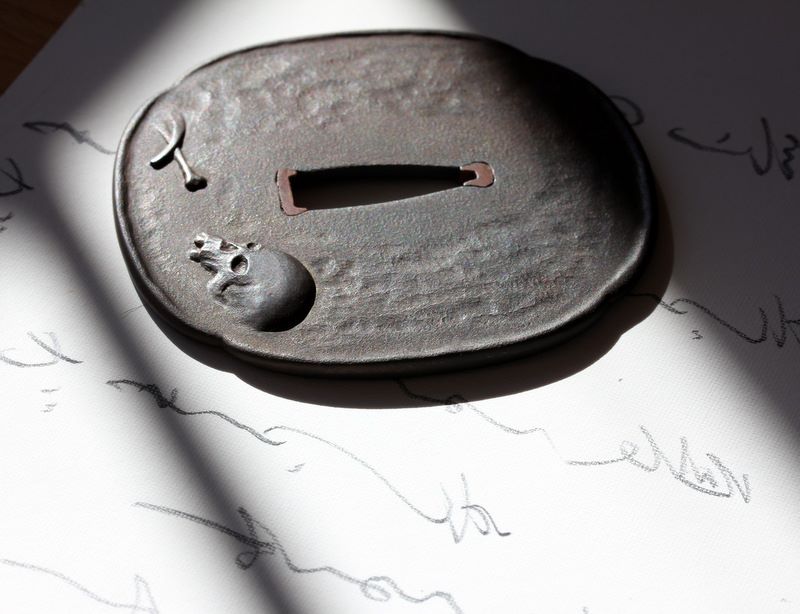
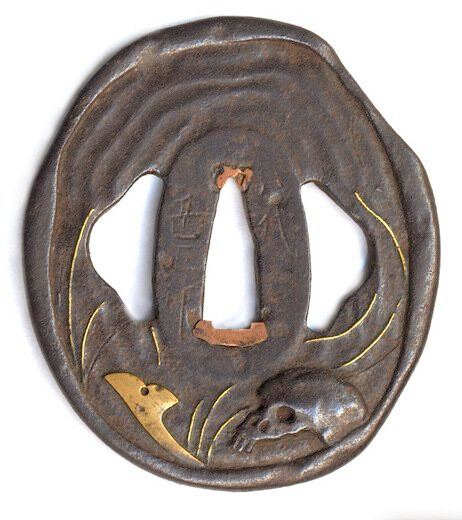
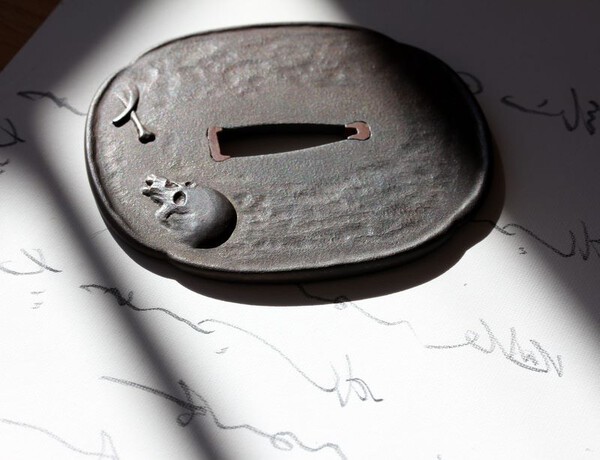
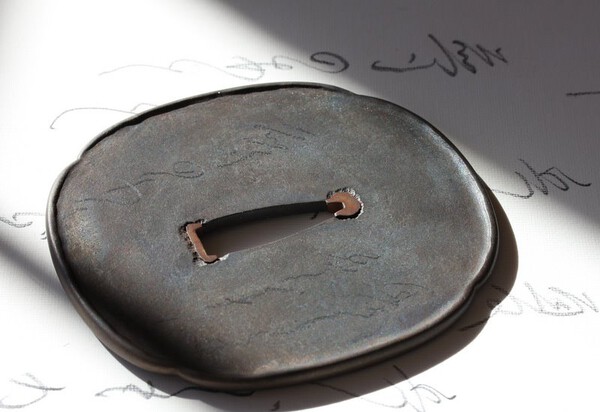
This is one of my favourite versions of this motif. Shimizu Jingu IV, if memory serves. And it's interesting that Malcolm cites the Basho haiku he does...I'm actually busy at the moment inlaying it on a tsuba, the other side bearing my own interpretation on the 'skull and bones' theme. Very much still a work in progress.
-
Cheers Brian, I also appreciated the responses. Next time I may have to be more devious though On a serious note though, I do think this is a good way to learn how to really see old and new. And to always be on your guard
-
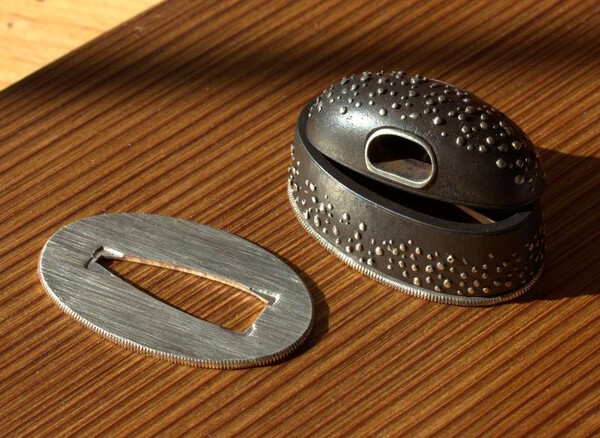
you mean this...? I believe the originals used real toad skin but animal rights activists have put a stop to that now. So I had to figure out how to do it just with metal, I'd have preferred real toad skin though
-
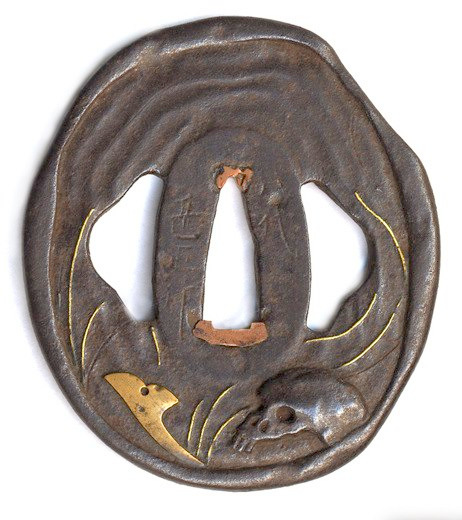
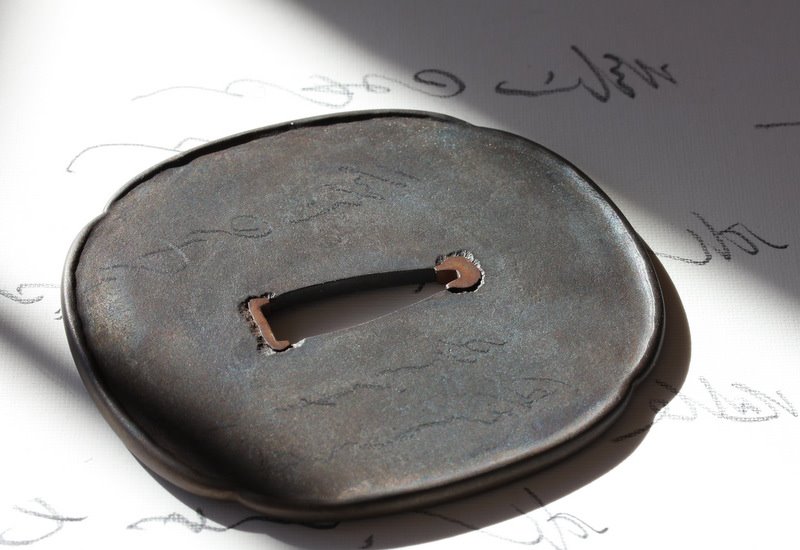
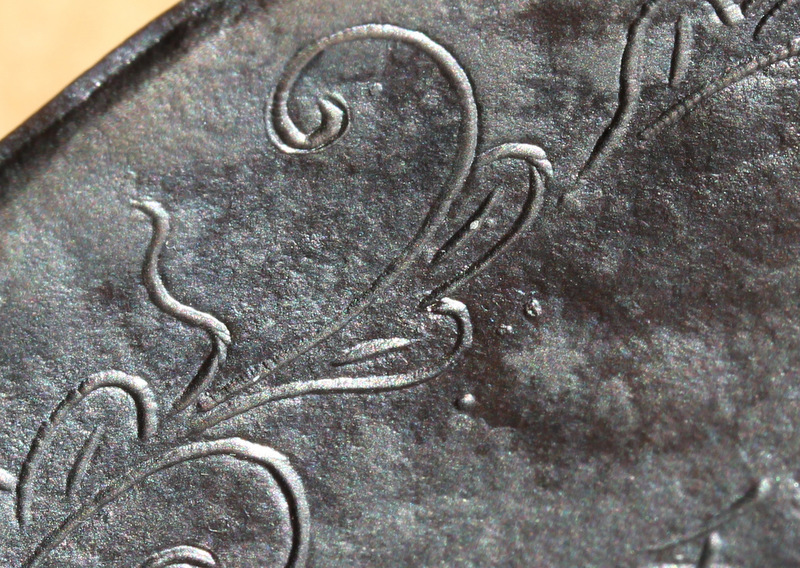
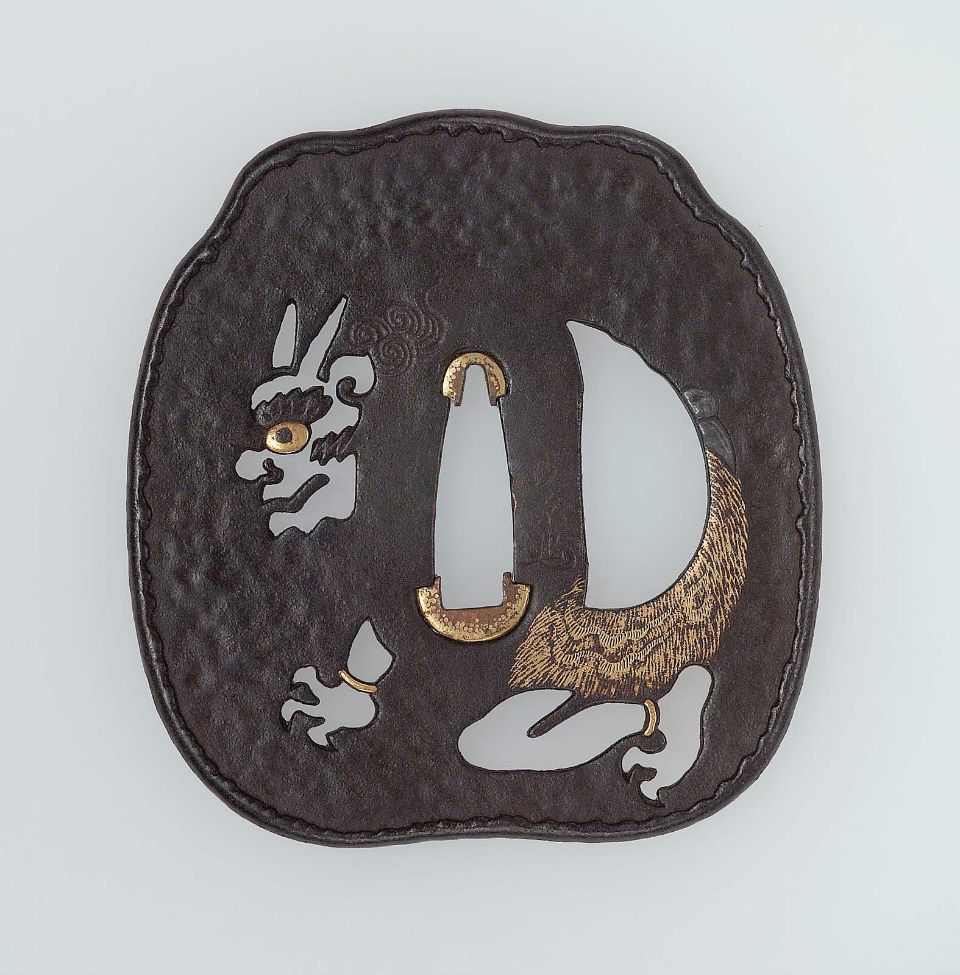
Ok, time for me to come clean. This is, as some suspected, a work by myself. I was very flattered by the various calls for Naruki Issei, a man who I greatly respect and admire, (thanks Pete ) and the other late Edo makers also. This piece wasn't actually conceived as an utsushi in the usual sense of the term, rather I used it to explore and experiment with various effects and features to be found on Nobuie type works. Obviously the shaping of the mimi was something that I was keen to work though, it's the only way to develop a proper understanding of the methods the original makers may have employed. In this case I worked the steel cold, making the job harder as the metal is thickened only slightly and quite close to the edge as opposed to working hot (red) where the displacement of metal will invariably extend deeper into the plate giving a softer and fuller effect. I think working cold is most likely what they did, perhaps with initial preforming of indented notches while hot, just to get the depth and thickness. The surface texture is the other major aspect I've been working on. The usual description is 'yaki-shitate', suggesting that it was melted. I've never felt that the term was actually technically literal, for various practical reasons, but rather that it is a label that merely describes the appearance and not method. Chances are the term was invented by a collector and didn't come from a workshop anyway. Having said that it seems clear to me that the softened and gently 'weathered' appearance of Nobuie style tsuba is achieved by some process of heat oxidation and controlled erosion/corrosion. What I am doing is using the forge's heat, combined with a clay slurry (with a secret blend of herbs and spices) to 'age' and modify the steel surface. The decoration I applied was chosen so that I could study the effect of my developing process on these types of surface decoration. The giri-bori scrollwork when fresh has a very sharp displaced edge but on older examples we note this is very pleasingly softened. I'm satisfied that repeated applications of my method will yield an appropriate look also. At the moment I'm using 3 or 4 cycles but perhaps a little patience is in order and I could try 6 or 6 times to get a really aged effect. The reverse, with the flower pattern, was very rapidly carved and left in a fairly rough state with only the lightest scraping to take away sharp edges. As can be seen the 'aging/weathering' process has rendered that side quite convincingly to a soft stone-like texture. For me that is a very pleasing result. The patina is also a process in development and I'll probably use other preparatory process next time to further 'open up' the steel surface. I'd like to point out that I don't, nor will I ever, deliberately try to make pieces intended to deceive as to their origin. In this case there are a few point, which have been picked up on by the eagle eyed among you :D , that mark this as a modern work. The uncharacteristic handling of the carving of the flowers was an obvious one (the usual approach would have been a simply geri-bori outline, John's call on Kamakura bori was in fact quite accurate as that was part of my thinking as I did it.) and the rather clan appearance of the seki-gane. I would caution, however, against rely too much on seki-gane. They are actually the easiest aspect to fake and make look really old. So if that was the warning signal for you please consider checking more closely other aspects of pieces your examining because a sneaky faker may catch you up on that point. In fact, next time I may be tempted myself I attach a few more close up images for your examination. Thanks for indulging me and for your considered input. And thanks to Henry for colluding with me me in this challenge.


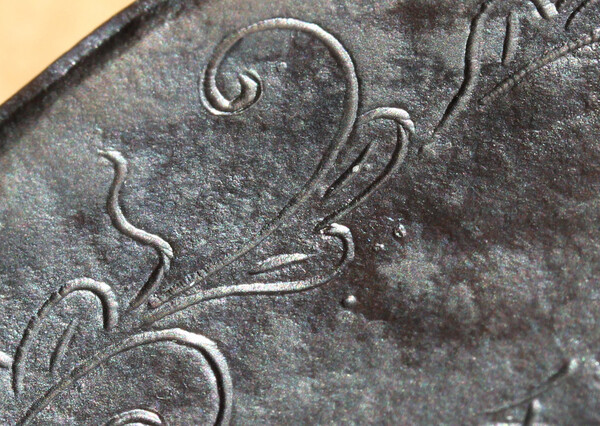


-
Adrian well we'd expect it to be much better This is Tanaka Kiyotoshi, the most celebrated artist from this school and the teacher of the maker of the discussion tsuba. It's probably safe to call this one a masterpiece, but it's very important to recognise that not every piece made by a BIG name is necessarily a masterpiece. I would hazard a guess and suggest that were this tsuba available on the open market it might fetch $50 000...or more. I would add, though, that while this Kiyotoshi is a far better composition the workmanship is not that much finer really, imo.
-
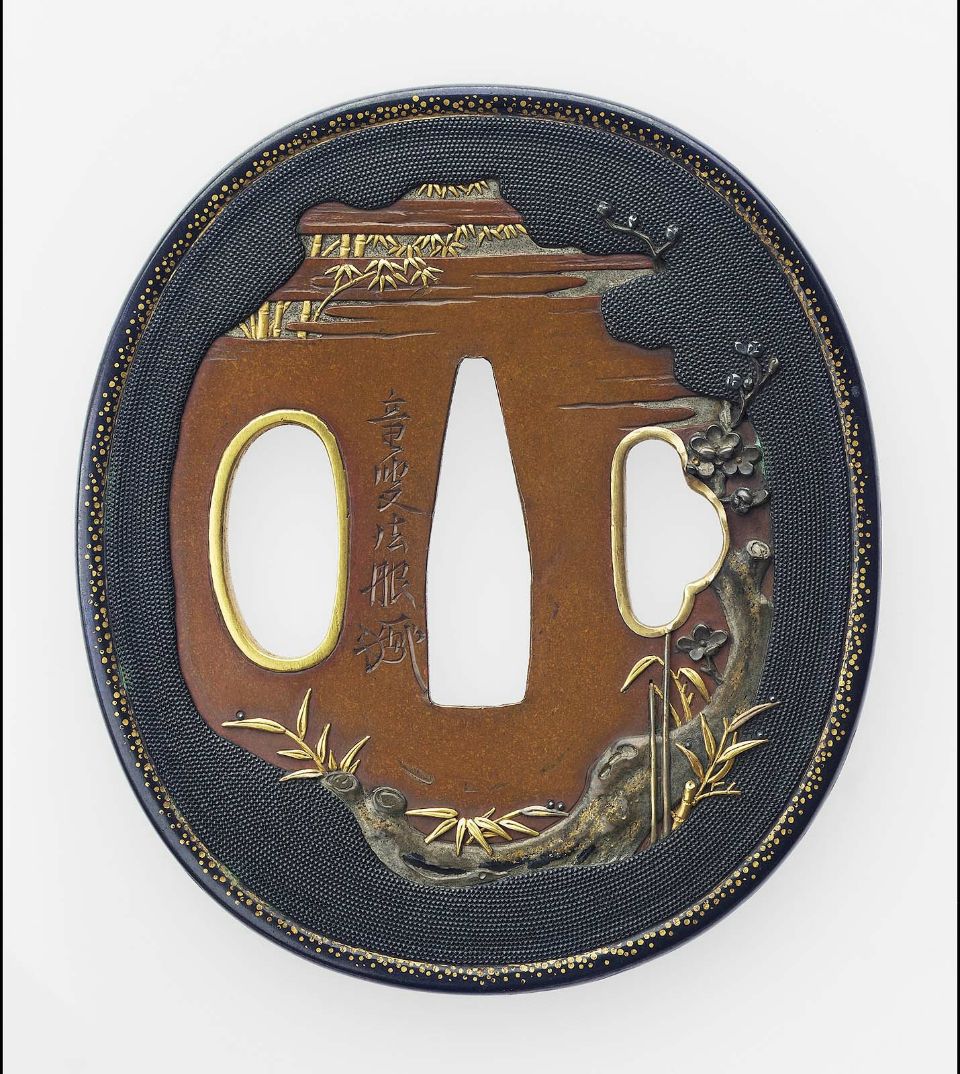
Brian it's simply carved to look like that. If you examine the rims of the examples I posted you'll see a few variations of the same feature. As I explained to Pete; I would also point out, in case some missed it, that the brass/shinchu ground is in fact quite extensively and subtly textured. There's more variation around the base of the tree and other plants and stream as well as texture used to enhance the 'shading' around the edges of the clouds. Examining the tree you'll notice 2 tones of gold in foliage and very fine modelling of the bark. Similarly the stream is very delicately carved, and inlaid in silver, with the rock also having pale gold touches to the shibuichi and a different gold used to pick out the leaves and growths. I suppose I might add now that the other important aspect of judging quality, apart from knowing a particular school or artists traits etc. , is to learn to really see what's in front of us. It takes time and a very good visual memory of relevant work to begin to accurately 'read' this sort of metalwork. It might be trite to say; 'the more you look the more you see' but it happens to be absolutely true :D
-
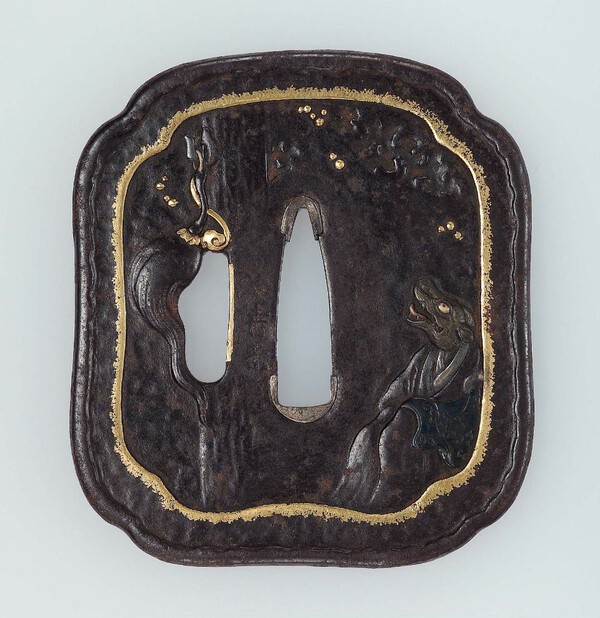
Pete this type of frame, with nunome-zogan 'nashiji' and an incised outermost edge, is a fairly standard feature of the Tanaka school, Tanaka Kiyotoshi (this tsuba's maker's teacher) in particular. I don't think there's any need to speculate about the possibility of the fine edge being a later addition when it's quite common on Tanaka work. This also highlights the shortcomings of critiquing a work without having a good grasp of the schools traits and style. Kevin provided a decent analysis but it didn't take into account the fact that this style is fairly common in the Tanaka school oeuvre. A very elaborate frame with an irregular inner edge etc. and a design/composition simply made of of a few finely rendered elements. Not so much a painting more of a shorthand image intended to evoke a specific mood. This particular style is expected to be 'flat'. Consider woodblock prints and how they differ from say, Chinese landscape painting. It would be an error to judge either by the accepted 'rules' of the other. Compositionally it is exactly what I would expect from a student of Kiyotoshi. Personally I find it to be a carefully crafted piece and with a lot of fine detail that is easily overlooked. It's critical to put aside one's own personal preferences when trying to asses the relative qualities of work like this and knowing what traits and features to look for is a start towards objectivity. Here are 2 classic examples of Tanaka Kiyotoshi's work for comparison as well as one by Morikawa Toshikage, a leading student of the school. I've borrowed these images from the MFA Boston's excellent on-line collection.



-
Pete, you surprise me.... :? What we're looking at isn't a fukurin at all. In fact this is a fairly characteristic feature of Tanaka school work. The steel rim is actually solid (and an original and major part of the tsuba) , the brass/shinchu may be either inset plates or a separate solid inset plate. Examining the nakago ana would resolve that issue. The rust on the rim is not really serious and in the hands of a competent restorer is not a matter for concern. The craftsmanship is well above average but certainly not worthy of the 'masterpiece' label. Having said that I think this is a pretty decent example of Tanaka School work. Aesthetically speaking it is fairly typical, the only real criticism I might offer is the 'heaviness' in the way the deer is rendered. Apart from that I think it's a fine piece of work. Every other detail is very well carved and finished. I say this trying to be objective and keeping my own preference or tastes out of my considerations....after all, who cares what I like As to the price, it's ultimately worth what someone pays for it. :D At $5000 you can't get it replicated today...
-
Steve, Henry, George etal... Isn't this lovely? We must be getting old...or something. We'll be having group hugs next :D It's all good stuff though. One point I'd love to see some more reliable material on is the whole matter of the first 2 Nobuie being asked to work for Takeda Harunobu in Koshiu. The story (apparently from the Soken Kisho 1781 and reported in Helen Gunsalus' catalogue, after H. Joli ) tells us that Nobuie originally used the name Yasuiye until he was reward for his abilities by Takeda Harunobu and given the 'Nobu' character to use in his mei. He is supposed also to have signed Sakon no Shokan, Osumi no Kami, Iyeyasu, Rakui, Koshu Myochin, Ujiiye and Gakui although what we're to make of all those I can't say Nobuie I had a son named Ujiiye and signing Nobuie from around 1550. He apparently also signed Shichirodayu and Iyeyoshi. A second son, Sadaiye (1513 - 74) is called the 18th Myochin. He lived, allegedly, at Odawara and later in Iga. He was also called Matahachiro and Heiroku. Is there any actual material evidence for any of this or are we looking, again, at fokelore? Masayuki Sasano offers, what to me seems to me, the most sober account; "He is an elusive figure...(he then goes on to discount the armour maker/Myochin connection) ...and continues; The maker of swordguards Nobuie used seven different ways of writing his signatures and a number of widely differing guard styles as well. There is no reason to wonder that over a long lifetime a man might change the way he writes his name, but seven different ways seems excessive. Possibly, then, among the guards that pass as Nobuie there are designs by his students and by later men with the same name, as well as a certain number of copies and fakes. This would account for the variety of signatures." He then goes on to suggest that we need to establish standards by which to identify the genuine work of the first master. Unfortunately what he offers is not much help, being terribly subjective. " First, works that are true Nobuie will impress the viewer with the dignity and assurance inherent in designs from the hands of a master. Second, they will never give the impression of being imitations by second-generation workmen or students, but will instead have the excellence and sense of historical period found only in true Nobuie guards." In a nutshell, they'll look awesome and just what you'd expect from a real master....whatever you imagine that to be.
-
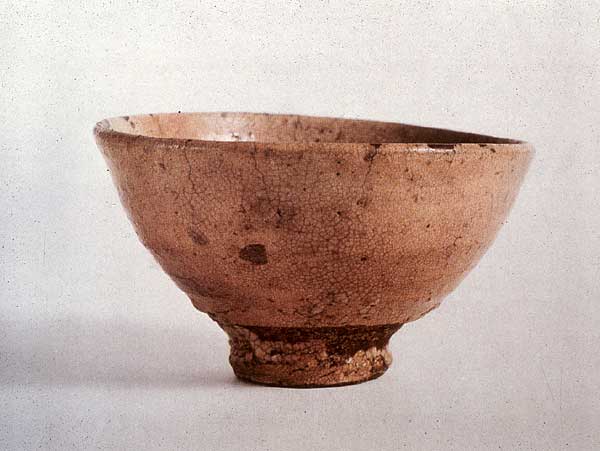
Hi Steve let me start by saying how nice it is to be able to explore these ideas with you. The whole Nobuie topic has long perplexed and bothered me so it's a relief of sorts to finally be able to expound on some of my own, and your's too it seems, misgivings. To clarify and elaborate on my suggestion of 'efficient production'; what I'm getting at here is the very uncontrived, almost natural expression the finest Nobuie tsuba seem to exhibit. We accept without complaint that this, the most exalted form of aesthetic in tea philosophy, is the result of unconscious and repetitive work by unknown peasant potters. In fact the very attempt to consciously produce this sort of aesthetic is regarded as false. The most highly regarded tea bowl in Japan, the Kizaemon Chawan, was made by an unknown Korean potter and most likely as part of a batch of dozens or more rice bowls. It is from this point of view I regard the most appealing Nobuie works and consider their manufacture. Then, thinking about later attempts to emulate the same feeling, and how they reveal their self-consciousness, I am forced to conclude that the way they were made is fundamentally different. I refer to the mind-set of the maker not so much the actual physical processes although they are also, I believe, fairly significant. When I speak of refinement in this respect I don't mean the makers of fine Nobuie were not careful or considered in their work merely that I don't feel they were overly fastidious. They simply made good, honest guards...and occasionally one was bloody brilliant. In the same way that on rare occasions, among hundreds of tea bowl thrown by a potter, almost in a state of 'no-mind', something unique came together to produce a bowl that would later be 'recognised' by a real connoisseur as something very special. Perhaps the mei, Nobuie, gets in the way of us more objectively examining and evaluating this group of work and better 'recognising' the best of the bunch. As for your Nobunaga hypothesis, I absolutely love it :D If I was a less critical or analytical man I'd happily embrace it right now. I actually think, in all seriousness, that the notion may well hold some water. Some actual physical evidence to validate the connection would be delicious. best, Ford

-
Hi Steve logically inconsistent? me....never. Maybe, but that's 'cos I'm an artist and can entertain conflicting ideas at the same time. And I was only half serious about the variations in the mei but serious enough to make my point I trust. Yes mei change over time, no doubt, so then lets try and establish a timeline and explain these gradual changes. Unless, of course, they are too random to suggest a real demonstrative connection or 'familial traits' I made reference to Sato's notion of makers being all over the place, yes, but this doesn't exclude the possibility (one I lean towards) of a core group who may be regarded as the 'real deal' and who work is generally regarded as the better class of 'Nobuie'. I didn't establish the classification of Nobuie mei into two basic types and my rejection of the notion is completely consistent with my observation regarding the significant variations we find....personal evolution of mei accepted, I still don't see any overwhelming evidence in terms of writing style to suggest the same hand, quite the opposite in many cases, actually. And this convenient sifting into 2 discernible groups (according to criteria I've already implied I regard as fallible) may well sift out finer into even more groups if we look more closely....so where does that leave us? But that may be a matter of subjective observation and interpretation so I wouldn't be able to suggest a resolution to that matter. No. it doesn't seem to be a given...it seems to me the claim of a genuine Nobuie mei is enough to validate it's value in far too many cases, especially when offered for sale. Anyway, I'm not trying to build a thesis merely trying to demonstrate that what is often taken as fact is not much more than speculation based on no solid evidence. regards, Ford
-
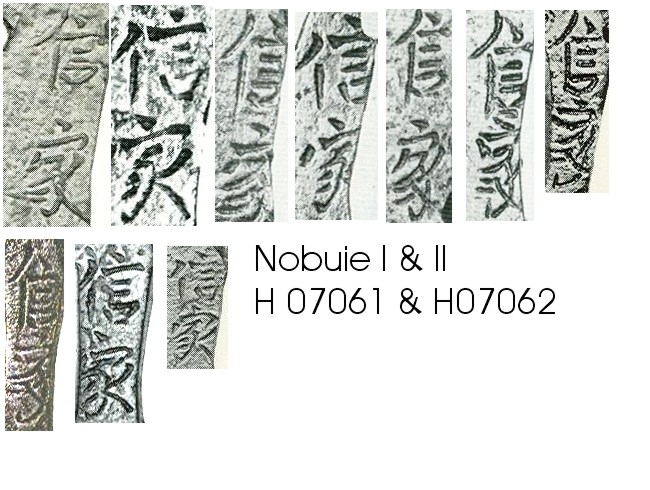
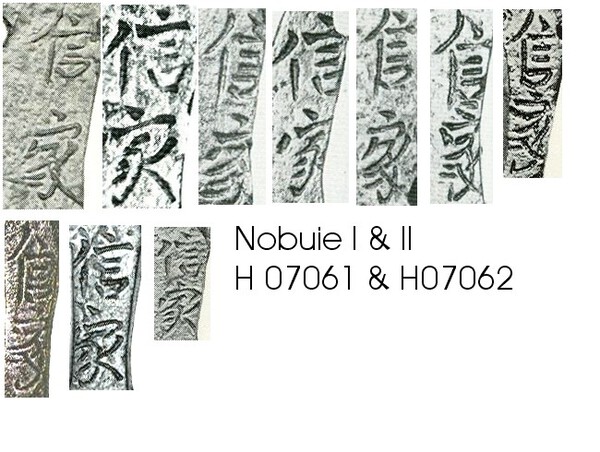
I've followed this discussing with interest and rising amusement. :D What strikes me as glaringly obvious is the following. Examining the mei as provided by Steven and selected by Haynes it is self evident that Nobuie I is actually 7 different people and Nobuie II, in this instance, at least 3 different men. It seems somewhat arbitrary to be nitpicking variations on Henry's tsuba when this sample group doesn't contain 2 mei that could be regarded as the same either. And who decided which mei, hanare or futoji, indicated shodai and which nidai ? There are no dates nor other literary data that would allow anyone to make that call. This is simply an accepted convention without any real evidence to back it up. Is there even enough reason in the tsuba themselves to support the idea that there were essentially only 2 'real' Nobuie ( I and II ) tsuba-shi...or has the vague split of mei type (hanare and futoji) provided a false impression of the numbers of actual makers we're looking at? To be clear, I don't think there were only 2 BIG name Nobuie at the start. I think there were more likely a group of them working under that name. I think, further, that once we look afresh at the only evidence we have, the tsuba themselves, we may begin to discern far more distinct traits that may point to a larger group of individuals all working at the same time. And while I'm here I'd like to point out that the mei 'Nobuie' ( sincerity/fidelity house/studio) isn't even a real art name. It, like 'Kaneie' (metal house/studio) , appears to me to be a studio or 'brand' name. And these are the first tsuba to bear any makers mark so no precedent had yet been set in this respect. The kanji Ie means house, as in Iebori - house carvers. The Goto, for example to the Tokugawa. As Kanzan Sato suggests this "signature probably represents a group of individuals working in several provinces rather than a single individual". I'd suggest the wide variation in the 2 rough groupings of mei style would support that notion. As far as production I'd posit that the processes used were actually not as refined as many like to imagine. I think these tsuba were actually made fairly efficiently and quickly. They were all clearly skilled workers but variations in quality is always to be expected in a studio set up, or co-operative village even, that's geared to a degree of mass-production. I would further suggest that these tsuba were initially quite humble artefacts and were only later 'recognised' as expressing the much admired and revered tea ceremony aesthetic in much the same way as many anonymous tea bowls were. Returning to the issue of the mei, I think it a mistake to focus on this aspect because I doubt very much the makers back then were all that concerned with individuality nor did they consider that in centuries to come the authenticity of their work would rest on such an irrelevant mark. It may also be worth considering that many of these men may well have been illiterate, we know many swordsmiths were at the time, and merely copied blindly a sample mark. If these tsuba have any significant aesthetic value then it lies in the workmanship and not in the minutia of mei construction. Anyway, just a few 'alternative' thoughts to challenge a growing orthodoxy I personally find a bit tenuous. It might be worth remembering the words of Shoji Hamada, the first National Living Treasure potter, when asked why he never signed his work; "in the future my poor work will be ascribed to my students and followers while their good, also unsigned work, may be credited to me" . We don't know how serious he was either
-

New member need help with books
Ford Hallam replied to Marc's topic in General Nihonto Related Discussion
Paul, ok, so if you have concerns about other controversial theories presented in the book perhaps you should point them out...failing to do so leaves your 'concern' undefined and therefore still unfair. If you don't have the energy to explain why you feel as you do about the book you're expecting the OP to simply accept your opinion based on what...? No lengthy debate required, just a simple piece of rationale would suffice. And to be frank I really can't find any other point that you might feel is so controversial...hence my assumption. I accept I may well be wrong and you can end our confusion by simply pointing out exactly what bits are of concern...and why. Jean, of course this book is specialised and technical....anything after Yumoto Sensei's book has to be. It's the nature of the subject. -
New member need help with books
Ford Hallam replied to Marc's topic in General Nihonto Related Discussion
Paul, I've just spent a few hours going through 'Facts & Fundamentals of Japanese Swords (Nobuo Nakahara)' and I think that it is actually a very good introductory text. The only real 'controversy' would be the matter of mumei blades. This covers about 2 pages and with about a further page of explanatory commentary from Paul Martin (the translator) The matter is perfectly well described and intelligent rationale supplied. To suggest that because of this one touchy aspect the wealth of really useful information in the rest of the book should be approached with caution is to do the book a great disservice. Far better, I feel, to merely highlight your disagreement with that aspect and perhaps offer some rationale as to why to disagree. To leave it at ; " I think it does raise some controversial ideas which contradict some more traditional concepts." casts doubt on the work without bothering to show where and how. That's not a critique, it's unfair. -
New member need help with books
Ford Hallam replied to Marc's topic in General Nihonto Related Discussion
Hi Paul, can't say I read any such hyperbolic endorsements myself...I was rather of the opinion that book burning parties were being arranged in certain circles I'm actually meeting with Paul in Tokyo next week to discuss exactly this issue...among others :D I just feel that as original and well researched/considered material is so hard to come by in English Paul Martin and other translators efforts in that respect ought to be more generously supported. I think radical theories have value even if they are wrong. What they do is force a re-examination of what we think we know and take for granted. But the truth is nothing really changes as a result of reasoned argument and debate. Old ideas are only replaced when those who are invested in them die out and a new generation, familiar with new ideas, replaces them. I think it was Niels Bohr who said that. And of course just because something is traditionally held to be true doesn't negate it but neither does it automatically validate it....all I'm saying is that we ought to think about things even-handedly and objectively. -
New member need help with books
Ford Hallam replied to Marc's topic in General Nihonto Related Discussion
'a sausage of caution' :D I love these obscure Old English expressions, so colourful! And while I appreciate Paul's concerns over "Facts and fundenmentals" it might be more useful for those theories that are controversial to be pointed out rather than suggesting avoiding the entirety of the book. I actually don't agree that one ought first to be grounded in the 'majority view' at all. I think theories should be more properly understood on their own merits and not simply be accepted because that's what everyone else believes. There's a truism that may apply here; "if every one thinks the same thing then perhaps only one person is doing the thinking" This also reminds me of a young woman I was speaking with a little while ago. On the subject of faith she offered; "I'm so lucky to have been raised a Christian because now I am free to choose what I believe" -
They look like cast brass to me. And brass is a relatively cheap alloy....with a copper base. So both David and Mariusz are right...in a roundabout way :D I'd estimate these cast fakes to be under 200 grams in weight so the brass cost them less than $1.40 (they would have used scrap metal). To sell as these fakes as scrap brass I'd suggest collecting at least 5 and then you'd get about $1.50 from your local scrap metal dealer.
-
It's not in the edition of the Natsuo Taikan I have... And you don't have the rest of the mounts by Yasuchika...pity
-
the deer is signified by the antlers... roku is the 'On' reading of Shika 鹿 - deer hou is the 'on' reading for hachi 蜂 - bee, hornet or wasp 俸禄 or 俸祿 / houroku : retainer's stipend; official pay; salary