Ford Hallam
-
Posts
3,091 -
Joined
-
Days Won
78
Content Type
Profiles
Forums
Events
Store
Downloads
Gallery
Everything posted by Ford Hallam
-
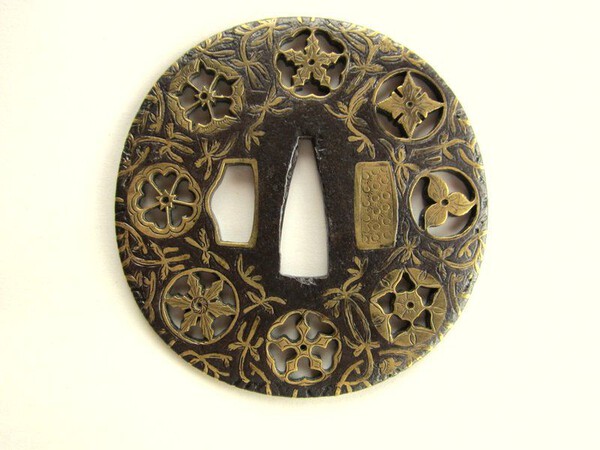
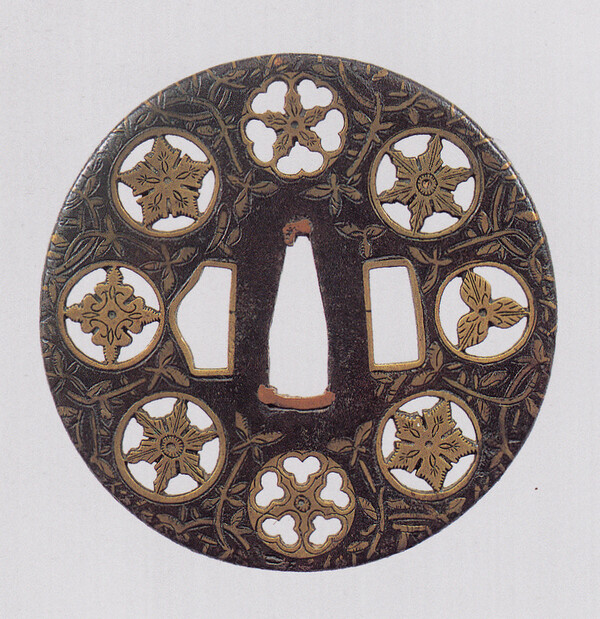
Gentlemen, for your consideration. Bernard's tsuba and a similar example from the Sano Art Museum. They describe it as Yoshiro, 17th century. I think we need to allow for differences in colour and tone due to print quality and lighting but I would suggest the workmanship is essentially identical. If not actually made by the same man then at least there would seem to a likelihood they were made in the same street in the same decade.
-
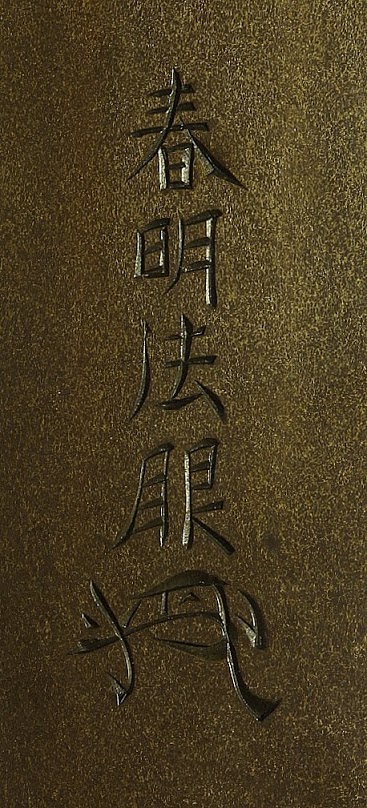
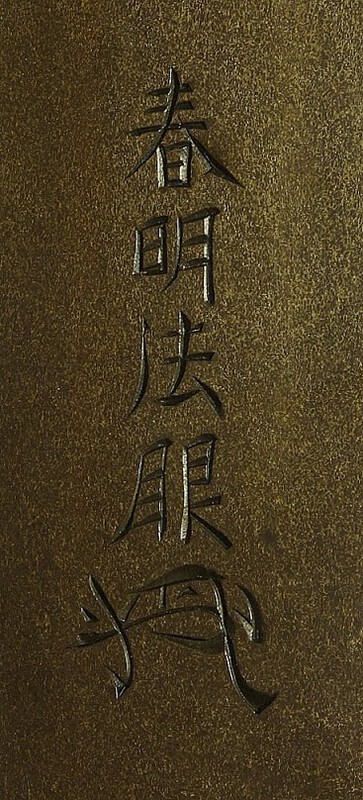
the kozuka is 'signed' with the mei of Haruaki Hogen. Given that he's one of the 'greats' we only need to asses the workmanship to validate the piece and signature. imo this is a pretty average work. To be blunt, I am saddened that collectors are not even able to 'read' or recognise the names of the most famous artists of this tradition. This suggests to me a deplorable lack of useful information to educate newcomers to the subject. I believe this piece was recently sold by Klefisch in Germany. for reference here's a Haruaki Hogen mei from a superb piece of work;
-
As a matter of fact dragonflies do fly backwards, they're quite possibly the most agile fliers in the insect world, they can even fly upside down and perform an Immelmann turn. There you go, another unexamined myth busted and I only learned this recently myself. Perhaps they were admired by swordsmen because of their agility and speed, which makes more practical sense to me.
-
Stephen, and how, exactly, would that photo be of interest to anyone other than with respect to the situation presented?. The sword itself is merely a prop.... And this is not about politics ( to suggest so is merely dishonest) nor is it about patriotism. What would that poor child know of either? Frankly I'm appalled that you'd even bring contemporary military and nationalistic issues into this discussion....have we learned nothing? "Those who cannot remember the past are condemned to repeat it." George Santayana
-
Brian, so you hear an opinion you don't like so you propose locking the thread.....revealing. Steven, there is no discussion on the sword....the photo is of a boy holding a sword that none of us can really guess at..... what is there to talk about? Only the photo itself and what it portrays and represents.
-
In my opinion, while the child may well have felt proud at the time (being oblivious of reality and completely brainwashed) the photo itself does portray something profoundly tragic. There is absolutely nothing glorious or noble about teaching children to honour war, especially expansionist war.
-
It's not about the kokuza fellas...it's about a piece of carved calligraphy by possibly the most skilled and artistic metal artist ever. I very much doubt Natsuo himself would have stooped to make a trifling Kozuka blade.
-
Hmmm, Aokakamae.
-
Hi Peter the tsuba body is a 'mechanical damascus' laminate and the rim simply pure iron. Hard to say how many annealings, it all depends on how much you move the steel and how well it's behaving. I anneal when I feel it needs it. If you consider the initial starting point of the lip and how, when it;s finally in place the actual circumference is about 2 cm smaller that metal had to be forced back into itself to allow the contraction to happen. I only needed to raise one side, cut out the unwanted centre of the plate, pop the tsuba in and work the raised edge down. Simples :-)
-
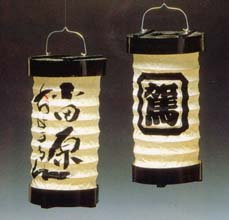
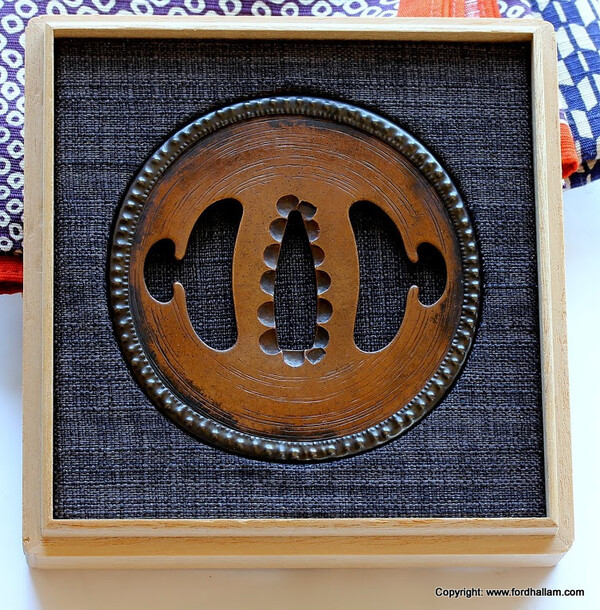
And for the sake of completeness here's an example of a classic Odawara fukurin as often seen on Hitata Hikozo tsuba. The fitting is essentially the same as the previous version with the difference being the dimples have to be punched into the strip of metal before it's soldered into a ring and obviously before it's fitted. :D The trick is not to flatten the dimples, imo, many older versions, as well as modern copies, seem to have been dented or crushed bumps. Incidentally, the name Odawara fukurin refers to the paper lanterns, Odawara-jochin, a style of chochin (paper lantern) specific to Odawara City.


-
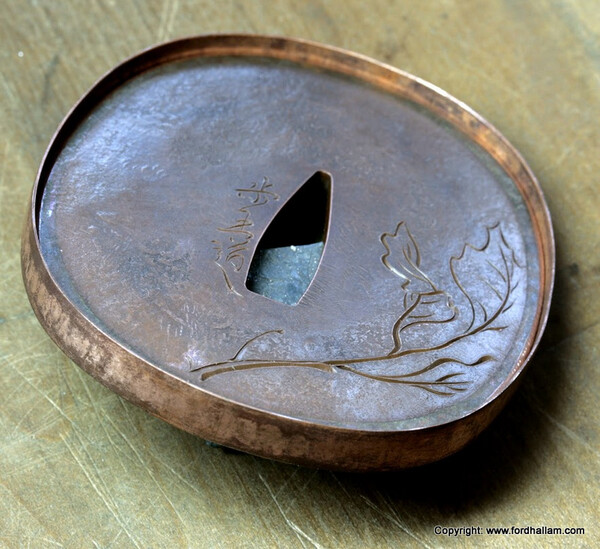
By contrast fitting a soft-metal fukurin is far easier. Most, if not all are made from a strip of metal (shakudo, copper, silver etc.) and will have a fine silver solder seam somewhere, typically at the bottom. Here's a link to a sequence of images that illustrate the fitting of such a fukurin, this one a yamagane based shakudo.


-
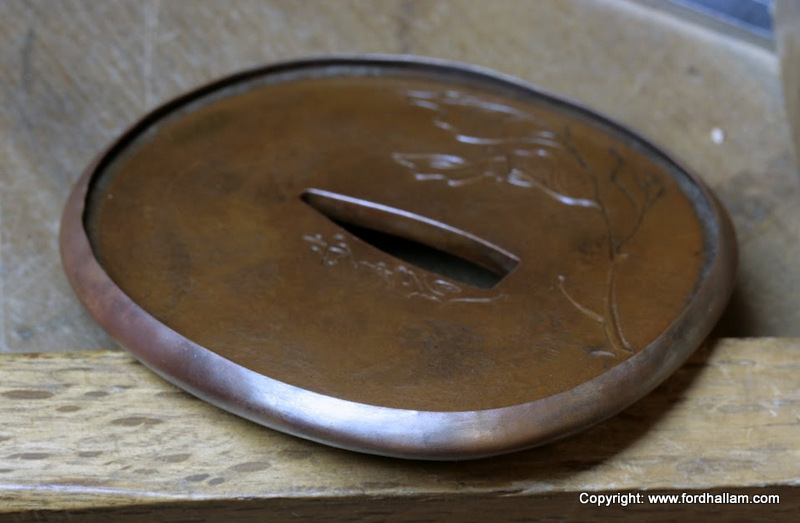
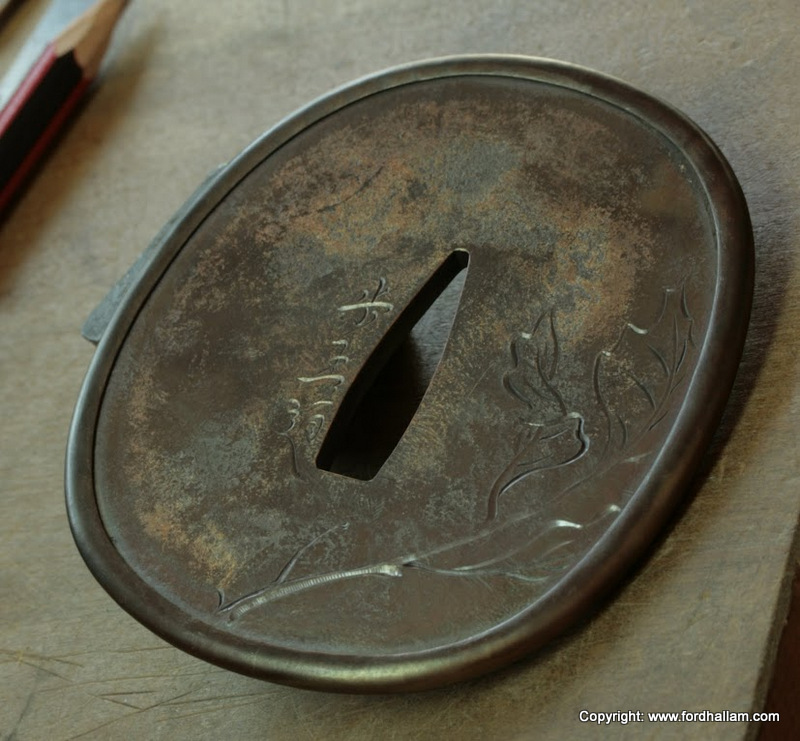
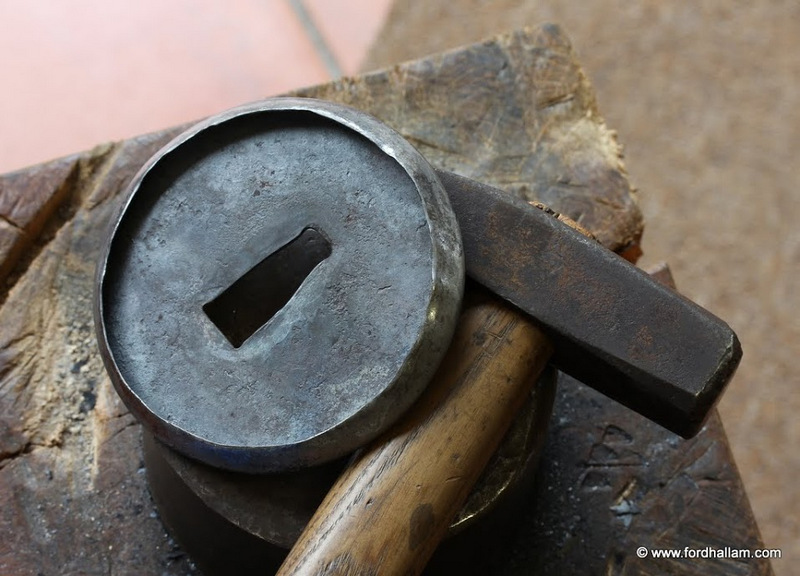
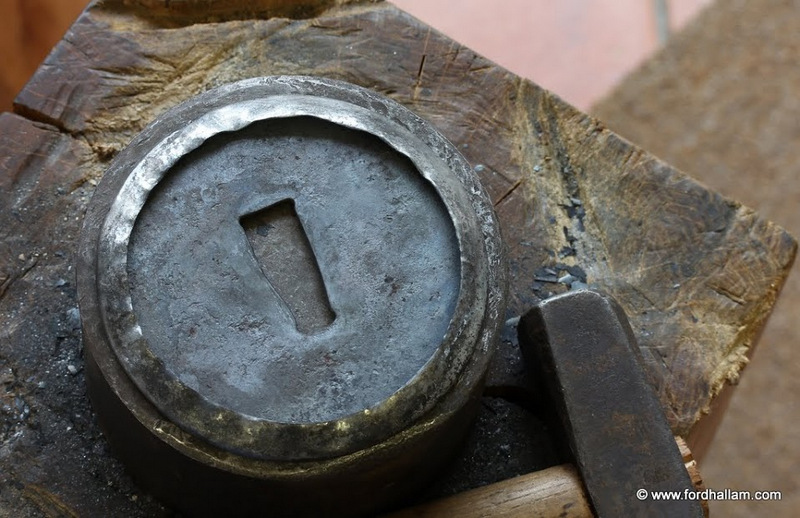
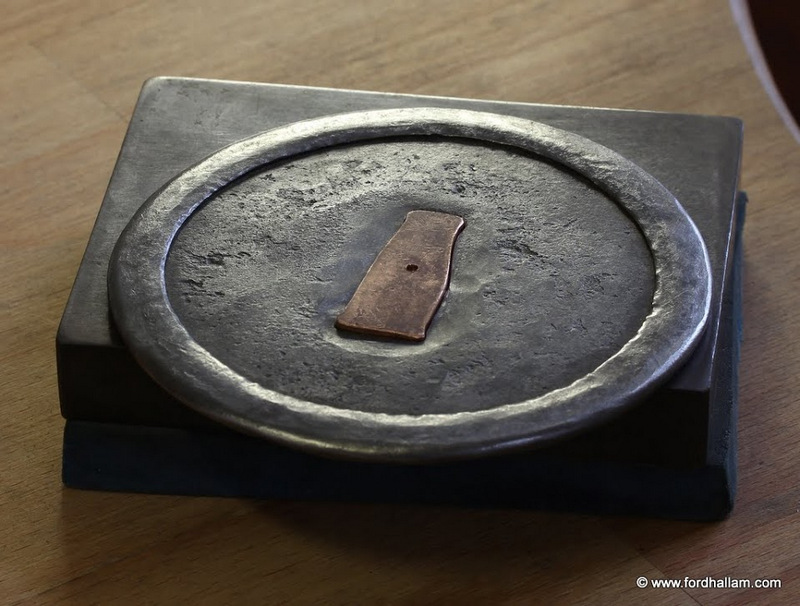
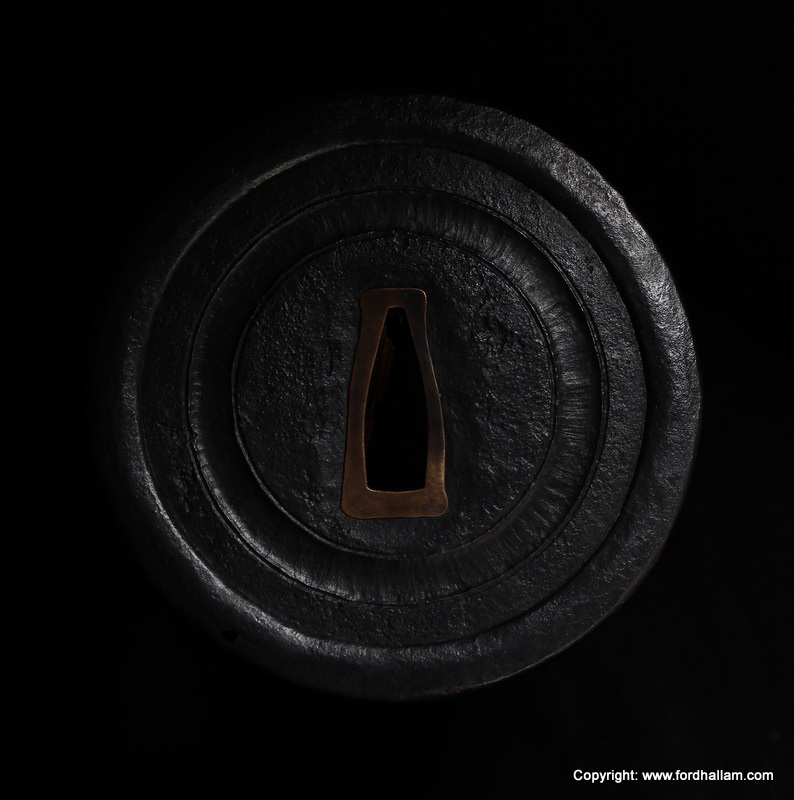
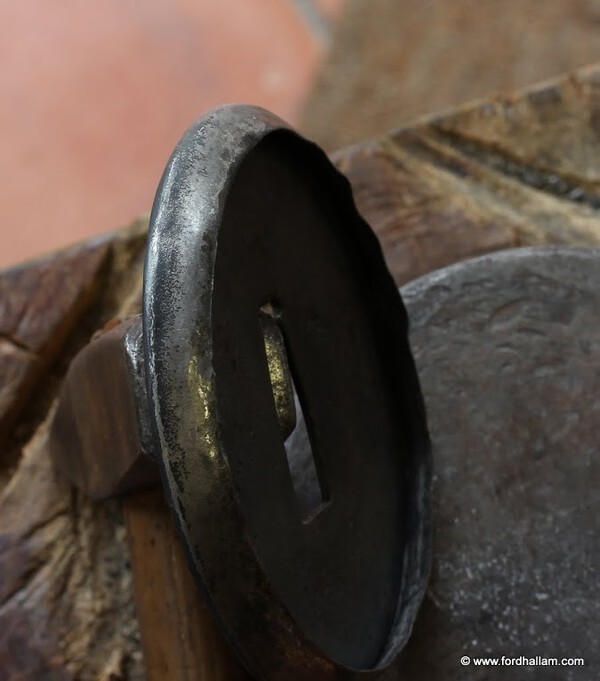
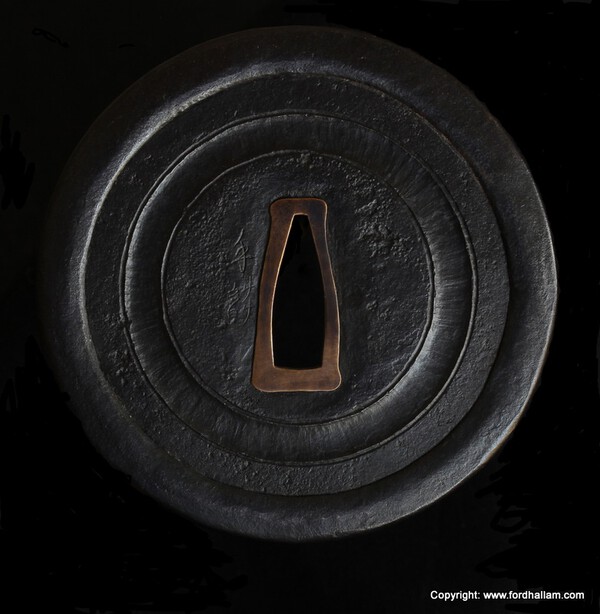
I started with a disc of steel and raised a rim that would allow the tsuba to fit tightly inside. At that stage it looks like a shallow dish with the tsuba sitting inside. I then cut out the base of the 'dish' to leave a frame. From then it's fairly simply to fold the lip over and to close it up tightly on the tsuba's edge. Actually it's not a simple matter at all :lol: It takes a lot of control and care to ensure everything stays even and the steel doesn't wrinkle as it's hammered over ( in the air) and the rim is forced to contract into itself. I have no idea how this works. I think it's magic



-
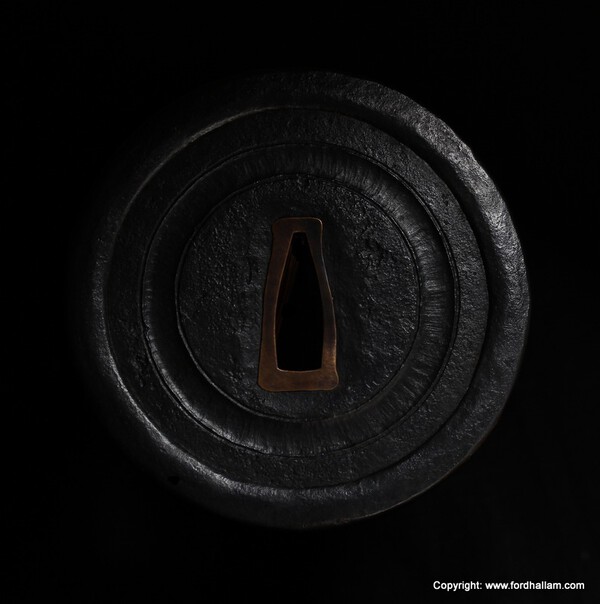
This is a piece I made a short while ago for a friend and client in Belgium. I thought the images I took of it's making, especially the fitting of the mimi, might be of interest and educational. It's a fairly large tsuba, 94mm in diameter but still quite light despite it's imposing appearance. I think it weighed about 120 grams in all. This is the second such steel one piece mimi I've fitted to a tsuba and to my knowledge this hasn't been done in Japan for a very long time, certainly no-one today is doing this sort of thing. If you're interested you can see a sort of photo essay of the making of the piece here.

-
Cheers Pete, yup, life seen through the lens of the tsuba This was actually a pic taken by a fellow who did an interview and a 'sort of' photo essay on me and my work a little while ago. His idea but I think it's sorta cool, gotta work with what ya got.
-

Hirata II tsuba (cloisonné on iron) - LARGE PICS WARNING
Ford Hallam replied to Gabriel L's topic in Tosogu
I have say I agree with Guido, I do on most issues (it makes life so much easier that way ) but the point about the relative coarseness of the enamel is well made. This is a technical matter relating to the preparation of the powdered enamel before actual firing in my opinion and having done quite a bit of enamelling myself. -
Piers, Yes, the fuchi it came out of was probably shibuichi The linings themselves are of fine silver except for the pink one, which is shibuichi. The other kanji reads 'uchi' or inside...which seems pretty obvious :D
-
Mark and Lance are spot on :D And yes, they way they were assembled, with the fitting 'glued' in place with hot pitch, means that most fuchi/kashira can be safely recovered. Lance, it was actually that image that a friend posted on facebook and which prompted me to dig these bits out of my scrap box. This sort of refashioning was done in Japan as evidenced by the kanji scratched on the inner linings and the fact that one of the pieces is actually shibuichi (the pink one)
-
Jean C has the right sort of size in mind....
-
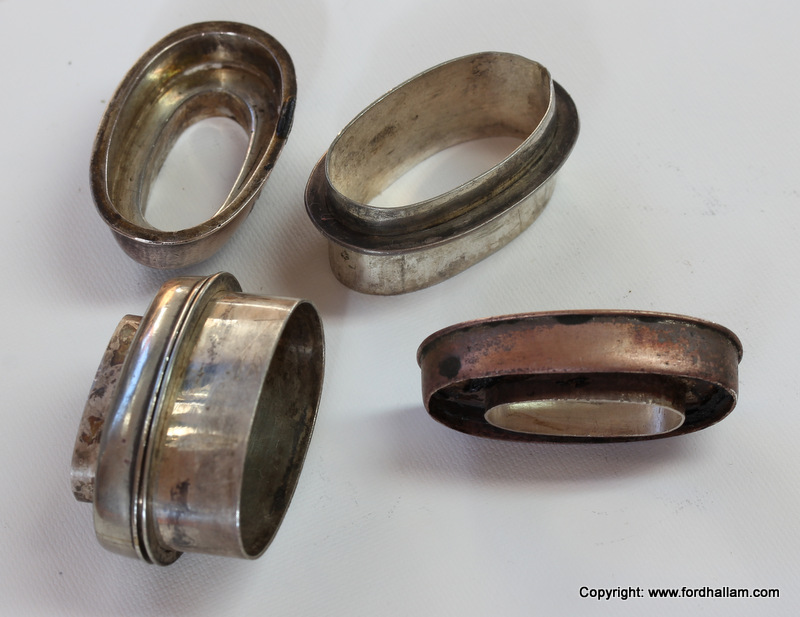
I suspect some of the members who've been in the antiques game for a few years may have seen these before and if you're a friend of mine of facebook you're not allowed to comment ... So, what are these used for in relation to tosogu?


-
Some friends of mine are putting on an exciting series of demonstrations in traditional Japanese swordsmithing this October, in New Hampshire. Demonstrations are over the weekends (2 days) 5th, 6th Oct; 12th, 13th Oct and 26th, 27th October. 10am to 5pm. You'll find all the details here. I'll be there too, demonstrating my own techniques and answering questions as well as showing a selection of my work from the Bob Morrison collection. Fusataro will also have some of his completed blades on show.
-
Quality of tsuba on yahoo.jp?
Ford Hallam replied to Mantis dude's topic in Auctions and Online Sales or Sellers
Hi Ken glad to have helped. I don't have the Kaga Taikan so I just got lucky -
Quality of tsuba on yahoo.jp?
Ford Hallam replied to Mantis dude's topic in Auctions and Online Sales or Sellers
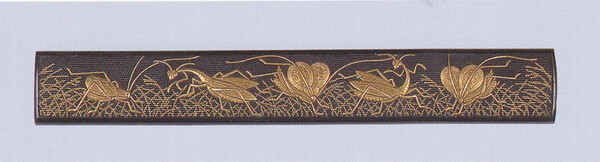
Here's my 2 yen's worth I think he gold decoration is actually true inlay (nunome-zogan would be perhaps risky if one were to punch a nanako pattern over it, it would likely cause some loss to the gold). Also, it would be virtually impossible to apply nunome-zogan after the nanako ground had been struck, can you imagine cutting a fine cross hatch texture over a nanako ground....I can't , so the decoration was inlaid at the original time of munufacture. I don't think the fact that part of the insects antennae crosses the seppa-dai is really noteworthy or indicative of much. There are many examples form the early Edo period onwards that show a similar 'looseness' and 'flaunting of the rules' in this respect. The style of inlay reminds me of Kaga work. Personally speaking I don't find the 'rustic' quality of the nanako troublesome at all. I think it important to judge, or appreciate work in it's own context. This is clearly not in the same same class as Ishiguro or fine Goto work but if it were considered alongside some types of Ko-Kinko it would be deemed very appealing I feel. From a technical point of view nanako on iron is the same as on soft metals. The only additional concern is damage to the punch. This may be why, in this case, the dimples are quite shallow. A less deep punch will suffer less impact stress when being struck. And for reference here are some Kaga examples from the Ishikawa Prefectural Museum. Ishikawa used to be called Kaga. These are obviously much finer but the style of the insects is very similar and I know Ken loves his mantises :D and one of the kozuka shows nanako over inlaid grasses albeit in shakudo.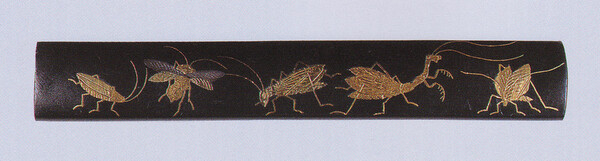


-
Kodogu for the fairer sex....traditional or electroplating?
Ford Hallam replied to kaigunair's topic in Tosogu
This is a pretty nice example of Kyoto nunome-zogan made probably in the Showa period. Records from the Meiji period indicate that Higo workers migrated to Kyoto for work and provided the skill base for the famous nunome zogan export wares. Companies like Komai, Inoue, Otsuno and others all produced remarkable nunome zogan work in Kyoto. This obidome was made for the domestic market and I'd suggest Showa period because it was about that time that metalworkers in Tokyo came up with the notion of wearing these little brooches on Obi as something of a fashion statement. The fad was enthusiastically taken up by the 'so called' Mitsukoshi wives, fashion conscious ladies married to wealthy businessmen. One interesting story about the origin of obidome is that in the Edo period a young Geisha might use a piece of tosogu belonging to her lover as a decoration on her obi to signal her devotion. After the ban on wearing swords metal artists adopted the idea as a way of creating work for themselves. -
Ko-kinko tsuba - what is this shape/profile called?
Ford Hallam replied to growlingbear's topic in Tosogu
A very appealing yet unusual tsuba I think. If you look closely at the seppa-dai area it's clear that area was forged beyond the original finish as some of the hammer marks have flattened the edges of the wave pattern engraving. I also get the impression the rim was also forged into it's present tapered form sometime after the tsuba was originally made. Perhaps to make the tsuba larger. That would make the silver wire inlay a later addition. -
As some of you may already know, and already contributed support to, Paul Martin is embarking on a new project to bring the world of Japanese Swords to life. I'll let Paul describe what he's planning, I'll be adding what bits I can also. This is essentially an educational project and one which I believe will provide valuable insight into the subject both from a historical and contemporary perspective. With Paul living, permanently now, in Tokyo he has unparalleled access to the leading scholars and artisans in the field. Having Paul as our guide and translator into this world I imagine we may all be in for a pretty exciting journey. As I mentioned, some of us have already contributed support to get this project up and running and now there's a fundraising site on-line to make donations easy. Please consider what this Video Magazine might be worth to you and if you can consider helping know that every amount however small will be much appreciated. Here's the link to the Fundrazr page. Thank for you time and consideration, Ford Hallam