Ford Hallam
-
Posts
3,091 -
Joined
-
Days Won
78
Content Type
Profiles
Forums
Events
Store
Downloads
Gallery
Everything posted by Ford Hallam
-

Just when you thought it was safe to go back in the water...
Ford Hallam replied to Ford Hallam's topic in Tosogu
Hmmm....pieces of 'the true cross' ...is it permissible to express doubt? by which I mean all attributions of metalwork supposedly by Musashi. -
Just when you thought it was safe to go back in the water...
Ford Hallam replied to Ford Hallam's topic in Tosogu
:lol: -
Just when you thought it was safe to go back in the water...
Ford Hallam replied to Ford Hallam's topic in Tosogu
Cheers :D ...I'm working on it -
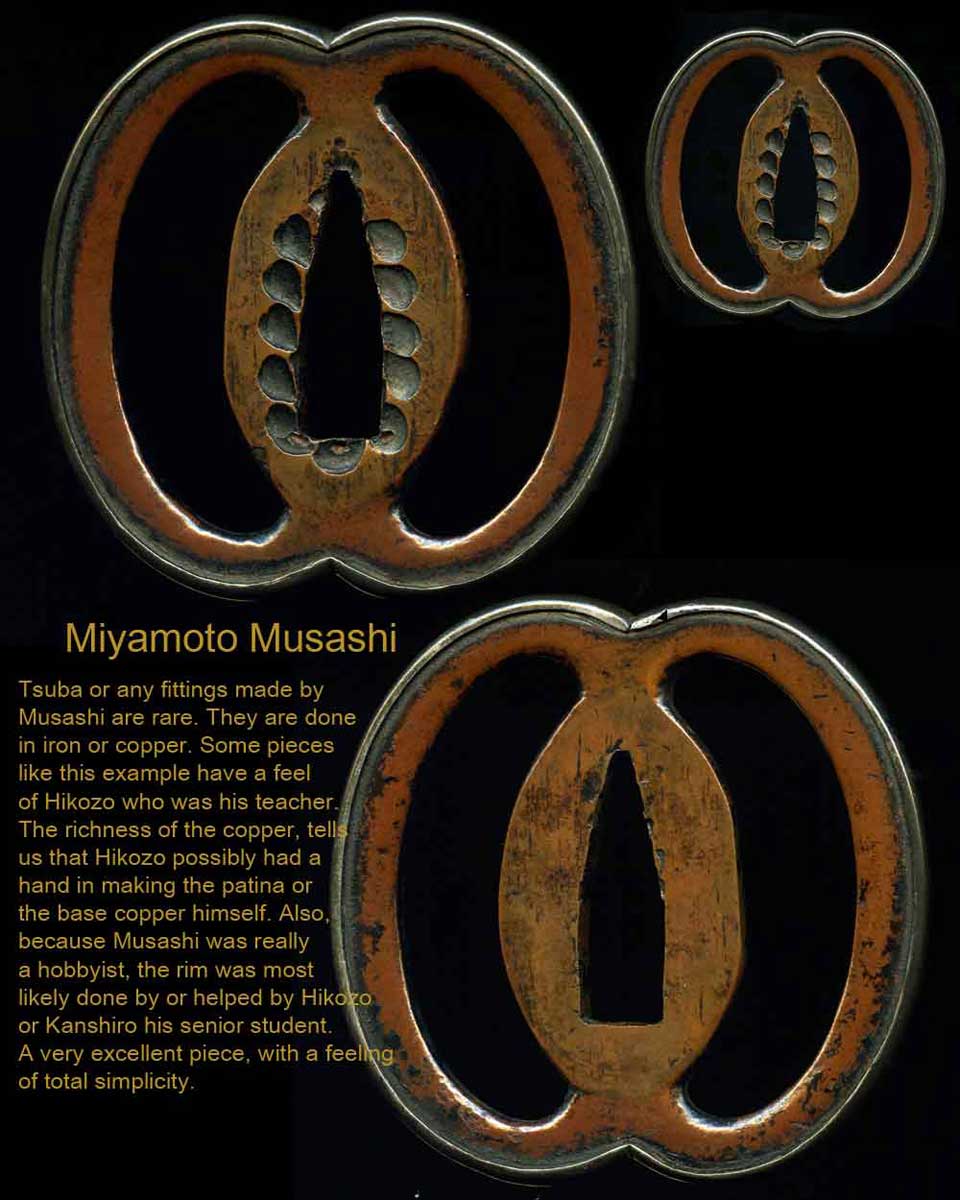
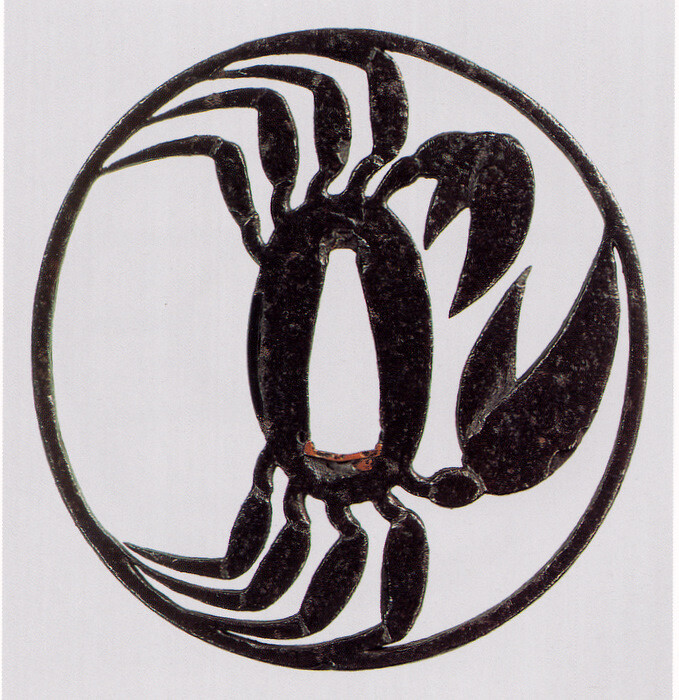
The ever helpful Mike Yamasaki sent me this fine example of a Miyamoto Musashi attributed tsuba. Classic namako form in copper.

-
Malcolm's observation is a valid one, imo. And puts in mind a discussion Bob (Morrisson) and I had recently. Bob suggested that by displaying a tsuba that indicated one was not concerned with defence or protection it could signal to your opponent one's superior attitude and confidence.... very important traits when entering into a fight. In that sort of scenario a lace-like Kyo-sukashi tsuba would serve it function perfectly well...that being NOT to be obviously defensive. As many a warrior 'guide book' advises, warriors should have no thought for preserving their lives. Ashigaru were obviously the bravest though...they went into battle with no trousers on! I've enjoyed this discussion and am relieved we've pretty much exhausted it...for now :lol: without any loss of blood or mud slinging. Thanks to Chris for providing a robust counter to my own ideas, this has helped me tremendously in terms of my own grasp of the issues. Thanks also to everyone else for your observations and contributions. Now I'd better get back to work...those 'tsuba-like' objects don's reproduce themselves you know :lol:
-
That is a great tsuba, Mike. Moritoshi was indeed a supreme artist craftsman. A Mito artist.
-
It would be a reproduction if a copy of a pre-existing original or 'done in the style of' if a new composition. What you're asking here is like asking me what I would call a tsuba that I'd made if were to make a exact a copy of a Kinai tsuba (for example). I'd call it a reproduction...or an utsushi. It's a very different thing when an artist uses the same materials as an impressionist painter of the 19th cent and creates their own style of painting. In that case it's simply a painting. Your analogy is not relevant.
-
But as I pointed out....I decided not to divorce functionality from that tsuba made in 'Musashi style' similarly it's perfectly possible for a smith to make a blade that doesn't take functionality as it primary concern. You admitted as much earlier when you said some swords were obviously not good swords. Just because something can be made in a 'less then ideal' way does not automatically imply it was. Your reference to style also seems to miss an important point. Apart from the obvious utsushi type pieces which of my tsuba are in a previously defined style? 'Tsuba' is not a style, it's a type of object....like a painting. You make a fundamental category error here. I have defined a personal style that didn't exist before so in that respect 'reproduction' is nonsense.
-
Why not, you must be consistent in your argument or show good reason why there needs to be a different logical thought process in the case of tsuba. Besides, you didn't say tsuba 'may' be reproductions....you have been very adamant. No 'may' about it in your mind. You've specified why modern tsuba are not 'real tsuba' and merely reproductions....I simply applied the same logic to certain blades. Seems perfectly reasonable to me. And in any case you didn't make any fundamental distinction between tsuba and blades when you started your thread that this one followed from. We're not talking about specifics relating to only a blade or a tsuba but only about the principles by which you chose to judge. But from what you have written about some modern blades made for martial arts use you would then fairly judge this to be a tsuba. A reasonably accurate copy of a form supposedly created by Musashi (someone you suggested would know what a functional tsuba should look like) and made to actually fit a blade...and function as a guard if, in the highly unlikely event, it needed to (something I always keep in mind btw). If you still feel this is merely a 'tsuba-like' object then all those blades made by modern smiths, albeit intended for serious practice, are also, by your own definition, merely 'sword-like' objects. I rest my case. The steel itself was painstakingly worked by myself and treated to reveal the grain to demonstrate that it is in fact hand made steel, the few restrained touches of 'decoration' don't imped any functionality. Like many smiths I also make fittings that are intended for use...so do I get the same status you seem prepared to afford smiths? And, I've actually never made a tsuba that wasn't first fitted and conceived around a blade of my own. How it works as a functioning tsuba is always by starting point. In fact at the moment I'm carving, from steel I forged myself, an original design (not terribly unlike Musashi's version...only better) of a catfish. This will be part of a koshirae intended for serious use. And mine will easily stand up to a sword strike much better then most classic pre-1600 pierced tsuba because mine is essentially a plate. But ultimately you fall back on this; Which is nonsense and just a cop out. Since when did the market decide what was legitimate classical music, ballet or even literature? Money doesn't answer every question of culture. In this context money buys you choices...not intellectual property rights.

-
And it therefore follows (according the Chris Bowen) that blades made by today's top swordsmiths, obviously not intended to be used to kill an opponent in battle, are sword-like objects. They are reproductions. Good luck with advancing that fancy in Japan among professional smiths. Additionally, Chris, your use of the word 'reproduction' is clearly very specific and obviously inaccurate in many respects. A reproduction can only be of something specific that existed previously. Ergo; if a tsuba is an original design it cannot be a reproduction. Obviously what you mean is 'a object made in a particular genre' ...but that would give it too much credibility for your taste I suspect. Further, as there are so many different style of tsuba, as well as different aesthetic expressions (apart from wabi/sabi) there are a wide variety of genre's to work in. The form itself is not a genre....merely a generic term for the object itself, a bit like 'oil painting'. Oil painting have a long and varied history, and were/are commissioned for a variety of reasons. Any book on art history will reveal that art in the past inevitably served very specific functional purposes. Portraits most frequently to signal the sitters status and importance. If, for argument's sake, we claim that the original oil paintings were only portraits and that therefore a painting today, done on canvas just like the originals, but of an oily tool box is not a 'real oil-painting' not a single art historian or critic would take you seriously. This is essentially the position you've painted (unavoidable pun) yourself into.
-
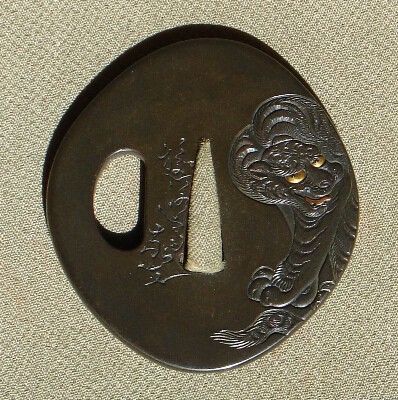
Oh dear, Ludolf...it's true then. Germans really don't have a sense of humour Cue Herr Schiller It was a joke. I ought to insulted that you thought I was serious in saying that. I actually had this one play with a little while ago. In fact it'll be in my book.... There's more about it here
-
Hi Edward , glad to help where I can. That "silver-gray-color iridescence" is not common on copper, but you see it on well preserved copper pieces with a good patina intact. By which I mean the original colour hasn't worn away and the the bare metal simply tarnished. As in your piece a fine film of further oxides, including most importantly sulphides, can develop. It's just enough to create an interference layer that affects the light reflected off the surface. This is what gives it that iridescence. This feature is actually the most desirable state, from a connoisseurs point of view, for old silver. It's virtually impossible to fake.
-
I see the discussion has veered inevitably to that 'a tsuba must be functional' mindset and that what I was trying to explain is being overlooked. Whatever the requirements in terms of functionality might have been for warriors who used their swords in battle it is glaringly obvious from simply by looking at the evolution of tsuba, ....long before the 'decadent corrupting rot' set in , that what shaped their appearance was not the physical reality of stopping a sword blow but what the thing looked like, ie; aesthetics. Chris, it would be good to be able to ask the opinion of a battlefield season warrior, indeed. This is what I tried to do by making reference to the very man who used them, way back then. Sadly, such a person, with the real world experience we're looking for, simply doesn't exist. All we have are the objects themselves. I'm afraid I know too much about the development of Ko-ryu , particularly the modern Toyama Ryu, to be swayed by their claims of superior understanding of battle field conditions and requirements. That part of my library is complete and merely further informs my opinion. And over 25 years practice myself (I was forced to stop in 2000 due to illness). So you'll forgive my scepticism regarding the views of dojo experts.
-
Christian, are you a lawyer? :D
-
Hi Edward These fitting are of copper, not shibuichi. Definitive answer from S. Alexander Takeuchi, Ph.D The full, excellent article here. regards, Ford
-
Hi David, thanks for your kind appreciation, glad it was helpful regards, fh
-
This obviously the work of a drunken madman ...look at that mei! It wanders all over the place.
-
Keith, so the opinion of Morio Ogasawara (and other senior Japanese authorities) as to the function of tsuba being merely to prevent the hand slipping onto the blade is irrelevant? Your contention that it is all about protecting the hand from sword cuts is more informed than their then. You speak of "plain common sense, knowledge and logic" yet seem unable to provide any really convincing evidence other than to continue asserting that that it's obvious. I would have thought that a fair reading of the points I've made would have at least provided some evidence worth considering. Evidently, your 'understanding' of this matter is so secure and certain that you are unable to entertain the notion that the whole idea is based on erroneous assumptions. I invite you to consider the point I made regarding a choice between a Katchushi tsuba or a pierced Owari guard, as I illustrated earlier. Consider, if you will, what the over-riding factor was likely to have been if the warriors choice was the Owari guard. There is no question that any suitably sized disc will serve to stop a hand slipping forward or help deflect, or stop an opponents blade that might slide forward. Protection against a full on strike/swing...I very much doubt. As I've argued extensively, this 'functional' aspect is so easily met by almost any disc, that other considerations, namely the aesthetic aspect, came to regarded as more relevant in terms of selection. My point being that the entire development of the tsuba is clearly driven by aesthetic demands and not practical, functional ones as that aspect was already inherent in the form. This discussion reminds me of the sort of argument climate warming deniers try to use. I invite anyone to compare Keith's undefined "plain common sense, knowledge and logic" with the points I've elaborated on at length in this thread and Chris' earlier one. The truth is, apart for repeatedly claiming that their position is just logical and obvious they fail to present any real evidence and refuse to address any counter evidence. And it's not about championing soft metal tsuba at all. It's about getting to a realistic understanding of the subject, one not based on fanciful imagining and romantic elitism. Everyone is entitled to their own opinions but not to their own facts.
-
Hey Christian, So because it obviously very good quality and a fine work of art and you have not seen it published it must therefore be gimei? This is very faulty logic :? I'm afraid. There are a great deal of very major works by the finest artists that appear only in a few obscure publications or are documented in the pages of the NBTHK journals and might take years or browsing to find. For myself, after nearly 30 years, I'm still 'stumbling' on masterpieces I've not seen before. This area of study is really still in it's infancy and we have no complete catalogues of works of all the great and significant masters. Consider this, if the piece Mike had posted was signed by Otsuki Mitsuoki (just as an example) which catalogue of his works would you look to to see if it had been published? For that matter how many of his tsuba can you think of without referencing any books? Previously unpublished works by BIG names are regularly coming to light. regards, Ford
-
Intriguing piece, Mike It appears to be a Hamano work stylistically and I really enjoy the work on the pine bark. I've seen another tsuba that looked very much to be Hamano style too but was signed Omori Teruhide also. I'd say judging from the quality of the workmanship and the subtle details and delicate expressive touches that this is a genuine work. A nice big and sharp image of the mei would be handy... so we can play spot the difference Although at least the last stroke on the the 4th kanji slopes down without a return hook...so that's good. Thanks for posting. regards, Ford
-
Hi Ian, thanks very much for that additional information. It's all very germane I think Mariusz, What Chris wrote their was not what I meant. Just mentioning it in case anyone takes Chris' misundertsanding as being my point. To clarify, as I did to Chris; You probably understood what I meant but I don't want any more misrepresentations clouding the issue
-
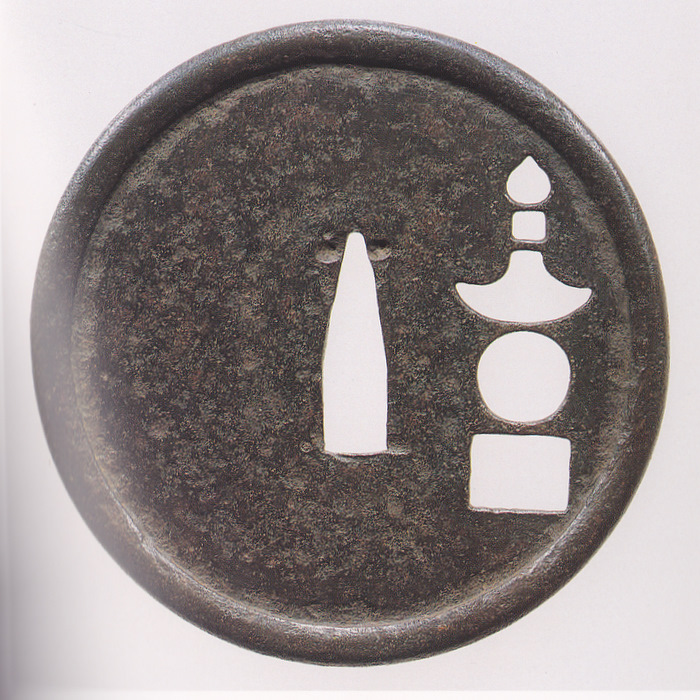
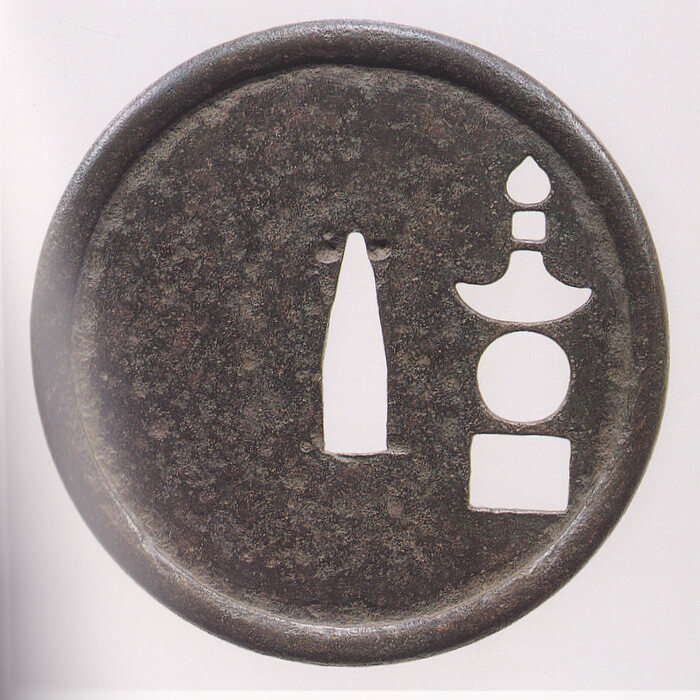
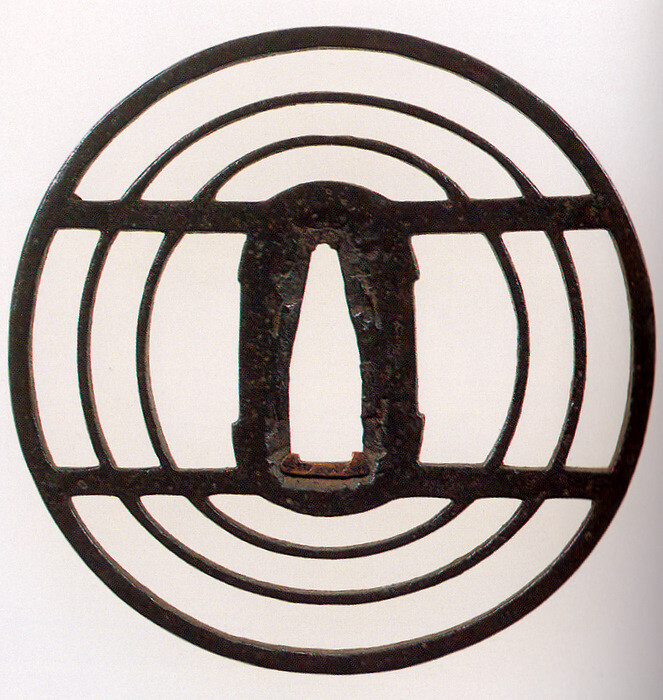
And if there remains any doubt that the Bushi class chose their tsuba primarily on the basis of what they looked like, aesthetic considerations, over purely functional factors consider this famous and venerated Owari masterpiece. It is glaringly obvious that in choosing this type of guard over a Ko-katchushi type a clear preference for the artistry and appearance of tsuba has been demonstrated. Whoever used these guards wasn't concerned about it withstanding a sword cut. By your definition, Chris, this is a bad tsuba. I think that concludes my argument. Tsuba might have served a minor role in practical terms of preventing the hand sliding onto the blade. Any significant protection against a sword cut was clearly not enough of a consideration to direct the design evolution of tsuba in a purely functional way that reflects that concern. Therefore we must regard all development of tsuba beyond the most basic and functional, ie; tosho and katchushi, as being as a result of aesthetic considerations.
-
Hi Thomas, thanks for the additional material and I'm chuffed you can see the sort of character and attitudes these men displayed in the same way I do. The fact of the matter is the warrior class were extremely conscious of their appearance on the battle field. The most striking example being the rather conspicuous army of Ii Naomasa. The whole lot of them in bright red and with huge banners on their backs sporting gold mon and kanji. Not very subdued at all. And it was Tokugawa Ieaysu who made the suggestion that they display themselves in such a striking manner. Consider the armours most higher ranking warriors wore. If they are restrained at all, the kabuto rarely was. In fact the taste for striking and flamboyant helmets was fairly common, if not de rigeur. This from Stephen Turnbull's; 'Samurai, the world of the warrior' pp56 "Wishing to make themselves noticeable above the common herd, senior samurai frequently enhanced plain body armour by embellishing their helmets with many weird and wonderful designs of buffalo horns, peacock feathers plumes, theatrical masks and conch shells. When Admiral Yi of the Korean navy won a battle against the Japanese in 1592 a collection of extraordinary helmets was among the booty taken, and Yi described them in tones of wonder in his report to the King of Korea." Hi Chris, to address your objections and points; I don't think any warrior going into battle sporting a giant pair of lacquered rabbit ears could be considered by anyone to be particular reserved or influenced by "philosophical and religious underpinnings" in terms of his appearance. :lol: and as my references cited above this seems to have been the norm. With regard to my question re; "finely forged and tempered" tsuba. That isn't my term, I used it as an example of, as I wrote, the sort of thing we frequently read in descriptions of tsuba. The very point I was making was that it is imprecise and unverified and yet another example of the sort of unexamined notion that clutter thinking about this subject. Thank you for your helpful explanation about steel and heat treatments though . The use of the word tempered does suggest to me that the steel had sufficient carbon content to heat treat it (it would have to above 0.3% actually) and that by tempering it had previously been hardened as tempering is the final process. I know that and you must know I do so I assume your detour was merely a smoke screen intended to draw attention away from the main point I made and which I, rather helpfully, I though, made bold for you. As for the whole functionality issue which seems to be the main point you are stuck with i think we've actually been misled by this red-herring. I think it fair to say that most modern Japanese authorities now agree that the guard was not intended to cope with blade strikes at all but, as has been pointed out repeatedly, served to prevent the hand slipping onto the blade. Nobuo Ogasawara re-states this view in the new Metropolitan Museum catalogue. That being the case any suitably size disc adequately serves that function and it follows, as I've demonstrated in my previous post (in bold) that this requirement is so easily met that it allowed for the development of a wide array of styles that clearly were not conceived with strength or durability in mind yet were regarded as fit for use. The mere fact that warriors could then choose a different style of guard means that they all 'worked' and that the decision over which type to choose was based on aesthetic criteria. If function, as you define it, ie; to protect the hand from a sword blow, was really the main consideration why then did the classic and elegant Owari guard supplant the no-nonsense and rugged Katchushi guard? It's self evident from simply comparing these 2 examples the choice of the Owari guard was made on the basis of what it looked like and not that it was more likely to hold up to a blow from a sword.
-
Hi Charles, glad to have been of service :D good luck....and don't hesitate to post any questions that arise as I'm certain the discussions that follow will inevitably be of use and interest to others also. kind regards, Ford
-
Cheers Pete, I thought it was a typo, but it's my spell-check...it just did it again as I types Tadaoki...I've only got Tadatoki in. Fixed now. :D My 'story' wasn't really meant to be taken literally though...but I doubt tea would have been offered in that situation. Tea in a crisis is peculiarly English response, as you know.