Ford Hallam
-
Posts
3,091 -
Joined
-
Days Won
78
Content Type
Profiles
Forums
Events
Store
Downloads
Gallery
Everything posted by Ford Hallam
-

Andrew Graham-Dixon's I, Samurai.
Ford Hallam replied to Ford Hallam's topic in General Nihonto Related Discussion
Thanks ...I can make one for you without cracks The cracks cost extra so it'd be a bargain I always thought the bowmen of England ( I used to shoot a longbow myself) were a cut above the rest, let's not mention the Welsh -
Andrew Graham-Dixon's I, Samurai.
Ford Hallam replied to Ford Hallam's topic in General Nihonto Related Discussion
It's interesting to me to read how others, like yourself Paul, regard varieties of "irregularities" in tsuba in the same light as in swords rather than as being more like "hataraki". It's a natural enough thing to do if one's eyes are attuned to blades but does illustrate very well the need for various art forms to be understood on their own terms. Perhaps blades are more akin to fine porcelain while certain tsuba (the Higo for example) have more in common with earthenware. I experienced this mis-apprehension with a work I made myself some time ago. You may remember the Umetada Myoju utsushi I made about a year ago. Typically shakudo will not patinate properly when inlaid into brass type alloys such as those evidently used by Myoju. In fact, I was told in no uncertain terms, in Japan, that it simply couldn't be done. I fiddled around with the actual composition of shinchu until I hit upon a mix that did allow for the two alloys to be coloured together. However, as I forged this new alloy down to a suitable plate it cracked in a few places. I'd noted exactly the same "flaws" in Myoju's own tsuba so I felt I was on the right track and embraced these "flaws" as being signs of the integrity of the approach I'd chosen. I soldered the cracks as they appeared, to stop them growing. This was something Myoju himself also did and allowed for the fact that in time these fine hairline cracks in silver would mellow and create an element of intrigue in the finished piece. I wrote about all this at the time when I first posted the images of the finished tsuba but there was still a great deal of suspicion, I suspect, that I was simply trying to make up an elaborate story to excuse what was simply seen as a mistake and evidence of a lack of skill. Happily, someone did appreciate the work for what it's now and it's safely preserved in a collection near you
-
Andrew Graham-Dixon's I, Samurai.
Ford Hallam replied to Ford Hallam's topic in General Nihonto Related Discussion
Morning Ron, thanks your positive response...I was beginning to feel a bit plebeian in my populist taste :lol: I pleased you managed to find the little kernels of value in the film too. I'm a little amused that my use of the word "esoteric" when refering to what Victor said has apparently been seen by some (yourself and did Paul understand me) as being a criticism. I had a similar misunderstanding on my own forum. I don't regard the "esoteric" as being a negative thing at all, in fact, in my view, at some point it's an inevitable aspect of this world of swords we choose to inhabit or visit. To clarify my own feeling on Victor's "esoteric musings" here's what I wrote on FTIB; Anyway, I trust some of our members got a little something out of the film . regards, Ford -
The Wichmann books was written first and is pretty exhaustive, it's also nearly twice the size of the later book. It is far more specific in terms of examples and literally overflowing with illustrations and in this way more useful for artists. Lambourne's book is probably more than enough to gain a fairly good broad art historical overview.
-
Hi George, dozens of them! :D What this book does illustrate is how extensive Japanese art's influence was and continues to be. In many respects a significant amount of what the untutored Western eye takes to be modern or Western came about as a direct result of this exposure to Japanese aesthetics. But you don't get to appreciate that simply from looking at pictures or browsing the net regards, Ford
-
Andrew Graham-Dixon's I, Samurai.
Ford Hallam replied to Ford Hallam's topic in General Nihonto Related Discussion
Paul, of course we can agree to disagree, l'll still let you buy me beer in a pub of your choosing anytime I do have to say that I really didn't see the segment in the forge in the same light as you though. I actually thought it was quite respectful and even deferential. As for dumbing down, well that depends on where you expect the base line to be. I thought this was a pretty decent introduction for the general public and wasn't condescending towards the tradition at all. The only piss take was Graham-Dixon allowing himself to be the joke..which revealed him, to me at least, to be someone who didn't always take himself too seriously. regards, Ford -
Andrew Graham-Dixon's I, Samurai.
Ford Hallam replied to Ford Hallam's topic in General Nihonto Related Discussion
Piers, obviously I haven't seen the film you're speaking of but knowing Lyall Watson's books very well I can imagine...and yes, I reckon this is exactly the sort of charm that flies at the mere touch of cold philosophy. -
Andrew Graham-Dixon's I, Samurai.
Ford Hallam replied to Ford Hallam's topic in General Nihonto Related Discussion
Hi Morita San, yes, I was wondering how many people would recognise Ginza Choshu-ya :D Henk, I think that in general all documentaries intended for the general public have to be "entry level" having said that, and as I wrote, I think there are some significant insights to be gleaned from listening carefully to what is being said. Paul, I would agree that there is an unfortunate degree of "silliness" about the film but I still maintain that he does in fact offer some valuable insights. For myself I'm prepared to look through the mud to find the jewels I seek. I had hoped others might also find something of value there and not merely dismiss it outright. You saw it some time ago and dismissed it without, evidently, passing it on. Had you told me I'd have been quite pleased to see it. As for Victor appearing eccentric...he is actually merely reflecting what many active smiths today feel. In this I thought it offered an intriguing glimpse into a world we only think we understand. Perhaps you might view the film differently after having sat for a while in the Ryoanji garden and merely experienced it rather looking too analytically. or perhaps I merely feel slighted that the insight he offers, and which I drew attention to, you judge to be "better forgotten". Clearly, by your standards, those things I value are not of relevance or interest to you. -
I know that actually reading real books to learn new stuff is probably considered a bit old-fashioned by some but for those fuddie duddies who are interested the best book I've encountered on this subject is "Japonisme: The Japanese Influence on Western Art Since 1858" by Siegfried Wichmann. It's on Amazon here. This book was something of a bible (along with "The unknown craftsman") when I was an apprentice and first discovering Japanese art.
-
I was quite surprised to discover that a serious art historian and critic had actually done a programme on the Samurai. I watched this last night on youtube, it's a BBC4 production. It's in 6 parts, I thought the conceit of him wanting to become a Samurai was a bit lame but I suppose it provided some sort of vehicle for the story. Those of you who are knowledgeable in matters related to Japanese blade making will find his bungled explanation of hamon and hada creation a bit irksome but ignore that part, you know better anyway . Victor Harris makes a brief appearance in Yoshindo Yoshihara's forge....and muses quite esoterically on the matter of when the kami enter the steel via the fuigo (the bellows) There's some beautiful images to enjoy in the film and despite a few of the usual clichés there are some moments of real insight that are well worth savouring. In particular the bit where he compares the ineffability Chinese landscape painting (actually Japanese interpretations) with the mysterious qualities of a hamon as well as his observations on imperfection in teaware. There's a fairly satisfying segment on the Ryoanji rock garden (they obviously got the loudspeakers turned off for the filming to help create the right atmosphere ) that provides some food for thought. And before you all sneer at the bit where he gets to dress up as a Samurai at the Toho film studios and act in his own mini chambara film just be honest enough to admit that if you had the chance you'd be in like Flynn. :D Enjoy, Ford
-
I would agree with Henry also, especially his comment regarding This is a fairly decent piece of work but I wouldn't get excited about it being of above average. In my estimation I'd actually place it slightly below average generic work that is common in genuine Kinai work, for example. Depth of carving is not an indicator of quality in my opinion. Crispness, certainly can be but that can be achieved on very subtle works that appear to be almost flat. The actual carving, while expressive and bold is, to my eye, a little crude. However, with regard to the material I agree with David. I don't agree that one would expect to see any real activity in the steel of extensively carved work, even of the highest quality. The two qualities are in many respects mutually exclusive. I'll see if I can dig out some examples of what a very fine example of a carved steel dragon tsuba can look like. That's the best way to appreciate the difference. regards, fh
-
NBSK Craftsmen Competition results
Ford Hallam replied to Clive Sinclaire's topic in General Nihonto Related Discussion
I was quite amused to see Remo's entry described as butterfly wings I thought I'd explained that one ...didn't anyone tell the judges? :lol: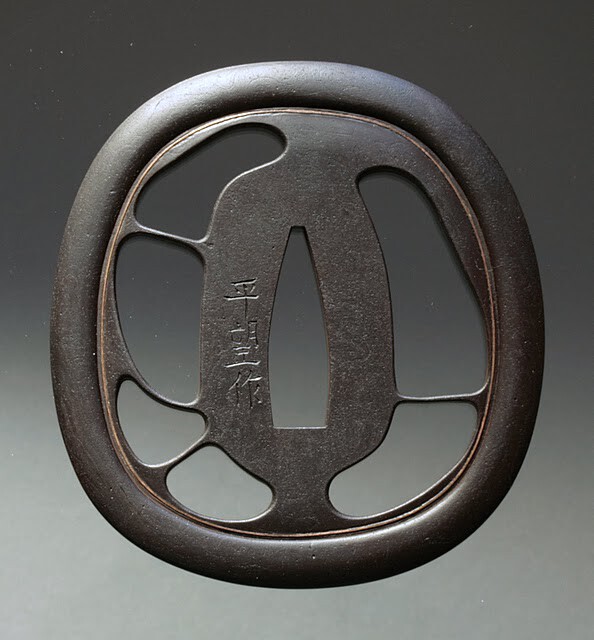
-
NBSK Craftsmen Competition results
Ford Hallam replied to Clive Sinclaire's topic in General Nihonto Related Discussion
I think that at this point we should also remember the awful tragedy that Japan suffered exactly when many of us were hard at work on our entries. Our efforts fade into insignificance in the face of what the Japanese people have had to endure. For myself, nothing I can ever make can express the sadness I felt, while forging a plate of shakudo, when the news first came though from Japan of that terrible disaster. Having said that I must also say; 3 (apart from myself ) out of 11 nyusen, all "followers of the iron brush" , I'd say that's a pretty good showing lads I, for one, am bloody proud. It's exactly this sort of dedication, respect and effort that pays most sincere respect to Japan, her people and her traditions. Namaste all, Ford -
Hi Andi these marks are very small, really, in comparison to the average size of mei on older tsuba. Their position is also not at all typical for a mei. I don't think they can be deciphered as part of a name but early Tosho (and Katshushi) type tsuba tend not to have mei anyway. Hope that helps a little, Ford
-
Seriously Jason, this is quite possibly the worst piece of crap seen on this forum, and we've seen some crap . You ask for a translation and get all put out when the pointlessness of your request is pointed out to you. Why would anyone who's made the effort to read mei bother trying to make out this doodle in dog excrement? That you even bothered to look at this thing for more than a second reveals exactly how in need of assistance you are yet you're too arrogant to begin to consider what a liability your ego is to your wallet.
-
Could it be read thus? 知らぬが仏 (Shiranu ga hotoke)
-
Curran, I don't mean that the design on the tsuba under discussion is elementary or simple but that it is simply not laid out correctly in terms of the essential features of this type of pattern. I think it's also worth noting that the technique on older works, while perhaps not as refined as later work, is never the less still clearly skilful in the sense that they exhibit a notable confidence in their execution. If I am presented with a similar wave pattern, of certain age, that exhibits a similar sort of regularity in the way the pairs of waves are simply repeats I'd have to reconsider my view but I think you'll inevitably find that the waves are staggered in relation to each other and not, as in this example, lifeless repeats. It's ok to disagree with me btw, but it saves time to agree with me from the start regards, Ford
-
I don't see how a seppa would rectify anything really, all that does is act as a gap filler. It doesn't alter the alignment of the nakago at all. An NBTHK origami is also "just" an opinion, albeit in Japanese. They have been known to be wrong... and faked too. You only have to do a tracing of the lines that define the waves to see how amateurish the thing is. But if you choose to regard this as a pleasing example of early kinko work good luck with that. Personally I think it's very poorly made and not very at all convincing.
-
In some cases these are rivets that are holding a san-mai stack together.
-
Is it only me but doesn't the doubling up of the waves peaks seem a bit "wrong" to anyone else? I mean the way they're arranged in pairs and in repeat rows as they are. My feeling is that the waves design was drawn out by someone who didn't understand the essence of it's rhythm. I find the outline of the wave peaks a bit amateurish also and the nakago ana, specifically the top part, seems unconvincing to me. If that nakago ana was fitted to a nakago consider where the habaki would be and how that would relate to the saya and tsuka. Just my opinion but this looks like a modern amateur piece. Regards, Ford
-
I've seen a couple. One in particular was quite corroded, almost an archaeological artefact, and judging from the proportions it was on a pretty beefy blade. Apparently it was judged to be Kamakura period. The owner used it on his key chain and I must admit it was/is a very appealing object.
-
I'd also like to add that in having new habaki made (and not necessarily throwing old ones in the bin ) modern collectors are helping to keep the crafts associated with the sword alive for the future. I believe this point is very well appreciated in Japan today, perhaps encouraged by the artisans themselves, and had it not been for a similar sentiment prevailing in the past we'd have a lot less "stuff" to enjoy. Although, come to think of it, there are those who'd have us believe that everything made after the end of the Momoyama period is irrelevant anyway I think Paul has summed the situation up perfectly.
-
Hello John, Thanks for that additional info. I'm assuming then that this is essentially speculation on Ogawa's part and that no concrete evidence actually exists other than the engraved VOC mark. I'd suggest that it could equally have been the case that these types of guard were commissioned by VOC officers from local Japanese artisans as gifts to Japanese officials. Occam's razor...anyone? I just don't see any convincing evidence in the pieces themselves that indicates foreign metalwork technique and workmanship. Looking at 17th cent. Indian arms and armour doesn't suggest design influence as seen in these auriculate guards.
-
It all raises an intiguing point for me though. Some of the material I use is not of Japanese origin so ought I to inscribe those tsuba as being of Namban material? and obviously add a premium to the price due to the rarity. John, I have to confess that I havn't read a copy of you book on Namban tsuba so don't know what the evidence is for the auriculate group having been produced by the East India Company, in India. Could you perhaps provide a brief précis? regards, Ford
-
I think I'd plump for Umetada school myself. Mid Edo-ish. I agree with Henry about it being Kyoto work.