


Ford Hallam
-
Posts
3,091 -
Joined
-
Days Won
78
Content Type
Profiles
Forums
Events
Store
Downloads
Gallery
Everything posted by Ford Hallam
-
Curiouser and curiouser :D thanks Gents
-
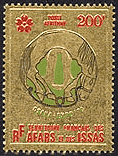
I can understand how a tsuba might be used as a design on Japanese stamps but this is something of a surprise Sorry about the small image but this is all I could find. Before 1967 the territory was known as Somali Coast. In 1977 it became Djibouti Republic. Evidently someone there fancied tsuba.
-
I have to say that I'm finding the idea that a certain category of Namban tsuba, like this example just linked to, may have been made by Chinese artisans to be quite reasonable. It's these oddly shaped seppa-dai that make me feel that this group were physically separated from the rest of indigenous Japanese tsuba-ko. It almost as though they were working from drawings/paintings of real tsuba and had never actually seen real ones. We see a similar "misunderstanding" in some of the modern fakes we see on the net. Just to speculate a little further...if you were going to set up a manufacturing base to make products like tsuba to export to Japan you probably want to sell something that the local market didn't already have. The more characteristic "interwoven vines" design does have a precedent in Chinese Jade carving so it's plausible that this technique was adapted to plates of wrought iron to create something unique for the Japanese market. My feeling is that a foreign place of manufacture is thus more likely but without some solid evidence of this sort of trade we're still guessing really.
-
Technical analysis' done by Prof. Cyril Stanley in the mid '70's revealed at least one tsuba inscribed "nambantetsu" as being of wrought iron. The general appearance of the iron as described by David would be consistent with this analysis. As for the methods of manufacture every iron example I've examined in hand has revealed traces of chisel work in the openings and evidence that the opening were initially drilled.
-
Yes, you called? No need to worry, Rich. Saffers are a hardy bunch...as your rugby team well knows. We quite enjoy a bit of rough and tumble, unlike some Chardonnay sipping, quiche eating antipodeans and lets not mention that stuff you try to pass off as beer
-
John, I have to say I'm intrigued with this one. The fact that the net is all brass inlay is notable. The shape of the seppa-dai does make me feel it may well be early rather than late Edo, perhaps even pre-Edo. The single kozuka-hitsu (clearly original) is also significant, I think, and may suggest that this tsuba was made for an uchigatana and so possibly be period Heianjo and not a later revival version. It's in terrible condition though so this is really speculation on my part. regards, Ford
-
Keith, absolutely, I was just trying to provide some context for what I then come to and which you quoted. I would emphasise the last bit too, though :D Amen and good night Ford
-
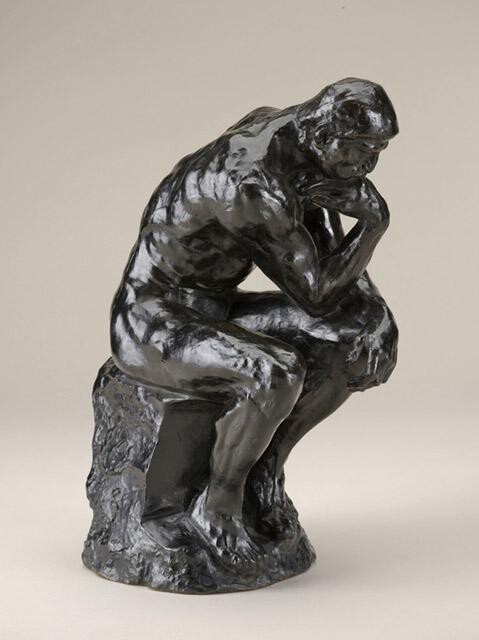
Keith, Steve the reason I posted an image of a Rodin was specifically because he is credited with being something of a first in the very expressive way he modelled the wax and clay, with his fingers, when he created his figures. This from wikipedia; This model was then carefully translated into hard bronze. The beauty of the process being that all the direct expressiveness of Rodin's touch can be thus preserved. Perhaps the sculptures need to be seen "in the flesh" and while moving around them to appreciate the qualities that have been imparted to the bronze. I would suggest that to the connoisseur the cast iron kettle is rich with qualities that are completely comparable and on a par with those that are valued in worked steel. Had Japanese tsuba artists felt that cast iron was suitable and legitimate material for tsuba they would have used it. But we can be pretty certain they would have developed a completely new range of aesthetic qualities (contrasting those of worked steel for example) in this new medium. It doesn't matter what the actual material is, in the hands of a real artist it can be as expressive as he needs. There is no true hierarchy in terms of process or medium. All attempts to suggest that there are are subjective value judgements. So to claim forged iron is more expressive or vital compared to cast iron is to miss the point that you're trying to compare apples and oranges. As Steve describes, though, if cast iron is used to try to capture the quantiles of worked steel then it will merely produce a poor simulation.
-
Modelled in wax, invested in plaster of Paris and cast in bronze. Lifeless.....?
-
Hi Alex, well I hope what I'd suggested makes sense and helps to provide some sort of rationalisation for my opinion. I can't claim to be "all knowing" :D but I do spend most of my waking life (and dreaming too , for that matter ) pondering this art form so if I can provide some insight that helpful I'm satisfied. Enjoy your beers with Guido too :D ...NMB is almost a dating agency for sad lonely old bastards now regards, Ford
-
Hi Alex the heron theme is quite a common one on Japanese tosogu but the the actual composition and rendering that bothers me on this. With genuine antique pieces of this type either the maker was an accomplished artist and drew their own designs or they relied on design books that were produced for this purpose. This design seems to be "unaware" of the many conventions that would be almost instinctively followed by classically trained workers. The technique is all genuine inlay and the materials all look reasonable although the leaves appear to be unpatinated, perhaps red gold. If it is red gold then it's definitely not Edo period. The way the tree bark is carved is a bit vague and here there are quite clear approaches one would expect to see. Have a look at Hamano work to get an idea of how traditional workers would have treated a tree like this. The way the bottom of the design is abruptly cut off with that last section is simply wrong in Japanese design terms, it doesn't make any sense nor add to the composition at all. The 3 clusters of leaves on that bit are also a bit like clusters of chips, not leaves. The chiselling of the willow branches doesn't seem to know what it's supposed to be. In classical work this would be done with a kata-kiri chisel which leaves a cut that is reminiscent of the way a brush stroke swells and thins as it moves across the paper with one edge of the cut nearly vertical and the other gently sloping away at different widths depending on the overall depth etc. I wouldn't call this fake though. Someone has obviously gone to a lot of trouble and the work, despite missing the mark compared to traditional work, is still a fair bit of workmanship. It may well be the work of a contemporary Japanese hobbyist or just as easily a western amateur. I know Don Bayney well btw, please give him my regards when you next see him. regards, Ford
-
Hi Alex, not too sure this is actually of Japanese manufacture. It looks to be an honest piece of work but not pre-modern period in my opinion. Is there anything on the back? regards, Ford
-
Hello John, good to have your view to add to the growing consensus :D You may be interested to read the follow on to this unfortunate idea here.
-
Gentlemen, I'd just like to reiterate what I've been saying all along. We can speculate and come up with all manner of theories as how or why cast iron tsuba MIGHT have been produced but the fact is there is no real evidence that they did. Please remember the fundamental difference between "it's possible" and "it's probable" More specifically it worries me that so called "evidence" such as the examples Mr Hayes has published in his new book as being cited as proof that cast iron tsuba were made in the Edo period. That the weakness in this assertion and the complete lack of solid evidence, or even reasoned explanation, doesn't immediately tell everyone that this is nonsense leads me to believe that Mr Haynes words are being accepted merely on the basis of his reputation. A few moments of informed critical thinking easily dismisses this notion. This is not a clash of two opposing theories either. It's not a matter of "did they" or "didn't they". In the absence of any convincing evidence, apart from the object itself, the default position has to be "they didn't". Anyone who wishes to suggest that MAYBE they did cast iron tsuba in Edo Japan must assemble some evidence before the notion can be called a theory. If this evidence stands up to examination and is convincing then we can begin to reassess what we thought. Until this is shown to be a plausible theory my fear is that obvious modern cast steel fakes are being sold to collectors as being something special. This is an absurd position and one that may seriously undermine the credibility of further amateur research in this field. I'm grateful that many of our more thoughtful members are able to recognise that the whole idea is unsupported by the facts. So until someone can show some real evidence regarding this idea I've said all I want to. regards to all, Ford
-
A couple of years back I was invited for tea with Princess Takamado, she asked to meet me and to see my work . While there she showed me a tsuba that had been given to her as a gift by a wealthy American collector. You can imagine my inner conflict when it became immediately obvious that it was a modern cast fake, complete with dodgy gilding. Needless to say I kept my thoughts to myself, although my Japanese friend who was with us and who's known the princess a lot longer than I said later that I ought to have simply explained to her what it was and that she's have preferred to know. Not all collectors are that interested in the truth though... The really odd thing was that the next day I saw pretty much the same fake in a store near the Yoyogi sword museum.
-
Christian, I very well aware of the state of research in the field of pre-industrial metalwork. This is why I will keep asking for some real proof not hints and vague guesses. I'm also well aware that not all published research is accurate also, particularly in terms of various assumptions and deductions that are cometimes drawn. I've seen loads of metallurgical analysis' and even been involved in some studies at the British Museum myself. Whether or not the book you cite was written taking some metallurgical research into account ( and you are only guessing that it was, I don't see where it was needed at all) it is still not in any way relevant to the matter of cast iron tsuba.
-
Yes, it's well known that certain Buddhist implements were cast in iron pre-Edo period. This does not mean you can then just make a wild leap to saying that therefore tsuba were cast as well. This is a book about Mikkyo Buddhism, this from the product description on Amazon I have no idea how this is supposed to provide any reliable evidence that Japanese tsuba-shi cast iron tsuba...unless they used Mikkyo magic :D Honestly, all this leaping about making speculative "connections" is making me dizzy. In the words of Christopher Hitchens "that which is proposed without evidence can be dismissed without evidence" I give up....if people want to buy fakes cast steel tsuba who am I to try and stop them. so long, and thanks for the fish. fh
-
Piers, "Tapping tells him what the material is" he he...a friend of Uri Geller, no doubt "Lack of a mold line suggests use of a single cast that was broken up to reveal the tsuba." or; any seam line left by a two part mould was subsequently filed off, an easy enough process. If the tsuba was cast from a wax model, which itself was created from a mould taken of the original, someone needs to explain how this was done using pre-modern technologies like rubber moulds and injection waxes. btw; most casting in the jewellery trade and bronze sculpture trade today is cast into moulds that are destroyed to release the model. The model would have been created in wax, either as a handmade one off or from a rubber mould which will have seam lines visible. These seam lines are then to be seen even where the mould was one piece.
-
Piers, it's a form of cast iron that's been subsequently treated to render it less brittle. Here's description of the traditional Japanese process. and some info on cast iron on Wikipedia.
-
Hi David, thanks very much for that. I have to say I'm disappointed that Mr Hayes seems to omit providing any evidence for his claim though. He simply asserts that it's a cast tsuba made by a tea kettle caster. This is a copy of an original Myochin work with the mei being also reproduced . I'd be fascinated to learn what technique this "unknown" kettle caster used to create an accurate wax model of the original Myochin tsuba. I doubt he had access to vulcanised rubber mould and a wax injector. To me it seems that if we apply Occam's handy razor we're left with a far more plausible explanation. This is simply a modern cast steel fake. Mr Hayes also tells us the charcoal used to heat the metal, presumably he means to melt it, was rare and very expensive. I don't think anyone can claim it was rare at all. Practically every sword and tsuba forged was done so in a charcoal forge and every tatara was fuelled by charcoal. While it may have been expensive it certainly didn't make it in any way particularly rare nor was it's use limited. In a country covered with mountainous forests charcoal as a fuel was big business. Sadly, it is exactly this sort of vague rationalisation that continues to muddy the water. Having said that I think Mr Hayes book looks to be a very valuable reference work in terms of good examples, the present piece accepted.
-
David, I think we would all agree that those early examples we describe as being kagamishi products are cast. Bronze alloys, in general, don't lend themselves to being forged but yamagane works like copper so where we see relatively simple yamagane tsuba, pierced plate with added rim etc. I don't think casting needs to be cited as a method of manufacture. In fact forging an ingot into plate and working from there would be more efficient and straight forward. The resulting metal would also be stronger than an "as cast" plate. I'd love to see this example that Mr Haynes presents Any chance of a scan of it as well as the text that describes it? Hi Steve, I thought you'd appreciate this As I say it's not "case closed" (it's impossible to prove a negative :? ) but it does illustrate something about the sensibilities of the culture we're looking at and I think we need to be far more conscious of this sort of background when hypothesising. Henry, as you know the Japanese crafts systems, which were pretty much well established by the Muromachi period, defined the work and processes of each crafts very tightly. Kinko does not utilise any form of casting to create the initial forms. It would have been technically possible but there are very significant reasons why an as cast surface on soft metals is un-acceptable for iro-e and fine inlay. Think of porosity ( tiny bubbles) for example. Even with the very sophisticated casting processes we have today in the jewellery industry the casting of traditional alloys into a fairly finished form is still results in a product that lacks the qualities we expect from decent period work. Many of you will have seen how I cast copper alloy ingots into water and then forge them into usable plates. I believe this was a fairly standard workshop practice but I should also point out that flat plate ingots (of no thinner then 4mm thick) could be cast into a 2 part closed mould. Shinchu alloys need to be cast this way as they don't stand up to extensive forging and I've learned that shibuichi can be more readily processed this way too. Interestingly, it can be established fairly conclusively, simply by examining the surface structure of the metal, whether or not it was cast in it's final form or to what degree it has been cold worked. These precess even alter the colour that develops in the patina. Personally, I don't think casting is acceptable in kinko work. In the book "Conversations with craftsmen" (Nihontô shokunin shokudan) one of the older metalworkers interviewed tells of his memories of Unno Shomin. We learn how Shomin explained to him that the philosophy of kinko workers just wouldn't allow for them to take the "easy option" of casting. There was a fierce pride in their skills that ensured that any workshop that employed "lesser" processes and placed commercial efficiency above the integrity of the craft would soon be pushed to the edges of the established craft world. Keith, I've never been completely convinced that tsuba were mainly utilitarian. This is something I wrote a while back; "the tsuba "functioned" in all periods, to display the status, cultural refinement and personal taste of the wearer. It also allowed for political loyalties and philosophical concerns to be signalled. It was in these contexts, that the tsuba as an art form expressive of the time and group who used them, developed." In this light I think it is clear the tsuba was an artefact that was at the heart of the warrior culture, a mirror, in many ways. regards to all, Ford
-
As many of our members here will know the notion that tsuba were cast in steel or iron in the Edo period, or earlier, is a proposition I regard with complete derision. Recent "discussions" with an unfortunately misguided young fellow on another forum have prompted me to quote the words of a gentleman who was one of the first Europeans to travel to Japan and report back on her various technical achievements. That he was related to a personal hero of mine, Sir Richard Burton, and evidently shared his relation's independent strength of character is, for me at least, of great significance. Cpt. Francis Brinkley arrived in Japan in 1867 and remained there until his death in 1912. This from Brinkley's "A History of the Japanese people" (1915)(vol 7, p 256) I will readily concede that this is hardly conclusive or emphatic proof but I quote this with the challenge that if anyone would care to suggest the opposite they will need to present some fairly convincing and relevant material to allow for a reassessment of what we presently take as understood. regards, Ford
-
Having now read Ian's suggestion I have to agree that a plausible option (Occams razor and all that ) might be that this is simply a woodworkers specialist saw and has merely a passing resemblance to a kogatana. After all, this saw blade has a mekugi ana, which as has been pointed out would be essential on a pull stroke and I've never seen a kozuka with a hole in it for a mekugi....has anyone?
-
I picked this up last week in a second hand book-shop. While not strictly a history as such it does provide a good overview of the evolution of the warrior class over a 700 year period. Lots of relevant images of period paintings and screens etc provide a good feel of what their world looked like. At as cheap as $2.65 I don't think you can go wrong on this one. http://www.amazon.com/What-Life-Among-Samurai-Shoguns/dp/0783554621 "A Brief History of the Samurai" by Johnathan Clemments is also an easy and reliable read. Clemmnets writes in a very engaging way and is not at all dry and overly academic in style. He provides a picture of the warrior class that is devoid of romanticism and is harshly realistic. Copies available for as little as $ 3.10 Stephen Turnbull's books are reliable and very thorough but personally I find his writing style to be a bit dull. He's a remarkably knowledgeable researcher and historian but his books tend to feel a bit dry, to me anyway. http://www.amazon.com/Samurai-Military-History-Stephen-Turnbull/dp/1873410387/ref=sr_1_2?s=books&ie=UTF8&qid=1309768986&sr=1-2
-

Andrew Graham-Dixon's I, Samurai.
Ford Hallam replied to Ford Hallam's topic in General Nihonto Related Discussion
a motto to live by


