Ford Hallam
-
Posts
3,091 -
Joined
-
Days Won
78
Content Type
Profiles
Forums
Events
Store
Downloads
Gallery
Everything posted by Ford Hallam
-
I like the sofa. :D and the tiger skin cushion.
-
Hi John This from Wikipedia; The modern commercially available alloy called kuromido contains 3% As but is not regarded as a bronze by kinko in Japan as far as I know. I use kuromido to add 0.5% As to my shakudo alloys when I'm recreating Momoyama period shakudo that needs a true soot black patina.
-
Yamagane is, as you know, unrefined copper and contains various trace elements. The mos significant in terms of it's effect on the patina is arsenic. Typically Yamagane alloys contain about 1 ~ 0.5 % As and exhibit a deep chocolate colour wit various overtones depending on the actual composition. I don't know the origin of this notion but I have never seen any Chinese artefacts made of shibuichi nor read any reference to the Chinese having exported it. Joseph Needham, in his extensive writing on Chinese technology certainly never mentions anything like it. Personally I'm not convinced that shibuichi was used before the Early Edo period and it does seem to be uniquely Japanese, unlike shakudo. What can and does often happen with shibuichi that has been handled a lot is that the copper content oxidises and is eventually leached from the surface leaving a silver rich patina of sorts.. You can sometimes see this around raised inlays and where the rest of the body of the ground has then been further "abraded" by handling and reformed a much darker patina then the original colour. On copper, suaka, do, aka-gane are all synonyms for copper but some people use the term suaka to also refer to the terracotta/persimmon fruit colour like that on the second example you've posted.
-
Yes, I think it fair to say this tsuba is made of copper. There are quite likely some other trace elements present but one would expect that in pre-industrial processed copper.
-
To be honest, Maruisz, it could well be brass. :D there does appear to be a hint of yellow/mustard colour in these images. At least on my monitor. We can rule out shibuichi, shakudo and sahari though :D
-
Hi Henry I think in this case, the one you cite, Sasano is being reasonably accurate. It's an objective fact that a reddish colour in non-ferrous alloys can be due to the copper content. It doesn't really tell us much about the alloy as this is merely a relative observation though. It's possible to develop a post office red on a bronze and that alloy would be considered as having a relatively low copper content in terms of the range of traditional alloys. If you think about it it's obvious that we can't make instinctive guesses about alloy composition based on patina colour. Shakudo is a very high copper content, some being 99% copper and yet the colour is still pretty black. Basically, depending on how the metal is treated, it's possible to pull a more red colour out of almost any copper based alloy. Metal patina colours are not subject to the colour mixing theory of painters either. :D
-
Gentlemen, I don't wish to add to the discussion regarding this particular piece but feel I just have to say something about what appears to an almost supernatural ability on the part of collectors; ie; you chaps to discern the metallurgical composition of metals based only on their appearance. Please don't take me as being overly harsh and rather consider this a kindly chiding.... :? I will defy anyone to positively classify a soft metal tsuba as being yamagane or copper of varying degrees of purity, any of the many varieties of bronze/brass, and an almost infinite variety of related alloys without solid analytical analysis. Speculating on metal composition based solely on it's present patina is simply guesswork. I must admit, and I think I can reasonably claim some expertise in this area , when I read such confidant commentary about metal composition I do sometimes feel like Alice in Wonderland . What I'd strongly argue for is a far more rigorous basis in terms of evidence when we make our assumptions. My apologies to you, Mariusz. I didn't intend to criticise your observations but I've noted this fuzziness of argument in a number of post and blogs previously. Someone has to say something about this....it might as well be me being the bad cop.
-
Hi John The different metals are actually fused together and not soldered so it's even more of a technical achievement than soldering so certainly quite remarkable for the time. What I find more impressive is the very precise cutting of the curving V grooves. Total control of width and depth and all within the context of very complex and symmetrical patterns . and of course the whole effect of the classic layered look is utterly dependant on this precision.
-
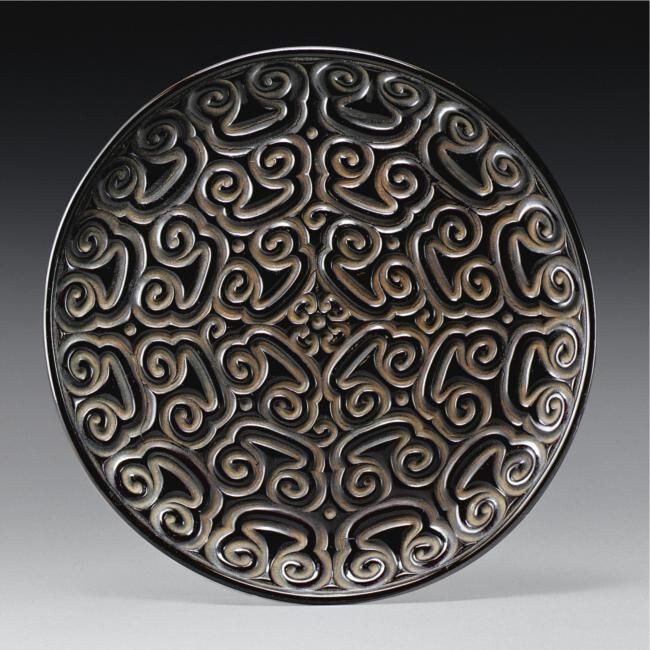
Hello John I recognise your point about this present example not being typical of so called "guri-bori" work but I think it would be a mistake to judge a piece by our contemporary standards (as collectors and classifiers) . I can see no real reason to suggest this set is in any way inferior the the more typical works either in terms of technique or aesthetic. As you point out, the actual carving is round bottomed ( like some girls I know ) whereas classic mokume guri bori has a sharply defined "v" shaped groove to better define the layers but this merely seems like an aesthetic choice to my eyes. As I've argued, the term "guri-bori" may refer only to the curvilinear pattern itself and we know that the inspiration for this style was Sung Dynasty lacquer ware. One of the distinct styles within the Chinese works is in fact a solid black lacquer carved in this way. One might even suggest that rather than being a lesser version this, plain black, example might have been worn by someone wanting to demonstrate a degree of educated culture and a willingness to go beyond the more obvious fashion of the day. Here's a fine example of the sort of Chinese lacquer I've referred to.
-
Hi John, I believe this description of what guri is makes things clear. The addition of bori ( hori) lit; to carve, completes the explanation....for me at least in metal working parlance. "屈輪 also written 呉利, and pronounced guri, gori, or gurin. A design of stylised bracken-leaf shapes forming repeated curved lines, or a continuous spiral. The pattern was brought to Japan from China with Zen Buddhism and was used on Zen style architecture *zenshuuyou 禅宗様, and smaller items like incense cases *kougou 香合, and trays bon 盆. The pattern was carved into red lacquer tsuishu 堆朱 and black lacquer tsuikoku 堆黒."
-
Hi Veli I think this is a very decent set and shouldn't at all be considered less than patterned mokume guri bori. In fact the material cost of solid shakudo set would actually would have cost more than the usual copper/shakudo mix. The mei is so confidently and elegantly cut as to completely convince me of it's authenticity any question of it not being "right" seems unnecessary. As to what to call this technique, I would not describe this as takaniku-bori. Sorry John ....Takaniku-bori is the inlaying of a raised motif that is then further carved. In this case the design/pattern is incised, ie: cut into the ground. I've not been able to find the original kanji for guri but there are associations with a curving movement/pattern and the sound of this word. Bori is hori, to carve. I'd suggest the term guri-bori therefore refers to the technique of producing these sorts of incised curvilinear patterns, the layering itself is not specifically implied by this term alone. Where we see distinct layers we tend to add the qualification mokume. This is just my understanding of this technique at the moment and may be revised as new clues come to light :D . There's some interesting info here, on this mokume artisan's site. regards, Ford p.s. edited toadd; This kanji for Guribori 屈輪彫 would seem to support my conception of the meaning; ie to do with the curvilinear pattern etc. p.p.s Just found this here; "屈輪 also written 呉利, and pronounced guri, gori, or gurin. A design of stylised bracken-leaf shapes forming repeated curved lines, or a continuous spiral. The pattern was rought to Japan from China with Zen Buddhism and was used on Zen style architecture *zenshuuyou 禅宗様, and smaller items like incense cases *kougou 香合, and trays bon 盆. The pattern was carved into red lacquer tsuishu 堆朱 and black lacquer tsuikoku 堆黒." So it does seem the term "Guri-bori" refers to the pattern and not specifically to the layering of different metals.
-
I have to say, gentlemen, I disagree with the general consensus expressed regarding the quality/aesthetic of this koshirae. To my eye the work is in fact quite sophisticated. The aesthetic, while not typical is by no means that unusual. I have no problem seeing this as a product intended for a cultured and refined person. Perhaps not a Samurai but by the late Edo period I think the distinction between tastes of the upper levels of the merchant class and that of the warrior caste were somewhat blurred anyway. Perhaps this was worn by a netsuke fancier, someone who was intent on expressing Iki. regards, fh
-
Hi Ron, thanks...
-
Hi Ron, I think that while paint stripper might be termed caustic because of the way it can burn skin etc from a chemical composition point of view the action is quite different. I just a had a look on Wikipedia, it's quite a complicated mix. The description of how it works is very interesting.Here's a link What is particularly helpful about paint stripper is the way it causes the paint/varnish/wax/crud to come away from the metal without dissolving and working it's way further into the metal surface. Caustic soda (Sodium hydroxide) won't attack iron as such but can break down the various compounds that make up the patina. For this reason I'd be very weary of using it. It will make a right mess of soft metal patina. regards, Ford
-
Paint stripper (which by it's very nature is a bunch of chemicals) will not in any way effect patina either on iron or soft metals. Boiling steel tsuba in caustic soda is not to be recommended as it will break down the rust patina....so please don't do it
-
That nakago ana seems a bit big. A blade that would fit that would hang over the top and bottom of the seppa-dai If it is Cashew (one give away is that you can generally smell it whereas urushi once cured is odourless ) it can easily, and with no harm to the iron, be removed with paint stripper. I don't know if Nitromors is available in Australia but the one in the brown tin is the best for this problem. It's vile stuff so use outdoors ( burns skin, fumes are highly irritating etc) , it destroys rubber gloves too. Nutralise with turpentine.
-

Thanks for many things to many people.
Ford Hallam replied to b.hennick's topic in General Nihonto Related Discussion
On-line forums can be monstrous places and all to often bring out the worst in people. Here, on the other hand, I think we have something approaching a real community, with all that that entails For myself, this community is a real lifeline so I too must offer my gratitude. Ford Pete, thanks for the menuki. I hadn't seen those before....I'll make copies this week-end :lol: -
Hi John, Sterling is 92.5% silver and the remainder copper. This particular alloy wasn't used in Japan in the past. They used either pure silver (being unaltered in the usual patination solutions) or silver alloys that tend to be classified as shibuichi's with typically 15 or more percent copper. That would be for all tosogu. The silver for a tsuba like this would be about $100 ~$150, I'd guesstimate. I'm afraid the close ups show that the inlays are not separate pieces but blend seamlessly with the ground. Have a look at the tips of the leaves. regards all, Ford
-
Hi John, It's standard practice to file casting seams away so their absence is to be expected. The seam btw. is actually in the the wax model ( it is a result of the joint of the 2 piece that make up the rubber mould. It's good practice to clean up the wax before casting it in metal thus eliminating extra clean up later. If the outline of the sappa dai is faint it merely tells us that either the original was worn or the casting had to be polished down a bit. If you think about the relief flowers ask your self why, on a piece like this, would they go to all that trouble to inlay the motif in the same material as the ground only to then gild it to get a contrast. If the gilding was planned they would not used silver I think but copper as it provides a richer base for the gold. In any case the gilding is clearly just a wash plating done with an electo-plating set up. I wouldn't mind seeing some close up images of the inlays but bear in mind that whatever marks were visible on the original may be perfectly well reproduced on the copy so.... regards, Ford
-
Hi Curgan, In my opinion this is a modern cast copy (in sterling silver which the Japanese didn't use btw). A rubber mould was taken from an original (probably shakudo) tsuba and a wax produced from that. This wax model was then cast in silver. This has clearly been done in an experienced jewellers studio. The gilding is merely a light wash plating and not all what one would expect on a genuine tsuba of this type. The apparent inlay work is, to my eyes, not inlaid either as it's all one piece of metal. The sekigane in the bottom of the nakago-ana is also part of the body of the tsuba, that's not possible if it was a genuine tsuba. If you examine the nanako ground carefully you will see a number of very obvious areas where whoever reproduced this has had to try and repair bits of the nanako texture that didn't come out clearly in the casting. Based on the shape of the seppa-dai I'd suggest the original that this was made from was a Meiji period work. The present shape of the nakago-ana is not convincing but this is because it's been filed up by someone who doesn't know anything about tsuba....like most jewellers Sorry to have to tell you this. regards, Ford
-
Martin, David, Eric thanks very much this is all very helpful. I starting to get a much better feeling for his style and technique now. A bit of experimenting shortly and I should be on my way. I may have something pretty to show in a couple of months If anyone has any more images I'd still be keen to see them. Thanks again gentlemen, regards, Ford
-
Interesting essay on tameshigiri.
Ford Hallam replied to xxlotus8xx's topic in General Nihonto Related Discussion
http://Inari, the Shinto deity regarded as the guardian of smiths and metalworkers. Inari would often appear in the guise of a white fox, Which perfectly explains my attraction to foxy blondes. -
Hi Curran, thanks, I'll check them out. There are a number of well published tsuba by Tomei that feature his famous millet. I don't think functionality was foremost in this particular artist's mind though. :D
-
Interesting essay on tameshigiri.
Ford Hallam replied to xxlotus8xx's topic in General Nihonto Related Discussion
Carlo, you may find various books by Carmen Blacker of interest. I was fortunate to have a lengthy conversation with many years ago, she was a superb teacher and researcher and very highly regarded in Japan. The Catalpa Bow: A Study in Shamanistic Practices in Japan (1975) Collected writings of Carmen Blacker a sample This is quite good too but doesn't really deal too much with swords and spirits. It does tend to be a bit dry and academic in places. Shingon - Japanese Esoteric Buddhism Taiko Yamasaki (Author), Carmen Blacker (Foreword) -
I'm doing a bit of research in preparation for a new project and am looking for some good high resolution (preferably close up) images of Araki Tomei's millet heads. I've got a good image of some menuki but I'm keen to see some that are inlaid into a solid ground. I've got a number of good images in various books so I'm really hoping someone has a tsuba they'd be able to photograph....unless I can borrow it for a while. :D Any and all assistance gratefully received. Thanks, Ford