Geraint
-
Posts
3,161 -
Joined
-
Last visited
-
Days Won
10
Content Type
Profiles
Forums
Events
Store
Downloads
Gallery
Everything posted by Geraint
-
Dear Brad. I think Jamie is another victim of auto correct, Should read, "If they are large, ara nie is the term". All the best.
-
Hi Richard. (Please add your name to your posts as we all do.) You will find a ton of information here, http://ohmura-study.net/962.html Nothing to be gained by removing the hilt in this case. All the best.
-
Dear Jay. I'm not sure this is always so, though of course the original patination is done this way. I have a wakizashi which was sold to me as having a copper tsuba and sure enough, when it arrived the tsuba was bright copper coloured. I had some hopes when I noticed that the tsuba was a three plate construction with a silver fukurin and, sure enough, over the years the surface has returned to a rich black shakudo with no help from me at all. Hence Richard's remark about the spots healing themselves. All the best.
-
Dear Peter, Your research may already have turned this up but just in case.........http://www.smokingsamurai.com/KOMAI_OTOJIRO.html All the best.
-
Japanese War Medals
Geraint replied to christianmalterre's topic in General Nihonto Related Discussion
Dear Christian. Not my field but Order of the Rising Sun, 7th class. You may find this useful in identification. http://www.johnnyg.whsites.net/medals-Japanese.html All the best. -
Dear Jay. Nothing to get excited about but at least Japanese. If they are as cheap as chips then worth it for the kogatana blades which are useful to add to a mount but as to school......condition is bad and originally they were not great. Number 2 is arguably Nagoyamono, the crude carving and basic nanako suggest something like that. Number 1 looks older and might have been something once. Just hoping you have not spent a lot of money on these? All the best.
-
Nothing that I am about to say will change the very sound advice to use only rice glue for shirasaya.. With respect large end grain chunks of Wenge splitting is a rather different case to the timber movement in a shirasaya. Wood as an organic material will absorb and give up moisture throughout it's life and in doing so will change size and shape however it is the way in which the changes occur that is interesting. Green or newly felled timber will lose a great deal of moisture as it seasons and sections of timber will change shape. The wood will shrink as it loses moisture but crucially it will shrink more radially, ie in line with the annual rings if they are present, than it does tangentially, ie in line with the rays if they are visible. This diagram illustrates what happens. If we look at the upper left then the problem of end grain squares becomes obvious, they are going to change shape and nothing you can do will stop them as they adjust either to a dry environment in a centrally heated house for example or if they are exposed to direct sunlight, or indeed if they are in a higher humidity environment. Lower left is the situation that should apply to shirasaya, what woodworkers call quarter sawn timber. Given the orientation of the growth rings, and the same applies to species where these are not evident, the timber will change size but not shape. Now if your shirasaya craftsman knows his stuff he will have taken a well seasoned piece of quarter sawn timber and having cut the profile of the shirasaya, the curve of the sword, he will split the timber into two, carve the inside of the saya and eventually glue the two halves together in the same orientation. The upshot of all this skill is that the grain direction in both pieces is running the same way and in effect the two pieces have been reunited. The consequence is that when the timber moves, and it will unless kept in exactly the same humidity and conditions that it was made in, then the two halves will move as one. Unless the piece is particularly rouge there should not be any warping or twisting but the overall size will change slightly, hence the common question about habaki sticking. The difference in movement is about twice as much radially as it is tangentially, which is why quarter sawn timber is sought after, but the change in length is almost negligible. Shrinkage or expansion across the grain can be as much as 1mm in 33mm, doesn't sound much I know but as Darcy says it will rip your furniture apart if you don,t design for it. Please forgive an ardent woodworker for this elaborate response. All the best.
-
Hi Jamie. Glad to see you are getting the hang of it and making progress with your research. Shingunto mounts sometimes have a leather cover over the tsuka, (hilt) and often have leather combat covers over the saya, (scabbard). This site has a wealth of information for you, http://ohmura-study.net/900.html As to date, well there may be a date on the other side of the nakago, (tang) but if not then you are pretty much looking at the period just before or during WWII. Any sign of a stamped mark on the nakago? Enjoy this project and may both you and your son have a great time with this sword. All the best.
-
Hi Jami . Please add your name to your posts as we all do and try again with the image. If you go to "Reply", then bottom left, "More Reply Options", then "Select Image" and then "Attach image" it should come good. All the best.
-
Hi Matt. Keep up the good work! Showa mei are hard. Have a look at Kunifusa (?)) for a possible. The Kuni kanji is a significant one as it occurs in quite a few mei. All the best.
-
Dear Patrice, It certainly looks like something you would not want to own. All the best
-
"covered a bit by the hagiri polish". Love the idea!
-
Dear Dow. So pretty much exactly what it says on the paper. Nice sword in nice koshirae, what's not to like? All comes down to the price now. All the best.
-
Dear Krystian. I am afraid that I can't make out very much but the second tsuba seems to be "Choshu Hagi ju........" and then I run out. All the best.
-
Hi Dave. Try a search for Nagoya mono, you should get lots. Or go here, http://www.shibuiswords.com/tsuba.htm#nagoya Scroll down a bit and you'll come to Nagoya. All the best.
-
"Stephen is saying", or Patrick as he is sometimes known.
-
Hi Ben. Sorry to hear that your first sword has caused you problems. I guess the first step is to show it to someone who can confirm in hand the hagire, the other flaws were mentioned in the description but hagire were not. They can be hard to spot and in hand is the only way to be sure I think. Not sure where you are in the UK but there are quite a few of us here and one of us is probably in fairly easy reach for you if that is something you would like to pursue. If it came from where I think it did then the returns policy might be your best bet, "All Internet / email customers have the right to return an item within two weeks of receipt for a full refund if the item is not as described / depicted in the photographs. EU customers have additional rights to cancel for any reason within 7 working days of receipt of the item(s) under 97/7/EC (in such cases the customer is obliged to return the item / items to us at their own cost). Any insurance element paid in the shipping cost is NOT refundable if the item / items has / have already been shipped / sent. If you wish to return an item for refund, please contact us by email first" Did you ask for the full size pictures? Even if you did then this might be hard to spot. I hope you can resolve this but above all don't let it put you off. If you are in the northern half of the country then join the Northern Token society, great bunch of people and a chance to see some good stuff. If in the south then the same for the Token Society of Great Britain, who have a meeting coming up in Northumberland in October. http://to-ken.uk/home/news.html All the best
-
Is The Shape Of This Blade Fairly Rare - Double Sided
Geraint replied to drbvac's topic in General Nihonto Related Discussion
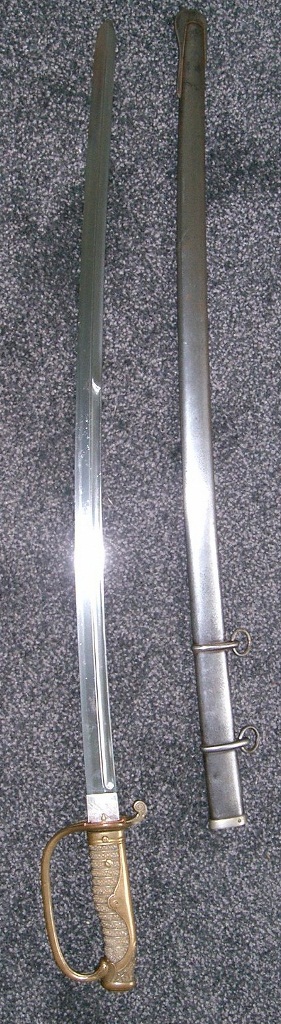
Dear Brian. A nice write up of a daisho example here, http://www.nihontocraft.com/Hayama_Enshin_Daisho.htm Here's one in kyugunto koshirae.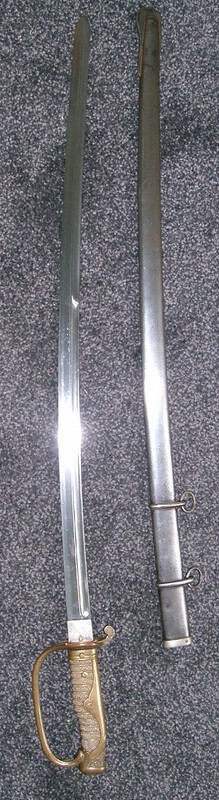
-
And of course "Echizen ju" on the other side. Look forward to seeing more, but so far this is genuine in the sense that it is an original Japanese sword. You might compare here, http://www.militaria.co.za/nmb/topic/6704-echizen-no-ju-omi-no-kami-fujiwara-tsuguhiro/ All the best.
-
Dear Kurt. My first thought was that this might be Satsuma age but from the description, (At least what Google translate makes of it!) they seem to suggest that this is something else. The other puzzle is what exactly is left of the boshi? It certainly looks as if it would not be what is left after shortening a damaged kissaki. I wonder what has been happening at the habaki moto? I look forward to others opinions. All the best.
-
Dear Carlo. This is an unusual style of yari and its saya. There is a similar example illustrated in one of Knutsen's books, the more recent I believe. The example he shows is in the Horniman Museum from memory. I have not noticed them in any other reference but they remind me f some of the more extreme arms illustrated in some samurai prints. (R and P Knutson, "Japanese Spears", 2014, Plate 16 described as "The awesome Ono-no-yari from the Horniman Museum Collection..... This must surely have been made as a parade weapon from its very size.") Looks like a nice display. All the best.
-
Dear Ken. Looks like you already have this but just to add, Japanese wooden wheels sometimes do not have the inside of the felloes radiused which creates a rather different shape. All the best.
-
Lets Play Can You Spot The Crack !
Geraint replied to lonely panet's topic in General Nihonto Related Discussion
What a shame, a pretty thing otherwise. All the best. -
Dear Matt. Pierced tsuba and all, nice one. All the best.
-
Dear Corry. (Apologies if that is not your name.) Genuine shingunto, I think I can see a small stamp above the date inscription. I have owned one gunto with a black lacquer saya so this may be original. No signs of paint straying onto the saya fittings? That might indicate a repaint. You might also find spots where the original colour shows through in places where there has been a knock if it is a repaint. By the by, is the saya metal or wood? You Ok with the mei? All the best.