Guido
-
Posts
3,242 -
Joined
-
Days Won
99
Content Type
Profiles
Forums
Events
Store
Downloads
Gallery
Everything posted by Guido
-
So it's Gimei? What do we do with it?
Guido replied to george trotter's topic in General Nihonto Related Discussion
Here's the Haynes entry: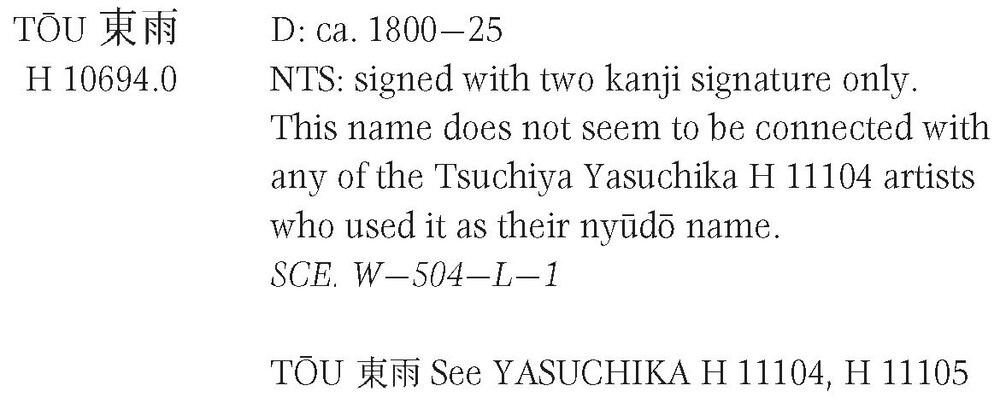
-
You don't - at least not like Western lacquer - except for Irizeshime, Ki-urushi thinned with camphor. Working with Urushi is a difficult and time-consuming process, years of proper training are needed to master this craft. You don't just buy a tube of Urushi, "dillute" it and happily paint away. It seems to become an awkward habit of mine to quote myself time and again, but FWIW, here we go again:
-
Could a mod please delete this atrocity ... pretty please?
-
My daughter made it finally back home after a 4 hours walk. Chaos in her apartment, but nothing valuable broken. No cell phone reception yet, but we skyped and she's doing fine. My inlaws, too, escaped unharmed with just a few broken dishes and other minor damage. People on the West coast of the Americas still have to brace for the Tsunami that is going to hit them in a couple of hours, but at least they can prepare themselves. I experienced a couple of strong quakes while living in Japan, but nothing of this magnitude. Waiting for hours to get news from loved ones in Japan really took a toll on my wife and me - I have to admit that I'm now not entirely sober anymore ....
-
It took me quite some time to get through to my daughter - she's "stranded" in Ikebukuro since all trains and subways suspended operations. Hope she'll make it back home to Kôenji safely ...
-
Couldn't have said it better myself.
-
A common mistake in terminology: not futatsu-ji but futa-suji (二筋).
-
There's only one Yoshifusa of note who used the Kanji 義房: Tamba no Kami Fujiwara Yoshifusa from Echizen, second half of the 17'th century - this is obviously not the one. Hawley lists two others, a Gendai smith ca. 1951, and a Shôwa smith ca. 1926, both from Mino/Seki. I'm not up to date on 20'th century smiths, but my best guess would be that it's the wartime one ...
-
IIRC, that type is called Bajô-jingasa (horseback Jingasa) or Shingen-jingasa (named after Takeda Shingen); the flat type is usually called Ichimonji-jingasa or Hira-jingasa. Ian, are you aware of any real connection to Takeda Shingen, or is that name as misleading as the so called "Shingen Tsuba"?
-
The smith is Yoshifusa 義房, the year January of Shôwa 20 昭和二十年一月. Quite frankly, the signature and date take only a little effort to read/research, even for a newbie ...
-
Huh? That’s news to me, can you name a few? And why wouldn’t they sign their swords? “Ersatz” is a German word and means “substitute”.
-
You are both right: 破門 has a couple of meanings, among them to exclude, to ban, to excommunicate a.s.o. One of the reasons why the Japanese never gave up Kanji - or in other words, switched to Kana or the alphabet - is indeed that it has all those countless homophones.
-
Tekkan or tetsuken with kurikata
Guido replied to estcrh's topic in General Nihonto Related Discussion
鉢 (hachi) can mean pot or bowl, and therefore is also used for the bowl of a helmet. But it also means scull or brainpan. I always assumed that helmet breaker for Hachiwari is one of those Western misnomers, like "battle wrap" for Katatemaki (single hand wrap) and so on. IMO Hachiwari therefore means "skull splitter" and not "helmet breaker" ("breaker" would be a wrong translation anyhow). But I totally missed this very obvious explanation: Right. Ripping off the Maedate with a specialized tool - especially if combined with a blow dart to pierce the Fukigaeshi - would be an unbearable insult, leading to a brain hemorrhage which brought instant death to the opponent. What a deadly attack! -
There are quite a few; here are some titles from my library (in [Western] alphabetical order): 本間順治 & 佐藤貫一 - 日本刀全集 vol. 6 井出正信 - 江戸の短刀拵 井出正信 - 江戸の刀拵 鹿児島県歴史資料センター - 薩摩拵 梶原皇刀軒 - 日本刀用語辞典 小窪健一 - 図鑑 刀装のすべて 小笠原信夫 - 日本の美術 日本刀の拵 笹野大行 - 刀装具の起源 東京国立博物館 - 刀装篇 東京国立博物館 - 打刀拵 調所一郎 - 薩摩拵
-
-
Yup, that's me, I can lower myself to standards so low that your consciousness can't comprehend it. Especially if I had one drink too many. Just ask the DTI regulars. I've learned to live with much more annoying things than a dedicated Guntô / militaria forum in my life, and since it's here to stay, I made my peace with it. Besides, I'm mortally afraid of wet bath towels, being alone in a room with a spider, and Brian threatening to make certain forums invisible to me.
-
Unfortunately "one size fits all" isn't one of the concepts of Kozuka - I learned it the hard way quite some years ago. Measurements (width x length x thickness in mm) can range from 14 x 95 x 4.8 to 15 x 98.5 x 6.8 and any combination thereof and in between. 1 mm is a tiny difference if the slot is wide enough, but buying the nicest (and quite expensive) Kozuka only to find out that it's 1 mm wider than the beautifully lacquered Saya slot is a real bummer, believe me!
-
Mariusz oh Mariusz, I fought that war when I was still a mod, but in the end met my Waterloo. Nice try, but unfortunately a totally moot suggestion.
-
Just in case somebody wonders where some of those pristine tassels might come from ... http://www.casiberia.com/prod_Detail.aspx?ID=sh2445
-
This thread beats the movie "The Men Who Stare At Goats" hands down!
-
Let's have a competition: who can post the most links of crappy swords on eBay? Bonus points will be given for each Chinese knock-off, and a double bonus for posting in the wrong forum.
-
Tsuba on JSA auction site
Guido replied to gtstcactus's topic in Auctions and Online Sales or Sellers
The description on the auction site says 鎌倉時代の甲冑師鍔を模した一鍔である。幕末頃の作品。- a copy of a Kamakura period Katchû-shi Tsuba made during the Bakumatsu period (i.e. late Edo). IMHO it's much younger than that. -
saru-te = 猿手 = monkey hand(s) / monkey arm(s)
-
http://www.amazon.com/National-Treasure ... 55&s=books for those who don't know the book/author. I enjoyed reading it shortly after it was published, but still wait for the movie - starring Nicolas Cage, perhaps? .