Guido
-
Posts
3,242 -
Joined
-
Days Won
99
Content Type
Profiles
Forums
Events
Store
Downloads
Gallery
Everything posted by Guido
-
There's an updated version in the articles section of this very board - and yes, he plagiarized my article extensively (except that I never mentioned that nonsense "navy polish" thing) ....
-
It actually adds to my confusion. If everybody on this forum would be in the position to make up his own mind we would have countless one-post-threads. Explanations by more experienced collectors are usually the reason why many newbies come to NMB. I also don't agree with Louis that only polishers can judge a polish. Like everything else when it comes to Japanese swords, it's a question of experience and education. I have quite often discussed polishes with polishers in Japan and was never told that my reasoning is flawed because I'm not a polisher myself; and I'm talking about traditionally trained, professional Togishi, not self-taught amateuers.
-
I think even more reshaping is necessary, and there are quite a few other points that should be addressed. However, I didn’t reply after seeing the initial post because although I’m a little puzzled as to why the polish is proudly presented in public, but discussion of it discouraged …
-
Miike MITSUYO Imperial Household Sword
Guido replied to Ed Hicks's topic in Military Swords of Japan
Nihontō are Nihontō, no matter if they were made 1,000 years ago or yesterday, and no matter what mountings they are put in. Nihontō made during WWII are few and far between, and even those are more often than not of little artistic merit. There are notable exceptions, but the difference is in the *workmanship*, it doesn’t matter if they carry a star stamp or are made at the Yasukuni shrine. I do have an extensive library, own a couple of quality blades, am collecting for more than 30 years, and have lived quite a few years in Japan where I attended Kantei sessions on a regular basis. That doesn’t make me an expert by default. I know a few people who spend little time in Japan, but I step back and listen whenever they have something to say. OTOH, I don’t see the need for pretended modesty (“I’m still a beginner”). Knowing one’s place is indeed the biggest problem this forum suffers from. P.S.: I never used the word "crap" for Guntō - to each his own, people should collect whatever makes them happy. But they only have in shape and function some resemblance to Nihontō, and are otherwise totally different animals. P.P.S.: My use of Gaijin / Naijin was meant to make a point. I'm glad it worked, but we should leave it at that. -
Miike MITSUYO Imperial Household Sword
Guido replied to Ed Hicks's topic in Military Swords of Japan
Very well said, Paul! It’s refreshing to hear a voice of reason once in a while. I’m still of the opinion that Guntō don’t belong on this board; there are quite a few other, militaria fora around that specialize in mass-produced war memorabilia. Whatever they are, they are not Nihontō to which this message board is dedicated. Having said that – and since the sword in question obviously isn’t a Guntō - back to the item itself: Miike swords are very rare. I remember having examined only two in all my years of collecting. I’m currently travelling in Germany and am therefore without my books, but if I remember correctly, Miike swords have a Chū-suguha Hamon with Midare mixed in and outstanding Hataraki, short Kissaki with Ō-maru Bōshi, a wide Mihaba and Torii-zori. Mitsuyo was famous for his well cut, wide, Kata-chiri Bō-hi. The photos posted seem to fit many of these Kantei points, but it’s impossible to tell from them one way or the other. However, there are a few points that raise a red flag: the odd, out of place (pun intended) Mekugi-ana, and the “stand alone” Kinzōgan-mei, i.e. one without a Kaō that doesn’t have the “feel” of being done in the Edo period, as well as how and where the Bō-hi ends. I don’t want to get into the strange Habaki that looks very much like the design was milled or laser cut since it could be a later replacement. If it wasn’t for the Nakago I would give the attribution the benefit of doubt, but it looks too much like an “imposter” for my taste. -
Jean, your line of "reasoning" is getting awfully close to me agreeing with Herbert on some points ...
-
Let me tell you a little secret: my secretary loves cats. She also is very keen of horseback riding, and is madly in love with Russel Crowe. She’s in her late forties and unmarried. Anyhow, cats are her whole live. A couple of years ago she wrote a book about how she adopted a stray cat and her litter in Outer Mongolia. A heartbreaking story, really. The book was published and sold 38 copies. She bought another 200 copies herself and hands them out to everyone who shows the slightest interest in the story. She’s a published author. Wow! Let me tell you another secret, this time an open secret: above a certain level of Nihontō appreciation the air gets pretty thin. There are a maybe a hundred or so serious students who can live in that hostile environment, and – surprise, surprise! – they know each other. There’s no real need to introduce one self, just reading the name tells you the story. It’s somehow like Japanese society: Naijin and Gaijin. When it comes to Naijin, they usually appear like elitist, cryptic, pompous pricks to the Gaijin who never will get beyond the “invisible wall” (as a good friend of mine always puts it). Naijin recognize Nihontô as an art form, and usually invest a substantial amount of time and money into studying their field of interest. They enjoy reading books on the subject, visiting museums and dealers, go to Japan to study first-hand the finest specimens available, discussing different aspects with craftsmen and fellow collectors, and generally aspire to learn as much as possible about the subject, often sacrificing other desires to achieve their goal. The Gaijin don’t realize that their inability to follow the comments of the Naijin is a result of their own ignorance. This ignorance is more often than not the unwillingness to spend quality time to study the subject as it deserves. They concentrate on well documented Guntō that show no artistic merit whatsoever, just because they are affordable and readily available. They collect militaria, not art. They never will become Naijin if they continue treading water. Reinhard certainly doesn’t need me to speak up for him. The Naijn know him and his credentials and what he stands for.
-
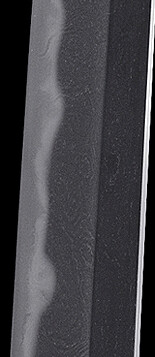
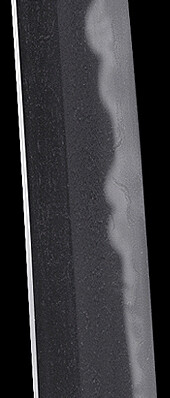
The information provided by "sho-shin" is not correct - Masamitsu didn't belong to the Kozori group. The founder of the Osafune school is thought to have been Mitsutada 光忠, followed by his son Nagamitsu 長光. The third generation is represented by Kagemitsu 景光, and the fourth by Kanemitsu 兼光. Masamitsu 政光 was a student of Kanemitsu 兼光, together with Tomomitsu 倫光, Motomitsu 基光, Tomomitsu 友光, Shigemitsu 重光 and Yoshikage 義景. Masamitsu worked, as his teacher and fellow students, in the Sōden-Bizen 相伝備前 style, incorporating features of the then popular Sōshū school 相州伝 in their work. However, the Sōshū influence shows mostly in the shape of the swords, to a lesser degree in the Hamon, and the Jigane is pure Bizen style 備前伝. Works bearing Masamitsu's Mei date from Embun 延文 through Ōei 應永 (because of the long span of time there's a theory that there must have been two smiths represented by this name); his early work resembles that of his teacher Kanemitsu, but is less massive and ambitious, and his Hamon, consisting of Gunome and Ko-Notare, is markedly more compact. On the other hand, his Ōei works are shorter, of a fairly narrow Tachi structure with more pronounced Sori, and contain more Chōjiba as part of the revivalist fashion trying to go back to the Kamakura way. It also had usually a straight type of Utsuri 棒映り. Attached are a photo and an Oshigata of a Masamitsu blade from my own collection. The slim blade structure of this sword, combined with a thick Kasane, shallow Sori and elongated Chū-Kissaki, as well as the Midare-utsuri 乱映り, places it firmly at the end of the Nambokuchō period. Although it lost its signature due to shortening, it displays typical Masamitsu workmanship of outstanding quality, and therefore received a Jūyō Tōken designation without reservation of Den. Looking at my sword and the fabulous eBay treasure presented by Herbert, there’s little evidence to support his Masamitsu attribution. If that tired Tantō would be a horse, someone had long ago shown the mercy to put it out of its misery. 40% Jūyō? You wish!


-
I think Stephen recently made one of the most profound statements ever on NMB: This is very true and very sad at the same time. It ultimately calls the very existence of NMB into question, or at least its current format.
-
Did they put a pistol to people's heads? Did they use mass-hypnosis? I really would like to know how they achieved this omnious "information monopoly". And why didn't we hear about all those Honami theories before .... ?
-
Chris, thank you for this excellent summary of my own thoughts - I got my copy two days ago, and spent the last two evenings reading and re-reading it. As you, I found many thoughts expressed quite agreeable, some theories outragous, and am still mulling over others. Quite a lot food for thought if nothing else. I also agree that this book belongs in any well rounded sword library. However, I'm feeling uncomfortable recommending it to newbies, at least not as the first book on Nihontô a newcomer to this field of collecting should read. Challenging the (sword) establishment certainly has its place in advanced discussion, but can only lead to fruitful, educated discussions if there's a common ground based on the conventional scholarship of the last couple of centuries, and especially the last 50 or so years. The euphoric recommendations of this book in another thread on NMB remind me of kids who don't have a drivers license yet, discussing the handling of high perfomance cars.
-
Ariuji-tô = carved by Ariuji
-
菱 (hishi) means water caltrop or rhombus. It's extremely difficult to trace a Kamon back to a certain family, or even individual, without supporting evidence. Kamon were not copyrighted, and basically could be chosen and changed freely. But if you wait a little longer one of the usual suspects will post a page from the Hawley Kamon book and tell you *exactly* which family it belonged to . If you're into romantic "interpretations" and not too fond of historic research you should take Hawley at face value as do many others.
-
So far I don't see any defensiveness or a potential fight - only a discussion among some more or less learned members, naturally reflection their own preferences. But it seems that anybody who isn't able to use the magic word "nice" for each and every sword or fitting that is of Japanese origin, is immediately branded as a self-righteous party pooper. O.k., I'm not going to point out the (to me obvious) differences between the examples Reinhard posted and those that started this thread. Let's instead do a group hug and sing Kumbaya. Over and out.
-
Chris, waaaay back in high school I wrote a 30 + pages essay about Picasso's "Guernica". It's a fascinating painting with an even more fascinating history. I didn't like it back then and still don't like from an aesthetic point of view, but am able to "understand" it. I understand the "tea taste" of Higo Tsuba and appreciate the workmanship, but don't find many of them appealing. I love Nobuie Tsuba although many ask me what I see in his "crude" (or "rustic" if they're trying to be nice) decoration of the plate. What kind of artistic appeal or noteworthy workmanship am I supposed to see in those "garden tsuba"?
-
Henry, don't you just hate it if we have the same opinion?
-
庭園 = tei-en = landscape garden, park edit: oops, didn't see page 2 of the thread, Henry was faster than me ...
-
I think my above post was somewhat misunderstood. I grew up in a very conservative family, and was taught from an early age on to respect my elders. That's one of the reasons I didn't mention his name. But be that as it may, it's all besides the point here. This gentleman truly believes he owns priceless treasures. Everybody else (at least those above a certain level of knowledge) knows he doesn't. There's no way of convincing him that he's wrong. The only thing we can do is to ignore his items for sale and tell newbies the reason why. I'm the first to get down on frauds with fire and brimstone, but he's not a fraud, just delusional. We should show the decency of staying away from ridiculing him.
-
Let's not beat around the bush, Mark. This seller/collector is well known in Nihontô circles, and it's a truly sad case of half-knowledge combined with delusions.
-
deckungsgleich = congruent
-
This year I'll go a week earlier than usual to Japan for the DTI since there's also a Netsuke Symposion (http://www.klefisch.com/index.php?page_id=91&lng=en) the previous weekend, worth attending for those of us who have problems wasting their money only on swords and fittings ... :D
-
三日月= mikazuki = moon at the third day of the moon calender = crescent moon.
-
Shinsakuto ...... are they Nihonto?
Guido replied to sanjuro's topic in General Nihonto Related Discussion
I think I already posted the following excerpts from the minutes of a NBTHK management staff panel discussion, held in January 1992, some years ago (don't remember where, maybe SFI?), but it's still an interesting read, so FWIW ....