

Guido
-
Posts
3,242 -
Joined
-
Days Won
99
Content Type
Profiles
Forums
Events
Store
Downloads
Gallery
Everything posted by Guido
-
Try Karl-Heinz Peuker (http://www.japanische-schwert-galerie.d ... /start.php), honest & reliable, and a very nice guy on top of that; he will answer all your questions, and can get your item to Shinsa.
-
Chris, I thought the question was answered ... kind of ... but anyhow, here's my take on it: Jūbi can be exported, Jūbu & Kokuhō not. All pre-war Kokuhō were re-assigned as Jūbu, and therefore have to stay in Japan. If, for example, the Honjō Masamune is brought to Japan, it can't leave the country anymore. If it also would be returned to its original owner is a question for a lawyer. All those famous paintings found in Germany recently will be returned to their previous owners, but the Chinese are fighting for years to get back those ancient bronze animal heads, and the British Museum rejected claims by a couple of countries to return their national treasures. International law seems to be kind of a grey zone when it comes to the status of art objects displaced during and after armed conflicts.
-
The name of the sergeant who got possession of the Honjō was noted as コリーディバイモ (ko-rih-di-ba-i-mo) by the police officer who surrendered the swords (please note that there is no "・", which is usually used between given and family names of non-Japanese, so it might well be just one, i.e. family, name). Concluding from that he was an African American Sgt. named Colonel Davey Morrissey is as absurd as it gets, and doesn't really need any commenting on. That's all, folks. As they used to say on "Dragnet": just the facts, Ma'm.

-
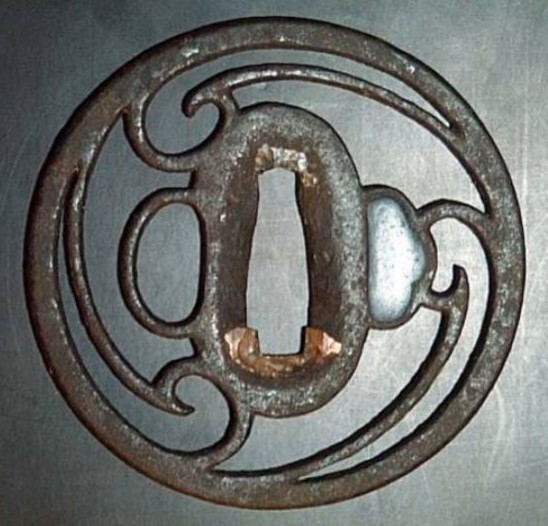
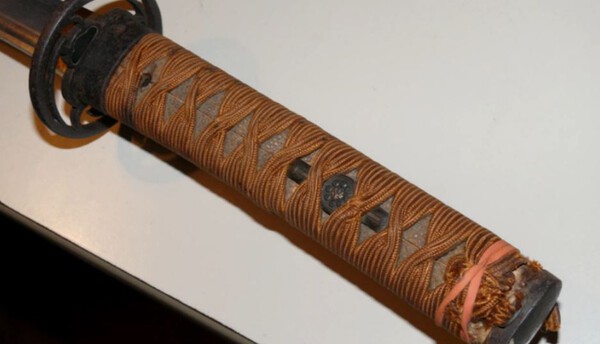
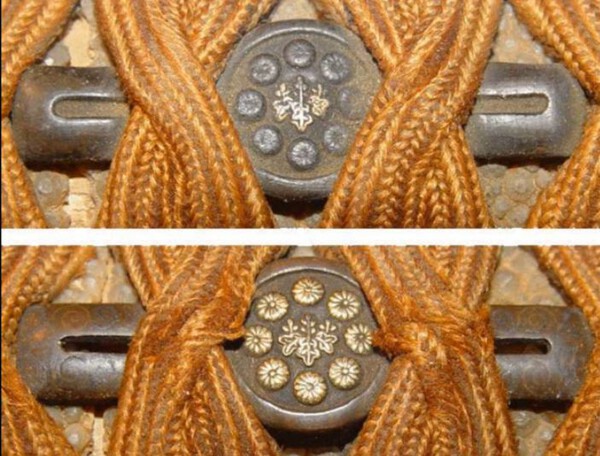
The Koshirae: Momoyama period Uchigatana-koshirae, the Tsuka has black Samé, indigo-blue leather Tsukamaki, the Menuki are pairs of three Kiri, the Tsuba and Fuchi have a Kiri and Kiku motif, the Kozuka and Kōgai are Kiri in gold. In other words, a typical Tenshō-Koshirae. Stephen's Koshirae doesn't match this at all, and of course there is neither a Kozuka nor Kōgai:
-
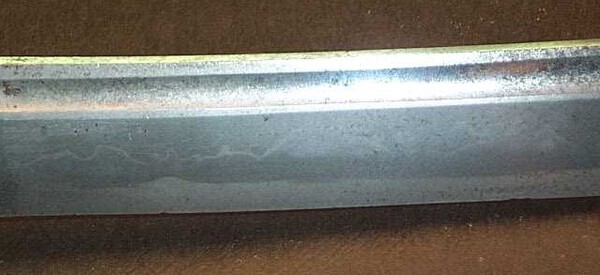
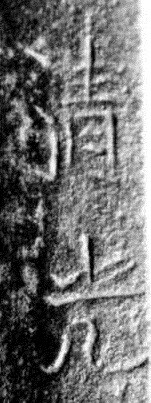
Although it might appear that way to some, I'm actually not as obsessed with Stephen Thorpe (a.k.a. Steve a.k.a. Zack Crebber a.k.a. Lucien Berry a.k.a. fiddlin4you) as he is with the Honjō Masamune. He constantly manages to annoy me, but I promise that these will be my last words on the matter (of Steve, not Masamune). I would hate to continue seeing respected members of this forum falling for his delusions. It actually all started in 2003 when Stephen T. posted on SFI At that time he claimed that the sword was appraised at US $ 600,000,000.-, which he later raised to US $ 2,000,000,000.-. Two billion, for those weak with zeros. He constantly changed his story, though: one time he was just helping a friend, the other time he owned the sword himself. It was buried, then it was not. The NBTHK confirmed it as real, then they even didn't know about it. And so on and so on. After some skirmishes we had on at least three forums (I already linked to some threads), he stopped posting. He even PM'd me and apologized. I'm not the unforgiving, resentful guy some think I am, so I left it at that. I even was very happily surprised when he went out of his way to scan the de-classified US Govt. documents relating to national treasure and other important swords after WWII, and posted them on NMB. I still commend him on that, and thought he finally got around. As this thread shows, I was painfully wrong. Brian, of course there is no answer, and there never will be one. But it's not too difficult to put together pictures of his "Masamune" from what he made public so far. First the blade. The description in the Meibutsuchō states that it has no Horimono (which includes Bo-hi) and is Ō-Suriage Mumei. Stephen's sword has both: a groove, and it's signed "Kiyomitsu" – the way the signature is written makes it easy to identify it as a work of one of the Kaga Kiyomitsus.
-
Oh, he did so some time in the past. I remember seeing pictures of the parts of the Koshirae sealed in plastic bags before he burried them (I' not sure if he posted those in public or PM'd them to me). Neither the blade nor the Koshirae have the slightest thing in common with the description in the Meibutsuchō.
-
Adrian, since you joined NMB, you made more than 650 posts, 1.5 a day on average. There is not a single one among them that contributes in any way to the advancement of Nihontō (or Nihontō related) studies. Zero, nada, zilch. They are without exception opinion-based. You only pop up when you can argue for arguments sake. You are the textbook example of a troll, so no wonder you take another troll's side. It is beyond me why Brian lets you continue posting here, but it obviously feeds your delusion that your opinion is as valid as others. Learn to just shut up when adults are talking, and one day you even might learn something.
-
What a wonderful example of the Dunning-Kruger effect.
-
Sorry, but you don't qualify for this job, so we gave it to "the other Stephen" ...
-
O.k., I think the cat is out of the bag: since Jacques is lying low, we called back Stephen, because NMB needs at least two extremely annoying forumites at any given time.
-
Guys, don't feed this troll again! This is going on for at least 8 years, part of the story can be found here viewtopic.php?f=1&t=505 and here http://forums.samurai-archives.com/viewtopic.php?t=553, and especially here: http://www.swordforum.com/forums/showth ... UNE-katana.
-
WWII NCO swords have Tsuka made of metal simulating Tsukaito and Same, but I, too, have never seen something like that. I wouldn't exactly consider it "eye candy", however - just because something is rare doesn't automatically make it desirable.
-
OMG, not again, please ...

-
Real smoked bamboo (Hon-Susudake 本すす竹) is exactly that, smoked. In the old days people put fresh bamboo into the rafters of Minka (farm houses) above the fire place for at least a year, usually much longer. Nowadays craftsmen use smokers, and are quite secretive about their methods. But there is no shortage of this material from old houses, and a sizable piece can be bought from Namikawa Heibei for just 1,000 Yen (http://www.namikawa-ltd.co.jp/cgi/item_ ... e=14&no=28). BTW, bamboo is the preferred material for Mekugi, because even if it breaks, there are still enough fibers left to keep it together; horn just snaps. That's why swords that are meant to be used have bamboo Mekugi, and Shirasaya and "display Tantō" have horn Mekugi. IIRC, Keith Larman and Ted Tenold sometimes use Delrin as a Mekugi material: polished it looks like horn, but is as strong as it gets.
-
I know that Noshû Tôken (http://www.nosyu-token.jp/) sells Tsunagi (and Saya and Same and horn parts and so on), they always have bundles of them at the DTI.
-
Naginata (nagamaki) naoshi yokote
Guido replied to Marius's topic in General Nihonto Related Discussion
A Ko-Uda blade with Ayasugi-hada? That sounds indeed most interesting. -
Do you mean Chiisagatana? It's one of those wrong labels that seem to stick forever. Somehow people got the notion it means a Wakizashi length sword mounted in oversized Katana fittings. A Chiisagatana is actually (at least from the Edo period on) a Tantô mounted with a a Tsuba and handle wrap, much like a regular Katana or Wakizashi, just on a smaller scale. Both: the style is Hineri-maki, which is done in two colors.
-
He's just following your lead - have a look at the "sick" nail in your signature.
-
This style is called 色違ヒネリ巻 iro-chigai-hineri-maki.
-
There are quite a few Kodōgu maker who signed Kunihiro. The Kunihiro is considered as one of the founders of Shintō - one of the top smiths in Japanese sword history.
-
The second character is 臣, not 長.
-
Naginata (nagamaki) naoshi yokote
Guido replied to Marius's topic in General Nihonto Related Discussion
Most swords don't have an abrupt "change of angle" at the Yokoto - the Yokote is usually placed where the Koshinogi starts to narrow down. However, putting a Yokote on a Nagamaki (-naoshi) looks a little awkward in my personal opinion, I guess it's up to the taste of the owner and/or polisher if one is done or not. -
Signed (Rai) Kuniyuki Tachi - NBTHK
Guido replied to Curran's topic in Auctions and Online Sales or Sellers
We desperately need this kind of smiley:
-
Can't find the smith either, but the Mei should indeed read Shigekazu (or the modern reading Shinichi).
-
Actually it was me who posted that information, and Mike confirmed it.



