Guido
-
Posts
3,242 -
Joined
-
Days Won
99
Content Type
Profiles
Forums
Events
Store
Downloads
Gallery
Everything posted by Guido
-
Barrie, consider yourself lucky the traditional pine tar wasn't used - you should be able to get out the paper with a pair of fine pincers. A couple of years ago I talked a dentist I know out of some of his old instruments. There's a tiny, heart-shaped spatula, and the different spirals used for root canals that I like the best for this type of work. They don't only do the job well, it also gives me immense pleasure to imagine the agony they previously inflicted ...
-
The stash I've seen at a Mukansa's house (10 or so blades) only lacked the mei and final polish/habaki/shirasaya since those other craftsmen are reluctant to work on an unregistered blade. He told me that if a customer orders a type of blade he has "in stock", he only signes it, puts a date on it, and "made for X". Then he registeres it and sends it out for polish etc. So much for "this blade was custom made for me" ...
-
Not trying to re-open a can of worms, just filling in a blank: Fujishiro writes indeed that Yoshihiro changed his signature from 義廣 to 善弘 to 義弘. However, this is not mentioned in any of my other (Japanese) books (and I have quite a few :D).
-
My wife of 25 years is Japanese, too. Having said that, I a) don't understand what relevance the nationality of a spouse has in regard to this topic, and b) what's wrong with being paid for services rendered? Do you work for free (except transportation reimbursement)?
-
It's your own fault. Until you become a naturalized Japanese, don't expect any respect. And even then you'll lack the proper DNA. Dear Spaghetti Monster, don't make me going down this road again ...
-
One could write a psychology PhD thesis on this thread alone ...
-
-
Same family, but as I pointed out already, there's a difference between daikon and kabu, Pete's fuchigashira is showing the latter. The longer this thread goes on, the more I have to agree with Curran about overanalyzing ...
-
The giant one, yes, but usually it's called kabu 蕪. As they say in Thailand: "same same, but different" :D.
-
Good point, but how much staple food-themed kodōgu have you seen? I don't think fittings makers got ideas for their work from what was on their dinner table. I have no proof, of course, but the possibility that a fittings theme hints towards a military strategist instead of the neighborhood vegetable store is IMO more likely.
-
The turnip is also associated with Zhūgě Liàng, the famous strategist from the Three Kingdoms period of China, the story of which was very popular in Japan. Zhūgě Liàng ordered the pickling of turnips, so his soldiers could have salt and a vegetable for their rations. In China it's still called "military pickle".
-
I clearly remember having seen a couple of tokubetsu jūyō swords by Hizen Tadayoshi, so shintō have already received those papers. Not sure about shinshintō, but I *think* I remember at least a Sa Yukihide and Kiyomaro.
-
Thanks to Paul Martin - 2014 - NBTHK Competitions results
Guido replied to Jean's topic in General Nihonto Related Discussion
The Masamune Award (for producing nie of the most outstanding quality) is seldomly granted, and even mukansa (but not ningen kokuhō) are eligible for this most distinguished prize. I don't remember when it was last awarded; the Kawachi Kunihira sword should be spectecular! -
Austrian MA canditate . She focuses on iconography (i.e. identification, description, and interpretation of the content of images), so the quality of the tsuba isn't that important, and her explanation of the differnt tsuba "schools" is quite good. However, I agree that the examples are mostly just dreadful - being in a museum collection doesn't automatically make them worthwhile.
-
Juyo Toso Daisho Koshirae....
Guido replied to Soshin's topic in Auctions and Online Sales or Sellers
In my experience, wakizashi often have a kozuka, occasionally a kōgai as well; katana occasionally have a kōgai, and very seldomly a kozuka. We're looking here at the fully loaded version, the Mercedes S-class of the Edo period. :D -
You're probably right, but now it's on record, and we can rub people's noses into it.

-
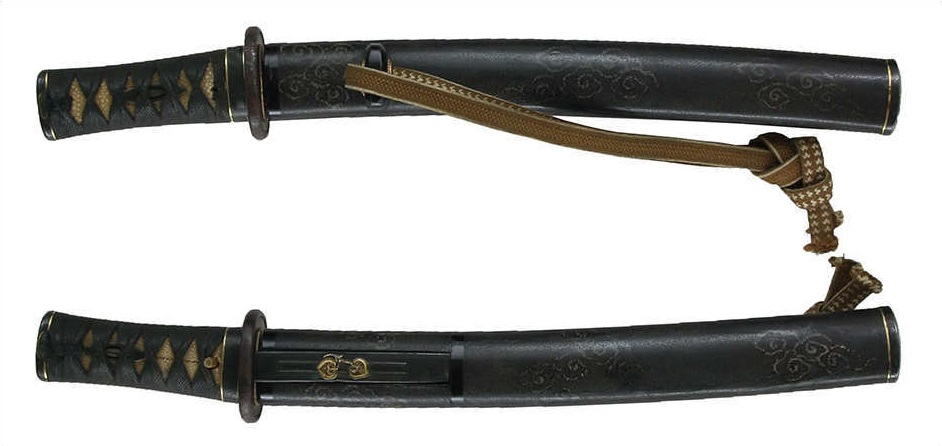
Seeing a koshirae on Aoi Art today (see attachment), I couldn't let the opportunity slip to post it here in the hope that it will put a die-hard urban legend to rest – the all too common misconception that chiisagatana 小さ刀 (often misspelled "chisagatana") stands for a sword slightly shorter than a katana (i.e. wakizashi) but mounted in a katana-sized koshirae. Kind of a make-believe katana, usually explained as a merchant or ninja sword, intended to hide the actual length of the blade. Even some seasoned collectors stick stubbornly to this nonsense . Before the uchigatana came into being, shorter swords mounted differently from tachi were called chiisagatana or koshigatana 腰刀 (hip-sword). Chiisagatana, which literally means "short katana," are tantō or sunnobi-tantō mounted in a similar fashion as a katana. Another term for chiisagatana is tsubagatana 鍔刀 or "sword with tsuba," as opposed to aikuchi (“meeting mouth”), which is a tantō without tsuba. Although the meaning of chiisagatana changed over the course of Nihontō history, this term was used from the Edo period on to describe tantō that had a tsuba and usually tsukamaki as well. This is a typical example:

-
Please, someone stop me from going to the root cellar and unchain my evil twin ...
-
I disagree. What good does all the knowledge gained do if one isn't willing to pass it on to the next generation? That's what this forum is all about. In my experience, people who claim to have some "secret knowledge" are simply living off this myth, hiding their actual lack of knowledge behind it. I also would caution against the impulse to take comments at face value because the poster is into swords / fittings for a long time. There are quite a few old-timers who were ahead of the crowd in the sixties and seventies- the one-eyed is king among the blind - but never advanced their knowledge, and are resting on their laurels ever since.
-
Camellia oil with a few drops of clove oil was - and still is - used traditionally. Clove oil (or rather the eugenol in it) has antimicrobial and antifungal properties. Mineral oil (liquid petroleum) came into use during times of high demand, probably at the beginning of the 20th century and especially WWII. Camellia oil has a pale yellow color with a sweet, herbal scent. It has a shelf-life of about 18 months. It tends to harden after some time on the blade, that's why Uchiko is needed to remove it. Mineral oil is odorless and clear and can be applied in a thinner film. To entirley remove it, pure alcohol is best (which also doesn't leave any discoloration). Mineral oil is sold with and without the addition of clove oil, Fujishiro oil is the latter. It's basically the same as sewing machine oil. I don't know what Fujishiro Uchiko consist of, but if one uses light mineral oil, the application of Uchiko isn't neccessary anyhow.
-
To me it looks like the the blade is Suriage and Machi-okuri, and that in the process the Nakago was reshaped. I find it highly unlikely that this was done for a pre-existing Tsuka. There was no need for that back in the day, having a new Tsuka carved wasn't a big deal. Also, someone who actually used a sword wouldn't risk to have a Tsuka that wasn't a perfect fit.
-
Thats a common misconception, it actually happened frequently. Mr. Tanobe even writes in his article about Gimei (Nihontô o Miru, translation by Markus Sesko) This was especially done with (originally unsigned) Shiiremono; the idea behind it was exactly the above reasoning, i.e. (fake) signatures of lesser known smiths are also less suspicious.
-
I always thought that "vet bringback" on eBay translates to "I-hope-nobody-detects-in-the-blurry-pics-that-it's-a-Chinese-fake" - learning something new every day ...
-
Yes, it probly has seen a few polishes, but it still looks proportional, i.e. no major change of its geometry. I think it's save to say that it was very narrow from the beginning. Indeed an unusual blade.
-
A Kodachi is kind of a scaled down Tachi, so technically speaking this sword is not really one because of the length. However, I can understand why Tsuruta-san calls it Kodachi, it certainly hasn't the usual measurements, and Kodachi means small Tachi anyhow. Well, yes, it isn't really small, but narrow But does it really matter? All this getting ones pants around the ankle because it doesn't fit the textbook description is kind of silly ...