Brian
-
Posts
21,858 -
Joined
-
Last visited
Content Type
Profiles
Forums
Events
Store
Downloads
Gallery
Everything posted by Brian
-
NMB 2007 RAFFLE:- PRIZES REQUEST
Brian replied to Brian's topic in General Nihonto Related Discussion
Rich, Wonderful prizes I was really hoping to have one of Darcy's books, but a friend "permanently loaned" my spare..lol. Fantastic to have a copy as a prize. I bet the video is also unique and will have the winner drooling over the items shown. Much appreciated! Brian -
It is intriguing, isn't it? I like it, and think the price will probably have a hefty jump near the end. I don't think the underside is representing a mushroom...I think it might be the walls of a cave with that texturing. Pretty unique, and the motif has that feeling of slightly commical imho. Brian
-
NMB 2007 RAFFLE:- PRIZES REQUEST
Brian replied to Brian's topic in General Nihonto Related Discussion
Many thanks Paul I think those 3 will go great together as a nice prize. Also something to encourage our French-speaking members to buy some tickets Also something for our armor enthusiasts. Brian -
I think Mike summed it up quite nicely. Reinhard does have a point though..as do most of the people in this thread. The correct advice is to avoid ebay until/unless you have a solid background knowledge of Nihonto. Yes, there are some nice deals there, and some good dealers, but you need to invest in books first, then see good swords..and once you know what you are looking for you can go looking for good deals. Some of the top dealers sell on eBay, so if you know your stuff, then by all means buy wherever you choose. But as we always tell newcommers who come here with a fake they just bought: Buy books, see swords, meet up with other enthusiasts...and then buy your first sword from a reputable dealer. As for all or nothing. Well.... there are NO swords for sale in South Africa here. And very few good ones to look at. So online is a necessary evil, and I was lucky enough to have arranged a trip to Japan to see good swords. But if it was a case of all or nothing then we wouldn't have this forum Not everyone has to be a purist in their own field. Some do it just for fun. Many eventually sell their 5 or 10 mid-level swords and buy one Juyo one. There is always a place for low to mid level swords, and not everyone has the money required for top class items. But always strive to improve your knowledge and collection, as having 20 junk blades does not benefit your knowledge. I think this subject is now officially flogged to death, so let's leave it at that. Brian
-
Hi Robert, Looks like a nice blade, and still fairly healthy. At a quick glance (and I may stand corrected) it looks like a naginata-naoshi to me. A naginata (or nagamaki) that was later cut down and reshaped into a wakizashi. This was quite common when the need for polearms subsided, and styles changed. Let's see if anyone agrees. Regards, Brian
-
NMB 2007 RAFFLE:- PRIZES REQUEST
Brian replied to Brian's topic in General Nihonto Related Discussion
Jean, You are a gentleman Thanks, that will definitely make this a worthwhile raffle. Surface is by ship..as by submarine would have to be sub-surface :lol: Thanks folks..keep them comming. The more prizes, the more prize winners. Brian -
NMB 2007 RAFFLE:- PRIZES REQUEST
Brian replied to Brian's topic in General Nihonto Related Discussion
Thank you Bob, that is very kind A great book too. I will be in touch shortly via email to sort out the details. Regards, Brian -
Hi all, As we approach yet another year end, I am once again hoping to have a Nihonto Message Board year-end raffle. Last year we had a generous donation by Alf Tan of a tsuba, and thanks to the funds raised, we were all able to enjoy more bandwidth, upload space and a free forum. As you all know, the NMB is offered free of charge with no paid advertising, and we hope to keep it that way. With all the helpful info and assistance provide by the members here (I hate to name names, as I am guaranteed to miss a few and offend, but we all know how much help we get here from these guys) I feel that the info provided is unique and valuable. Where else can you be warned about a fraudulent auction within minutes of it being listed, get a difficult translation within hours, learn photography tips or take a previously unknown "Nobuhira" tanto from auction to papers to publishing? Discussions give ideas for new articles, which end up in official newsletters. People ask for advice before buying something, and are therefore better informed before the sale. Fakes are identified, gimei are analysed, and drooling over nice new finds is encouraged. Many of us have used the free "For Sale" section to either advertise our goods or sales, or pick up good deals. Dealers are able to advertise when they have new items, and con-artists are identified and "outed" And all of this for the cost of an internet connection. With this of all in mind, the raffle is the one way I have to raise some funds to cover the daily expenses of the board. These include the hosting plan, web access and phone bills (Yep, I am sadly still on dial up) Tickets are only $10 each, and everyone who enters stands an equal chance. Those who enter have my sincere thanks for the support. In order to make this all worthwhile though, we need prizes. The more prizes the better This year I hope to make it even more enticing to enter. I am already sponsoring a book and a membership to either the JSSUS or NCJSC (If there are representatives of either of these on board, please could you contact me, as I wish to work out the details of paying for a membership for the winner) What we need is donations of prizes that we can offer. These can be in the form of Nihonto books, tsuba, fuchi, kashira, menuki, kozuka, kogatana....etc etc. Anything of interest to a Nihonto collector. Many of us have the odd fitting lying around that we can part with, or 2 copies of a book on the subject. Maybe you do restoration and would like to offer a tsuka rewap, or have something else that you don't need anymore. Look around your sword room and see what you have forgotten about that you won't miss too much. Offers are not expected, but are very much appreciated. I would like to make this a memorable raffle, with nice prizes to encourage even the most advanced collector to have a go. Shipping to the winners can be paid for by the NMB, or sponsored. They can be sent here first or directly to the winners. Whatever works for you. I am trying to avoid any repros or really bad fittings that are not of interest to real collectors. Doesn't have to be top class stuff, just reasonable items that will enhance the raffle. I would love to have a nice 1st place prize if anyone has anything in mind. Milt...you are in charge of contacting old "Po-Edo" since he gets so much advertising here :D (joking) I have had some offers mentioned by generous members earlier this year, but do not want to take anything for granted, so will allow anyone who has anything to offer to contact me to sort out the details. I would like to start the raffle at the end of October, and the prizes will be drawn on the 1st January 2008. I hate asking for anything, but in order for this to be a success I am forced to make this appeal. I thank everyone in advance for any offers, and if you can't donate..then make sure you pick up some tickets when the raffle begins. Regards, Brian Robinson
-
Hi (Please sign with a name as per the rules) The nco shin-gunto's have totally machine made blades, and the tsuka is not readily removable. They are almost never signed at all, and not made by a smith at all. The tsuka is held in with a metal bolt and nut, and removing the tsuka would probably serve no purpose. No hamon or hada either. Also, in this case, the numbered habaki and other oddities make me immedately think it is a fake. Typically, Japanese swords with numbers exactly like this on the habaki are found on Chinese fakes, and the other inconsistensies probably back this up. There does appear to be some age to it, and the wear does confuse a bit, but if i had to make a judgement on it, I would have to go with the fake call. If you look at the fake Japanese swords link in the links page above, you should get an idea of the reasoning, and also take a look at the various military sword webpages that describe this model in detail. Hope I am wrong, but I think it unlikely I'm afraid. Regards, Brian
-
Genuine tsuba, genuine signature (meaning it is really signed in Japanese) As to whether it is gimei...I'll leave that to the experts The strokes look very hesitant and not fluid to me. Kinda forced. Could be wrong though. Looks to me like the nakago ana was widened at some point to fit it..leaving some kanji overlapping the ana. Not a fake tsuba though. Brian
-
Darn Darcy, nice looking piece I wanted to jump at it the first time you posted, but with the finances I was unable to commit to your request to have it polished and papered in the near future. I think this one is lovely, even with the nakago as is. A real pity about that though. Still like it though. Would love to see this as it progresses. Regards, Brian
-
Dr T. I can't thank you enough for that insightful and useful information. It is a pleasure to have you on board, and your website is one of the ones many of us read frequently, as the articles are excellent. It is one of the more popular links on the NMB links page. Many thanks. Brian
-
You are forgetting...it is not iron, and not sukashi :D :lol: (joke) I love this tsuba, but I do understand when collectors get past the beautiful kinko stuff and start delving into the metal preparation, sukashi cutouts and early forged iron plates. Different type of appreciation I guess. I can't claim to get it completely yet, but am working on it, and every now and then I make a breakthrough Brian
-
Indeed. I can only agree with what Darcy wrote. It is much appreciated by all on the forum, and from the pm's and emails I receive, we are all indebted and grateful to all those of you who work so hard sharing the knowledge you have, whether it be languages, metalwork or research. These thanks also go out to all of you out there who assist with any info you provide or with the actual running of the board itself. Brian
-
Thanks Benoit, I've been waiting for this one to be released. At over 400 pages, looks like it will be a worthy companion to the F&G book. I'll be ordering my copy. Brian
-
As owner of the forum, I get the privilege of shamelessly bumping my own post here :D :lol: I was hoping someone had decent Showa/Gendai books, as all I have is Hawleys and Slough, which aren't much help with this one. Brian
-
Talk about heavy hitters!
Brian replied to Grey Doffin's topic in Auctions and Online Sales or Sellers
Not sure what you mean there Grey...but I do like my grain to be on the blade, and not in the photos :D Surprised he didn't add "has a very visible grain" :lol: Brian -
Nice tsuba. Not quite priceless...but very nice Same theme as the one Milt posted about here: http://www.militaria.co.za/nihontomessa ... php?t=1983 Although his is a parasol, and the posted one is "straw hats" Brian
-
Yep, they can do that. If the material and cloth is not cotton-based, then you can heat a pin or nail, and once you have drilled through the wood, you burn the edges of the hole so that there are no edges to get caught by the screw. Don't everdo it, just burn the circle a bit so that it won't be visible when the peg is replaced, but the screw can go through cleanly. Brian
-
That is the big question :D Another ferric chloride polish that hides everything I need to see, and makes hamon appear everywhere. It is nasty stuff...even worse than mild acid I believe. Seeing it too damn often, and ppl should be strung up for using it. I do believe it looks like a koto though. The rust and corrosion on the nakago would bear that out, but I would have to post pics to get more of an idea. The multiple ana would also lean me towards koto. I don't get the impression of o-suriage though. Might be one of those things that I have to forever wonder about until I can afford to have it polished and papered. The ana could just be some odd variation on a whim, or it could be an indicator of what we have been discussing. Didn't see much info on the square or keyhole ana anywhere, but your info certainly does bring us some interesting possibilities on some of these blades. Brian
-
Pete, It's a wakizashi, nagasa around 43cm, shinogi zukuri. Needs a polish badly, looks like there may be some hitatsura. I'll post some pics when the light is right outside, I get horrible pics indoors. Brian
-
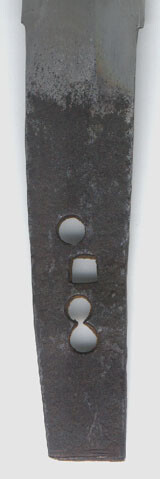
Pete, Here is the nakago in question. I believe it is slightly suriage, and the nakago has a slight bend too. :? It definitely looks punched that way. The yasurime are not visible, and look to have worn off over the years. Brian
-
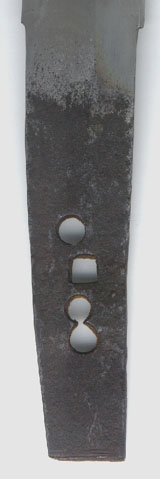
Pete, Your pic brings up an interesting question that i have been wondering about. I have a waki that has multiple mekugi ana, and one of them is deliberately square. I have also seen posts occasionally with theories that square mekugi ana can sometimes be linked to early swords. Looking at the posts of the ones you attached, it would make sense for the ana to be square or rectangular instead of round. Does anyone have any theories or examples of mekugi ana that are not round? I have also heard of them being keyhole shaped, and not caused by 2 ana crossing over into each other. Brian
-
By CAP FROM THE PEG THAT SECURES THE BLADE IN A TANTO OR SHORT SWORD I assume he means a single menuki. Menuki were originally positioned over the mekugi before they became less utilitarian. Entirely possible. Whether it is part of a saya inlay or menuki or other decorative motif, they all fall into the same category I expect. Quite possible it is a menuki though. Brian
-
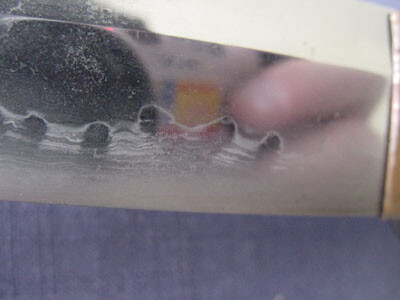
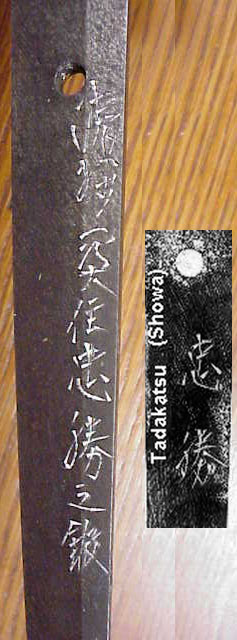
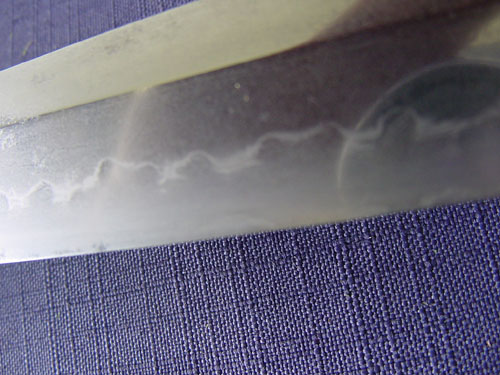
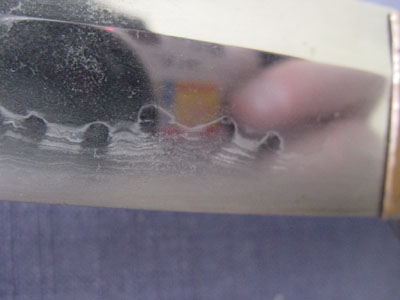
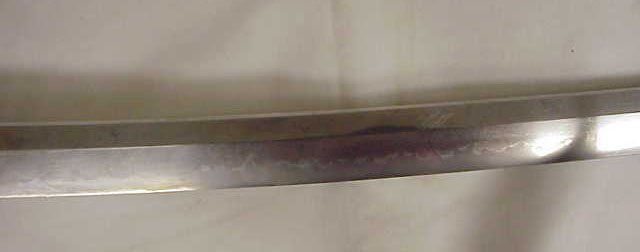
Hi all, I have posted about this one before, but wasn't able to find out any info about the smith, or whether this one could be a gendaito or not. It is signed Noshu Seki ju Tadakatsu, and there isn't much info to be found on him in any of my books. Dr Stein's site only has him as a Seki smith, and made showato. This one has an interesting hamon, but due to the fact that someone (*sigh*) has used that old enemy of Nihonto...acid or ferric chloride...the hamon has gone overly white and the nie/nioi and hada is not showing. I feel that the hamon does not look remotely oil quenched, and those contrasting lines might polish up to show some nice hataraki. I am not sure exactly what the ferric chloride does show, and if the lines that look like sunagashi and chikei would disappear with a polish, or show some nice hataraki. They might just be differing hardnesses in the metal, or maybe follow hada if it is there? A good reason to avoid the use of any chemicals in "polishing" What you see afterwards is seldom what appears to be there. So my questions are as follows: Does anyone have any books with any info on this smith at all? Does this look like it might be a Gendaito, or just a Showato? Looks like the hamon might be choji based, which isn't common with oil quenched blades? Any other comments? The koshirae is civilian and plain, and there are no stamps to be found anywhere. As seen, the mei does match the Showa one on Dr Stein's site. Thanks, Brian