Brian
-
Posts
21,859 -
Joined
-
Last visited
Content Type
Profiles
Forums
Events
Store
Downloads
Gallery
Everything posted by Brian
-
Can anyone assist with some advice? I may be going to Japan over November, and am trying to plan my trip. So far everything except 3 days is planned. I am looking for somewhere to go for 3 days, inbetween Kyoto and Tokyo and surrounds. However I am not necessarily looking for somewhere that is all shrines and temples. That is fairly well taken care of. And it doesn't have to be filled with architecture or hot baths. Basically we love to browse old areas that have lots of dingy little antiques stores that I can spend my days in. I didn't think it existed until last time I found an area of Takayama filled with antiques stores and interesting little shops. So I am hoping there are towns or cities that have old areas with shops like this worth spending a few days in. I don't mind large cities with areas like this, or smaller towns. Something that will keep us occupied for 3 days. Anyone know any places worth visiting? I am considering checking out cities like Kobe, Nagoya, Yokohama or Shizuoka.....but don't know the smaller places worth looking at. Tokyo/Kyoto/Osaka are taken care of. I have thought about Nara, but that might be not worth 3 whole days? Izu area is expensive and will be on a tight budget. Would have to be easy to reach from the shinkansen line btwn Tokyo/Kyoto. So..what advice does anyone have? What is out there for antiques hunting and might be interesting with a little (but not too much) castle/temple vibe? I'm flying blind here, so any info would be appreciated. Brian
-
Hehe. We aim to please Bob, I am sure someone will assist with a translations shortly, but since learning is the aim of the game, we always encourage members (everyone watching too) to have an attempt at them, no matter how wrong or how much of the translation is attempted. It encourages kanji recognition and learning a bit, and before you know it, many of the symbols will become familiar to you. Not a requirement of course..just a general suggestion to everyone. Rich's page is very helpful at http://www.nihontokanjipages.com ...And of course mention if the info is to be used for commercial sale as some prefer to know in advance. Regards, Brian
-

DTI/Taikai Tokyo 2008
Brian replied to Brian's topic in Sword Shows, Events, Community News and Legislation Issues
So far so good..keep 'em coming. Looks like I may make it too. Busy making arrangements and selling a kidney :lol: Brian -
Mumon or mumei, and is there a difference in meaning? Brian
-
Guido is traveling a bit and heading soon for China, he'll be back shortly Reinhard is being diplomatic I think. The honest answer is that yes, those swords exported with the torokusho attached are exported illegally. If they ever go back to Japan, I doubt they will make the connection to the old license unless it accompanies it, but I wouldn't want to chance it. I wouldn't be happy with a sword that wasn't exported legally. Check that what you have is the original license, as some sellers make a photocopy for the buyer..which may be confused with the original? The original should never leave Japan afaik. Brian
-
I see Suke/Taka Masa x, but that doesn't make much sense? Brian
-
Hi. I was just wondering who will be in Tokyo this year for the DTI/Taikai week? Brian
-
Kevin, Nope, I still don't load the pics, neither from work nor from home. Something very odd with your hosts, yours is the only site that does this. Brian
-
Kevin, No. The license paper does nothing to verify shoshin or not. It simply states the sword is licenced and says what the sword looks like for identification purposes, including any mei on it. However they make no attempt at all to verify authenticity. It is worthless for any purposes besides legalities. Brian ETA - Piers..fast fingers there! :lol:
-
Hi Lee, If the signature and cutting test are genuine (they are very often faked) then whomever chopped it took off a few $1000 off the value (historical value too) Worth following up on though. Even if gimei, it might be a nice blade. Will have to find other examples of this smith's work to compare. Brian
-
Yoshitake daisho - Yes its back on eBay...
Brian replied to samuraisword's topic in Auctions and Online Sales or Sellers
Is it possible that the account was a stolen/hacked one and they have now restored it to the rightful owner? Just wondering. I think someone needs to speak directly to eBay and get some answers from them. Otherwise tell them we will keep bidding these auctions up to $100K and not paying. We have enough accounts that are not blocked. Brian -
Yeah, I was wondering too if the fact that it is a little tired hasn't affected the hada a bit too. We wouldn't be seeing the traditional Hizen hada if it has had some of the outer steel polished down over time. Brian
-
Yep, Knutsen has the 2 books on polearms. The latter one is supposed to be an update, but there is some different info in each, so best to have both. Otherwise get the new one, it is the best of the 2. I have both, and there isn't much more info available in English anywhere. No doubt there are good books in Japanese though. Brian
-
Yoshitake daisho - Yes its back on eBay...
Brian replied to samuraisword's topic in Auctions and Online Sales or Sellers
Ok, I'm confused now. The listing was withdrawn by eBay, and it seems like all the other item numbers also show invalid now, so none of the fraudulent listings are visible as proof anymore. And am I correct that the seller is lindy2277 ? Because if you check their feedback now, it is at 100% positive with no negatives. http://feedback.ebay.com/ws/eBayISAPI.d ... world=true Is this the same seller, because if it is, then there is something very strange going on here. Brian -
Another Kogarasu-maru in WWII Mounts?
Brian replied to James's topic in Auctions and Online Sales or Sellers
Well done Grey, was going to do it myself. Frankly, when you hear those silly stories of "unable to take more pics because I am traveling and the sword is with me" you just have to wonder Brian -
Question regarding an Ebay item
Brian replied to Taygrd's topic in Auctions and Online Sales or Sellers
:lol: Also, a straight single line must be one of the easiest mei to fake..and yet they still managed to make it look hesitant, uneven and wrong Brian -
Fritz, That is a good question, and I'm afraid is one that might never be answered. Probably not the horimono carver, and without further info, you can't be certain. Sometimes there were collaborations between makers, but nothing to verify this either. I saw the other thread, and the guy that suggested the horimono carver, would be guessing, as usually that would be stated on the nakago. There are a few possibilities, but nothing can be said for sure unless you know how to go back in time Even the horimono could be original or done later, no way of knowing for sure. I would suggest getting a window polished and someone to look at it in hand to count out retempering, and see what the blade looks like in polish. It seems maybe worth a polish. Wish I had more militaria to offer as a possible gamble in trade. WW2 FS knives? ZF4 Scope?.... :lol: Brian
-
This Week's Edo Period Corner
Brian replied to Bugyotsuji's topic in General Nihonto Related Discussion
Thanks very much Moriyama san. Brian -
This Week's Edo Period Corner
Brian replied to Bugyotsuji's topic in General Nihonto Related Discussion
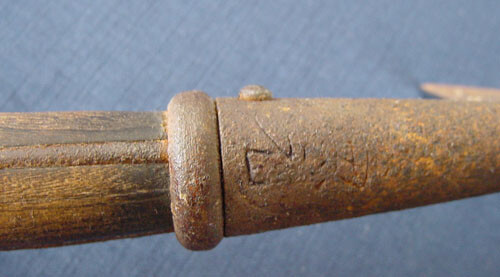
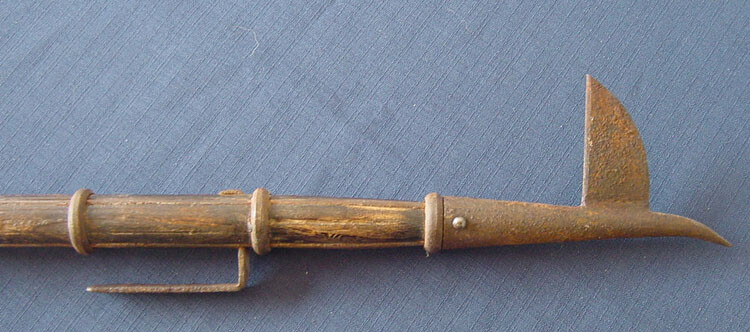
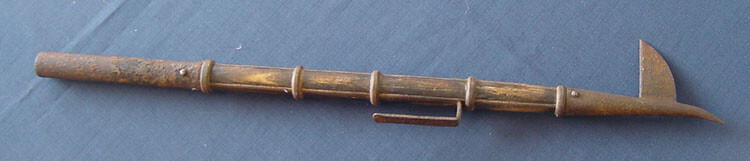
Not exactly a high class item, but maybe someone has some interest in seeing it. Picked this up at the Yasukuni Shrine flea market when I was there a year ago. Inexpensive and at least it could come home with me without needing deregistration :lol: I think it is likely late Edo period, and not particularly remarkable. A fireman's (hikeshi) tobikuchi. Much better than using a yari to tear down a burning building. Apparently they were sometimes also pressed into use during street brawls Signed, but I doubt it has any relevance. Hopefully original and no-one has started turning them out en masse for the overseas collectors. Rusty, but I don't see much point in cleaning it up at all. Brian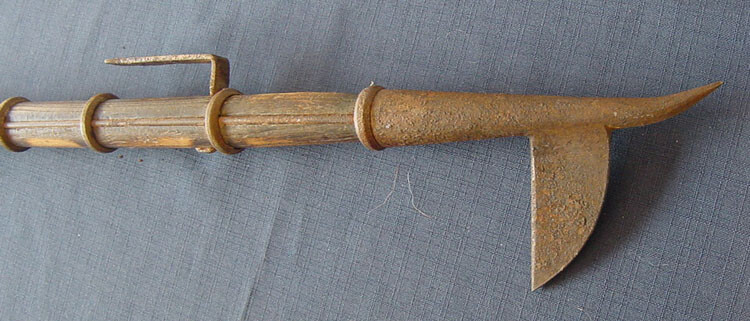
-
Peter, Sounds like you have quite a few slots in the shinsa, early bird gets the worm? What is the nagasa of this blade? Looks quite long from the pic. Agree with Ted, and I guess it also depends on if you are going to keep it and just verify what it is, or are going to sell it and hope the papers will increase the interest in it. Oh, and Ted..I love the location in your profile Brian
-
Wow. Katakiriba & Kanmuriotoshi Zukuri. That is a sweet blade. Not to change the subject, but very interesting. Looks like 2 totally different swords from either side. Must have been made to show what the smith could do. Very unusual, I would grab it if I had the cash. Ok..back to the sword at hand. I think there is a chance the sword is not tired, but just has some loose and open grain. But Jacques is correct that the ware in the hamon is disturbing. Polish is overdone a bit, but can be forgiven if it wasn't an expensive sword. I am unsure if it is machi okuri. Looks like it is a bit, however not dramatically, and it shouldn't change your own opinion of the sword. No hagire that I see..just a continuation of that ware that isn't good to have in the hamon but might be not too deep. Close pics always make things seem worse than they are, but not a high level sword anyways. However I bet you didn't pay a high level price for it? Brian
-
I considered that it might be the front of a longer blade, but the geometry, look and mounts are consistent with one of the WW2 personal tantos (sometimes called kamikaze dirks" and either way it doesn't appear to be a good deal unless you are after militaria and not Nihonto. Brian
-
A beginners question regarding ebay sellers.
Brian replied to Taygrd's topic in Auctions and Online Sales or Sellers
Moriyama san put it perfectly. The licence is a registration document in Japan, and doesn't verify the signature or quality, just the fact that it is registered and legal. This is handed in when it is exported and deregistered. Sometimes you can ask for a photocopy, but it doesn't give any real info and I wouldn't bother. All sounds ok here. Brian -
In my personal opinion, no. The nakago is badly shaped and the machi are all wrong. The ana is badly placed and it just doesn't have the lines a decent tanto should have. It looks to me like a WW2 personal dagger, which would have this kind of badly shaped grooves and nakago, and in that case I would expect the hamon to be oil quenched and similar to a showato. No forging or hada. Just calling what I see from the pics. (edit...which were there a few minutes ago but now seem gone?) Brian
-
For some reason, neither the webpage http://www.marshalltradecorp.com/coDe/hizen_kizu.html nor the embedded image will load for me. Flock/Firefox. Tries to load a page, but never does. Brian