Brian
-
Posts
21,754 -
Joined
-
Last visited
Content Type
Profiles
Forums
Events
Store
Downloads
Gallery
Everything posted by Brian
-
Hi Jim, There isn't too much that can be said without a decent polish so that the hamon and hada can be seen. What does strike me is that the curve makes it appear to be a kanbun shinto which would date it around the mid to late 1600's. It is of course shortened quite a bit, and may have lost its signature then. With the current length, it much have been quite a monster of a blade originally. Tsuba looks ok, but needs some tlc by a professional. The tip can be repaired by a professional, but of course a decent polish is going to run you around $2000, so you would need to decide if you are just going to keep it as it, or go for the restoration. It would need a shirasaya too. A nice original blade that needs some tlc but with no major problems that I can see besides the tip. Of course a polish may turn up other flaws like hagire, so you should probably get it to one of the various sword shows so that someone can look at it in hand. Regards, Brian
-
James, That's good news, good luck with it. I am not sure if you were getting an opinion from the polisher himself or just the agent making up his own mind. Seems very odd. Brian
-
James, If there is any doubt, by all means never give up. There are definitely similarities. It is always easier to find differences, and there are some. At this point, it would be impossible to come to a conclusion..and the work should be used for further input. This means maybe having it polished or sending it for a window. However you guys do have a shinsa coming up there sometime. This one might be worth using a slot if you have one. Everyone here expresses their opinion on gimei knowing and expecting that the owner should take note of the limitations of the internet and use the info to get more feedback in hand. Brian
-
Welcome John, A lot of us started out with a military sword or 2, and then found ourselves plunged headlong into the wonderful world of Nihonto. Hope we can be of some assistance. (Does that make us addiction enablers? ) Regards, Brian
-
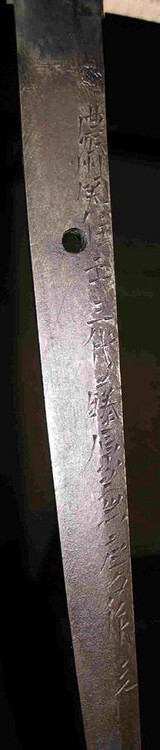
Thank you very much all. Much appreciated. I had the Noshu Seki ju.... saku kore part, and had actually guessed at Kanefusa, but hadn't explored it more yet. I will forward all the info to the owner. Thanks Rich, it was one of the first pages I came across once I knew the translation, and it is excellent as always Regards, Brian
-
Hi all, At the recent South African Japanese Sword Society meeting, the following sword was brought in by a member of the public for any info. It has a prominent showa stamp, but is in quite a nice original polish, and is definitely not mass produced. It has a nice tight hada and what looks like a choji hamon. I was wondering if anyone is able to assist with the mei? This is the only pic I was able to get at the time, so hopefully it is visible. I have attempted the translation here at work, but keep getting interrupted and didn't make too much progress. Appears to be the full smith name. Thanks, Brian
-

Finally....a truly functional tsuba
Brian replied to Ford Hallam's topic in Auctions and Online Sales or Sellers
The Fujishiro books? (which I am sure are) or the tsuba/bottle opener? (which is what I think Moriyama san was refering to) :D :lol: Brian -
I agree completely with Guido, and will add that I seriously doubt that he thinks it was burned merely because it is thin. He might be saying that it was easily detempered because of the thin blade, but he wouldn't assume something like that without checking or opening a window. Is this through Brian Pedersen, or someone else? Frankly, I wouldn't hold much hope if the guy does know blades, as detempering is not repairable. The sanding may have been done to hide the fact that there is no hamon, or maybe the polisher is mistaken and the hamon is there. Try and get a second opinion if possible. Brian
-
I might hopefully have a solution for those few browsing with javascript off. If it is off, hopefully the text will still show. Can those who have javascript turned off check the following spoiler and let me know if the text was still visible? Brian
-
James, This is what I read it as. I think by sword he means hamon. So: Hello James, Please understand that the hamon disappears when the sword is heated by strong heat. The hamon starts disappearing because your sword received strong heat. It is being polished by a specialized technique now to revive your blade. I think that it goes well maybe. The reason is that the houses in old Japan are made of wood and paper and burns easily, so a lot of swords like this are in Japan. You are still lucky that the swords remains to this day. My guess...English to English translation. As mentioned, there are a heck of a lot of fire damaged swords out there. Some with no hamon, some retempered. I am guessing yours has lost the hamon. In that case, I wouldn't continue with the polish unless it was very cheap and you just wanted a relic. It's a real pity, but common. The heat from common house fires in Japan would often just heat the blade without any other signs (fittings could be replaced later) Regards, Brian
-
Well done all Some really good points. Congrats to Jean for getting it spot on so early All the other points made were very educational too, I enjoyed this one a lot. Brian
-
I had better start buying all the African "art" I can find at the flea markets here :lol: Seriously though, I think John is correct in that there aren't easy words to describe this thing. "Art" is a simplified word we use for convenience much like many of the names we use in this field. One of Jacques' links categorizes art and says that by definition, for something to be art, it has to have been created as art by the artist as his original intention. By that definition, we aren't even collecting art. But of course we are. Art Swords of 1000 years of tradition. However once again it is all just semantics and it is easy to get lost in the words without being able to get to a point. It doesn't matter if we describe them as art, or masterpieces, or brilliant craftsmanship, or wonders of metal fabrication or whatever. We know what they are, what makes them special, and what we need to do to study and appreciate them. Sounds like we are in danger of becoming a committee discussing how we are going to discuss the discussion of Nihonto Brian
-
All good points, and I hope we can develop this discussion further, as there is just so much encompassed that it would take many pages to even start expressing some of it. I had a long chat with Ford, and even 45 minutes wasn't enough to even come to terms with the basics of this, there is so much involved. Guido points out the logic of study and the fact that good work is just that...good work. It can be seen and identified according to what we learn are the finest attributes. Superior craftmanship will indeed be art if we are talking about top level swords, and consider Nihonto art. But a master craftsman can make a wooden duck that might always just be a wooden duck, and never art. It is different for various fields imho. I would hate for this to be about whether Nihonto are purely either weapons or art. They can be both. Weapons that were refined to such a high level that they are now art itself. But the function is an inherent part of their character and desirability. We aren't studying pretty forged lumps of metal, we are studying art swords The main point is to study what we look for in this art field, and learn to appreciate those aspects and who are the artists that were good at their field, and not try and study the low end of the market and look for aspects that just aren't present. In other words, don't study low class stuff and then identify the good items by how much better they are to what you know and are familiar with... Rather study the best and know the low class stuff from how inferior it is to the masterpieces you have seen. Brian
-
Btw..I've taken the liberty of adding a first name to your signature as per the rules Tyler, and will do this for new members from now on if they forget to sign posts. People are welcome to go to their profile and edit their signatures if they like. Only way to make progress in the "sign with a name" thing Brian
-
I'll remind folks that a lot of this is opinion and personal tastes, just in case this gets ugly Different people, different cultures, different eras, all have their own opinions on the art vs weapon vs quality aspect. Art itself is very personal. While one person may consider something art, another may regard it as junk. One only has to look around you to verify this. Dogs being staved to death = performance art and paper crumpled up = bolder origami :lol: A doodle done by Picasso on a napkin while he was eating = expensive art :? Anyways, my point is that we all have our own definition of art. The Japanese have to regard Nihonto as art, or it will be impossible for them to continue owning and studying it. Weapons are banned, art is appreciated. And yet if the sword is no longer functional, then it is no longer a sword. If it is purely the working of the metal that is appreciated, then modern smiths may as well turn out a long rectangle of forged metal, no need for a point or handle if you are not still considering it an Art Sword. Basically any item that takes incredible skill and talent to manufacture by hand can be seen as having an art aspect. Myself? I regard Nihonto as art. But also as a functional weapon. The art comes in because it was refined to the point that it is unique and the individual talent can be discerned in each blade. Yes, not all swords are skillfully made. But not all paintings are well done either, and the ones on the wall in your house may be low class art in some cases. Same with Nihonto. You get not very talented works, and then you get top class mind numbing items made by uniquely skilled artists. No real point debating if he was making a sword at the time or a work of art. As long as it is appreciated and studied..then I feel you are welcome to find your own attraction to it. It is impossible to say where art starts and stops. Much easier to declare a certain field art, and then categorise it as either low class work or better class. Without a book that says "this is art, this is junk" we have to draw a line somewhere. Some may choose origami or old Japanese books to tell them what is art/collectible and what isn't. Others see simple beauty in utilitarian blades that were made for a purpose. Everyone is entitled to enjoy what they like and can afford. I know this is mostly rambling, and i am not even sure where I am going with this, I just want to give yet another opinion to the debate. We don't get to decide what is and what isn't art unless we know what the artist was thinking at the time. Some of it is junk and not worth studying maybe, but not everything fits into neat little boxes imho. Brian
-
Just a comical remeberance before I go pass out after a hectic weekend... When I was in Tokyo, Ichi was kind enough to take me to a major dealer sword sale. Almost as soon as I walked through the door, I was presented with row upon row of top class swords, all shoshin. At least 3 Ichimonji, 2 Rai, 2 Shinkai, 2 Kotetsu etc etc.... Well...they kept thrusting them in my hands, and I was so stunned that the more i tried to concentrate on all the workmanship and characteristics, the more I was getting overwhelmed and worried about what I was saying, how I was acting, and what i should look for. To cut a long story short....at the end of the day I remember the amazing swords, but can barely remember any individual characteristics at all This is why it takes repeated exposure to these swords, and a steady brain to learn from the best. It is hard to go from seeing almost no good swords to seeing a room full. Sensory overload is very real :D Brian
-
I have had a hint by a kind member that this blade might be published somewhere, so wouldn't be surprised if someone stumbles upon it Regards, Brian
-
Hi Barry, Difficult to see in the pic, but I think this is indeed wrapped from individual strands of jabara ito that are sewn together. Not as decorative in the wrap as your example, but I do think it is indeed jabara ito there. Brian
-
Hmm....that is going to be interesting. It is not a regular military pattern blade. Looks like a nagamaki style blade? I look forward to the nakago pics when you get it. Brian
-
With the built in led lights, might also be great for taking close up shots of mei so that they can be compared to shoshin examples. Lovely for those tosogu shots too. Brian
-
My first impression, like Ted, was that the horimono is a later addition. It has a fresh feel to it. Does the nakago really look like a Koto nakago? I got the impression that it looked fresher than that, but it might just be well preserved. The machi are still fairly healthy, and the horimono hasn't seen too many polishes. It does look like it has a bit of a shinto yakidashi. What is that muneyaki/tobiyaki telling me? hmm. Hada looks a bit hard and coarse too. Brian Edit to add; If the horimono is original, the nioi, nakago, hada and horimono do lead me closer to Jean's answer of Tsunahiro. If I had to call it right now, that would be my guess.
-
Well...here is a decent write up on Kunihiro: http://www.nihonto.com/abtartkunihiro.html Not sure I can see many of the standard features that he supposedly used? I'll have to have a look at the books and see what I can come up with. Brian
-
How about we do an analysis of it here, give it a few days, discuss and see if we can all come down to a single smith..and then ask Jean or someone to email in the answer as a combined submission by the NMB? Just a thought Brian
-
Not stopping it (i am sure Reinhard and Rich will agree) It is still useful. Just asking for us to watch when we use it, and keep it for times when others might not want to see the answer just yet. No worries...there are serious things in life..and spoiler use doesn't feature in the top 10 :D Brian
-
Hi Lorenzo, Good to see you here. (Assuming you are the Iron Brush Forum Lorenzo) That first pic isn't Ezo though...those are touristy Meiji period fittings, although in this case housing a much earlier blade. I have a tanto in those mounts too. Very late export mounts. Regards, Brian