watsonmil
-
Posts
1,406 -
Joined
-
Last visited
-
Days Won
4
Content Type
Profiles
Forums
Events
Store
Downloads
Gallery
Everything posted by watsonmil
-
Matchlock barrel and stock translation please
watsonmil replied to mercierarmory's topic in Tanegashima / Teppo / Hinawajū
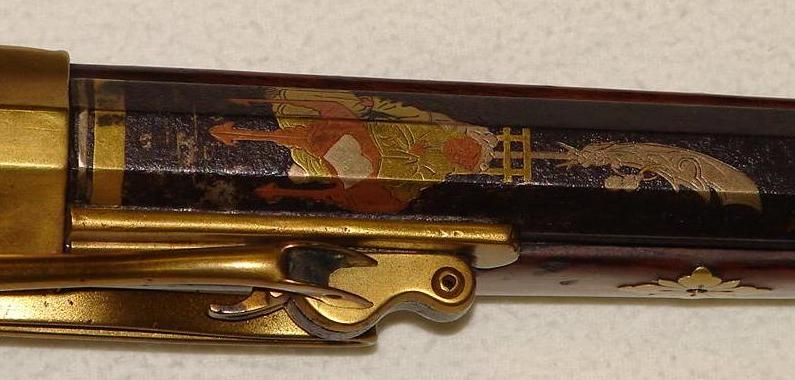
Dear Peter, Here's an example of a barrel inlay from a Sakai Tanegashima dated 1825 that I own. It depicts Kwanyu , a celebrated Chinese General of the 2nd century deified by the Japanese in 1594 as the God of War. He is usually depicted carrying his large spear. The inlay work is finely done in brass, silver, and copper. Now compare the inlay of mike's example. Usually if we find inlay on the barrel of a Tanegashima it is of very high quality. ... Ron Watson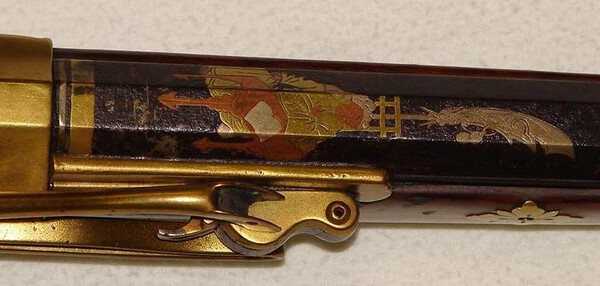
-
Matchlock barrel and stock translation please
watsonmil replied to mercierarmory's topic in Tanegashima / Teppo / Hinawajū
Dear Mike, Well no damages here. I therefore stick to my observation that the gun can be restored, but for the inlay. It would look quite presentable restored. I would give the stock a light washing with mild soap and a damp cloth to get off the crud. I would then oil the barrel with some 3 in 1 machine oil to brighten it up a bit and wipe off the rust. I would then give the stock a good wipe down INSIDE and OUT with Lemon Oil ( good quality furniture oil ) to bring out the wood grain and give it some luster and body. Repeat every week or so, and you will begin to see a difference. The ramrod can easily be replaced by visiting a lumber yard and picking up a suitable piece of oak dowling. ... Ron Watson -
Matchlock barrel and stock translation please
watsonmil replied to mercierarmory's topic in Tanegashima / Teppo / Hinawajū
Dear Brian, You noticed too. I did not comment on the fact that the inlay depicts an apparent Westerner. I commented instead that the inlay was amateurish and poorly executed. This is one of the reasons I give for thinking the gun is rather late production. ... Ron Watson -
Matchlock barrel and stock translation please
watsonmil replied to mercierarmory's topic in Tanegashima / Teppo / Hinawajū
Dear Mike, A picture ( side view ) of the muzzle and forend wood please. Thanks, ... Ron PS. Piers and I are having our e-mails crossing today ! Listen to Piers, and George, ... I own seven matchlocks, and out of 7 , ... 3 were still loaded upon receipt. The reason why muzzle loading firearms were often left loaded was because the only easy way of unloading was to fire them, ... and this then necessitated a cleaning operation taking up an hour of time plus a messy job. It was just more convenient to leave them loaded. Convenient but not a good idea ! -
Matchlock barrel and stock translation please
watsonmil replied to mercierarmory's topic in Tanegashima / Teppo / Hinawajū
Dear Mike, Hate to ask for one more picture, ... but a photo of the breach plug would possibly confirm my suspicions that this is of the Tazuke Ryu ( school ). Also a photo of the muzzle and end stock ( side view please ). Most Tanegashima have a square end to the breach screw ( plug ), but for some reason many of the Tazuke Ryu sweated their breach plugs in place ( not threaded ), and therefore round. The butt is missing a brass reinforcing band which helped protect the butt when held against the ground for loading. The configuration of the pan and pan cover to me at least also confirm this to be somewhat of an aberrant however even for the Tazuke Ryu. PIERS, ... help me out here, ... have you seen this style of pan before ? The serpentine is squashed where the match cord fits. Part of the brass barrel protector ( amaooi ) appears also to be missing. It is my opinion ( but first I'd like to see a photo of any damage to the stock near the muzzle ) that the gun could be restored or at least vastly improved. I would not spend a great deal of money on restoration however as the inlay work on the barrel would be very difficult to do correct, and given its amateurish work to begin with this is not a high quality Tanegashima. Unusual yes, but not a great Tanegashima. ... Ron Watson PS. Just noticed Piers and my post have crossed paths in cyber space. -
Matchlock barrel and stock translation please
watsonmil replied to mercierarmory's topic in Tanegashima / Teppo / Hinawajū
Dear Mike, Your gun is somewhat unusual in a several of ways. These Flat Butt guns were produced not in one region, but several. Know examples were made in Kunitomo, and Sakai among other areas. Virtually all have a serpentines with a bamboo design near the pivoting pin. Virtually all are made with an inside coil spring rather than the outside spring as seen on your example. The pan cover too is unusual in shape. Next the inlay on the top of the barrel is rather crude and poorly executed for a Tanegashima. My opinion is that it may well be late in manufacture as the quality is just not there for an early example. In 1871, the Emperor Meiji forbade the wearing of swords as a first step in Westernizing the Army. The Samurai, thus stripped of their traditional swords turned to foreign pistols for personal adornment. This brought about fear in government circles ( got rid of one weapon from the samurai, the sword only to have them adopt an even more dangerous pistol ). A special bureau was established to register every firearm in the country. This began in 1872. It is interesting to note, even with the influx of modern western type firearms, ... a few die hard Matchlock Smiths were still producing traditional Tanegashima. One such Smith was a man named Rikizo Yoshida and he was known to be making traditional Tanegashima during the period 1870 - 1896. He may well have been the last. I am quite proud to own one of his Tanegashima, and the quality is top notch. If you have the inkling, ... I would like to see a close up of the entire lock, a close up of the pan cover assemblage, the butt end and side view of the butt end. Also the stock pin hole covers ( Mekugi ana covers ). Also a side view near the muzzle of the gun. ... Ron Watson -
Dear Piers, From the few photographs you have provided, ... it would be my opinion that your example falls under the heading of " form of currency ". With that size of touch hole, you would have as much back gas escape as pressure forcing any projectile down the barrel. By the way, ... I would also say yours is in all probability GENUINE and a lovely example of something that has become quite rare ( the small status symbol and currency cannon of Borneo ). ... Ron Watson
-
Dear Piers, Your cannon is known as a Lantaka. They were found in the Philippines, Malaysia, and in particular Borneo. Many were cast in Brunei on the north coast of Borneo. Although a few were large ( slightly over a hundred pounds ), ... most were smaller and often mounted on a ship's railings for defense. Smaller ones like your example were primarily used as currency and were often traded to pay off debts, as dowry for brides, ... or to buy something as we would use cash. Most are poorly cast, and never really intended for firing as they are more of a status symbol of wealth than a weapon. They are still being cast today to supply the tourist trade and of course the fake antiquities dealers. ... Ron Watson PS. Here's a place specializing in their sale : http://www.cannonsuperstore.com/lantakas.htm They generally are not worth a great deal, and being poorly cast are not really safe to fire. I've seen them with off center bores, and any number of other faults. Some were even cast in Portugal ( better quality ) for trade to Malaysia. The old original stuff from Malaysia have mostly been picked up years ago.
-
Dear Piers, In answer to c), ... although not the best of photo resolution, ... I think I see a Teppo ( matchlock gun ) laying on the ground in the bottom left corner of the first print. The answers to a) and b) will have to wait until I get out a few books. ... Ron Watson
-
Matchlock mei and Goshu smiths
watsonmil replied to David McDonald's topic in Tanegashima / Teppo / Hinawajū
Dear David, Yes, ... there is a Japanese ( language ) book listing most or at least many of the known Japanese Gunmakers. I believe Piers Dowding ( Bugyotsuji ) has a copy, and although he is presently in the UK, ... you could send him a PM via the Nihonto Message Board. There is also Koichi Moriyama ( Nobody ) who although has limited knowledge of the Tanegashima could possibly help you out with the signature translation. ... Ron Watson -
Dear Grey, Thank you for the photos, ... it is nice to see. It is sad the show was not better attended. Perhaps if the show is able to continue, ... more people will learn about it and attend. ... Ron Watson
-
Dear Junichi, Although it would be better to form an opinion with it in hand rather than making a judgement from photographs. I would say this is plating rather than inlay. It is never the less quite attractive. ... Ron Watson
-
Dear Howard, Barry spelt the eBay sellers name incorrectly, ... his eBay sellers name is toraba and he has 3 or 4 for sale on eBay at the moment. ... Ron Watson
-
No hope for this tsuba?
watsonmil replied to Mantis dude's topic in Auctions and Online Sales or Sellers
Dear Peter, I must agree with Mariuszk on this one. The insects are childlike in their execution with some inlay not only badly worn, ... but also missing. The sekiigana in the unplugged hitsu-ana actually has droplets of solder appearing on the join. The fact Peter, as you have pointed out that the abuse as you say is concentrated on the surface rather than the mimi is a puzzle ?? Other than being terribly dirty, ... most of the inlay is in relatively good condition. It makes me wonder if the decorated mimi was added at a later date, ... as in my eyes at least it is of a higher ( somewhat ) quality of workmanship than the rest of this tsuba. I doubt even Ford Hallam could restore this tsuba, ... nor would he want to. ... Ron Watson -
Difficult Tanegashima kinpun mei?
watsonmil replied to Brian's topic in Tanegashima / Teppo / Hinawajū
Dear Brian, As I posted in a previous thread, ... the time to buy a desired item is when you first see it. It would appear to have been a very nice example ( from what little I see ). Obviously someone else thought so and didn't hesitate. I realize I have few facts to base my criticism on ... price, overall condition, missing or replaced parts, etc. Tanegashima do not pop up everyday particularly in South Africa ! ... Ron Watson -
Dear Malcolm, When I was in business ( Watson's Fine Art & Antiques ), ... I had a sub-section on the Internet Store devoted to Antique Silver, ... mostly but not limited to Georgian, ... some really rare Canadian Silver and American as well. I appreciate the " link ", ... as I spent many hours searching books for hallmarks. Since you are still in business, ... should you have cause for suspecting a piece to be either Canadian or American, get in touch with me and perhaps I can provide printed help from my reference library. Kind regards, ... Ron
-
Dear Malcolm, If you consider Paul Storr to be a maker of dubious quality :D : " Here is a meagre example of some lesser Georgian tat by a maker of dubious quality: " http://www.pashantiques.com/pd866/paul_ ... mports.asp I take it you are being deliberately facetious ( all in good humour I pray ). I have been searching my research library on Antique Silver for a definitive description of the bluish tinge ( subtle ), .... as trying to illustrate via photographs is nigh on impossible. In : The Book OF OLD SILVER, author, Seymour B. Wyler. On page 12, ... I quote: " To an expert, the easiest method of judging the age of a piece is by its color, and although this rule is not infallible, it generally proves true. Silver over a period of years becomes oxidized many times, and this continued action of the elements on the metal gives it a certain softness of texture and color that is known as patina. Frequent cleaning and use in service mellow the piece, and it assumes a certain smoothness that time alone can produce. One often revels in the beauty of old silver, because of its soft BLUISH color. This is an integral part of the make-up of the patina. " ... end of quote. Perhaps it is you Sir rather than my butler who needs a damn good thrashing for over cleaning The defense rests it's case. ... Ron Watson
-
Dear Piers, Just make sure you keep on rubbing ... the silver and gold with that soft cloth, ( not the shakudo however ) ... The true patina on silver should be a slightly bluish tinge ( very subtle ). You must have seen Georgian Sterling Silver to appreciate. ... Ron Watson
-
Dear Piers, I was going to venture that the signature is gimei. Personally, ... I rather like the carving on the Kiseru and/or the Kozuka. To some unless the silver is patinated ( black ) and the gold ( green ???? ), ... never personally ever seen patinated gold ... it would be ugly. But then who am I to judge what others find poor and ugly or what silver and gold should look like ? Thank you for posting Piers, and I thoroughly enjoyed the answer as to why it was so cheap on one hand and expensive on the other . ... Ron Watson
-
Dear All, The microscope pictured with the diagram of the snowflakes appears to me to be early to mid 1800's if that is any help. I can carry on a basic conversation in French, and can read French fairly well, ... but try to decipher Kanji as my old Japanese friend used to say for me was a hopeless task. I envy those of you who can. It would have been a great boon to my studies. ... Ron Watson
-
Dear Pete, Mike, et al, I have found in a Japanese book of mine, .... what I believe is the Japanese document from which the artist Ichijo copied the exact snowflakes pictured on his tsuba. Unfortunately I cannot read Japanese, so will leave it up to someone else to do the caption translation. ... Ron Watson

-
Dear Curran, The time to buy a piece is when you first see it PERIOD. Someone with your experience and taste is unlikely to make a mistake, ... and you can bet someone is standing there just waiting for you to set it down. You are also somewhat forgiving ... let me qualify that, .. to say that if you knew the dealer and he knows you, ... for him to sell the object because someone offered $ 50.00 more shows me a dealer with poor ethics. The proper thing to have done would have been to hold the item and then resell after an hour or so if you did not come back. I've done this many times for customers I know because I know their intentions without spelling it out. Don't know if I have come across the way I intended, ... but you get the picture. Dear Mike, I'm glad once again that Brian in his wisdom has made a fair decision. To me at least I echo Curran's thoughts that such an interesting set should be posted in this section where it will and should generate study both now and in the future. A rare set. Thank you for posting. ... Ron Watson
-
Dear Justin et al, One should never collect with investment as a reason. Collecting, be it stamps, coins, firearms, or nihonto and related artifacts should be for : interest, love, and study, ... never for the desire to turn a profit. Having in the past operated one of the most prestigious Internet Antique Fine Arts and Weapons Businesses in the world, ... I believe I can speak with a little authority on the subject. When I started back in the early 1970's, ... I remember selling a very nice Sharpes Rifle for $ 750.00, .... I later bought the same rifle back in the early 1990's from the estate auction and subsequently sold it for $ 3750.00. It took 17 years at an average bank interest of 10% to for the $ 750.00 investment to return the selling price of $ 3750.00. What one must remember is I used 10% as an average return, ... not all years returned 10%, ... a few years were higher and a few lower. Meanwhile the value ( what could be purchased ) with that $ 750.00 in the early 1970's was about the same or less than what $ 3750.00 could purchase in goods and services in the 1990's. Therefore, ... no REAL profit was realized either from the banks nor the purchase of the rifle. Both had approximately the same purchasing power. This is inflation. Although we still have inflation today, ... the banks and governments have not addressed the issue, but rather kept interest rates low. In Canada at least we have bank investment interest rates as low as 1.5 % per annum which in no way keeps up to inflation. What it does do is give banks the opportunity of making enormous profits ( Royal Bank of Canada made 7billion 500 million in PROFITS last year ) while the majority of Canadians due to both inflation and higher taxation had less disposable income. Less disposable income translates into fewer buyers of nihonto, kodogu, and any other collectible or non necessities of life. The result being that only the very rich feel secure enough to indulge their love, ... and they traditionally buy only the best. Consequently the value of lesser Nihonto, Kodogu, etc fall in price as fewer collectors have less disposable income. Now some might say, ... well now is the time to buy, ... but truth be known few young people have the security, nor the disposable cash to make purchases right now. Will things turn around, ... I have my doubts. As governments the world over are burdened with ever increased deficit spending the future is not bright. If one looks at the Stock markets, ... we see the same ... over-valued companies, ... and instead of sustainable growth rather we see an unprecedented bull or bear market where speculators are manipulating what investments the average investor makes being sucked up by huge financial institutions. If you Justin had wanted a good investment by buying tosogu, .... you missed the boat by about 40 years, ... and even then you would have barely kept up with inflation and the devaluation of currency. No, ... one buys collectibles the same way as some people buy a pint of beer, .... to be enjoyed now. The only advantage over your tosogu will be that you have the tosogu to look at in the morning long after you've pissed the pint of beer down the lou. ... Ron Watson
-
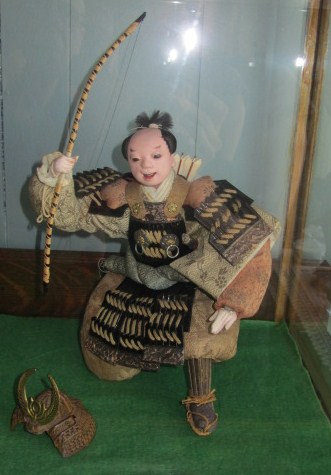
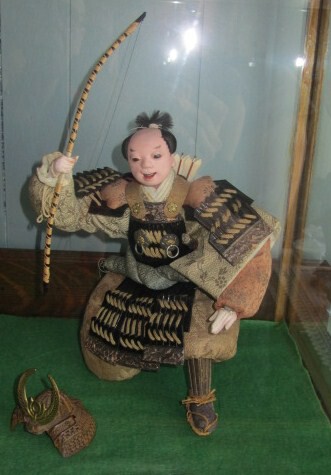
Dear All, I should like to endeavor to write a short treatise on the Girls / Boys Festival Dolls. I promised to do this sometime ago in response to the following thread by Ray Allen : viewtopic.php?f=9&t=8868&st=0&sk=t&sd=a&hilit=doll but just never seemed to get around to it. Although perhaps not of much interest to our Nihonto nor Kodogu collector members, ... never the less a few of us have interests in all forms of Japanese Art/Artifacts A short history on the Girls Festival ( March 3rd ) is often referred to as Hinamatsuri for when the peach blossoms open or Momo-No-Sekku or Peach Blossom Festival. Displaying dolls near children's beds were meant to ward off illness and evil spirits. The display of dolls became widespread after a display in Kyoto Palace, and continues to this day. Most of the Girls Festival Dolls incorporates the Imperial Couple and their court displayed on a shelf system of steps with the Imperial Couple at the top, and lesser members of court arranged on the lower steps. The dolls are called Hina dolls and vary in height from 4 inches to up to 15 inches. The dolls are constructed of straw, wood, silk cloth, and gofun ( crushed egg shells for the faces and hands ). The dolls are never, never played with and are most often handed down as family heirlooms. The detail and artistic merit of the best Hina dolls are a thing to behold. For a far more detailed discussion on the Girls Festival dolls, please refer to the magazine Arts of Asia September - October 1986 issue. Now lets deal with the Boys Festival ( May 5th ) often know as Tango-No-Sekku .... the first day of the horse. Here the dolls are also Hina dolls of the same construction as the Girls Festival dolls and again are arranged in the same system of steps for display. The main difference is the theme of the dolls. They are generally all of Heroic Personages and their attendants, .. but quite often a doll horse will also be displayed. The dolls again can be of considerable height often as tall as 15 - 16 inches tall, with an average being about 11 - 12 inches tall. The heroes come from all periods of Japanese history, and among the most popular are Yoshitsune, Benki and various non descript samurai attendants. Ocassionally we see the Chinese warrior Shoki ( the demon queller ) . In addition it is not unusual to see displayed clay dolls, as an example the seven gods of good fortune displayed on a lower step of the display. Kato Kiyomasa ( 1562 - 1611 ) is also another popular clay doll. There are several others including Toyotomi Hideyoshi ( 1536 - 1598 ). Again I must emphasis the dolls were never meant to be played with but were considered heirlooms to be put away and handed down to future generations. I have already mentioned the magazine Arts of Asia for further study, but I would also like to add the book: Japanese Dolls by Lea Baten as an excellent reference for not only Girls/Boys Festival dolls, but other traditional Japanese dolls as well. I am including a few photos of Boys Festival dolls from my own collection. I believe all are Meiji era, and all are of very high quality and form an important part of my Japanese Art collection. Presented for the enjoyment of NMB members. Any errors are mine alone. ... Ron Watson PS. I regret the poor quality of the photos but I did not want to remove the dolls from their display case.



-
Dear All, " Once there was a watch. It had a minute hand and an hour hand, and one was longer than the other. Most people thought it worked just fine. Then someone invented the digital watch. This meant that whenever daylight saving time came or went, you had to devote much time to fooling around with digital buttons or, as I do leave things as they are and add or subtract an hour in your head. This too is called progress. " " Once there was a rule, and most people respected it. The rule was ... " If it ain't broke, don't fix it. " ... Then someone decided the rule was silly, and all sorts of things that worked perfectly well were fixed so they didn't work so well anymore. This is now called progress ( improved technology ). It used to be called STUPIDITY. " Quoted from the Washington Post Magazine ... author Richard Cohen ... Ron Watson PS. I skipped the 8 track cassett player, ... and continued playing vinyl, ... saved a lot of money :D