OceanoNox
-
Posts
350 -
Joined
-
Last visited
-
Days Won
1
Content Type
Profiles
Forums
Events
Store
Downloads
Gallery
Everything posted by OceanoNox
-
Speaking of which, I have been using paulownia to make both the boxes and the plates inside, as I understood it's good against moisture. Is balsa just as good?
-
It traveled from Japan to France in my checked-in luggage, no issue. The cushion I made was big enough that the tsuba did not wiggle about inside its box.
-
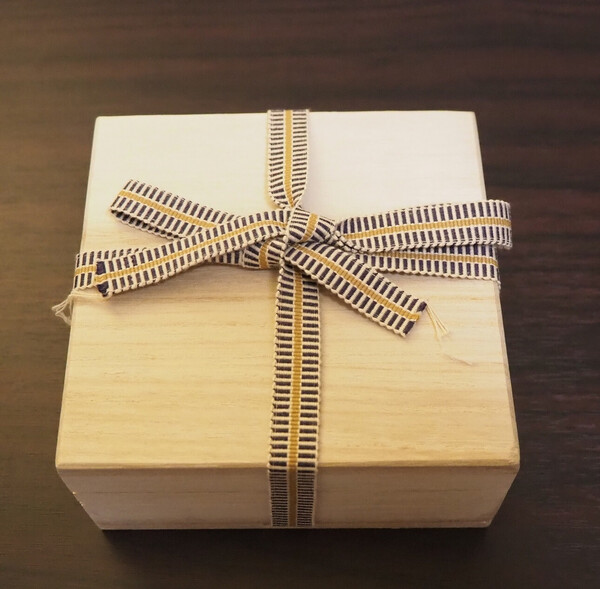
I made a box for a tsuba that was a gift. To make the airplane transport more secure, and to keep the traditional feel, I added sanada himo (they need some fixations at the bottom to avoid slipping). The knot makes it also very nice, even when closed.
-
How thick are those? They feel "powerful".
-
A storage box for tsuba - that won't break the bank
OceanoNox replied to Spartancrest's topic in Tosogu
I have been making my own boxes. Since I have my own poor attempts at tsuba, why not boxes as well. My main issue is warping, but apart from that, it's not too bothersome. I either do the nakago ana peg or the tsuba contour. So far, none have broken, and it seems the wood is relatively ok with keeping moisture at bay. I use wood glue for the box, and rice based glue to glue fabric to paper/wood. -
Ford Hallam and others know better, I think the detail of craftsmanship increases with time and also with the introduction of magnifying glasses. I am not sure if such glasses were solely imported by Portugal or the Netherlands, but their use is attested at least for the Edo period (https://www.metmuseu...lection/search/55407).
-
Amateur polishers on YouTube.
OceanoNox replied to Nicholas's topic in General Nihonto Related Discussion
Oh, but it is. Might even be the cheap one from the local hardware store. -
This is why there are several old documents state specifically that large sukashi are to be avoided, or that sukashi tsuba should be thick.
-
It is in French, but the document is available for free (download included). It is written by Mr. Tadamasa HAYASHI. https://bibliotheque...re&o=bookmark&n=0&q=
-
I remember that the interest in suguha is that there would be few stress concentrators, but I do not think the discussion went as far as differentiating nie and nioi, or discussing hataraki. Not being an expert, I am likely mistaken, but was it the shinto that had wide and wild hamon that ended up being brittle swords? So perhaps a not overly wide hamon is better in terms of properties. At any rate, I feel like I am going back to the thread about ideal swords (in terms of mechanical properties, beauty, or use for fighting?).
-
TEM: Transmission Electron Microscope, requires thin slices (below one micrometer) of samples usually ~3 mm in diameter. Relevant for dislocation, dislocation structure, etc. analysis, but difficult to scale and usually large scatter when trying to do quantitative analysis. The resolution can go to the nanometer. SEM: Scanning Electron Microscope, can analyze anything that transmits electrons (and even if not, covering the sample in metallic ion works). Newer ones have very high resolution at high magnification (x20,000). Also benefits from good depth of field. Even though SEM have bigger chambers now (enough to put both hands), unless the sample is small, cutting will be necessary. Prof. Morito has done some work with SEM with an EBSD camera (to obtain the grain orientation) calculating the history of the microstructure of Japanese swords, to evaluate the change in grain size and microstructure at the time of the quench (basically how fine the austenite was prior to quenching and tempering, simply from analyzing the martensite in the edge). Back to forge quality, I was just reading 武芸風俗姿 (I forgot the year). I cannot judge at all because I do not cut and I have not handle many swords, but the author maintains that small "kizu" is not an issue for blades, as long as these are not structural flaws, and rather show high hardness. From a purely metallurgical point of view, no segregation, microstructure uniformity, low amount of weakening inclusions, etc. would be indicative of a good process and good mechanical performance of the blade. Ultimately, in terms of hamon, and this has been stated by others who do tameshigiri, it would mean a suguha.
-
Most interesting, thank you for posting. Non-destructive analysis is a must for understanding such artifacts. The group led by Dr. Zoppi has also published work using neutron diffraction for tsuba analysis.
-
I think it was James Binion? who was making mokumegane jewelry, and he noticed that silver-copper mokumegane jewelry would lead to the silver being oxidized away, because of the humidity of the skin, leaving only part of the ring.
-
Is that a bridle bit?
-
To look SEXY when you take it off? Joke aside, it seems to have been taken from Croatian mercenaries in France who had scarves and were copied for fashion.
-
Kuroda Tetsuzan sensei seems to use the sageo like that. In the All Japan Kendo Federation iai, and many old schools, the saya is thrust between the first and second outer layers of the obi, and is supported by the lower hakama cords. Kuroda sensei has his saya through a rope around his hips, so it makes very different to draw as there little resistance and friction from the obi.
-
I usually treat what he says with a pinch of salt, however, there are documents (although I conveniently do not have them) concerning the sageo for tying people hands. I think you could use it to tie your kimono sleeve, like a tasuki. My issue is that if the sageo was short (and there are pictures with short sageo just set behind the saya, not tied anywhere on the obi or hakama), the uses he proposes would not be possible, it seems to me. Nowadays, the sageo is also used to tie the sword to its scabbard, to avoid it rattling in the saya. In terms of iaido, it has become a matter of decorum and can differentiate schools to an extent.
-
Maybe you could try Nosyudo (Igarashi-san), they also provide high-grade iaido swords, and MAYBE can help you.
-
I have read recently that the tousougu are usually one of the following: 1- 揃い all the same "image" (e.g. fans) but with different executions (different numbers, orientations, shapes, etc.); 2- 尽くし same theme (e.g. seasons), with different tousougu showing different aspects of a theme; 3- 語り a "story", with the story unfolding as the tousougu are looked at around the sword. Now, this is a reading, likely imperfect, from a Japanese article that I have read quickly, called: 刀装具のかざりの構成 by 宮崎 友見子
-
Micro hardness testing through the thickness would allow to see if any decarburization occurred to be followed by some detail work.
-
For iai, as taught by the All Japan Kendo Federation (ZNKR), the tsuka should be long enough to put both hands (not square with the tsuka, so a bit wider than palm width), with about 2 fingers width in between, without touching the fuchi nor the kashira (basically the left hand's little finger should be at the last or last but one hishi).
-
Thank you, Peter, it is much appreciated. Yes, I have found it is called "丸に隅立て角". A dojo friend has this kamon (and has it on his saya in a kuroishime/kuroro contrast).
-
Exactly! There is an anecdote of Rikyu attending a tea gathering with some of his students. The host was either not a veteran, or very nervous, but he missed some steps, spilled some water, etc. Apparently some of Rikyu's students snickered or exchanged looks of embarrassment, but at the end, Rikyu said "your temae was supreme". On the way back, the students were astonished, but Rikyu replied that the intent and honesty of the host were more important than doing everything perfectly.
-
I have read the previous forum discussion and the page from M. Nagayama's book. The article by M. Martin, while interesting, does not provide more information. It is still not clear to me (apart from M. Nagayama's book, which I haven't seen anywhere else) that there were two distinct swords at the same time: the long katana and short uchigatana. It still seems to me that the uchigatana or katana started one-handed and became two-handed. (I am trying to find the plenty available, but to little avail, what with video game and sword store stuff cluttering the net, but I did find this: https://markussesko....08/11/the-wakizashi/: still no idea if katana and uchigatana were different things during mid-Muromachi).