OceanoNox
-
Posts
350 -
Joined
-
Last visited
-
Days Won
1
Content Type
Profiles
Forums
Events
Store
Downloads
Gallery
Everything posted by OceanoNox
-
Hi Jean Thank you for the info. I did not know that was how borax/boric acid worked (I assumed borax made some kind of glass like surface).
-
Sorry for thread necromancy. I stumbled on a video about nanbu tetsubin. To make the handle look antique, they use a process they call moyashi: by putting boric acid powder on the handle and putting it in the fire, it will burn the metal (you can see sparks in the video), which makes an interestingly rough surface.
-
I am not aware of any work on the topic. I think your best bet is to look at contemporary depictions of warriors, particularly in daily life. For instance, 石城日記 (https://kmj.flet.keio.ac.jp/exhibition/2013/04.html#view) is a journal with drawings written by a bushi of the bakumatsu. You can see how he drew his friends and himself. As Tim said, each koryu that deals with the sword will teach how to tie the sageo. For instance, Muso Shinden Ryu and Muso Shinden Jushin Ryu tie it to the right hip, on the lower hakama himo, letting it hang from the kurikata in a curve. Muso Jikiden Eishin Ryu passes it to the back over the saya, then it's brought up to be tied just at the hakama himo in front of the saya. Some will just drop it behind the saya, etc. EDIT: On https://kmj.flet.keio.ac.jp/material/sekijou_diary/sn_04.html, pages 54-55, you can see two fellows with daisho. Although they have haori, you can see the sageo hanging from the back, so it's likely to be just put over the saya, between the body and the saya, and not tied.
-
You could choose any kanji with a reading close enough to your name. That's what the student helped me with when I joined a calligraphy club, and I had to carve my own signature stamp. For many non-Asians, it can mean quite a few kanji (mine was 4 for the family name, and 3 for the first name).
-
To comment on alkali use, I had my students make a fairly nice iron oxide layer on steel with NaOH. The recipe is not mine, and it involves a very concentrated solution and electrolysis. We made it to see how protective it would be in a specific gaseous environment (completely unrelated to tsuba). For my own texturing, I have done carving+punches (to make it a bit stone like), or glowing heat in air+acid wash after cooling (posted above). I think I will try a combination of both (carving, heating, acid, then additional texturing as needed) to see if it makes an interesting jigane. My most recent project involved forging a piece of angle iron flat on an old anvil, and already the surface needs very little work: there are lines and a roughness from the forging that give already a lot of character. Jean, it's a pity I cannot join your workshop in July. I hope it is fruitful, and I hope you can share some insights gained from it here sometime.
-
Literally not the topic here. We just discussed the use of heat with/without oxygen for the "melty" effect of yakite. Nobody talked about the possible effect of particular charcoal for this application. Yes, we are aware of the scientific literature on steel making tradition in Japan (in fact, I referenced a bit in my own posts elsewhere on this forum). Apart from the fact that heating a tsuba for some time, and then putting the oxidized tsuba in acid did yield a similar surface to what's being discussed? Use of acid is specified for patination of iron items (patinate a bit, then clean with some kind of acid, then patinate again), in books on traditional colouring methods in Japan. I am not aware of alkali, except to neutralize prior acid use. Do you have anything in mind?
-
Back to that and the original idea of masking/etching, do you have a theory, or are there info about the acid used (I always imagined it could be vinegar)? From Ford Hallam's opinion that a lot of the texture was made by chisels and textured hammers (possibly anvils?), I wonder if this kind of mechanical texturing process was not combined with heat to force surface "damage" via oxidation. Then removal of that with acid, finishing touches, and controlled patination. I suppose, aside from asking artisans who make similar stuff (are there any?), and barring the finding of documents detailing the process, we are left with our own experiments to confirm what kind of process could yield similar surfaces to the antique tsuba.
-
Jean, now my issue is that I used an electric furnace without option to control the atmosphere. I have no idea how it would look like for the same piece heated in a charcoal fire for some time.
-
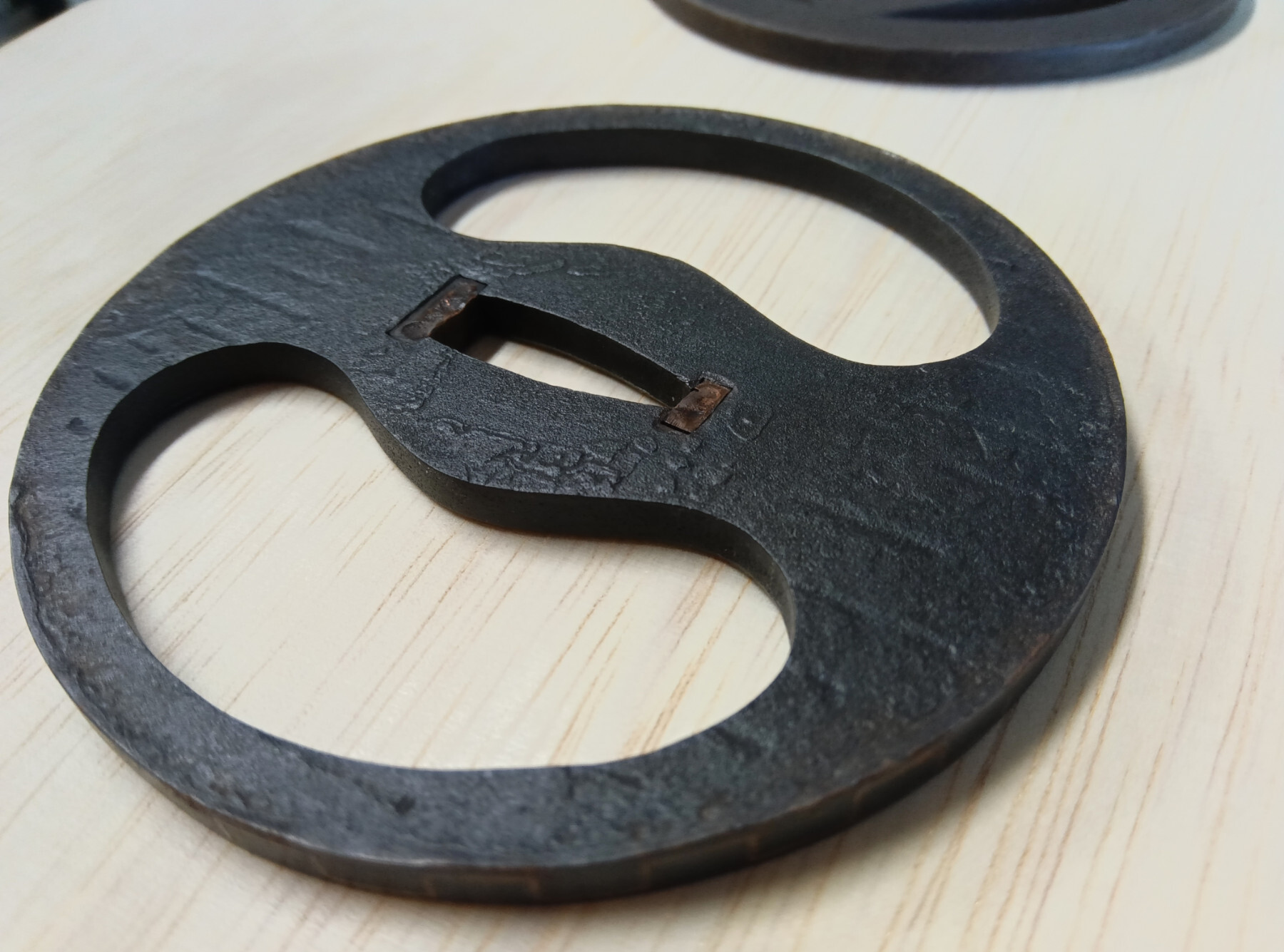
I used a piece of "steel", bought from an online shop called Haganeya. I suspect it is SS400, so low-carbon steel. In my case, it is likely coming from non uniform scale growth. You can see in the photo what it looks like. I did the heating prior to anything else. So it messed up the seppa dai, and I was too lazy to shave it smooth... In the end, I soaked the tsuba in warm citric acid for a couple of days.

-
To add, I have tried to have "fancy" surface by leaving a tsuba in a 1000℃ furnace (electric) in air, for an hour or so. It does result in a surface that seems to have partially melted. It was completely uncontrollable though.
-
I have tried it, like Ford (hole in the middle of the tsuba, small nail in the hole to hold the guide, and file/scrape away! It's fairly quick, especially if you're not concerned about even spacing. Depth of the lines is another issue, but you can do it with a file or make several passes. Agreeing with Jean here. Scientific analyses of tsuba (either neutron diffraction, or plain hardness measurements) all point out to iron or wrought iron.
-
I am very surprised it flexes in the air before the impact and in that direction. I expected it would flex at the moment of impact, but it doesn't seem to.
-
Could it be simply the way he cuts (I am assuming you are talking about the 3:00 mark). From slow motion videos, sometimes it looks like the blade bends downwards, but it's because the blade is more or less thrown before the hands. On the other hand, I have seen a bokuto bend upon strong impact (basically it straightens at the moment of impact before springing back into shape).
-
It seems that swords become harder in the Edo period. Hamon width and shape (someone told me the issue is with nie or nioi) play a role, I believe, as well as niku, in the durability of the sword. Perhaps more informed people can chime in; it's my understanding that older swords have more niku than later ones, which are both harder and have slimmer edges. (right now, I just found out that Tawara Kuni-ichi's book on scientific studies of nihonto is available on the National Diet Library website, he did measure a few parameters of antique swords). I want to add that there a few schools that do edge to edge, because it's better to chip a sword that can be replaced. From a purely engineering point of view, it depends how it was done. If slow and without heat, probably not much. Rather, considering how kizu and inclusions would be weak points, a reduction in length means a reduction in possible weak points.
-
https://ja.wikipedia.org/wiki/へし切長谷部 Heshigiri Hasebe is a national treasure on display in the Fukuoka Museum. The story goes that a servant was rude to Oda Nobunaga, who wanted to punish the servant. Said servant fled and hid under some kind of furniture. So Oda cut him by pushing the sword into him, not by swinging. Hence the name "Heshigiri" (cut by pushing).
-
New Video from British Museum
OceanoNox replied to MassiveMoonHeh's topic in General Nihonto Related Discussion
Ah, indeed, I missed the date for this one. Anything else wrong? -
New Video from British Museum
OceanoNox replied to MassiveMoonHeh's topic in General Nihonto Related Discussion
What's wrong about that description? It seems perfectly in line with the current understanding on Japanese armours. -
Brian, thank you very much for putting it up here.
-
A bit of necromancy to revive this thread. I have added a few data points to my initial slides, reformated the citations, so the reader can see what paper/book was used in each slide. Some of the data is not only in bar graphs, but with bell curves as well, with the addition of period and smith names on the curve. Also, with his permission, I added @Jussi Ekholm's data on koto, also with bell curves for tachi and katana, to see if there were some trends in sizes over time (this is a reaction to very uninformed video by Matt Easton about why Japanese warriors did not use very long swords). Unfortunately, the file is larger than 3 MB. @Brian, would you like me to send the updated file to replace the initial one?
-
For those who have an NDL account, it is accessible online here: https://dl.ndl.go.jp/pid/13238909/1/13 There is also this one about Akasaka tsuba, in open access. It has sketches, and it seems to be about the process and artisans: 赤坂鐔工録 https://dl.ndl.go.jp/pid/927286/1/1
-
In Japanese, brazing is called ロウ付け (roh zuke). Roh is Japanese for solder, but it's also the pronunciation of the Japanese word for wax. The latter being much more common, I suppose whoever did the translation got it mixed.
-
The relevant part is this: 扨又鍔の鉄の性これまた大ふん品ある事 本ン鍛ひ鍔といふは古鋤から古鍬がらを水に漬数日を経てのち土砂を洗をとし是を吹革に入レ尤至極きたふ事也 それを鍛ひ〱て鍔につくる 形彫は好に随ふこれきたひ鍔の上品 Further, the quality of the iron is very good / high quality. Forged tsuba are made from old hoes and spades, soaked several days in water, then cleaned of the dirt and sandm and put in a forge (the word fuigo, bellows, is used), and forged. This is forged into a tsuba. It is carved into the desired shape and it is a high quality tsuba. ※The translation is partially mine, helped with google. It is possible that miwo missed or misread some letters, but the text is transcribed in this paper, page 92: https://www.kurokawa-institute.or.jp/files/libs/640/201904281025162413.pdf ※※I am fairly sure someone (maybe me) has posted both links before, possibly even here.
-
万金産業袋 (also written 萬金産業袋), published in 1732, describes how to make iron tsuba. The method is to recycle old farming tools, no casting. https://kokusho.nijl.ac.jp/biblio/100258979/31?ln=ja It is all in Japanese and written in kuzushi-ji, but you can scan it with the miwo (みを) free application, which will give you the writing in typed text, which you can paste in a translation software.
-
Susudake is the best. Unfortunately, some sellers have the habit of burning the ends of non-smoked bamboo to give the illusion of susudake... Without access to susudake, there was advice on the Iaido journal, edited by Kim Taylor, a while back. I have used it to make my own: you need to cut bamboo that is on the outside of a tree grove, so that it is exposed to the wind and sun (as it should make the fibers grow stronger). Use the part between the ground and the first ring. Let it dry for some time (mine were left to dry for two years). And use the part near the outside, where the fibers are tightly packed. Then I was told that the the tightly packed section of the mekugi should be towards the kashira (and also inserted from the ura side).
-
Thank you folks, that's helpful. I had seen some seppa that had seemed to follow the bohi, but I did not know it was supposed to be like that. Most of what I had seen was probably mass produced.