
Soshin
-
Posts
2,939 -
Joined
-
Last visited
-
Days Won
3
Content Type
Profiles
Forums
Events
Store
Downloads
Gallery
Everything posted by Soshin
-
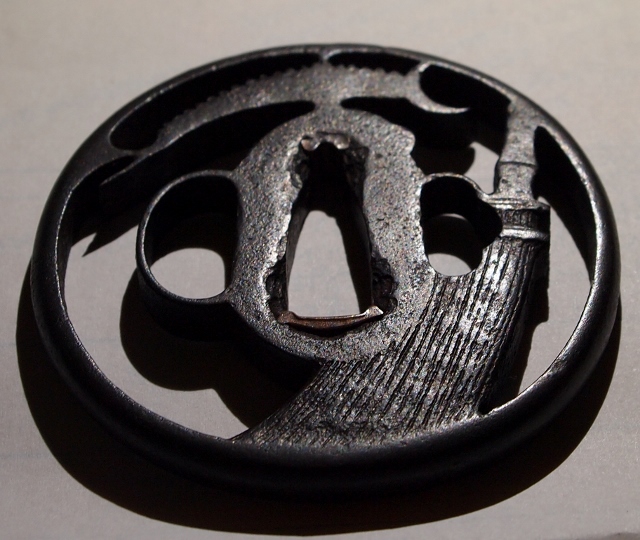
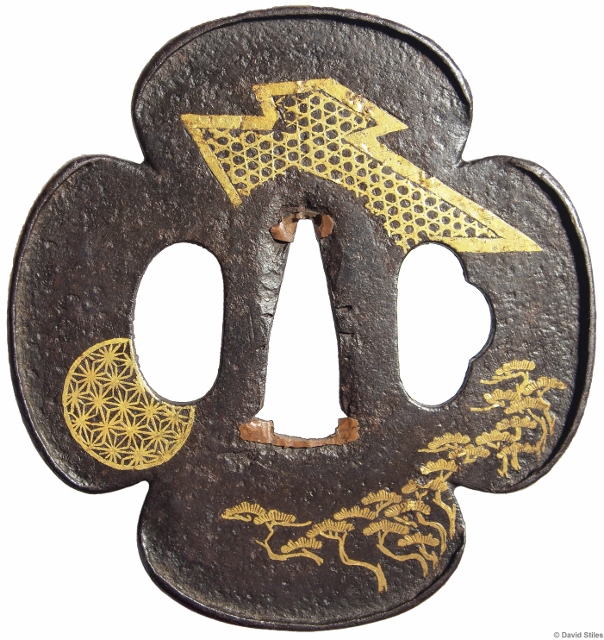
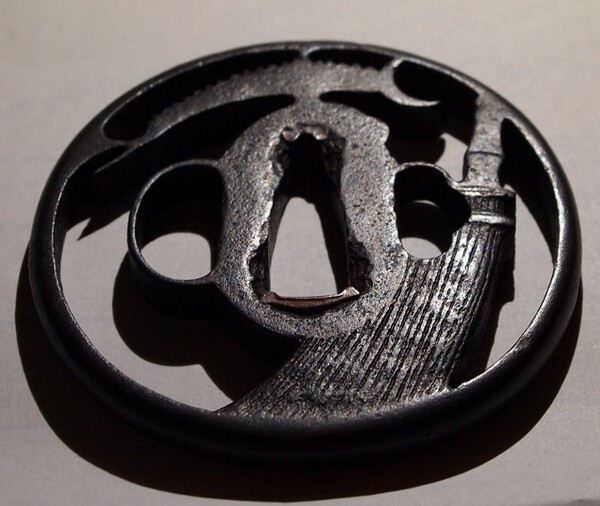
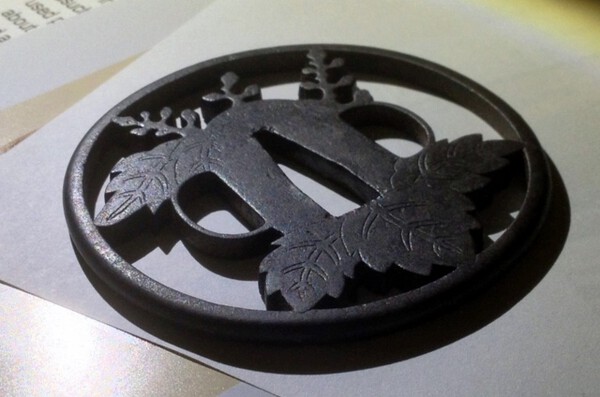
Hi Everyone, I was able to do some photos of a new tsuba picked up last weekends Baltimore Japanese sword show. The measurements are 7.1 cm wide by 7.2 cm high. The thickness of the rim ranges from 6.6-6.8 mm and is 7.0 mm at the seppa-dai. The rim is round, thick, and bold displaying a few fine iron bones. The sukashi is a mixture of robust and fine. The iron is well forged and has a nice blackish-brown patina with a glossy luster. The openwork design is interesting and related to the Chinese Buddhist monk Jittoku. He is often represented by a broom and is regarded as a incarnation of Fugen Bosatsu. I came across this after reading The Art Appreciation of Japanese Sword Fittings by Shigeo Fukushi. The other elements in the of the somewhat abstract design are a pine tree and a crescent moon. Does anyone know how these additional designs are related to Jittoku? The line carvings along the broom is a nice touch which leaves with me the impression that the broom is much closer to the viewer then the pine tree and crescent moon. Please feel free to discuss and thanks for reading.

-
 Hi Everyone, I think it was a good show and I was able to break even money wise. I traded/sold two tsuba, kogai, koshirae, and katana stand. I have five new tsuba added to my collection as well as a Japanese art book. The tsuba range in age from the late Muromachi Period to the late Edo Period. From what I heard the attendance wasn't great but I do hope they have another show next year. There is a photo of my table setup on Friday.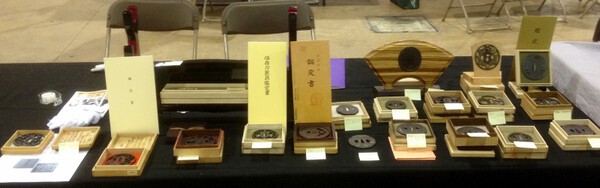
-
Hi Everyone, I pass this tsuba on to Bob Benson for NBTHK Tokubetsu Hozon shinsa submission in October. Will keep everyone updated what I learn. I am interested in what they say about the openwork design.
-
Hi Everyone, 2:00 AM and can't sleep as a specific tsuba is on my mind. Tomorrow is my last day at the show. I will let any two tsuba go for $1,200 cash with exception the set of consignment tsuba and the Momoyama Period Christian Nanban tsuba which has a new cash price of $1,200 down from $1,500. P.S. Gabriel L. thanks for the wonderful write up. The kogai has already sold from my table.
-
Hi Everyone, I hope to see as many people as possible at the show. I will try to take a few photos and post them after getting permission. I am packing things up now for the show. I will be bring my whole collection minus two tsuba in Japan for NBTHK shinsa. A fair bit of work this evening after my day job ends. :D P.S. My table number is 23. I will be sharing it with Eric S. a local member of NMB.
-
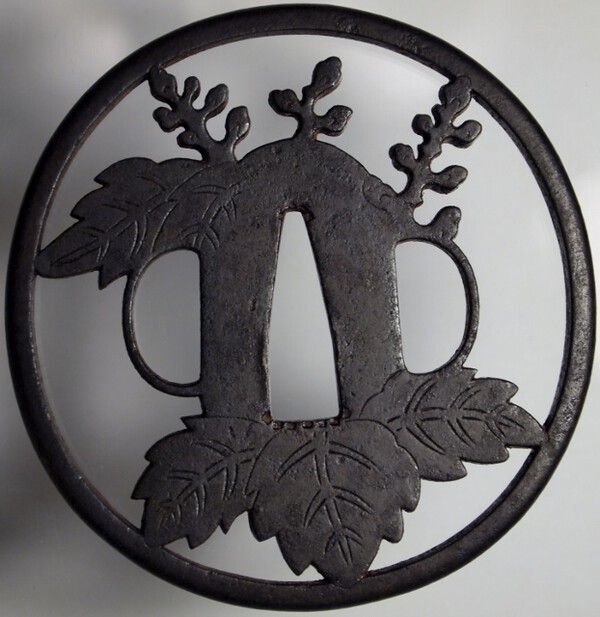
Hi Everyone, I was able to do some better photos of the Kamiyoshi school Higo tsuba today. Here is a new view of the omote side. The patina and the quality of the iron this tsuba is remarkable and wonderful to see in hand. I will updated my website with high resolution photos shortly. Enjoy.
-
Ko-kinko tsuba - what is this shape/profile called?
Soshin replied to growlingbear's topic in Tosogu
Hi James, Nice ko-kinko tsuba. -
Hi John S., What break? I don't see any. :? Pete K., nice kogai.
-
Simple Question: NBTHK June Shinsa Results out yet?
Soshin replied to Curran's topic in General Nihonto Related Discussion
Hi Everyone, I have two tsuba in the June NBTHK shinsa submitted by two different brokers. I haven't heard a thing. I have never waited this long for results. One tsuba I am fairly sure about the other one I have no idea about and nor did the tsuba fashionistas on NMB. :lol: -
Hi Jon, Thanks sounds like a good idea to me. Hi Everyone, For everyone attending the show I will have more than just what is display on my website. I will have three tsuba listed for sale on a consignment basis. I am doing this to help out a friend and fellow collector to reduce this collection and purchase something new. Here is the list with basic information provided by the owner. 1. Late Edo Period, Ko-dai Akasaka Tsuba 2. Edo Period, Higo Ji-Sukashi Tsuba 3. Middle Edo Period, Akasaka Tsuba with NTHK Papers to Akasaka and a Hakogaki attribution to Akasaka Tadamasa
-
Hi Everyone, Attached is a press release flyer sent to me as a vendor for the upcoming Baltimore Japanese Swords & Cultural Arts Show on September 20-22, 2013. I am very much looking forward to having a great show. I will have most of my collection at the show on display. The exception will be two tsuba being appraised at the NBTHK in Japan. Please PM or reply if you have any questions. Press release 2 for lfyer.pdf
-
Hi Paul M., This sounds like a good project and I will make a donation at the end of the week. I hope you will take time to profile modern Japanese sword fittings makers in Japan. I am still in the process of learning more about them as most of my recent interest has been with antique works. Here is a really nice Yagyu utsushi at a Japanese dealers website as an example: http://www.shoubudou.co.jp/tuba-408.html.
-
Hi Everyone, The 25% discount sale is over but I have made some major updates to all items on my website. Now all items on the website that are not already sold or on hold have a price. Items have new prices based upon a new standardized calculation. In most cases with the exception of one tsuba this resulted in a reduction in the price of the item. These are final prices but do not including shipping and insurance which will be quoted on a case by case basis on how and where the item is shipped. Let me know via email or PM if you have any questions. Here is a direct link to my website: http://dastiles1.wix.com/reflections-. Thank you all and enjoy.
-
Hi Justin, Well the koshirae isn't Higo it was just mismatched with a Higo tsuba. Thank you I think we have a match for my koshirae. All I now need is some money. :lol: I will still take a look at the upcoming Baltimore show to see if I can find matching menuki with this same design. Looking for people that can redo the tsuka in a handachi style is something I will need to do when I find and get a matching pair of menuki. P.S. I was able to find this tsuba on the website as well: http://www.tokka.biz/fittings/TS485.html. I think it is also a good match for my koshirae.
-
Hi Lee, I wouldn't surpised if the old paper was issued by a branch NBTHK club. It was uncovered that during a investigation Yakuza groups were found to be involved with the issuing of fale papers to Nihonto in a few of the branch NBTHK clubs. I think they were also into creating fake papers for Nihonto as well. This was fairly easy as the old papers unlike the new papers lack any build in seruity features. At my website I have a tsuba with a Tokubetsu Kicho paper. It is real but I think that the tsuba would paper if resubmitted now at the Tokubetsu Hozon level to Katchushi or possibly Ko-Katchushi.
-
Hi Henry W., This the topic that almost burned be out of NMB. I still really like your tsuba please let me know if you ever get tired of it. I have subscribed to Markus S. blog I find it very fun to read even when he is talking about Nihonto. Thanks for posting a link I am sure others will find it an enjoyable read as well.
-
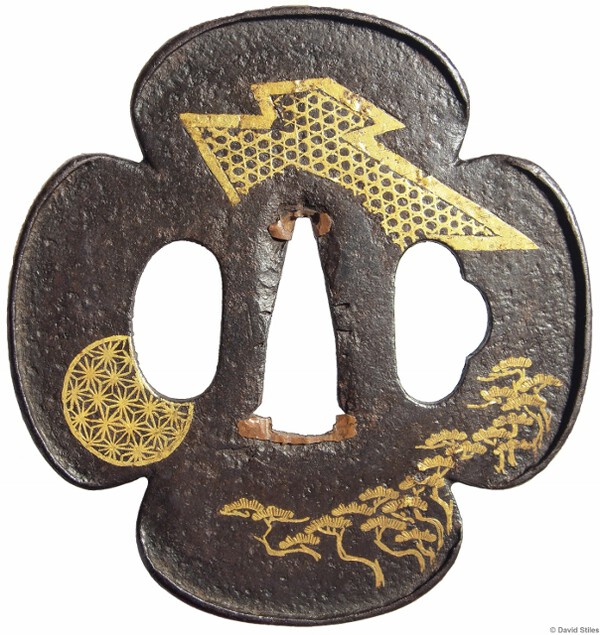
Hi Andrey E., The old NBTHK papers are reliable enough at that level in my opinion especially if they were issued by the main office in Tokyo. The problem with the old shinsa system were mostly with some Jyuo level nihonto and some of the certificates being issued by the branch clubs outside of Tokyo. This is one reason now all submissions for shinsa at all levels are examined at the Sword Museum in Tokyo the main office of the NBTHK. To get back on topic here is what I think is a Ko-Umetada tsuba currently in my collection. Enjoy and have a great weekend.
-
Hi Andrey E., Here is the information I have. In Tsuba Geijutsu-Ko by Dr. Torigoye lists Umetada Shigenari as a second level artist of the main branch located in western camp of Kyoto in Yamashiro Province. The other part of the mei on the right side of your tsuba reads "Yamashiro Kunni Ju" (山城國住). Here is an example of his work from Issue #636 of the NBTHK monthly magazine. In my opinion the signature is similar enough therefore I think your tsuba is authentic. My reasoning is the strange angle of the "Yama" (山) character which is observable in your tsuba and the published example. Also shape and style of the "Ume" (埋) is somewhat consistent. Finally more importantly the workmanship which the NBTHK says is about average is also consistent with your tsuba as well as other examples I have seen of Shigenari work. Overall I like your tsuba and love Umetada school work in general. :D

-
Dear Andrey E., I had a similar tsuba and after doing some research with a few issues of the NBTHK Monthy magazine covering the Umetada school I was able authenticate the signature by comparing it to the examples provided. Keep in mind I was also looking the workmenship as well not just the mei. Once I get home will check my references and reply with any helpful information.
-
Hi Chris, I wasn't aware of this fact until you pointed it out. Thank you very much for that additional attribution point. I agree that such a specific attribution of a unsigned piece to a master such as Fukanobu isn't possible with digital images alone. There is no substitute for in person examination. A friend who is a high end collector of Higo tsuba says that my tsuba is Kamiyoshi school work but that the rim on my tsuba is really good and reminiscent of Fukanobu workmanship therefore he is currently undecided. Below are two examples both with NBTHK Hozon papers one to Higo and the other to Kodai Higo with the same or similar designs. To me from looking at the photos the iron of both examples doesn't look that good compared to my tsuba. But in hand examination is always better to judge such things. Maybe on my next trip to Tokyo. Aoi Art: http://www.aoijapan.com/tsuba-mumei-unsigned-higo-school-kiri-plant http://www.aoijapan.com/tsuba-mumei-unsigned-kodai-higo-kiri-plant
-
Hi Ford H., So the use of line carving through the outside of the rim isn't a desirable feature. I was bit surprised to see this tsuba papered with such a large and major forging error along the rim. The layers used to make tsuba look like they are coming apart. This was a bit of joke to myself as I waiting the results of two tsuba I have submitted back in June. One was recommended by Pete K. I was thinking of the nagekiri sukashi design and really not meaning the iron and patina but you are correct it is a bit much to ignore. I should not have used that tsuba as an example.
-
Hi Everyone, Here is a good reference example with NBTHK Hozon papers of the same nagekiri ji-sukashi design made by the Tosa Myochin school also during the late Edo Period. That school often copied Higo designs like this. Aoi Art: http://www.aoijapan.com/tsuba-unsignedtosa-myouchinnagekiri-tsuba
-
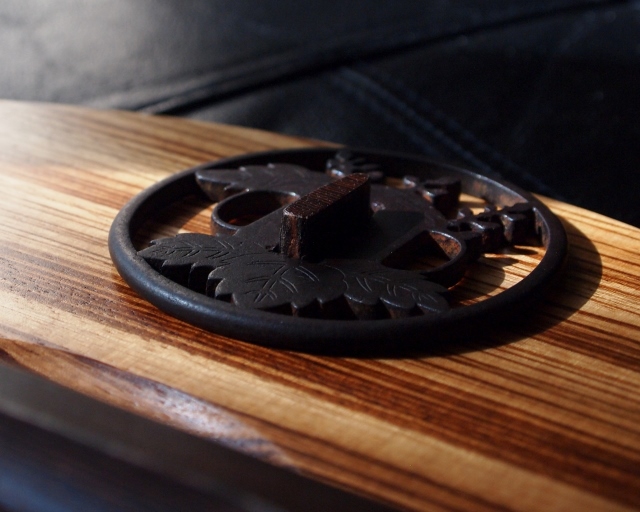
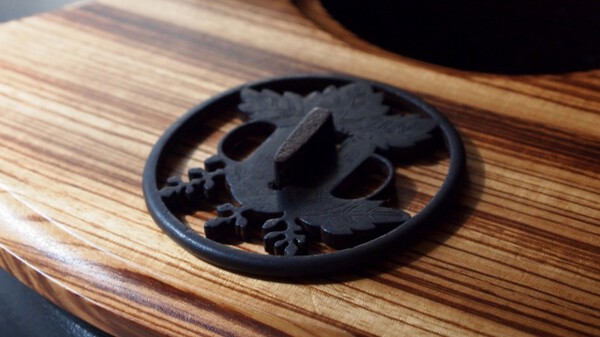
Hi KM, Yes chisel marks were generally used fit the tsuba better to the nakago but these on the tsuba in question are of the type that had no practical use in that regard. They were a way for a tsubako to sign his work without signing a mei, which were not allowed in certain cases. I have been told via email that the pattern of chisel marks I am seeing was common to Kamiyoshi school and not necessarily the second Kamiyoshi school master Fukanobu. Here are some art photos I did under normal sunlight at different angles.


-
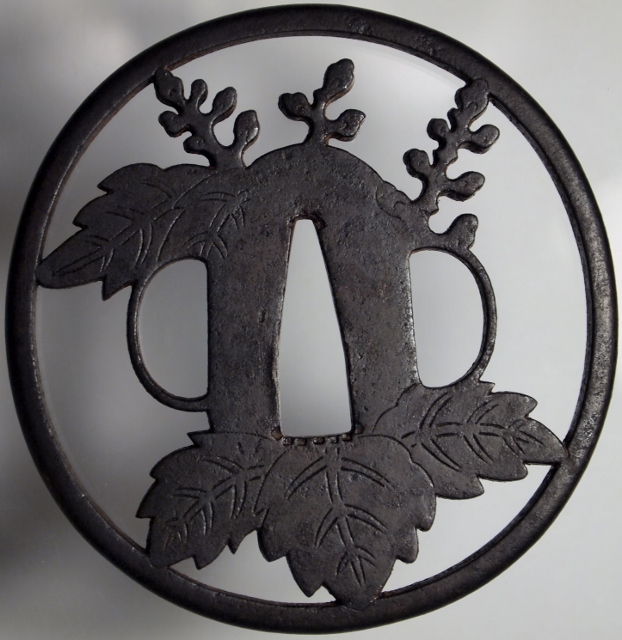
Hi Everyone, Here is a photo after I completed my rust removal process. Noticed some things about this tsuba. 1. The kirimon has different number of buds then is display in the handachi koshirea that it came with. The koshirea had the common san-go kirimon and the tsuba has the roku-san kirimon. The is more evidence of a latter mismatch discussed above. 2. The tsuba might be a antique copy made by the Tsuboi school of this popular design. I think this tsuba might also get a Higo, Kodai Higo, or Tsuboi call if it isn't determine to be the work of Fukanobu or more generally the Kamiyoshi school. The workmanship is good quality and kakushi-tagane around the nakago-ana is a good match for Fukanobu work from the example I have as reference. 3. Comparing this to my recent failed tsuba is like looking at night and day in terms of the iron. Makes me better understand the NTHK shinsa call better.
-
Hi Ford H., Thank you so much for the reply and the well worded explanation. I would agree but due to the fact that I need magnification to see the messiness where the gold mercury/fire gilded wire meets the shakudo nanako based makes me think the masking wasn't that bad just not perfect and therefore not up to your astronomical level of craftsmanship. What I have here is just a mismatched handachi koshirae of late Edo or early Meiji Period with a Higo tsuba from a later school (i.e. Kamiyoshi or Tsuboi) from around the same time period. This would also explain the differences in the number of buds on the kiri on the tsuba compared with the design at the end of the saya. I am going to keep the tsuba separate and just look for a replacement handachi style tsuba and menuki of the same level of quality using a gold mercury/fire gilding (kin-keshi) with a san-go kirimon design. I will also get the tsuka replaced in a handachi style as well using the fuchi-gashira. I am currently in the process of Goggling Unno Shomin, Kano Natsuo, and the gold application method to learn more. Thanks again for taking the time out of your busy day making tosogu to answer questions and provide additional helpful information. Hi Eric, My koshirae shows many more signs of age then your modern example but thank you for posting it for reference. I will try to look for a similar style tsuba at upcoming shows in the USA and no NMB.