
Soshin
-
Posts
2,927 -
Joined
-
Last visited
-
Days Won
3
Content Type
Profiles
Forums
Events
Store
Downloads
Gallery
Everything posted by Soshin
-
Hi Gwyn, It looks like your new tsuba has had a hard life. At one time the eyes of the two cranes might have been inlay with soft metal but not sure about this. The openwork design is very iconic but the overall workmanship doesn't look nearly as good as in many of the published examples. Just looking at Sasano first English book there are two openwork tsuba with this design attributed to the Akasaka School and Toso Myochin School by the author. What are the measurements of the tsuba including thickness? With the limited information you have provide so far I would say your tsuba might have been made by the late Shoami School trying to copy this iconic design or possibility the work of the late Akasaka School also trying to do the same thing. Hope you find this information helpful.
-
 Hi Everyone, I have been busy at work this long holiday weekend with updating my website. Please feel free to contact me via PM or via my website. Here is a list of the major changes. 1. Added photos of a new NTHK papered Saotome tsuba to the Homepage and added some hyperlinks and additional information. 2. Added prices (USD) for the sale items on the website. 3. Added a new small tachi-kanagushi tsuba to Gallery Number 3 webpage. 4. Added a new tanto sized Mino Kinko tsuba to Gallery Number 4 webpage. 5. Updated with more non-sword related Japanese antique art and updated some of the information on the Other Japanese Art webpage. 6. Updated Galleries Page with additional information. 7. Fixed some formatting issues with the mobile version of the website. 8. Updated the Contact Page with information about upcoming shows in the USA.
 -
Hi Bill, Your tsuba reminds of the nice sweet persimmon I had for dinner. It looks like the monkeys have the same idea. The Christies auction kozuka set don't look as good as your set of fitting. Sorry not much help with you artist but thanks for sharing.
-
Hi Rodenbacher, Putting jokes aside. The base soft metal is yamagane a common early soft metal used in Ko-Kinko tosogu. The turned up rim and the shape of kozuka hitsu-ana is also of a early shape common to pre Edo Period tsuba. I think these are a few major points used by Marius's in his analysis and conclusion.
-
Hi Rodenbacher, Marius is the Irogane mac-daddy and possessor of the blingest of bling-bling of Ko-Kinko. I am but the humblest of servants needless to say I agree with his analysis.
-
Hi Chris, I know the seller and we talked mid October he was planning to attend DTI this year. This fine sword must have been something he picked up at DTI. Nice sword thanks for sharing.
-
Hi Marius, Nice shin-shinto blade with great horimono thanks for posting it. I also like the tsuba made by this school of swordsmiths as well. :D
-
October 2014 Website Updates...
Soshin replied to Soshin's topic in Auctions and Online Sales or Sellers
Hi Bryan, Thank you so much for the friendly reply. The website while a lot of work has been a labor of love to organize from my own notes about each piece in my collection. Send me a PM via NMB or a email through the website if you interested in adding any piece to your collection or just have additional questions. -
Shinto Wakizashi in RED / GOLD Koshirae & NBTHK Hozon
Soshin replied to Nickupero's topic in For Sale or Trade
Hi Bryan, I can't agree more with Brian. Congrats Bryan nice pick up on NMB! -
Hi Alex., You did a good job of pointing out some of the very clear problems (signs of casting) with this tsuba. I also pointed out other problems on the front side when this tsuba was first posted. Was looking at the asking price for this tsuba on the website at $2,957.50 USD this is delusional.
-
Hi James C., It might be a British thing. My customers from the UK have openly complained about the pricing of nihonto and tosogu by many of British antique dealers. If is often cheaper to buy from me at a reasonable price and pay the import tax from the USA then it is to buy from any of the antique dealers in the UK that has nihonto or tosogu. I am so happy to fill the void due to their ignorance the above tsuba is a perfect example. :lol:
-
Hi Grev, Felt a little sorry for my sarcasm. Working on your museum cataloging project now. Wish me luck!
-
Hi Grev UK, Check on eBay. There is a Japanese seller (eBay ID# yumi3go55) that sells vintage and used boxes. He always has similar old boxes with such outlines in them. I have purchase some of the older boxes in the past that were in good condition. Here are three examples. http://www.ebay.com/itm/WOODEN-BOX-for-TSUBA-etc-USED-gi167-/291263904951?pt=Asian_Antiques&hash=item43d0ae7cb7 http://www.ebay.com/itm/WOODEN-BOX-for-TSUBA-USED-KIRI-gi171-/291264744384?pt=Asian_Antiques&hash=item43d0bb4bc0 http://www.ebay.com/itm/WOODEN-BOX-for-TSUBA-USED-KIRI-gi184-/351195954322?pt=Asian_Antiques&hash=item51c4e8fc92 [sarcasm] Yes I do find old used vintage tosogu boxes more interesting then the current tsuba being discussed. [/scarcasm]
-
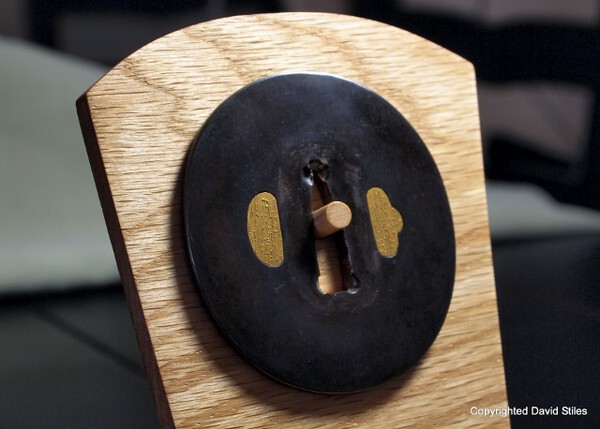
Hi Jeff R., Getting some books and doing some reading will help and it is a good way to start this hobby. The quick answer to your question is no. Generally small precious metals as inlays are so small they do not involve enough precious metals to do much to increase a antique Japanese sword fittings value. Here is an example in my collection where this isn't the case as precious metals inserts are fairly large and very skillfully done. I am not a licensed therapist but communication is key to any good relationship. I try to show my wife my tsuba and explain about the history (where and when) and the many designs pictured on them. My wife really likes the above Kenjo tsuba above she said it has a very refine appearance.
-
Massive Rai Kunimitsu on Aoi
Soshin replied to Marius's topic in Auctions and Online Sales or Sellers
Hi Everyone, Completely agree with Jean on this one but haven't read Darcy's comments about this Nihonto. Given the fact the dealer is literally just down the street from the NBTHK sword museum they would have submitted it for Juyo by now if they would have thought it would pass. With that said having a sword like this would be at the top or near the upper limit of what I could ever afford given my modest means. :lol: -
Tokyo report
Soshin replied to Jean's topic in Sword Shows, Events, Community News and Legislation Issues
Hi Everyone, I exchanged emails briefly with Curran upon his return to eastern USA. I personally have always found jet lag worst coming back from Japan then going to Japan from the USA. Going to Japan I was always able to sleep off the effects of the jet lag. I really hope to make it to DTI sometime in the very near future as it looks like a lot of fun. Thanks also to everyone able to post pictures of the event and Japan in general during their trip. :D -
Massive Rai Kunimitsu on Aoi
Soshin replied to Marius's topic in Auctions and Online Sales or Sellers
Hi Marius, Nice sword thanks for sharing. Is this why you are selling all those tsuba? It would look good in any nihonto collection in my opinion. -
Hi Derek, No don't see Akasaka, the style and thickness of the openwork is all wrong. Checked out the size information on the auction web page I would say Owari and not Kanayama but the two calls are similar and not unrelated. Would like more photos if possible. I just pick up another Owari tsuba about the same size but thicker with iron bones along the rim. It is current on my website along with a NBTHK papered Owari tsuba that previous owner was thinking it was Kanayama. Notice the symmetry of the openwork designs and compare it to both of my tsuba on my website. Here is a direct link to my two Owari tsuba for reference: http://www.tsubaotaku.com/#!gallery2/c5om.
-
-
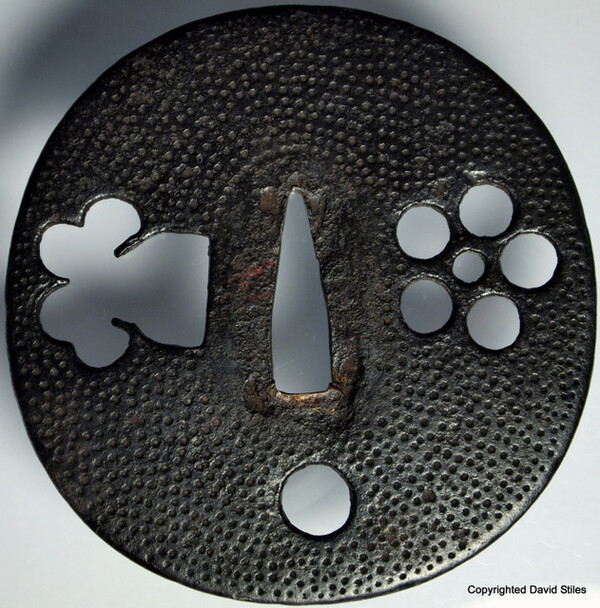
Hi Everyone, Many on NMB might thought I have been getting soft with my latest two acquisitions being a set of Shakudo menuki and fancy ko-wakizashi. Here is also something I was luckily enough to pick up on trade at the Philadelphia Japanese sword show in October. A old iron middle Muromachi Period Ko-Kachushi tsuba. I am dating it as such based upon previous owners comments and my own independent research of the piece as it sets in my collection. The surface has been covered with black lacquered that is typical of this specific time period of production. The measurements of the tsuba are 8.1 cm wide by 8.2 cm high. The thickness at the rim is 2.5 mm and is 3.0 mm at the seppa-dai. The rim also displays small tekkotsu. On Jim Gilbert's website there are a number of early iron both Ko-Kachushi and Ko-Tosho tsuba with similar characteristics. Here is URL to the website I am referring to: http://home.earthlink.net/~jggilbert/oldiron2.htm. Did some research and the enacted kamon ko-sukashi design on the right side consisting of the five circles surrounding one circle is called a "Umehach" in Japanese meaning plum bowl. The design was used by the Hisamatsu Matsudaira family before and during the Sengoku Jidai (Warring States Period). This information would be consistent with the dating of the tsuba to the middle Muromachi Period. I also checked Sasano first book Early Japanese Sword Guards Sukashi Tsuba it has a Ko-Kachushi tsuba dated to the early Muromachi Period that was a gift to a Shrine in Kyoto by the third Ashikaga Shogun Yoshimitsu that has a similar punch mark design on its surface also with extensive openwork. It is pictured on page 46 example #14. There is another Ko-Katchishi tsuba on page 44 example #12 with the same type of surface treatment made with a narrow curricular punch. On page 36 of the 2009 Kokusai Tosogu Kai Catalog there is also a similar Ko-Kachushi tsuba with a similar surface treatment and thickness of the plate. Shumei of red lacquer on the omote side is in the shape of the kanji for the number seven (shichi 七) also carved twice on both sides of the seppa-dai on the ura side. These are crudely carved not like a signature or anything. I think the meaning for the number seven has long been forgotten. Any reasonable ideas why someone would write the number seven along the seppa-dai? Here is a link to high resolutions photo of this tsuba on Facebook: https://www.facebook.com/photo.php?fbid=10201865051906367&l=51ad39e1c2. I hope to add a few different photos of it to my website soon. Below is a low resolution photo I was able to upload to NMB.
-
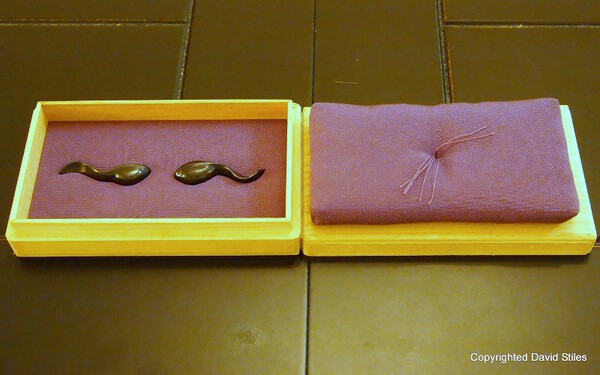
Hi Everyone, Here is another photo of the menuki that give you a sense of the size and scale of the menuki as they set in the custom box. Feel free to ask questions or comment.
-
Hi Stephen C., One very important word of caution Ford makes it look way to easy in his YouTube videos!
-
Hi Everyone, This is just a general notice that my website Tsuba Otaku (鍔おたく) have been updated. Here is a short list of the changes and improvements to the website. Here is a direct link to the homepage: http://www.tsubaotaku.com/. 1. Added photos of a new Tachi-kanagushi tsuba to the homepage and changed some of the introduction text. 2. Added a new katana sized Owari Sukashi tsuba with a famous family crest design to gallery number 2. 3. Added a new Ko-Kinko sukashi tsuba to gallery number 1. 4. Updated the Galleries main page with new key images. 5. Updated with more non-sword related Japanese antique art and changed some of the text. 6. Fixed some formatting issues with the mobile version of the website. 7. Updated the Contact page with upcoming shows and a new photo. Feel free to contact if you have any questions or comments.
-
Hi Jay L., The detail on the tsuba doesn't look good in my opinion specifically the execution of the ryo hitsu-ana. I agree with Ford. Grey has a really nice website and reasonable prices for the most part.
-
Hi Jeff R., The rear side of your tsuba looks like it is inlaid with a bit of silver specifically on the roof of the rural home. I have seen similar grass roofs when I was traveling to rural Shimane Prefecture in 2013. The front side is inlaid in what I think is copper and brass or even gold. Sometimes it is hard to tell the difference between brass and gold if you not looking at the tsuba in hand as color balance of the photo can easily make brass look like gold and vice visa. In terms of age and school I would say your tsuba was likely made by the Aizu Shoami school circa the late Edo Period around 1770 to 1868. I am basing my call on artistic composition, materials and techniques used. Once you see more examples you will start to see what I am talking about. With the inlay of silver in a almost highlight like manner is fairly commonly seen in Aizu Shoami school work which was based in Aizu Province. Many not so experienced or seasoned collectors dislike the Aizu Shoami school but I have seen enough very fine pieces and even masterpieces to truly understand and appreciate the school's work as a whole.