
Soshin
-
Posts
2,931 -
Joined
-
Last visited
-
Days Won
3
Content Type
Profiles
Forums
Events
Store
Downloads
Gallery
Everything posted by Soshin
-
Hi Matt, Typically Tosho tsuba have a thicker center (seppa-dai) then rim. This is fairly consistent trait of Tosho tsuba in general.
-
Hi Matt, From your measurement it is a bit small and likely made for a wakizashi. I would estimate a age range from Azuchi-Momoyama Period to the early Edo Period. This is the late 1500s to early 1600s. I would estimate a retail price of about $125 to $175 USD if I was trying to sell it online or at a show. From the limited photos (better focus helps) it is hard to get a true idea of the condition of the iron surface and if the restoration work was done correctly. Hope you find the information helpful.
-
Hi Matt, It looks like a Tosho tsuba in poor condition. What are the measurements including thickness? This important in determining the age and value which I can provide you with. I wrote a article about Tosho (sword smith) tsuba for the JSSUS newsletter a few years ago. A link is included here for my website where the article is located as a PDF. http://www.tsubaotaku.com/#!galleries/component_41229 The link is towards the bottom of the webpage.
-
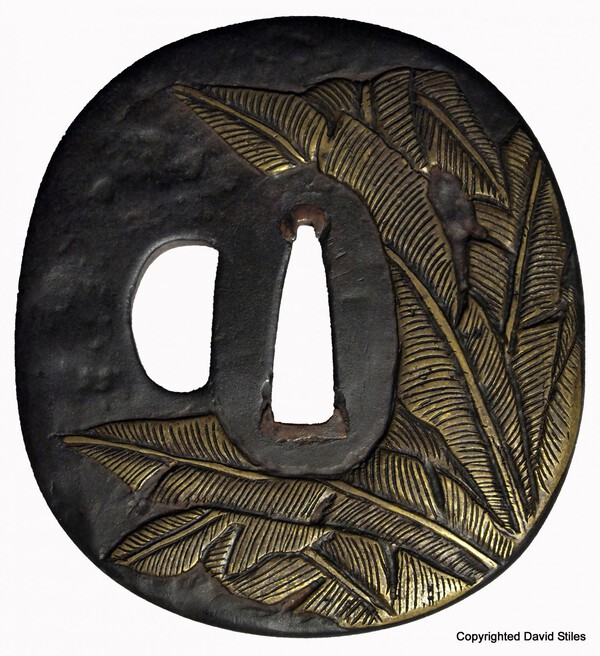
Hi Everyone, Can someone post some examples or references of Tanabe Yasuhira work who studied under Shigenaga the 5th generation Jingo master? I think he was located in Kumamoto during the late Edo Period circa 1850 and worked in a Jingo School style. Attached are photos of a tsuba that might be his work. The design of Banana Palm was made popular by the 5th generation master. This is a large tsuba measuring at 7.8 X 8.5 cm, 4.6 mm at rim. I presented 1:1 scale photos of this tsuba to Bob Haynes in November and received very positive feedback about it from him. I will present this tsuba to Bob in person at the upcoming Tampa Japanese sword show next month. This tsuba will be going to the NBTHK shinsa later this year. More information is available at my website: http://www.tsubaotaku.com/#!gallery4/c1jbk. It is the last tsuba on the webpage. P.S. Here is a example by a Kumamoto artist during the late Edo Period: http://www.tsuruginoya.com/mn1_3/b00027.html ,

-
Hi Antti, Nice Higo tsuba. The previous owner is a friend of mine. I really like Higo tsuba and currently have two in my collection one which is papered by the NBTHK. The other tsuba I will submit sometime this year to NBTHK. Both are iron and not soft metal. Not sure if your tsuba would get such a direct attribution to "Tohi Kohrin" at the NBTHK shinsa as your tsuba isn't signed or a published example so you should be prepared for the generic Higo attribution and as stated by Pete K. some type of Nishigaki attribution as well.
-

Tsuba Otaku December 2014 Website Updates..
Soshin replied to Soshin's topic in Auctions and Online Sales or Sellers
Hi Everyone, After noticing many of my posts have been deleted on the new forum I just what to post a notice that there has been a major update to my website for January 2015. The highlights of the first major update for 2015 is the homepage addition of a of rare large Ko-Katchushi tsuba. A 74 points NHTK papered Saotome tsuba is also listed for sale in gallery #3. A direct link to my website is below in my signature. Please feel free PM or contact me via my website if you have any questions. -
Hi Stephen, I would go with Kyo-Shoami School as the maker of your new tsuba circa middle Edo Period.
-
Hi Everyone, Scaling down my participation on the forum lately as I am preparing my website for another major update this coming week and have been busy with sales. Amazing my account isn't deleted. Been doing some research about the design of Brian's menuki and I don't think they are Buddhist Dharma wheel the term for this in Japanese is rinbo or rinpo. There are some stylistic variations between the different sects of Japanese Buddhism as well as varying degrees of emphasis on the importance of this symbol but all of the design share some important common features for example eight spokes to the wheel etc. not present in the design of Brian's menuki. I am currently working on alternative theories to explain the design but haven't come up with anything conclusive. I was thinking late along the lines of a Go game board or something similar but generally they have pieces of two different colors one light and the other dark. Brian, I hope you submit your whole wakizashi koshirae to NBTHK shinsa sometime down the line. From what I have seen it looks really nice congratulations.
-
A big thank you and recommendation
Soshin replied to Brian's topic in Auctions and Online Sales or Sellers
Hi Brian, My sense of humor is fine just wasn't aware of your current situation in terms of funding for NMB and other problems. You might have posted about it and I missed it. I am moving around a very little bit of money and will send you a donation by year's end even if nothing is sold. -
A big thank you and recommendation
Soshin replied to Brian's topic in Auctions and Online Sales or Sellers
Hi Brian, Congratulations on you sword purchase from Darcy and Ted. Anything I have seen they have been associated with is very high end nihonto and tosogu and way above my pay grade in the US government. From your post in the tosogu forum your sword also has very nice fittings. Always very important on any nice nihonto. You do realize you can no longer use the "I don't have money" excuse anymore as you clearly do. Either that or you have been putting all those donations to NMB to one very good use. P.S. The above post was intended as transcultural sarcastic humor. This will likely get my NMB account deleted. It's always better to go out laughing. -
Hi Evan, Just stating my educated opinion take it or leave it. No your tsuba is not on the thin side and is fine. Many tsuba made by the fourth, firth, and six generations have this what I would consider average thickness. Still think it is forth generation School work as the design is original and not a copy of a design developed by one of the Higo schools. It would likely get a plain "Akasaka (赤坂)" or even a "yondai Akasaka (四代赤坂)" attribution if your lucky to the middle Edo Period (江戸時代中期) but submitting it to NTHK might still be a good learning experience. Being there in person at the show for the NTHK shinsa is a good idea because they have answered my question afterwards in the past.
-
Hi Evan, Sorry all my Akasaka School tsuba have long since been studied and sold off so I can't share any photos for a public discussion of other peoples tsuba. Your Akasaka tsuba is a nice one thanks for sharing it. To me it looks more like the work of the fourth generation due in part to the original composition as the fifth generation onward the Akasaka School mostly copied Higo openwork designs. The second characteristic is the thinness of the plate of your tsuba. The third generation Akasaka the last of the three generation that make up the Ko-Akasaka classification and who made tsuba with characteristically very thick plates often 6 mm or greater at their thinness point with bold original openwork designs. Some examples I have found. Example #1 Ko-Akasaka
-
Hi Everyone, I concure with Jeffrey's statement. Was able to spend sometime with Mr. Quirt after the Philly show this year as we both had late flights out of Philly on Sunday.
-
Hi Pete, Thanks for the link. I don't have this website in my very long collection of bookmarks of domestic and international Japanese sword dealer websites and will add it. The prices on the website are meaningless as I can't buying anything now anyway but the pieces themselves are important to study.
-
Hi (Please added name it is the Nihonto Message Board rules.), I agree. It is a really nice set of Juyo Tosogu with a very interesting subject for sale on eBay. Love how the tiger is rendered in the composition on the tsuba and the other matching set of sword fittings. The only problem is I don't think I will be having $38,000 anytime soon to spend on this hobby or any hobby for that matter.
-
Hi Ford, Nice work! :D
-
Hi Maruo P., Thanks for joining the discussion and provide some helpful information. I did some web searching on katabami (片喰) kamon design. I found the following information. More information about the kamon design and common variations can be obtain on the website the above quote is taken from: http://history.stackexchange.com/questions/14178/meaning-of-samurai-crest-symbol. Searching Japanese Wikipedia (great resource of information if your know a little Japanese) I found this article about the Nakajō clan that used an identical kamon design as the damaged mon-sukashi on my tsuba. I wounder what the relationship was between the two clans who's kamon is pictured on the tsuba. I know that the Hisamatsu Matsudaira clan were retainers of Oda Nobunaga during Sengoku-jidai and before that likely the Ashikaga Shogun. More food for thought and discussion.
-
Hi Everyone, Was doing some thinking and came up with an additional question. Since Pete K. was able to come up with what the design of the mon-sukashi looked like before it was damaged and/or altered can it be attributed to a specific clan like the mon-sukashi on the right?
-
Hi Everyone, Agree with Brian. Pete's explanation seems highly likely given that the broken sukashi 'prongs' look bent and out of alignment.
-
Hi Pete K., Your art work looks good to me in terms of what the mon-sukashi looked like then the tsuba was newly made. Thanks again for your input into this discussion.
-
Hi Pete K., Thank you so much for joining the discussion. I forgot to disclose that the side I was showing in my zoom photo was on the back side of the tsuba that faces the saya. Your explanation of the deepening of the sukashi towards the seppa-dai to fit a narrower saya makes sense. Not sure if this tsuba ever had an original kozuka hitsu-ana or not given the close placement of the mon-sukashi on both sides of the seppa-dai. P.S. On a additional note I have found two Ko-Tosho tsuba with similar damage to its mon-sukashi. Ko-Tosho Tsuba
-
Hi Everyone, Here is a Ko-Kinko example to show what Boris is talking about in terms of surface treatment: http://blog.goo.ne.jp/tsuba_001/e/8da643da369f09d54424badab0dd07b7. The placement of the mon-sukashi with a smooth border is also very similar to my iron tsuba. P.S. I also found this Ko-katchushi tsuba on the same blog. It shows the same type of surface treatment and the thin rim is also similar.
-
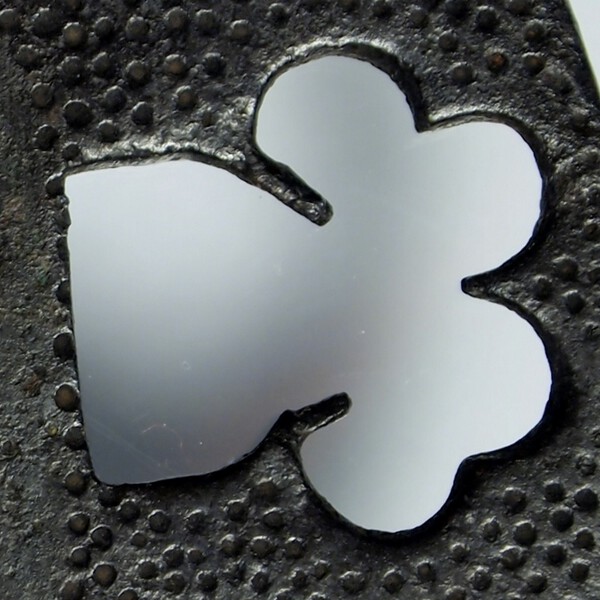
Hi Boris, Thanks for the very helpful information. I think the mon-sukashi plum blossom on the left side was damaged and the kozuka hitsu-ana was then added. I think the mon-sukashi might have looked like this before the damage and the addition of the kozuka hitsu-ana. The reasoning for this conclusion is the fact that the punch pattern neatly goes around the edges of the three ko-sukashi designs forming a clear border but the punch pattern is clearly interrupted at the edges of the kozuka hitsu-ana. Here is a detail showing what I am talking about.

-
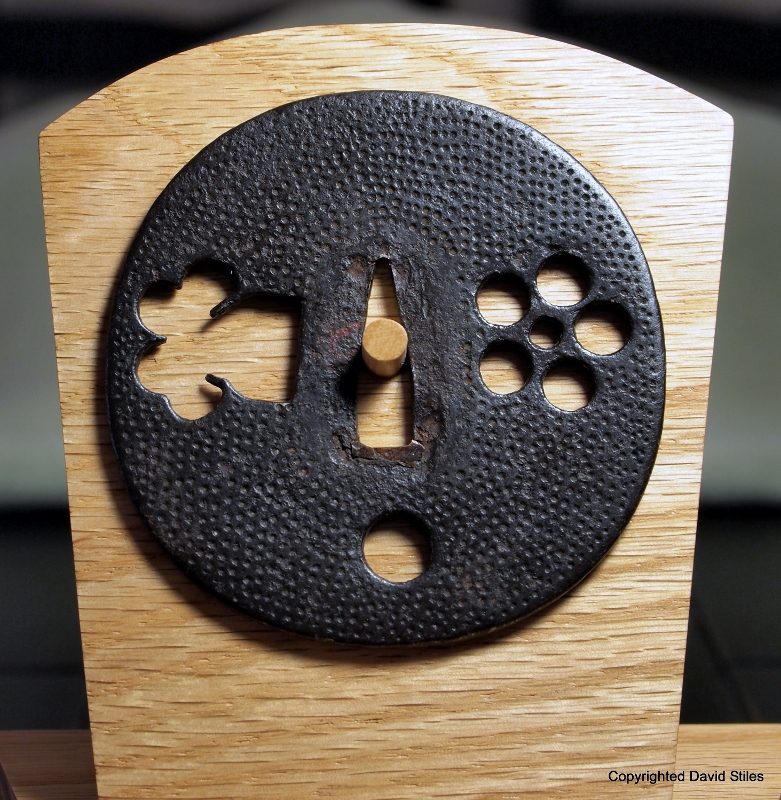
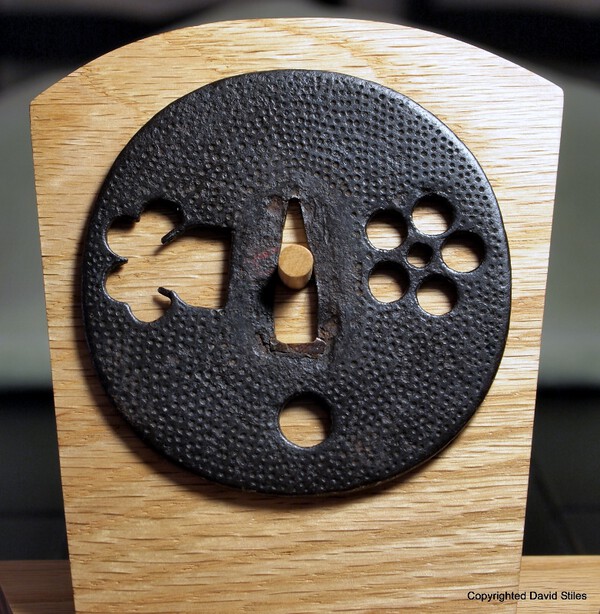
Hi Chris B., Yes the tsuba looks and feels very nice in hand. Thank you so much for the correction I can across a Wikipedia article in Japanese that discuss the clan that used this family crest. I likely was transliteration it incorrectly into rōmaji. Here is a Wikipedia article link to those who can read Japanese: 久松氏. Hi Peter B., I can't agree more. I have a general rule to handle shakudo and other soft metals with white cotton gloves but with old iron like this it is best to feel it in hand without gloves. P.S. Here is another nice photo of this tsuba on a tsuba stand at a different angle. Enjoy...
-
Hi Jason, The design is called (四方猪目透唐草文図) in Japanese which means four boars eyes in openwork and a arabesques pattern. Here is a link the a very similar tsuba for sale on Fine sword website right now: http://www.finesword.co.jp/sale/kodougu/htm/2001_3000/2201_2250/2241/k2241.htm. At only 65,000 Yen given the exchange rate in USD the price is right in my opinion. From my experience they write and speak English and I had no problem communicating with them via email. Hope you find this helpful.