Baka Gaijin
-
Posts
566 -
Joined
-
Last visited
-
Days Won
33
Content Type
Profiles
Forums
Events
Store
Downloads
Gallery
Everything posted by Baka Gaijin
-
Good morning all, Here's a seemingly dumb question. What was the polishing really like in Sengoku and Edo periods? Was a polisher really a sharpener? I've heard tales of stone lanterns and particular sections of a wall which have gouges and lines where Yari and Katana were supposedly sharpened by warriors prior to battle. Is this true or Fantasy Island? Admittedly these tales are usually fueled by elegant cups Sake or chilled cans what certain denizens charmingly refer to in the U.K. as "Wife Beater". Cheers
-
Morning all, The Kanji for the Heart Sutra seems quite well formed and balanced. Could this have been a form of Omamori 御守 (Talisman) over which a leather combat cover would have been fitted? Cheers
-
I have had three of these Tourist pieces, the carving on the Tsuka is always identical. They usually have a wooden tsuba, and I had one with a wooden Habaki. (Most go missing it seems). They must have been centrally made because the stepped nakagojiri is common. I had one with Hachiman Daibosatsu roughly engraved on both flats of the blade (Is that the correct term?) The steel is quite soft. Cheers
-
Good afternoon all, I have my doubts about its reality as a weapon during Sengoku Jidai (or any other period for that matter). I was told once they were feudal can openers for armour........ The koshirae looks like a working on Ebi zukuri. A long time ago I saw a similar Koshirae in a Temple devoted to Hachiman Taro Yoshiie. (I recall it being described as Koshigatana, but that was a long time ago and a galaxy far far away...........). Cheers
-
Morning all I suggest that something's amiss with the tsuka... Cheers
-
Hi Chris, This may help: http://ohmura-study.net/906.html I do wonder of the origin and age of your pierced example. Cheers
-
Hi Guido xxx mei ga aru meaning something like a signature is there.......similar interpretation as the auction term "bearing a signature"? Cheers
-
Cheers
-

very rare Yasukuni blade and koshirae
Baka Gaijin replied to cabowen's topic in Auctions and Online Sales or Sellers
Morning all, Just found this by courtesy of Ohmura san's excellent Gunto site, is another Onshi type 94 signed Yasunori Tsutsushinde Tsukuru (real name Kotani Kenzō). http://ohmura-study.net/931.html Here's another Onshi, signed Yasuhiro-Kinsaku http://ohmura-study.net/932.html I notice that the 3 examples don't have metal Sarute. Cheers -
very rare Yasukuni blade and koshirae
Baka Gaijin replied to cabowen's topic in Auctions and Online Sales or Sellers
Morning all, The Kanji on the habaki says Onshi - Imperial gift For Trivial Pursuit fans, Ueno Park in Tokyo's full title is Ueno Onshi Koen 上野恩賜公園 "Ueno Imperial Gift Park. An Imperial gift from the Taisho Emperor to the City of Tokyo in 1924. Cheers -
Good morning John K http://www.jssus.org/nkp/index.html Cheers
-
Good afternoon Hamish, It might be Japanese Sword Hataya. http://en.japantravel.com/photos/Japanese-sword-hataya https://www.google.co.uk/maps/place/Jap ... !1e1?hl=en Cheers
-
Good afternoon all, In the case of holding the sword in the saya, holes at the top, holes at the bottom suggests the Tsuba was originally Tachi or Katana mounted. Cheers
-
Who owned swordsmith lines?
Baka Gaijin replied to Peter Bleed's topic in General Nihonto Related Discussion
Thank you John, A very interesting article, particularly the Chinese proverb “wealth shall not pass to a third generation”. There is a similar saying in parts of the U.K. "Muck to money and back again". Small World, astute observation... Cheers -
Woodblock print with matchlocks!
Baka Gaijin replied to Viper6924's topic in Tanegashima / Teppo / Hinawajū
It may help to analyze the term Hidensho 秘伝書 ひでんしょ HI 秘 - ひ - Secret - Conceal DEN 伝 - でん - Transmit - Go along - Follow - Report - Communicate - Legend - Tradition SHO 書 - しょ - Write I have heard there are instances in both Japanese Arts and Martial Arts where the phrase "Hidden in plain sight" is used. Cheers -
Woodblock print with matchlocks!
Baka Gaijin replied to Viper6924's topic in Tanegashima / Teppo / Hinawajū
Good afternoon Eric, I wonder if there is something of a cross fertilization between the European manuals and Japanese. i.e. the Japanese having sight of European gunnery manuals (Slight pun intended) During the latter part of the Edo period the Dutch sold more than 10,000 foreign books on various scientific subjects to the Japanese from Deshima Island. These became the basis of knowledge of the wider World and a factor in the Rangaku movement (Dutch studies). Just a thought Cheers Malcolm -
Woodblock print with matchlocks!
Baka Gaijin replied to Viper6924's topic in Tanegashima / Teppo / Hinawajū
Sorry to come to this late. My take on Eric's post is that it is an important piece of social documentation, like a Senufo dream mask, it really is irrelevant whether it seems practical or not to us. Consider this: If we look at many of the surviving Makimono (Rolled narrative scroll) of Ryuha (Martial Schools), much of the wording and illustrations do not seem to make sense. Seemingly incorrect illustrations and vague descriptions of actions are deliberately placed to keep the secret heart of the Ryu intact. Only those who had made Keppan (Blood oath) and passed through the levels of trust would have access to the secret knowledge that made the scroll (Makimono) legible. Thus if a Makimono fell into unauthorised hands, the secret heart of the Ryu was preserved. Yagyu Tsuba are an example of this secret symbolism. And I'm still going to look for Hamster Ladders........ Cheers -
IDEOGRAMS ON WOODEN HANDLE - JAPANESE WEAPON OR TOOL???
Baka Gaijin replied to Bazza's topic in Translation Assistance
Hi BaZZa, This page should answer your question: http://www.pinterest.com/worldantiques/ ... ku-and-eq/ It can be written as とびぐち or 鳶口 Cheers Malcolm -
Woodblock print with matchlocks!
Baka Gaijin replied to Viper6924's topic in Tanegashima / Teppo / Hinawajū
Morning Eric, Talk about a moment of clarity. I have wondered why the rear sight was constructed so. Now seeing the slide in ladder sight / elevator, it all makes perfect sense. I shall be scouring the flea markets when I'm in Japan for "Hamster Ladders" Much appreciated info. Cheers -
Hi Ed Can you post pics of the other Kamon please. Cheers
-
No Problem Ken, Do you see the size of the Ken in picture four by comparison to the staircase which is just beside it. It's quite idyllic, turn 90 degrees left and there is a pond full of Carp and Turtles with a trickling fountain. Bring back some memories of Japan???
-
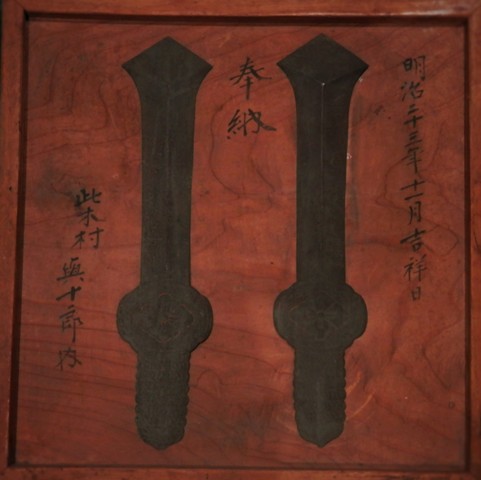
Hi Ken, If you check out Naritasan Shinshoji Temple in Narita City, Chiba Ken, you will discover it is packed full of Ken, Ken. Hundreds of them in the gardens standing sentinel and on the various Statues of Fudo no Myo-o that are to be found there. I have a votive Ema board, which is dated to 1890, which depicts two Ken, Ken. Also check out Kurikara with John Maki Evans (Who seriously studied esoteric practices for a number of years in Japan): http://books.google.co.uk/books?id=yGIB ... gy&f=false Cheers


-
WW2 ? handle wrap binding , unknown material ?
Baka Gaijin replied to phil reid's topic in Military Swords of Japan
Good morning all, I agree leather wrap and the style called Katatemaki: http://www.thejapanesesword.com/forum/v ... f=29&t=118 The glue that held the menuki is called Matsuyani: http://www.johnstuart.biz/new_page_22.htm High five for John Cheers -
Morning all, The Kamon looks like three stylised "Kara Uchiwa". So, perhaps Maruni san kara uchiwa might be an area to research. Just a thought Cheers
-
Thanks Ian, I can always rely upon you to add interesting Flesh to the Bone In "The Diary of an Art Dealer" Rene Gimpel (who dealt with Van Gogh's estate, Monet, Renoir and a very young Picasso) mentions disapprovingly in one of his diaries that a distant cousin is setting up in Paris selling luggage........... Cheers