Baka Gaijin
-
Posts
563 -
Joined
-
Last visited
-
Days Won
33
Content Type
Profiles
Forums
Events
Store
Downloads
Gallery
Everything posted by Baka Gaijin
-

Edo Period Corner Part II
Baka Gaijin replied to estcrh's topic in General Nihonto Related Discussion
Hi Piers, Looks like you guys had a real Blast!! 😎 -
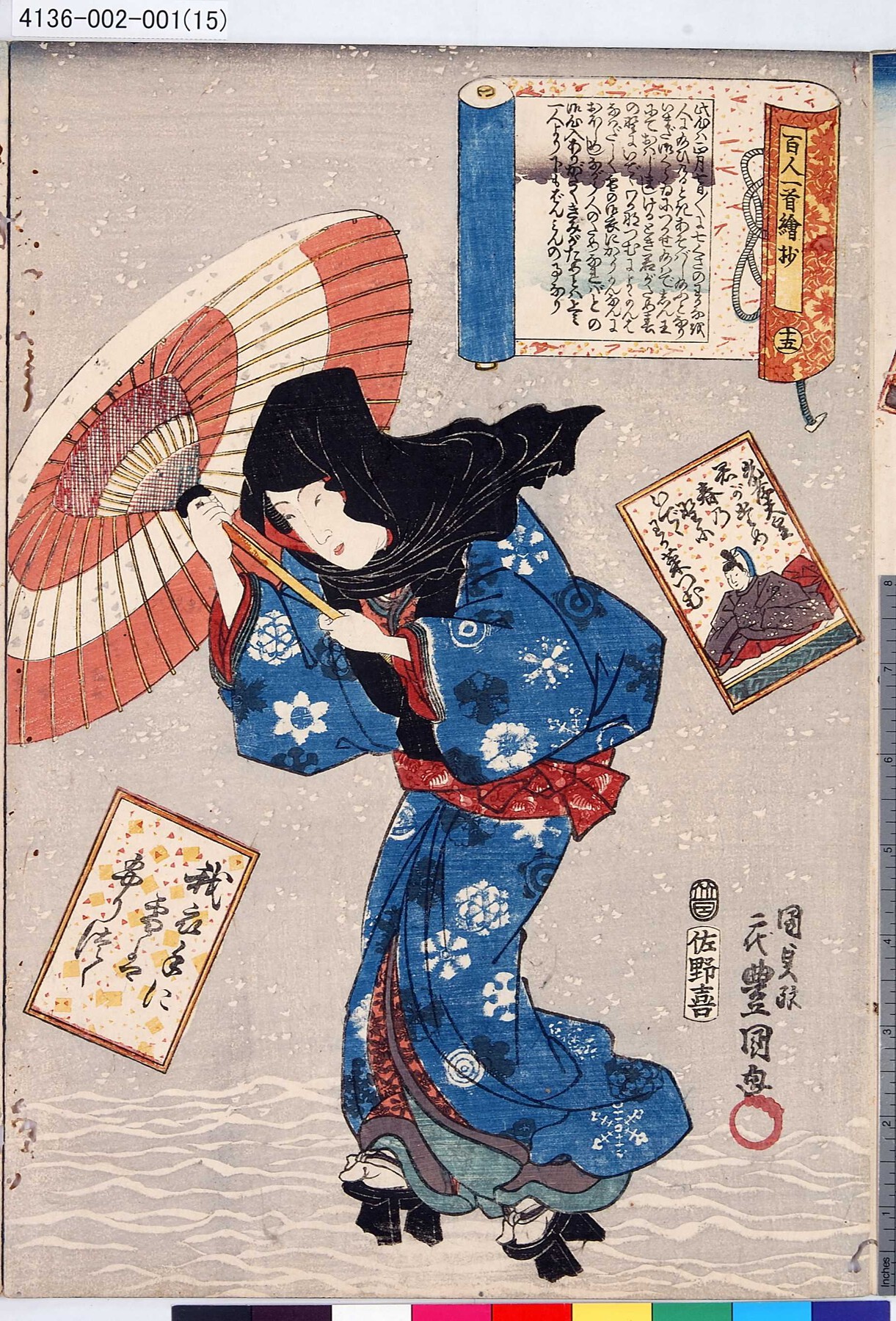
Just for fun, I was researching the impact that Doi Toshitsura's images had upon Japanese design, following the publication of his studies. It was an unleashing of new patterns on Kimono textiles, and the late Edo fashion world embraced it with fervour. Woodblock print by Keisai Eisen c.1840 Edo no Matsu Meiboku Zukushi Oshiage Myoken no Matsu ("Pines at Oshiage Myoken - From the series "Old trees of historical interest in Edo") Property of Koga History Museum Woodblock Print by Utagawa Kunisada c.1844 Poem by KouKou Tennou No 15 from the series Hyakunin Isshu Eshou (A Pictorial Commentary on One Hundred Poets)

-
Thank You Axel, I've drawn a blank with earlier studies in Japan, however, I did find out that even by 1810, microscopes were still comparatively rare items in Japan, and Doi Toshitsura, as Daimyo of Koga would have had to go through an application process through the Bakufu, to obtain the microscope from the VOC at Dejima. Sekka Zusetsu (Pub 1832) was the result of over 20 years of study by the Daimyo. Rangaku ( Dutch Studies ) had been popular with the upper levels of Society, and both Dutch Books and Translations of them into Japanese were available. Perhaps contacting the curators at one of these links may shed some light: https://www.hetscheepvaartmuseum.com/voc https://www.westfriesmuseum.info/category/east-india-company/
-
Hi Axel & Jean, Masaru Emoto is 20th / 21st Century. The popular reference may come from a late Edo period publication called "Hokuetsu Seppu" Snow Stories of North Etsu Province, a kind of Encyclopaedia compiled by a merchant called Suzuki Bokushi in 1837. Hokuetsu Seppu contains studies into Snow crystals by Doi Toshitsura, Daimyo of Koga. He wrote a book called Sekka Zusetsu (A Study of Snowflakes) in 1832. How apt a title for today........🤪 https://dl.ndl.go.jp/info:ndljp/pid/2536974
-
Hi Mark, Perhaps contact the To-Ken Society of Great Britain. I believe there are some members in Jersey & Guernsey. https://to-ken.uk/
-
Fascinating, does Moses train in Old School Okinawan Karate?
-
Thank You Steve, Very much appreciated
-
Good morning all, I wonder if someone could make sense of this signature which is on the nakago of a local veteran’s sword. I apologise for the poor quality of the image, It is the only reference that I have been able to obtain, as the sword is in storage. Thank you

-
The Yushukan Museum at Yasukuni has a database of last will letters, of which, it publishes one every month. The back numbers go back to 2018 https://www.yasukuni.or.jp/english/about/will.html
-
Empress Shoken, in the style of the Imperial Court, just post Restoration, your image is taken from this photograph from 1872, I suspect:
-
Hi Bruce, Try researching the Ando Family. Best Regards M
-
Just an aside, last year I walked past a Monkey show in a car park near the Ryogoku Kokugikan Sumo Hall, on the way to the new NBTHK Hakubutsukan. It was quite crowded with onlookers.
-
Bamboo Leaf pattern Tsuba on Gunto with old blade
Baka Gaijin replied to Baka Gaijin's topic in Military Swords of Japan
Thank You Dave. -
Bamboo Leaf pattern Tsuba on Gunto with old blade
Baka Gaijin replied to Baka Gaijin's topic in Military Swords of Japan
Good morning Gentlemen, It sort of makes sense now, given the magnitude of the Burma Railroad, and the intentions to go into India, that there would have been a host of civilian employees seconded to the Army. And, adding a little more to Bruce's post, I have heard that a number of the elder generation of Japanese Martial Arts Shihan, who were conscripted into the Rikugun, in the very latter days of the conflict, took ancestral blades to their induction and training camps. This was not a matter of rank, as there were often no other weapons available. I wondered about the choice of Bamboo as a subject matter, and was reminded of something the late Donn F Draeger wrote about a Yagyu Tsuba with a Bamboo leaf theme having a secret symbolism reminding the swordsman to recall the principle of Yawara (Pliancy), in respect of the Bamboo in winter bears a great amount of weight of snow, bending to an almost impossible angle and then shedding the snow, to return to standing in a swift springing action. Of course the Tsuba we are discussing bears no similarity to a Yagyu form, it is the concept behind it. -
Bamboo Leaf pattern Tsuba on Gunto with old blade
Baka Gaijin replied to Baka Gaijin's topic in Military Swords of Japan
Chris, you have filled in some important gaps. Thank you -
Bamboo Leaf pattern Tsuba on Gunto with old blade
Baka Gaijin replied to Baka Gaijin's topic in Military Swords of Japan
Good evening Chris, that is exactly the pattern I have in mind. -
Good afternoon Gentlemen, I wonder if you could help. Over the years, I have seen a small number of Gunto, which have clearly been converted from an Ancestral Katana, to Rikugun use. I have been told, candidly, by more than aa few Japanese Gentlemen, from that Hero generation, ( As both they and us view that dreadful era), that in some cases, local village Councils of Elders would "club together" to send one of their boys off to officer training with a sword , as their patriotic duty, even though, he , as a farme or local business man's son, could not afford to buy an approved Shin Gunto, as advertised in the papers of induction. In the examples that I have encountered, from 1971 to present, usually, the Kurikata has been removed, and a makeshift Ashi had been added, the rest of the lacquered Saya being clad in a leather combat cover. A makeshift hole for an Itomaki Sarute was drilled into the area just below the Kashira, and in some cases a Fusa Himo, still attached. Quite a few of these I encountered had a similar style of Mokko Tsuba depicting Bamboo leaves. I am interested in the prevalence of the Bamboo Leaf Tsuba. Can anyone shed some light upon this? My take is that it was a single shop, supplying Regiments bound for the Burma Campaign. Given that the items were from veterans in the United Kingdom, their field of operation from which they would have fought in or have been liberated from, was essentially, Burma down to Singapore. I believe that there is a wellspring of information out there, waiting to be tapped.
-
Hi George, here's the reference to "Shishi shinchu no mushi" 師子身中の虫 (Worms within the Lion's body) It appears in three Sutra: http://www.chinabuddhismencyclopedia.com/en/index.php?title=Worms_within_the_lion's_body
-
http://www.ksky.ne.jp/~sumie99/sunobe.html 😎
-
Perhaps a Sheep? Hitsuji 羊
-
Looks like the seal was burned in, using a preformed "branding" iron. I have seen similar effect on Koryu Bokuto from Meiji and Taisho era. Which supports Piers' statement: "We can guess that it was either an indicator for Mito (Ibaraki) Castle armoury, or added at the time of the great roundup and registration in early Meiji."
-
Hi Bruce, Looks like the type of weave known as Shigeuchi or Shigekumi, it was originally popular for swords in the Tensho era (1573 - 1592). Your can still get it as Sageo, from good suppliers of Budo equipment in Japan.
-
Armor created for the coronation of the Emperor Taishō
Baka Gaijin replied to Tonkotsu's topic in Katchu
http://yoroi.co.jp/english/english/history.html http://yoroi.co.jp/english/english/product-2.html -
Hi Patrice, is the top character on the signature cartouche 旭
-
Armor created for the coronation of the Emperor Taishō
Baka Gaijin replied to Tonkotsu's topic in Katchu
Hi Dick, the Kuwagata (Metal plumes on the helmet) need reversing, so they look like this: