Curran
-
Posts
4,656 -
Joined
-
Last visited
-
Days Won
24
Content Type
Profiles
Forums
Events
Store
Downloads
Gallery
Everything posted by Curran
-
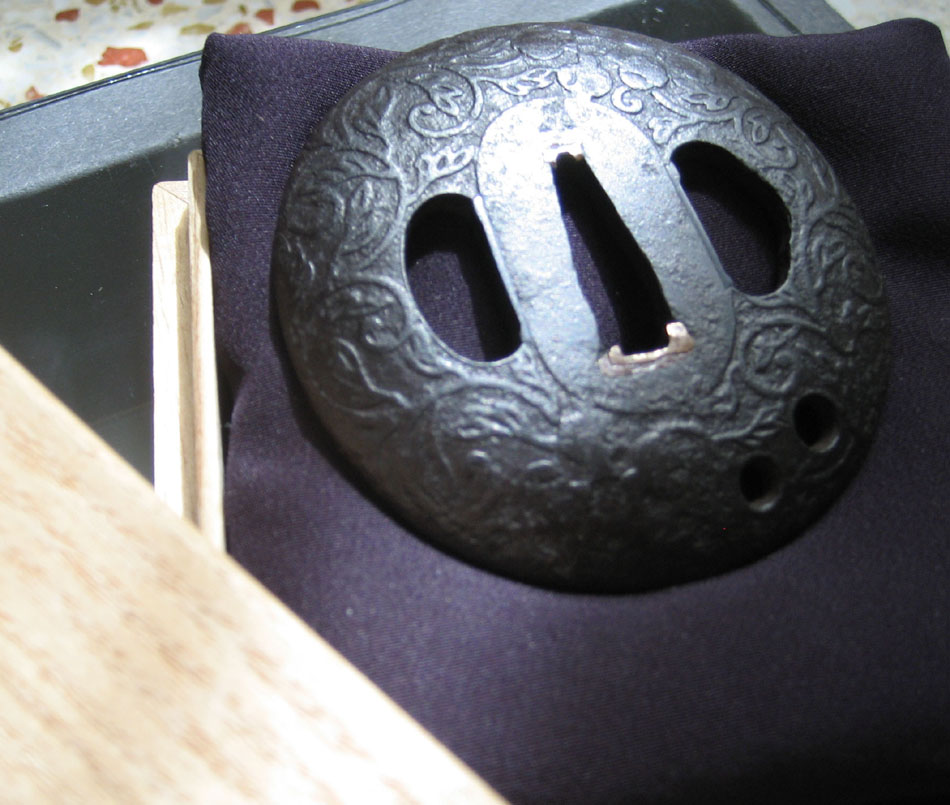
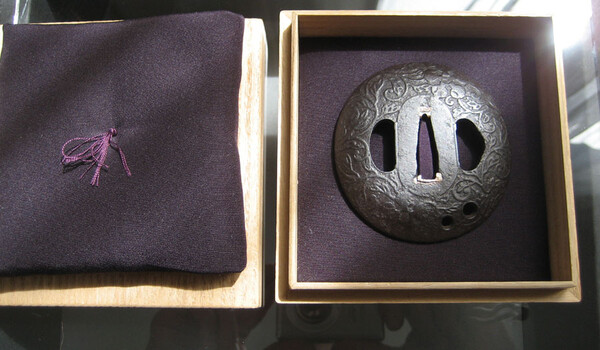
9.5 cm round. Choco-pie (Moonpie) anyone? John, thanks for the description read. I admit I had not read it. 'Post 1853' Kenjo (Kyoto specific shop production) is an interesting attribution by the seller.
-
That is perfect.
-
Haven't seen this before: http://page14.auctions.yahoo.co.jp/jp/a ... s354746176
-
Tom, Thank you. I know what I seek, but it was difficult to find without the correct terms. The link and term 組紐 opened the gates significantly. While at it, I also enjoyed this video, watching this man's spider dexterity: http://v.youku.com/v_show/id_XMzQ3ODM0MTU2.html
-
~Finding something appropriate of the sort we see in Edo no Tanto Koshirae book examples such as those on page 15, 16, 48, 54. After 80+ or so sites, it eludes. Beyond the basic ones, it is much more difficult to do than you might imagine. I can understand that higher end sageo, like higher end fittings boxes, may have become something few of the dealers want to source or inventory anymore- or at least list on their websites at all. One of the people who PM'd me reminded me of one person to contact, but I was hoping for a Japanese link I had missed.
-
Having already looked over ebay, I am in search of better quality sageo. I need one probably about 90cm in length, for a very worthy o-tanto with koshirae. Preferably gold, white, or mix of the two. As it is a Higo koshirae, a doeskin sageo also would be appropriate. Anyone able to point me at good Japanese resource? Very sincere thanks in advance for any help.
-
No, they are not always the same. I ran into this just yesterday with 春明法眼 Online resource says 法 is taught in about 4th grade and has 8 strokes. Haynes has it listed under 9 strokes.
-
1) Uncommon Namban 2) odd Namban- don't remember seeing a hamburger sized one like that before. 3) better Hizen 4) Namban, or low end Hizen Those of us that fenced Foil, Epee, etc are drawn to these guards even though they were usually worn cup down towards the blade. I have a Hizen one I like considerably, but posted for sale on eBay following a significant purchase almost 2 weeks ago. While there are many Namban and Hizen tsuba, good ones don't come along very often. A fellow at the Tampa show has 50 or 60 of them, and most just don't interest me at all.

-
Oh! Thanks. Geez.... knew I'd feel stupid on this one. You do consistently come through on the themes. I was hoping you'd see this post. I know the story of the serpent and the priest/warrior hiding in the bell, but didn't connect it with this hybrid demon woman - sea serpent I was seeing. I felt it would be something different. I do confess this one struck me as very well done and yet creepy at the same time. The temper of a Korean wife with significant martial arts training is one thing, but the kozuka reminded me more of a Class 5 Clinger. Even moving to a different continent couldn't shake her. Same face.... of a woman scorned. What sort of masochist guy would carry this around on his sword?
-
I can only say one of the painter influenced schools of Edo. While the detail level isn't as obsessively high as in some kinko schools, the artist had that strong sense of balance and make the important points extremely strong (the incredibly expressive faces). Cool stuff. You coming over to the Dark Side known as kodogu collectors?
-
Not a museum piece. It was up for auction. It was signed and the signature looked valid to me for 10th gen Goto Teijo (I think). Workmanship was good enough and signature good enough. He has a few interesting quirks to how he signs, so I tried to commit those to memory. I was more curious about the theme.
-
Thanks Junichi. Not a bad match, but I suspect it is something a bit better known since it is a Goto kozuka. Attached should be an image of the kozuka.

-
I've seen a goto piece piece recently that depicted a demonic faced sea-witch swimming through the waves in pursuit of a hero character that is fleeing on the beach carrying his staff or pole weapon. I didn't find it in Joly in my first pass. Does anyone know to what myth, legend, or theater this SeaWitch Demon-Dragon is from?
-
Thank you Morita-san. That was extremely helpful. I had guessed the tsuba might belong to a shrine as a dedication item or gift. If true, it would explain many things.
-
It amazes us advanced Beginner-Intermediate types even more. How many years or decade we have to go. Reading one of Markus' translations this morning and thinking of picking up the Natsuo one as an early gift to self. Confess I was hoping Lulu.com would do more for 'Black Friday'. Will send a PM to Markus on another topic, looking for recommendations of anything in English on another kodogu topic. Thanks for the Tombo -Tonbo read.
-
Crickets answer.... Anybody? I'm hoping for one of our very kind Japanese mentors to pop in.
-
It is a shame this is the last one. It has been a nice slideshow. I appreciate his aesthetic in his choices, and I wish he had been a member here.
-
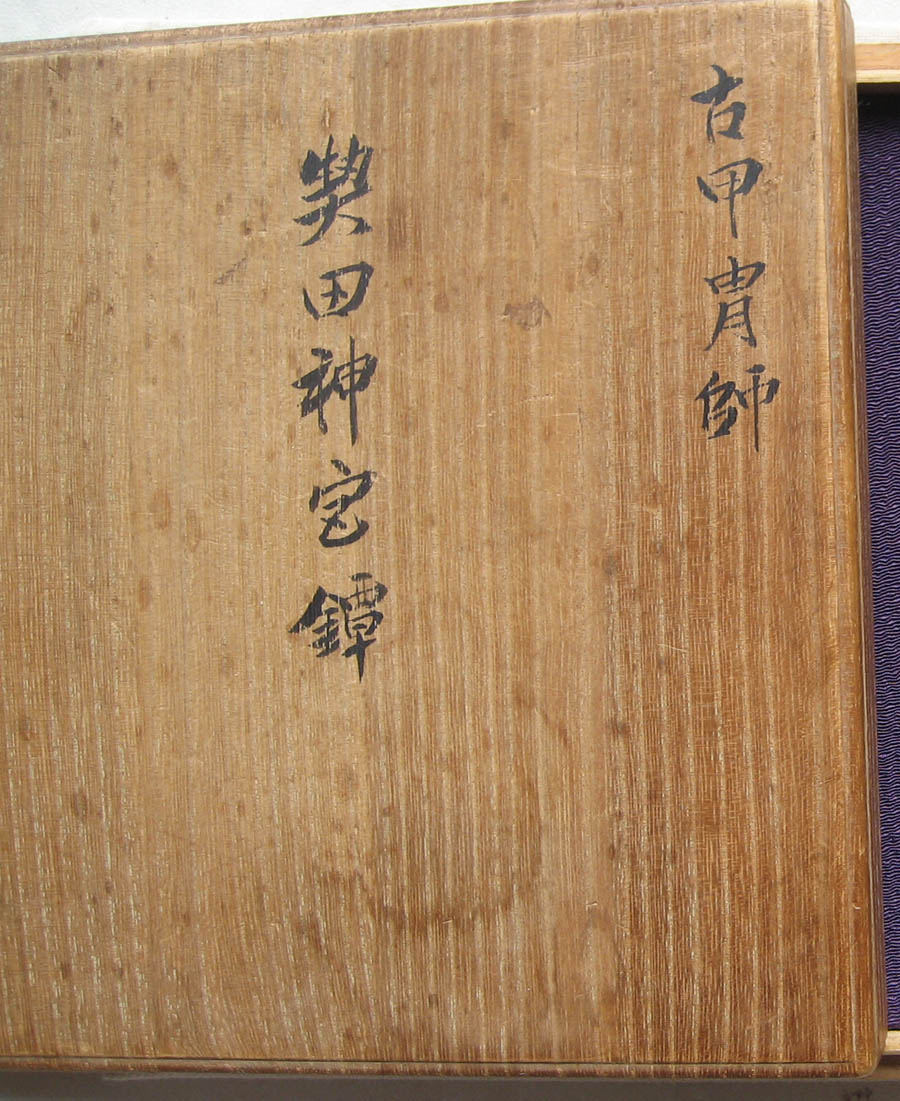
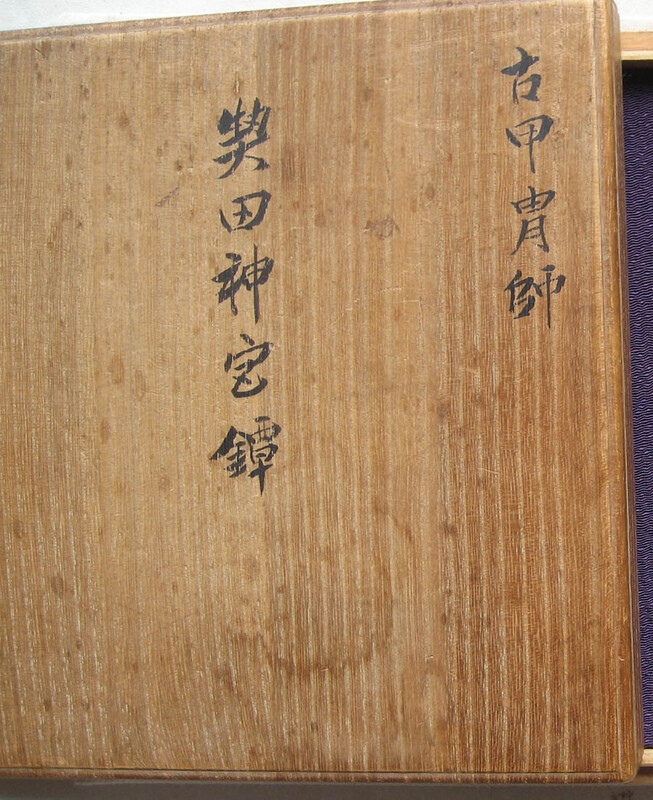
I ask for help on the center line of this box's hakogaki. The inside is easy to read, and of course the outside starts "Ko-katchushi" Then: [?] [field/rice paddy] [kami?] [kore?] tsuba Probably something very logical, but I'm drawing a blank and could use help. Sincere thanks in advance.
-
Concur with what John said. Seen mostly on koto swords. Often the appearance of this machiokuri 'mizukage' is stronger on one side than the other and bend away into the blade quickly fading without changing the jigane. Not the hard ruler line straight up both sides to the mune area. Most often described as a heated copper block tool with sword laid on it for transference- as localized trick to soften an area chemical structure and reduce risk of cracks while altering swords considered to be of a bit more valuable. One of Cary Condell's old tricks was to go around sword shows and spot unpapered ones with this phantom mizukage, kick the owner down to nothing on price, and then have it polished and papered. One of the listmembers had this experience first hand, resisted the Cary ploy, had it polished and Tokubetsu Hozon to Osafune Morimitsu. Lovely sword that I wish I knew who owned nowadays.
-
Nearly all Hirado Kunishige tsuba have the design go onto the seppa dai. Quite a fair number of smiths routinely wander onto the seppa dai. Nidai Kanshiro often did a bit. Perfectly functional. At first glance, that looks like a big name signature unless I am misreading it at this bleary cold early hour in the morning. Ie. possible misread. Workmanship doesn't quite seem to support the reputation of the name. I'd be more concerned with the signature, but someone may have gotten quite the steal.
-
Collection or museum catalog #207
-
Wow, what a pleasant one. I recognized the basket design, but didn't know it was:
-
First tsuba is appealing. Personal feeling is that it would be older than we are attributing it. While technique most common in late Edo, the skill on this one seems very fine like truer to a painting. I have much to learn about ko-umetada kinko, and every time I see a NBTHK papered ko-umetada kinko tsuba with this sort of fine workmanship.... I allow for something similar like this to be much older. Very difficult to date this one. This is a nice tsuba. While I cast pebbles at the quality level of the previous Tanaka tsuba, your father had fine taste. Most everything you have shown us so far has been at a very solidly elevated aesthetic above the vast majority of what people query about. In other words: batting average very high. Wondering if there isn't a home run or two waiting to be seen. Second tsuba: Mito or Nara work. My first thought was one of the decent 1800s Mito spin off schools, but John might be right on Nara call. Very hard to pin it down to a specific subschool without some sort of special clue, and nothing leaps out as evident in a quick look.
-
This is what I do for a living. US$ getting stronger? Maybe sporadically, but longer term Not Happening. No going back to April 2002 or 1990s hipness (=want USD for reasons other than fear) in the eyes of the world. Only thing I think Surf should have included is how changing international laws and shipping requirements prevent the flow of swords. These barriers have many results, and are partially responsible for my shift more to fittings after 2004.
-
Prado. That was the joke. Love that museum by the way. The mind buckles a bit when observing an entire room of Bosch's works. Sir Bernard's tsuba may very well be authentic, but not a very good example of the work that can be seen from the school. I'd seen a Juyo piece that was pristine in condition and excellent of workmanship, if a bit unimaginative in design. Thus I was lukewarm about this school's reputation. An American corrected that when he showed me a few pieces of his large collection in this area. The few he showed me easily eclipsed the few I'd previously studied, and he supposedly had 2 dozen more. I regret not making more time to visit with him and see the others. ~~~ this is to say that you see a wide spectrum of work in this school. Many things about this particular one fail to impress me. Wife's wallet says "Prada", but we both know it to be a functional NYC street market buy with decent stitching and leather that isn't quite the real deal. Hence we call it the "Prado" when lost around the house or apartment, in hommage to the many Chinatown special "Prado" knockoff versions of the wallet. My recent favorite from Chinatown was the hardware shop with large lionhead door knocks labeled "Loins Knockers - 50% off!" Sometimes being just a little off changes everything. Kick the entendre around as much as you like.