Curran
-
Posts
4,824 -
Joined
-
Last visited
-
Days Won
26
Content Type
Profiles
Forums
Events
Store
Downloads
Gallery
Everything posted by Curran
-
Dear Ed, Nice reply. I am not sure how to concisely or even adequately answer your questions. I trust my opinion on some area. On others, I'd defer to Grey or some of the other veterans of the hobby. I've spent the better part of the last decade focusing increasingly on fittings. Sword knowledge is just so-so. My first though: yes, yes, yes .... leave the patina on tangs and fittings alone until you've been at it a long while. Especially on tangs. I wish Darcy were around to talk on that. He is a much better teacher than I am on that sort of topic. A cared for tang will have gone through controlled oxidation over centuries. Distinctly worlds different looking and feeling on an 800 year old blade than on a 100 year old blade, even if the blade is so out of polish or otherwise gone. Tangs can be doctored to look older than they are.... but that is entirely a different chapter on forensics. Question of sustaining a new polish- geez, that is a devil of a question even for the oldtimers. The construction of the blade can depend on age, school, and subschool. Hizen blades are notoriously thin skinned and even though maybe only 300 years old, be at serious risk of core coming through. On the other hand, some 700 year old Bizen blades seem to take polish after polish until the hamon is very thin. Much of this I think you are going to need talk with people in person. Even then, get 5 or more opinions and try and find your way through. You need to find if there is a Boston area club still active. Otherwise, you may want to try and get involved with the New York club. Most of my hands on knowledge comes from their lectures and years of attending the Tampa / San Fran shows. Post images. I can probably help with fittings. The swords are a bit more difficult to do through online images, and others here are probably going to be wiser than me about them. Curran
-

Anyone have a copy of the Oeder Catalog?
Curran posted a topic in General Nihonto Related Discussion
I'm trying to research some items that are supposedly shown in the Oeder Catalog. I don't have this one in my little nihonto library collection. Anyone willing to look up one or two things for me and possibly scan in a page? Many many thanks in advance for help.... Curran -
Dear Ed, I am afraid that Grey is absolutely right. It is one of the deepest field of studies and takes a long time. This board is an incredible resource. Photos posted here will get you considerable (sometimes conflicting) info. Your best bet is to start taking a few steps: pick up some of the Intro texts available via Amazon, and start posting photos here and asking questions. Wish I lived back up Boston way, but we're in Florida for now. I don't know if there is still an active Boston Nihonto Club. Curran
-
Forgive the cross thread, as they said, sig reads "Hirotoshi". Not Uchikoshi Hirotoshi: viewtopic.php?f=4&t=5562 His signature was popular to try and forge, but yours is so different that I don't think it an attempt at forgery.
-
O-Tachi identification and can these flaws be corrected?
Curran replied to Bijouxneko's topic in Nihonto
Do you have a full length perspective image of this sword? -
Mr. Reinhard said, "What I meant was: Depicting objects upside down on tsuba is a no-go before and after namban(-style) tsuba." It is interesting that you raise this idea. Maybe I have never thought about this simple fact before! I think you are right in 99.5% of the non namban tsuba. We sometimes see inverted (upside down) birds in some sukashi tsuba designs, but rarely do we see any animal or beast head inverted / up-side down. One counterproof tsuba came to mind very fast: Ginza-Choshuya Mag #3 of 2008. #5 is a very distinct (and expensive) Yasuchika tsuba. I would not say it is 'auriculated', though some might view it that way. The dragon heads on bottom are inverted and maybe this is some Namban influence, but otherwise a very beautiful Japanese tsuba. Wish I could afford it, but $30,000 is champagne and caviar taste for my current frugal budget.
-
Shigeta, Yoshimura. Namban Tsuba: Akogane no Desain, Tokyo, 1998. Good book. I agree with Dr. L's statement, "Yoshimura Shigeta illustrates five such tsuba of the auriculate type on pp. 63-67 of his book, and upon every one of these this is a constantly recurring feature." I've been glad to own a very good example illustrated on page 64. Mr. Reinhart may raise the issue of whether or not these were made in Japan. I believe a fair number are, though the design may have originated elsewhere along the trade routes. Just as Plataresque architecture made it from Spain to Macau church (existing still) and into Japan (destroyed long ago). The Macau one contrasts from spanish examples in that it shows considerable chinese influence. I've seen several examples of the auriculated tsuba on page 64. They've ranged from crude ones that seem chinese manufactured, to some rather fine ones with considerable more detail. Iron differs from example to example. Someone gave mine a rather fine lobed shakudo mimi. As an aside, the Shigeta Namban book also touches on "Christian/Kuristian" tsuba from pages 69-76. Curran
-
Dear Ford, Right. To clarify, is there a photo of the full face of the side signed with the mei? The photos on your blog gave me some confusion as to the bamboo part of the design relative to the signature and the rendering of the backside of the "cat (out of the bag)" and its claws. Just curiosity. I've either seen this tsuba once before or its twin a while back. Unfortunately I didn't save a picture to file. Basically I've stuffed up my Haynes Index with reference images of signed examples from artists. Given that I don't have an image for this artisan, the tsuba I saw before probably wasn't signed. Not sure about that. If you have a full image with signature, intention is to print out small image of front and back and place it in my Haynes Index. Not exactly the best note system, but works for me.
-
Dear Ford, Forgive my confusion: --I read your blog entry. Do you have a full photo of the signed side of the tsuba?
-
Ford, Time to share a photo? C'mon. Lest we die from the boredom in our own lives.
-
Dear Ford, Markus, Brian, Dr. L, and Nobody-san, There was a point in life a few years ago when work was easier and I had the opportunity to spend a period helping with the cataloging of an old collection. It was fairly large with many kinko, and had many gimei pieces in it. I think that period was a significant leap forward for me in experience with tosogu. In that collection were two pieces that bedeviled me. They had complex signatures that were close to the books but I ultimately felt were 'not right'. The workmanship on these two was fantastic. One of them truly pained me to call 'gimei'. I was offered the chance to buy it at a very fair price and did not because I was not confident enough in myself to appreciate it for the skill regardless of whether or not it would NBTHK / NTHK paper. Many years later, it still bugs me that I didn't buy it. That has happened 5 times now for me: 4 where kinko tsubas, and 1 was iron- all from the 1830-1880 period where the smith had a relatively long life. Three of the five have gone on to paper or be deemed authentic. The other two: I have no idea who owns them now. I'm going to always wonder about that one tsuba and I hope to see it in the possession of another collector some day. I have my doubts about the signature on Ford's, but when these late kinko with a nice signature come up....I've been wrong on these 'near misses' to error on the side of caution more than I have been right. ...just a journeyman and not a native Japanese reader. *sigh* Brian hit it on the head talking about how "fluidly, confidently" the mei is done. I look forward to the day that I get a better handle on that aspect of a slightly irregular signature on an exceptional workmanship.
-
Ford, Thank you for posting an interesting exercise. Comparing the 3 mei you listed before even finishing reading your post, I singled out the first one as 'most unlike the others'. Still, I see variations within the genuine mei examples. As non-Japanese with only a limited amount of reading/writing experience, there is always that margin of error in my mind where something can be 'genuine' but not a lay down match with the reference mei. Especially when an artisan had a long life and an evolving signature. Looking over the references that Markus posted (hat off to Markus), it puts the first mei as the outlier of the bunch. I looked at it in a different order than Markus as my eyes jumped first to the direction of a stroke in the second character in the name and also what I would call an extra stroke in the kao as the signer tried to change direction in a way I don't think is seen in any of the other reference mei. Any chance this might be the second generation? ______________________________________________________ Regardless of the mei, I look forward to seeing this tsuba design- if you will share. So many fellow collectors focus on iron or early kinko, yet I greatly enjoy some of the late kinko art pieces.
-
Interesting discussion for those of us less technically educated. Thank you Ford, Lorenzo, and Ted. It sounds the work is much more involved than I imagined from the image, but I've long since learned there is much more to the tricks (I mean more the ~complexity~ or difficulty) of shakudo than I have yet read in any book.
-
Please provide the pointer to the Omiya blade on eBay. I do not think yours is Omiya. Though Omiya has mune temper sometimes, usually it is more to the front of the blade. Your blade appears to have it all along. Also, the temper line is a bit complex for Omiya. Omiya temper can have considerable activity, but is usually more subdued- "stormy ocean waters" but not quite the more chaotic activity I see on your blade. As to what it is, my knee-jerk reflex is more towards 1500s- but my Nihonto knowledge is mostly strong in a few schools and falls away quickly outside of that. I'm better at saying this is not Omiya Bizen than I am at helping identify it. Good luck. Curran
-
Hmm- I would not have gotten this correct. Ford ended it before I remembered to put in a bid. I was torn as a fellow collector has a beautiful but atypical ko-akasaka (NBTHK) that has some very similar details in execution, but much heavier than this refined tsuba. I couldn't call it Tadashige work. I wasn't sure what to make of it, and the answer is a stunner. Hat off to Rich. Curran
-
Sword Display
Curran replied to Chishiki's topic in Sword Shows, Events, Community News and Legislation Issues
Incredibly beautiful. I cannot believe I have not seen this thread before. My praise to Colin and all concerned with this. I like how the tsuba and kodogu are tastefully displayed. - Wow. - Curran -
Instant thought before reading anyone's reply was Goto Ichijo or one of his near students. Have I seen this tsuba before? There was one at Choshuya a while back, and another elsewhere that looked like Ichijo but I thought was by another signature. Both beyond my wallet. Curran
-
Miltie, You crazy kiltie, we miss ya'h. How is the local food? Glad to trade places with you if they'll permit. Curran
-
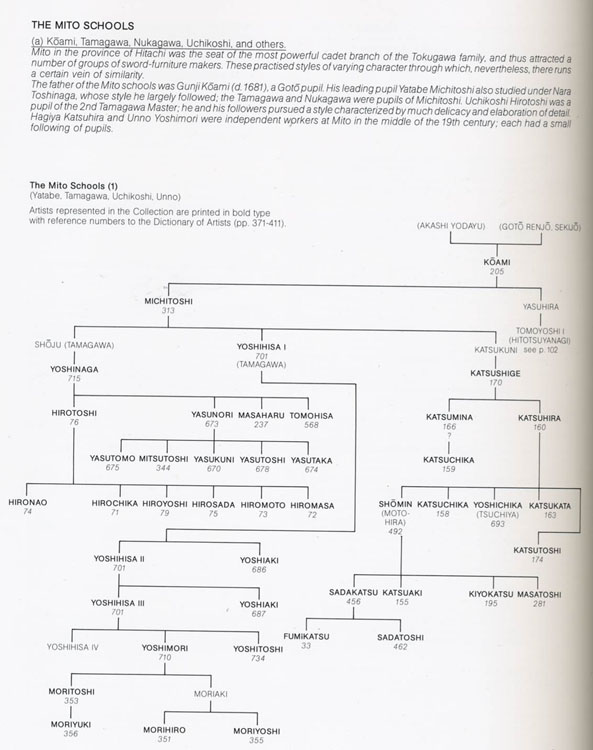
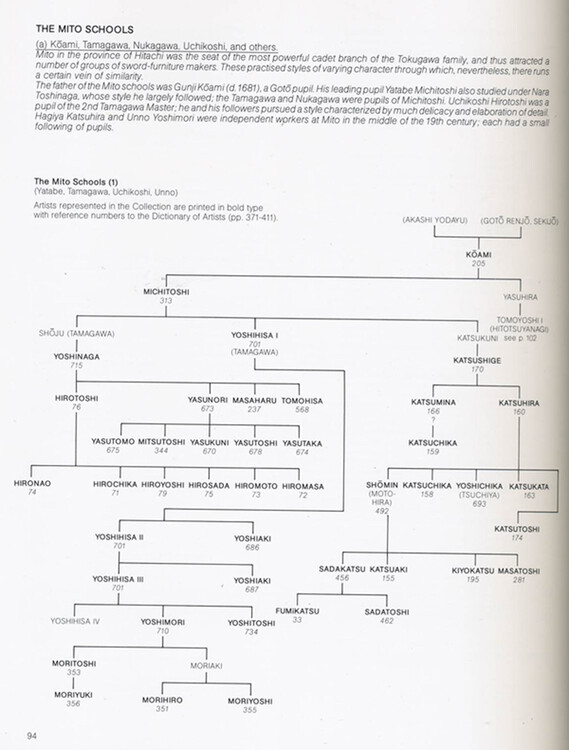
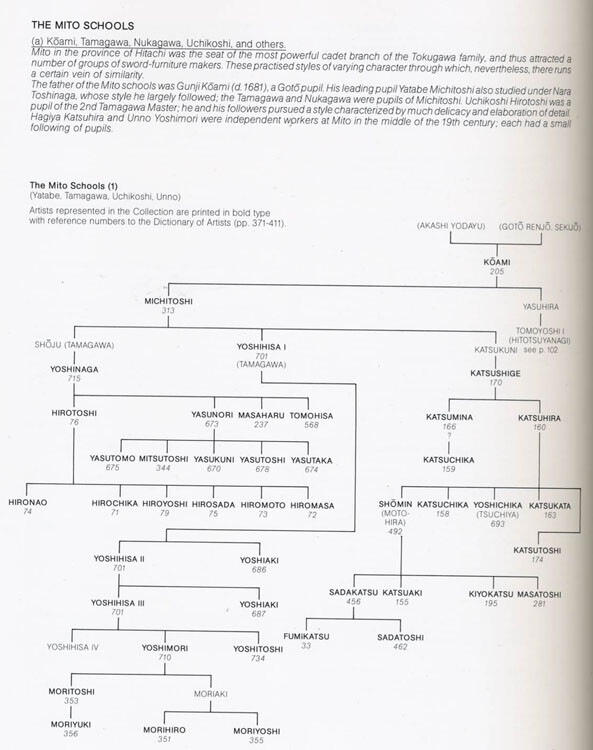
Mito School -see below scan from Baur Collection, for academic reference: Scan 1: Viewable for NMB Scan 2: Downloadable and much more readable. Mr. Stuart mentioned Uchikoshi Hirotoshi. Several years I found and papered a tsuba to him. Hirotoshi is one of those signatures like Shozui (aka. Masayuki, founder of Hamano school) that was a popular target of gimei.
-
Mantis, I did not mean to sound too harsh on the NBTHK shinsa process. I love Nihonto as a hobby, but the times being what they are I have become very sensitive to expense and even been selling tsuba I would much rather keep and may never be able to get back. NBTHK Hozon seem painfully vague except to verify signatures. I regret taking an overly hard knock at them. This Norisuke - Norishige was my last discovery. As the wallet closed, I've since had to watch some very nice tsuba go past. I hope some others of the community find them and can pick them up. Curran
-
Dear Brian, Thanks for the photo help. Reading my old post from August reminded me that the one Japanese gentleman had argued the Niwa Norisuke signature was a forgery by Iwata Norisuke. I felt it was real, but had slight variations from those given for Niwa Norisuke in the Owari ToSando no Tsuba book. Really an interesting papering dilemma if Iwata Norisuke forged his teacher's signature! _______________________________________________________ I still think it a bit odd what the NBTHK does at Hozon level these days. I sent a Higo tsuba that had attributes of two Higo sub schools. Someone later successfully convinced me was mid to c.1800 Nishigaki. It came back as "Higo". Well duh!?!. There is also a tsuba up for auction now with Hozon papers to 'Kanayama Den'. Wow that is vague... either it is "Kanayama or Kanayama like". With the yen so strong, it has gotten very expensive for even Hozon papers. The increasing number of vague attributions is off putting. Toku Hozon was always expensive and this Norisuke Norishige co-signed was definitely my last Toku Hozon submit for a while. Not sure I would dare submit anything unsigned to Hozon if the attributions are so vague these days. It was a fun tsuba to research. Lots of back and forth on whether the Niwa Norisuke signature was correct. Curran
-
Hmm, I thought I'd made the photos small enough they didn't need to be clicked on to be viewed. What are the size constraints Brian?
-
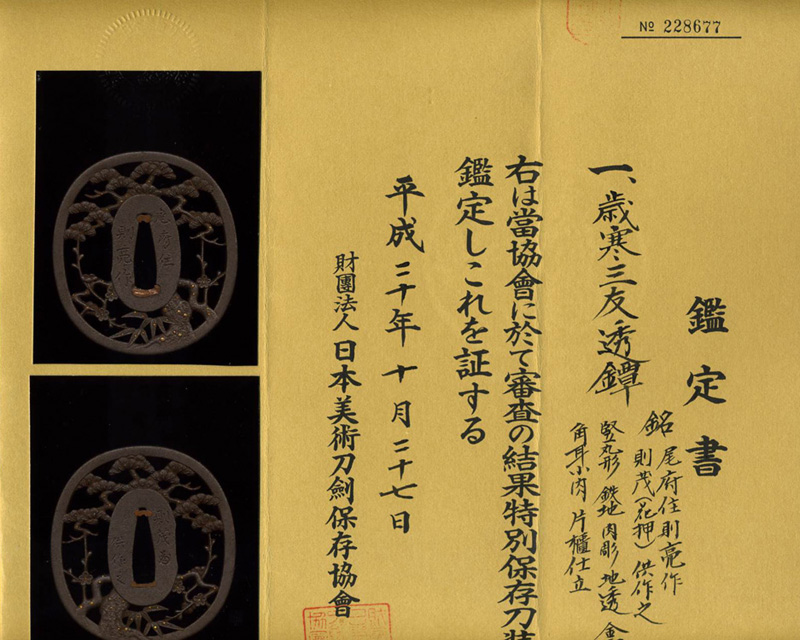
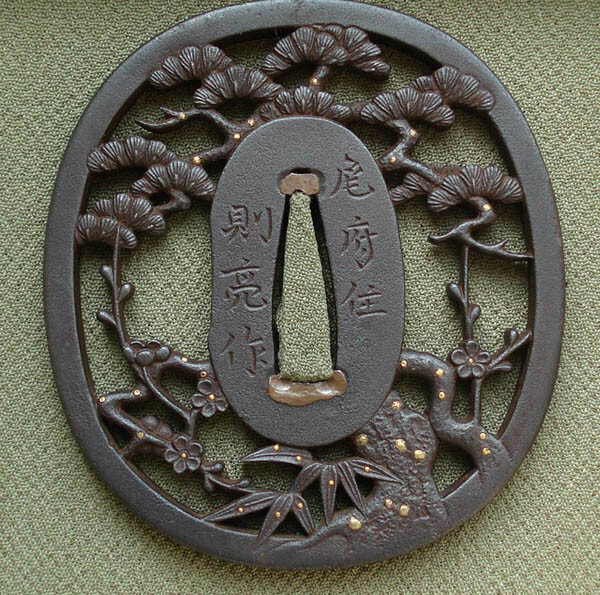
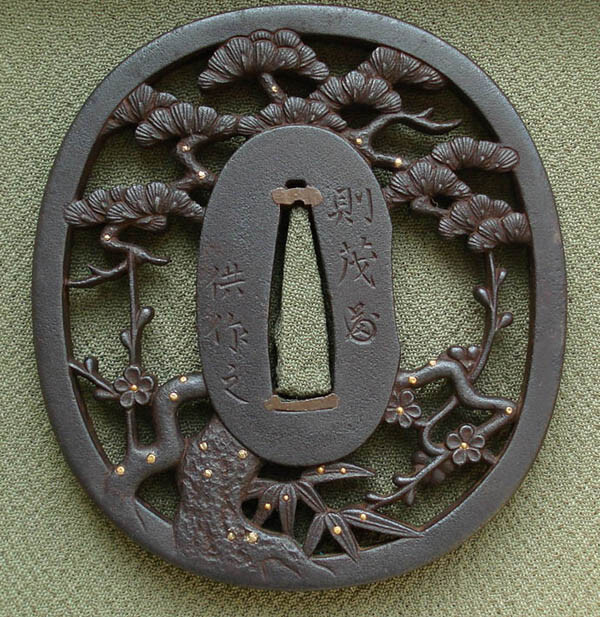
I traded for this tsuba 2 years ago and sent it for NBTHK papers last summer. It just came back with Toku Hozon papers and a letter from Tanobe-san. I haven't had much to add to this community of late, so figured I would share this. Background: As can be read in Art & Sword #3 or other tsuba texts, 1st Gen and 2nd Gen Norisuke were skilled artisans employed by the Owari Tokugawa. They were especially known as master forgers of Yagyu, Yamakichibei, and other types of tsubas- though they often signed them. Though prolific, they almost never co-signed a tsuba. Quality varied, as they had some master works and then some rather straightforward tsuba. This design pictured is considered the last or near last to be by Niwa Norisuke (1st gen). It can be seen in the Norisuke Tusba book as well as the Owari Tsuba book. On the reverse, it is dated late in 1850. He supposedly died April 17th, 1852. I am sorry that I cannot post an image of that tsuba at present, but it is near identical in execution. Iwata Norisuke (2nd gen) is known to have used 'Norishige' as early as 1849 in correspondence and there is a tsuba signed by him as Norishige. He took over as master in December of 1851. The tsuba I have is more in the handwork of Iwata Norisuke (2nd Gen), but is signed on the front by Niwa Norisuke and on the back by 'Norishige' (aka. Niwa Norisuke). Unable to find any evidence of joint signed pieces, I didn't know if it would paper. I wondered who would forge the work of two master forgers!? My best guess is that it was made some time during 1851 before Iwata Norisuke took over as master. Perhapse it was done by Iwata Norisuke to assist Niwa Norisuke in the completeing of a commission? Just a guess. Tanobe-san says there is record of other joint signed tsuba by Niwa and Iwata Norisuke, but that this is the only photographed one. It was a fun tsuba to research. I am not able to actively collect at present, but this tsuba was quite an adventure. I hope others get to stumble across a challenging one now and then. Curran

-
Interesting tsuba but unknown carver (Natsuo den ?)
Curran replied to Marc BROQUIN's topic in Tosogu
Interesting thread. Any more ideas? -
2 cents more to the conversation: This tsuba was on Yahoo!Japan. I wasn't confident on the signature and didn't have much money at the time (less now), so passed on it. I seem to remember it selling for sub $1000, which shocked me as I've seen clear gimei go much more than that. I thought someone had gotten a steal. Then it was on Ebay in the USA and I did not see what the auction closed for, though I believe it was Po-Edo (aka Posservice), selling it. It was only later that I spotted it in the Hartman collection and wondered if it was the same tsuba that had round-tripped back to Japan. I liked the theme. Curran