Curran
-
Posts
4,824 -
Joined
-
Last visited
-
Days Won
26
Content Type
Profiles
Forums
Events
Store
Downloads
Gallery
Everything posted by Curran
-
Richard, Pretty awesome image. Ready for a bunch of us to ask you to photograph our swords?
-
My two cent opinion was that the boshi looked wrong for Kanemitsu, but Darcy already mentioned that. Darcy's Bizen book has a great write-up on Kanemitsu. I heard about that Enbun Kanemitsu, but did not know that people thought it gimei. I hope to see that blade some day, if it remains in North America.
-
huntershooter (Todd M.), Pear skin is difficult to photograph in a way that truely captures what it looks like on a long blade. It is often found in Hizen blades and is very tight or fine. Occassionally someone will try and claim a blade with little or no grain and old polish is nashiji hada, but not true (this is my own personal experience as a newbie many years ago). I am afraid this is something best seen in person. A member of the New York club that collects Hizen blades showed me a good example once- and it has been my mental reference since then. Maybe Darcy has a photo? Curran (aka. Curran Campbell)
-
Dear John, If you have a photo of the signature, please post it. Your f/k sounds similar in construction to a tsuba I sold earlier this year. Curran
-
Ricky- What day and time? 3rd Sunday of the month? I visited Bill today and looked at his sword. I'm fairly certain it is Yamato from the Nambokchu period. Probably Senjuin. The geometry was a bit deceptive in the photos. Great blade that has seen better days, but I don't see any fatal flaws. Hard to tell about the grinder damage. I don't know if it will survive polish, but much more interesting than most I see. I think Kodama or Kunio should look at it and either confirm or nix my opinion. If you have his contact info, let him know he should come in. Curran
-
Yes, Kunio is a great resource for ID of the blade. He is in lower Manhattan. Ironchef-, is that you Rick?. I don't have Kunio's contact info. Is the club still meeting at the Times Square location, Mr. Grannick's boardroom? Ultimately I recommend the NY club for info. Moses and Kunio are usually there, and hopefully Kodama too. Curran
-
Dear WM, My wife and I are renting here in Darien, CT. We are Florida residents that decided to avoid the hurricanes this summer. We were residents of Jersey City for over a decade, and I have remained a member of the New York club since it is a good club. I will be attending the September meeting. We are staying on Post Road near the Trader Joes. If you want to arrange to meet, then feel free to contact me at: neobliviscar@yahoo.com I claim to be a 'fittings' guy more interested in things like your menuki, but I have a very good foundation of knowledge with swords. I have one of my swords here in CT and can give you a crash course academic introduction. The only drawback is that my extensive library is in Florida. The most comprehensively knowledgable person in the NY/NJ/CT area is an older Japanese gentleman in Jersey City. Moses is a well recognized polisher, and has a technical eye that can assess how well the sword would survive polish and if any serious damage has been done by the 'sharpening'. He is almost always at the NYC club meeting. If you are local, we can meet up any time after this Friday. I would be glad to do it, as my personal belief is I would like to see as many of these functional works of art preserved as possible. Curran Campbell
-
Dear Bill, I am in Darien, CT and there is another knowledgable collector in New Canaan. I believe Moses is in Long Island. You should attend the next NYC meeting. It will be in September (no meeting in August because of the San Fran show). If you are in the area, let me know. If you are in New Jersey, there are several good collectors in Jersey City and we can put you in touch with them. Curran
-
Dear Hank, Darcy told me about your post. My interest is mostly fittings. Nice koshirae you have. It looks like a matching set of waki-Goto fittings. Probably no signatures on any of the fittings then? Maybe signed on the kogai? The saya lacquerwork is very nice with skilled use of the crushed abalone shell (?) to get that stardust glitter look. The tsuka wrap looks like it has been *very* well maintained since WW2 bring back. Instead of same under the tsuka wrap, it looks like brocade silk was used? Any menuki? If you still have that box of tsuba, I'd love to see them. Just spread them out on a blanket and take a photo. It is a fun challenge to play 'ID that tsuba'. Best o'Nihonto to you, Curran
-
If soft metal tsuba, I do not know if you need to add the copper. I'd recommend against doing it, and leave it to a professional. It is very easy to damage the patina of some soft metal tsuba. If iron, then there are a number of people who can add the copper for remount. I've only had it done once. Some people do not feel this is necessary if the seppa and tightness of the mount is correct, but I do not practice, so one of the "swingers" should comment here. As a side note, I've also seen and own tsuba with brass, silver, shibuichi, and lead in place of copper. It would be interesting to hear a swinger comment on the use of ~lead~. I would think it too soft if the tsuba had much play. Curran
-

Please, Can you help me?
Curran replied to Chushingura's topic in General Nihonto Related Discussion
Here is a Toppei koshirae I own. It has a locking mechanism I haven't seen elsewhere. Some of the Toppei can be very unique. They seem to fall either into "very military" or "very splashy western influenced".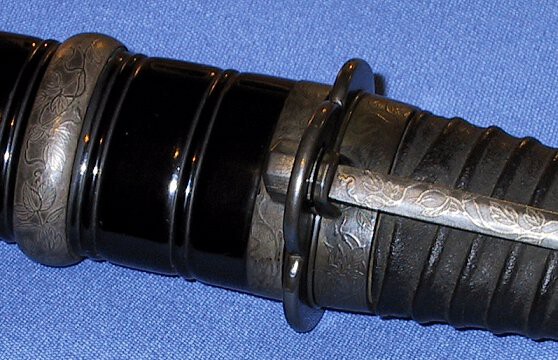

-
Dear Ludolph, Ah yes... I am dense headed. I should have known that. I have never studied the Echizen Kinai very much. Dragon theme is common in that school. There was a book out about the Echizen school a few years ago, but I did not pick up a copy. It was not a cheap book, but someone might loan you a copy. I believe it is the one photographed in Ludolph's link.
-
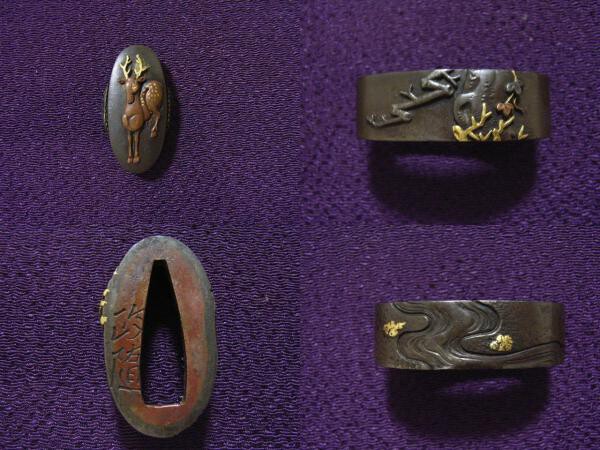
Just for the sake of reference, I have attached a photo of a Hamano Masayuki (Shozui) fuchi /kashira I own. It has NBTHK Hozon papers. The original Masayuki has what I find to be a distinct signature, though it evolved over his life. As for Haynes- well... he did that on quite a few people. Christies London insists that Hirotoshi is the wrong reading and that all educated Europeans know that Haynes is wrong. "What!?", I said. I tend to agree with Haynes. Thank you for the information Ludolph.
-
Your tsuba is Echizen. I should be able to read the name right off, but it escapes me at the moment and I am without my books. Your avatar is a nice tsuba. I owned it at one point. I found it in Japan. I know it doesn't show up in the photos, but have you noticed how the sukashi of the flowers floats on the grainline of the tosho tsuba? Good luck!
-
What Ted said- IYEHISA Kashira is Higo. Iron looks Higo or neighboring school, as sometimes they get very close looking. Gut reaction is that the inlay does not look Kaga, unless it is late Kaga. But shape of the fuchi is not quite what I would expect for main Higo school. I am away for the summer and do not have my references. Ah- I just read all of Rich T's post. I guess Haynes mentions two Kaga Iehisa working in silver hirazogan. Hmm. I would have thought it more Higo. I would have thought it later work.
-
Dear Rich, Send me a photo offline?
-
Peter, I was wondering the same thing. Anyone in Japan able to answer this?
-
Gassan (or rather not) on eBay?
Curran replied to Marius's topic in Auctions and Online Sales or Sellers
I would give the blade the benefit of the doubt that it is actually Nihonto. I do not know that the signature is authentic. (Edited) Regarding the length of this tanto, I forget the rules on registration. I've owned an O-kogatana longer than this that had no registration problems in Japan, but not sure what the length rule is and how it works between tanto vs. an O-kogatana. -
Dear Tree, I find those pictures a bit more helpful. If you have the Nihonto Koza Kodogu volume (Watson translations), look up the Satsuma tsuba section and see the related examples. I am not very knowledgable on Satsuma tsuba, and would try to go off the iron to give an opinion as to Satsuma vs. Shoami. Circling tiger theme, plus bamboo edges, and the gold vine paulownia scrollwork along the edge all look Satsuma at first glance. But looking at the seppa dai, spacing of elements, and (if in hand and I had a magnifier glass) how the gold has been applied might all point to it being a shoami tsuba. On the whole, a decent looking tsuba in my opinion.
-
Tree, I am surprised no one else answered. The cirlcing tigers and some other things point towards it being a Satsuma tsuba, though it may also be a Shoami copy as the design became very popular. That is my read on it. I will try to add more if you have better photos. Personally, I'm not too fond of tiger themes (or dragon themes)- but that looks like it was a good purchase.
-
I'd rather someone ask Ted Tenold in on this one. I don't want to anger Brian by talking about an ongoing auction- but my initial reaction at seeing this was, "D*m*, I hope someone takes a ballpeen hammer to the hand of the guy who did this." To me it looks that some of the other blades have had mild acid used in their polish. Perhaps this poor child was forgotten overnight... Others look relatively okay. The damage runs north of the horimono and pools all the way through the horimono. Just not cool... Maybe if I had a few drinks I could find it groovey! But it currently looks like chemical landfill erosion to me.
-
I agree with Stephen that you should post better photos of the fuchi kashira. The wrap looks like it was well done at some point, but has lost its integrity at this point. All it may need is a rewrap. I do not like the tsuba, but that is me. I cannot see the fuchi / kashira very well in the photo, but from the menuki and the way the wrap was done... I suspect the fuchi / kashira are okay. If so, then maybe the tsuba was swapped out by someone else for the original tsuba. This is just theory at this point. Further evidence will make or break my suspicion. On polish pre or post restoration, I think it depends on the restorer. I have had it go both ways. On a wak for shirasaya, he made the shirasaya first and then the wak went off to polish. It had to be slightly adjusted afterword,, because the polisher removed so much. But all in all it was fine. Please get a photo of the fuchi / kashira if you have time.
-
Ascher-san (Nidai), Nothing wrong with those menuki. Look like fresh cut pine branch, of the Shinto New Year's festival? Nice little things.
-
Paul, Thanks. I have that one on my shelf. I felt I had read that before. Good luck Martin.
-
Leroy, Search the archives of this board or the message board for articles on photography by Darcy or Richard George. Those two know volumes more about it than most of us.