Bugyotsuji
-
Posts
14,304 -
Joined
-
Last visited
-
Days Won
276
Content Type
Profiles
Forums
Events
Store
Downloads
Gallery
Everything posted by Bugyotsuji
-
Edo Period Corner Part II
Bugyotsuji replied to estcrh's topic in General Nihonto Related Discussion
Children’s Day Sunday, actually part of the annual Buddhist Kuyosai ritual commemorating the souls of Osafuné swordsmiths. The day started off with speeches, incantations and pinched offerings of incense. Kōzuke Daijo Sukesada’s gravestone is here, behind the dark green bush. I went round later to have a look. “No photos allowed” the sign said. It was the first time I had been invited to do a stall illustrating Bizen guns. I unloaded the car and set up the display at 9:30 am. Imagine my surprise then, when they required my attendance in the special dignitaries’ tent, and to be called in turn by name to go and offer incense and prayers at the altar. I watched closely and tried to memorize the ritualized movements of the Mayor etc., giving an internal moment of thanks for the lives of all those Bizen smiths of yore. Various attractions and events were held during the day for the children, with whole families joining in. Most visitors to my little display were respectful and full of questions, but a couple of the hyper kids were grabbing antiques as if they were playthings, and needed close watching! Family sword play My table


-
Ah, no, I think it is something else that has been made into a maedate, Bernard. Perhaps a post- or wall-plate from a Jinja for example.
-
Identify? Do you mean what does it represent, Bernard, or are you asking which family might have used this Kamon? It looks to me like a folded paper ‘Noshi’ design, with an internal ‘Ken’.
-
Looking for Masakazu and ceramic Netsuké, I came across this in the MCI. Thanks, Pietro above. No.6

-
Accessories for the Tanegashima
Bugyotsuji replied to Bugyotsuji's topic in Tanegashima / Teppo / Hinawajū
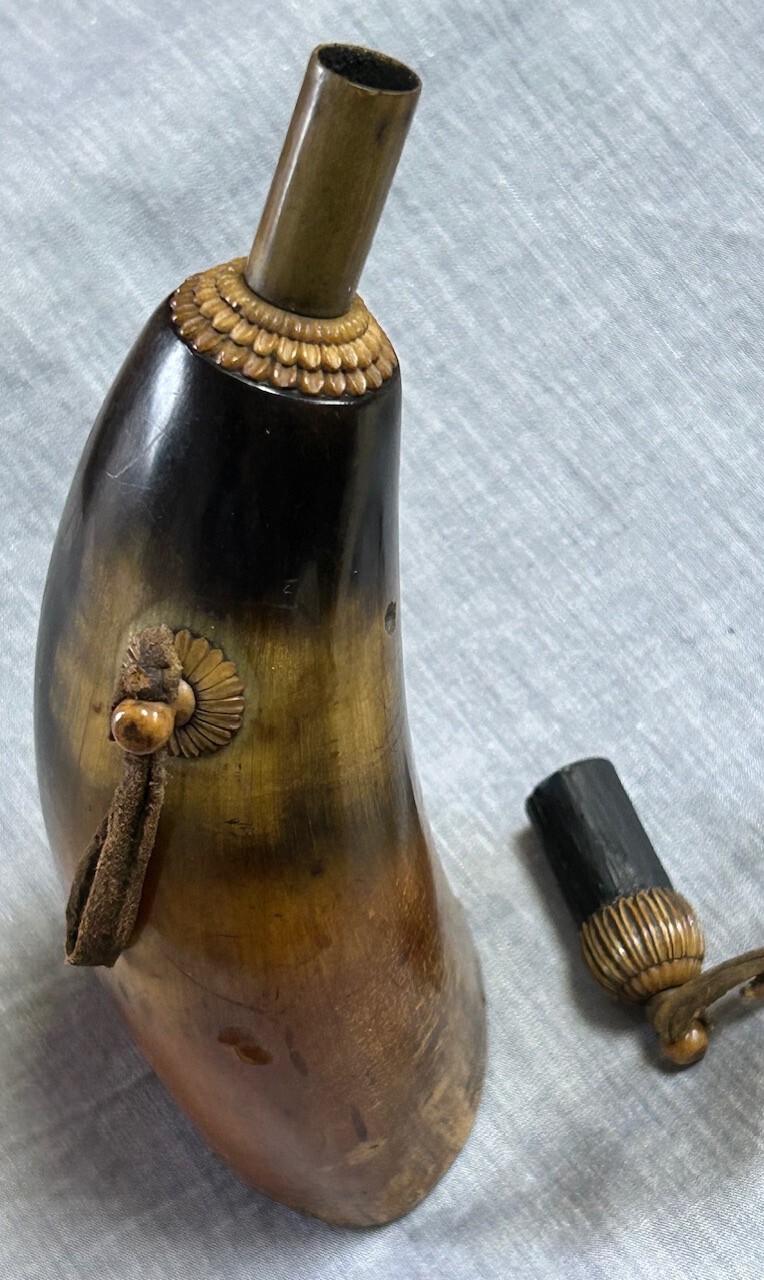
These are to my mind older, from a time when guns were still thought to be ‘Western’, a time of strict imitation, when artisans thought a ‘powder horn’ ought to be made from cow horn. They still retain some Western feeling, but already the artistic sensibility was at work. The ‘frilled’ edges may also pay lip service to Western clothing ruffs which were still somewhat in fashion. Later on, people felt free to create powder flasks in more Japanese iterations. The ruffs often continued however. -
Vesta! That is so neat! The waves look at a glance like Ōmori work, but there were many imitators.
-
For me it’s more Momoyama/Keichō than Edo period, but it’s just a feeling.
-
Hi Billy, yes, but not necessarily just because the holes are the same size. Where to start? Someone has quickly created a Netsuke-like object, hoping for a sale, but the all-round quality is completely missing for a ‘genuine’ old Netsuke.
-
Accessories for the Tanegashima
Bugyotsuji replied to Bugyotsuji's topic in Tanegashima / Teppo / Hinawajū
This topic is surely worth expanding. Looking to post a coarse powder flask I found over the weekend, I discovered this good old thread! These old black-powder flasks can show astonishingly fine work. If you can find one with matching bits (frills), then all the better! See below the collar of the spout, the top of the powder measuring cap, the heads of the pegs, and the flask side-attachment seat. Detail Pouring spout


-
Thanks Pietro for the great feedback, and for showing us your examples. The various coloured glazes do make them more attractive. Surely elements of the finer detail were added by hand at some stage.(?) John, I am not sure if these would be more expensive than bone or metal. Metal Netsuke are rare enough in their own right.
-
Agreed that it’s a pretty ugly thing to look at, but to some people therein lies the very charm of pottery netsuke.
-
The other day I found a Netsuke with simple ojime and Inro attached. The dealer said the Netsuke was ‘stag antler’, but when I objected that it looked more ceramic, he grabbed it, looked more closely and then bumped up the price. I should have kept my mouth shut. Golden Rule of bargain hunting in Japan that I have oft broken and later rued. Not that I am particularly collecting ceramic Netsuke, but this one just drifted along the stream in front of me and begged to join the others. Compared with several examples in Toledo Museum’s Silverman collection I would have to call it as they do: “Hirado ware; porcelain with matte bisque glaze and stain.“ Tsuru Sen-nin, a Chinese immortal/sage, carrying a crane. Edo Period Right view Left view Back view. Big chunk missing, probably dropped at some stage. To left, imprint of maker’s seal?


-
PS These are written in old-style (pre-simplification) kanji that most Chinese and Japanese today could not read.
-
Even upside down it looks like gimei characters. A Chinese fake?
-
WW2 Japanese Naval Sword
Bugyotsuji replied to Swords's topic in Auctions and Online Sales or Sellers
You must have a private theory…(?) -
FUCHI KASHIRA & ASSORTED MENUKI KAGA MAEDA MON
Bugyotsuji replied to Marc BROQUIN's topic in Wanted to Buy
Inverted heart, boar’s eye ‘inomé’. -
Black lacquer gold Mon Tazuke School Tanegashima
Bugyotsuji replied to Bugyotsuji's topic in Tanegashima / Teppo / Hinawajū
Since then I retired it, using a much lighter but again genuine 20-Monme Ōzutsu from Ki-Shū, Wakayama, and subsequently, more recently, a 50-Monme from Sendai. For static displays, however, it’s great to have three Tazuke school matchlocks. -
Black lacquer gold Mon Tazuke School Tanegashima
Bugyotsuji replied to Bugyotsuji's topic in Tanegashima / Teppo / Hinawajū
What a trip down memory lane! Since then I fired that gun at blackpowder displays about eighty times over ten years, even taking it to celebrate Japan Week in Portugal later on in 2010. It had to be de-registered to leave Japan. Sadly on return the Tokyo Board of Education re-measured the bore at 2.1 cm, dropping it from a 20-Monme Ōzutsu to a 15-Monme Ōzutsu. But then it got married and had a family. •Ōzutsu •Gunyōzutsu •Bajōzutsu (Kagozutsu)
-
岡田兼定 作 Okada Kanesada Saku https://kako.nipponto.co.jp/swords2/KT215403.htm
-
The history of guns floor at Nagoya Tōken world, however, has made great efforts to provide accurate and readable English signs for almost every display. The curators for each floor seem to be markedly different, left entirely to their individual devices, with insufficient overall museum policy. The blades are generally good, and plentiful, but the displays could certainly be improved.
-
Fairly common Hira-sankaku Yari indeed, but heavily damaged. I’ve never before seen a gimei Yari, but 大吉 作sounds more like a fortune telling than a real smith’s name. The slightly longer kerakubi could indicate a little more age, possibly early to mid Edo period(?), but I’m just guessing.
-
重 ‘Shige’ can also be a nickname or short form of a person’s name.
-
Ojime Bead Translation Assistance Needed
Bugyotsuji replied to hddennis's topic in Other Japanese Arts
銘酒 Famous liquor (Probably imitating the old earthenware Yomeishu flasks found in Tomo.) Tomo-no-Ura is where Miyazaki Hayao wrote Ponyo. Exciting find!- 1 reply
-
- 3
-

-

-
Edo Period Corner Part II
Bugyotsuji replied to estcrh's topic in General Nihonto Related Discussion
Every weekend this autumn we have been donning full armour and putting on displays with old smoothbore ‘Tanegashima’ guns. Busy, busy, busy. On Sunday we will be part of the Daimyō Gyōretsu at the old Honjin (inn) Sankin-kōtai stop at Yakage. The constant wear and tear of equipment means the ever-present need for running repairs. Most of these, you have to be ready to do yourself. The medieval battlefield would have been similar but more extreme. I have just finished applying glue to broken tsukamaki strings on the tachi koshirae. A cheaper fix than ordering an identical complete restring! It looks fine, except when it rains and the transparent glue sections turn milky white. Half a day I spent on reattaching loose iron plates and chain mail on the kote sleeves, and the main frontal cord of the haidate had snapped and needed replacing. Meanwhile, the matchlocks also need constant cleaning and prepping, before and after each display. (PS Yesterday with Igor I bumped into Les and Ray at the sword museum! Small world.) -
Edo Period Corner Part II
Bugyotsuji replied to estcrh's topic in General Nihonto Related Discussion
Wordsworth said something about emotion recollected in tranquillity. On Saturday I laid out a table of objects, this and that, and with the help of the organizers, gave a talk to an audience of local citizens. Since then I have heard back through the grapevine that it was an acceptable afternoon and that people enjoyed it. I may have put a noose around my own neck though, as the city has now asked me to do a static display for their children's event later this month. Hmmm... Onko Chishin, 温故知新, learning from the past, to fashion the future? The past can teach you about the future?