Bugyotsuji
-
Posts
15,076 -
Joined
-
Last visited
-
Days Won
323
Content Type
Profiles
Forums
Events
Store
Downloads
Gallery
Everything posted by Bugyotsuji
-
Generally this kind of arabesque vine pattern is loosely described as: Karakusa moyo 唐草模様 Definitely unusual though and a goodly size.
-
 Probably the same year, even though you’ve cut off the important part above.
 -
Dang Jean, I did not want to answer that here... grrr... Over the phone: I asked him if it was easy to remove, and after a moment's thought he said "Yes." He said to use 'a sanding eraser', but without actually seeing him doing that I would not like to encourage anyone here to try any such procedure. I suggested to him hopefully that such work should be done gently (yes/no?), and he agreed, saying that one should be careful not to expose the iron/steel surface of the tsuba. Well, that sounded pretty obvious, if not exactly easy to perform smoothly. The above answer will self-destruct in five minutes.
-
Been doing a little digging around as I have a nice tsuba with a wet black appearance. A friend looked at it and immediately put it down. "Ibota," he muttered. "How can I remove it?", I asked. It seems that over the years there are some people who continue to apply this 'Chinese wax', or 'Japanese wax' to protect tsuba etc. from rust. Exuded by insects on the leaves and branches of Ibota no Ki, Ligustrum Obtusifolium. Also known as Chuhaku-ro (虫白蠟 Insect white wax, 雪蠟snow wax), イボタ蠟Ibota-ro.
-
Perhaps I should add a word for Pietro too. I remember when he first appeared on the INS Netsuke scene as an eager youngster, and how he devoted himself to researching netsuke, walking the museums over the years, searching out netsuke collections and linking them electronically for people to experience, building up a vast knowledge in the interim. Still maturing! Never met him personally but generally I trust his judgment, as too that of Colin. Ron reminds me though of a grizzly Canadian frontiersman, who has seen much, bitterly forged by harsh weather, his thriving business shafted by fools in high places. What an incredible background he has had though, and what stories he has to tell, as Brian says. Needs to be heard by a glowing fire with a pinch of salt and a glass or two of whisky, all judgement suspended meantime!
-
Kunitomo teppō by Kyūbei Enju, who made the stock?
Bugyotsuji replied to Peter D's topic in Tanegashima / Teppo / Hinawajū
Peter never came back? -
From a discussion on another forum re AI. ”Apparently Chat GPT and the like are liable to teach themselves to be dumb. As they work on a learning loop if they regurgitate incorrect information they also consume that information as truth and around the loop they go. This is said to be the reason why AI companies with huge efforts try to harvest old pre-AI internet and media content, that is free from copied and loop-recycled AI fantasies.”
-
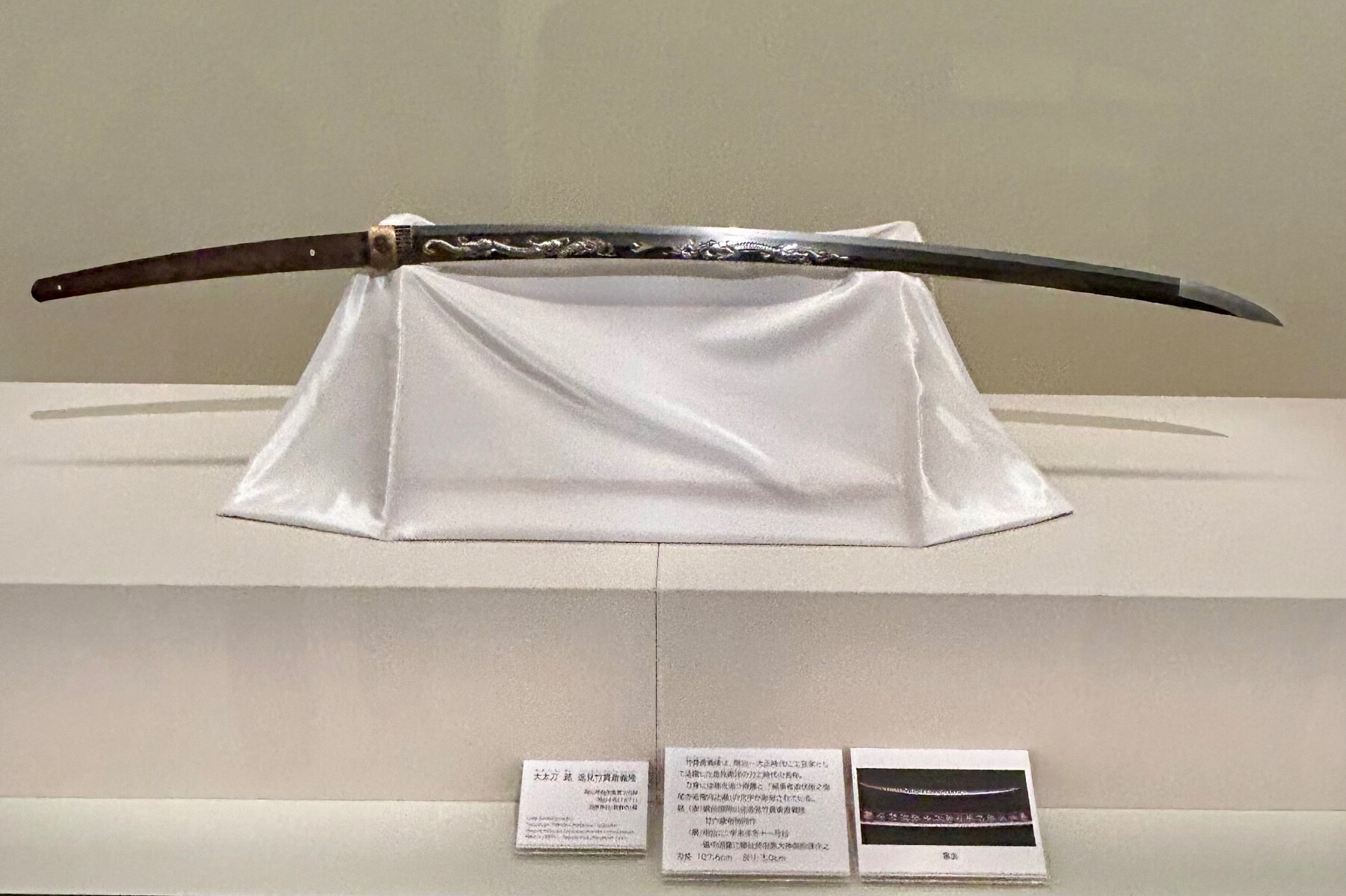
Some genius smiths appear in every generation to transcend the tradition. One such is Henmi Toyo (Chik-kansai Yoshitaka) from late Edo and early Meiji. Not only did he make fantastical blades but his carving was superlative, for Mei and horimono, and in other materials. https://www.google.com/search?client=safari&hs=52n&sca_esv=04a6da60a81ec2d8&hl=en-gb&udm=2&q=逸見東洋&spell=1&sa=X&ved=2ahUKEwip_a3cu6GVAxWBgVYBHdGsBPcQBSgAegQICRAB&biw=390&bih=699&dpr=3

-
Ron, these are simply two individuals who pop into the NMB and enjoy heated discussions. Many others are reading and learning from every post, while they suspend judgement. Some posts do have little barbs or triggers in them but the majority of participants really do try to avoid posting or getting caught on those. Colin and Pietro will challenge others, as you will challenge them, but you are all three of you quite strong characters who definitely add colour to the world! I have learned much from all of you. As to the NMB itself, it’s a little like a kaleidoscope, never the same from one year to the next.
-
Going back in time. Some natural, and some adapted netsuke from over the centuries. One o’clock is a flattish Corazon seed with two holes drilled for use as a netsuke. (They were also turned into powder flasks for matchlocks.) Three and four o’clock show stones from rivers or sea shore with natural openings in them, found in antiques markets with disintegrating strings attached. At five o’clock is an old, well-used sea shell with drilled hole and string, found at Tenjin San antiques market in Kyoto. Functional netsuke. Down the middle from 12 to 6 is a root (?) with a natural channel throughout. Decorative object. At seven o’clock is an inro set hanging from a section of umoregi semi-fossilized peatbog wood. Hole was probably drilled through. This netsuke at least likely fits the Edo Period remit. Inro is wood, the sections carved to look like bamboo. To the left of the root is a wooden hook formed from a branch(?) with original piece of rice straw twine. At nine o’clock is a fishing-net weight, fired clay, cylindrical. A perfect practical netsuke for a fisherman wearing only a fundōshi loincloth. Top left is a clay object with two holes sold to me as Chinese from 700 AD(?). But we do find 2000-year-old flat oval scrapers in Japanese archaeology museums, said to have been for agriculture, with similar two-hole layout. Netsuke origins?

-
Remember that a blade can be fitted with almost any tsuba, having no intrinsic relationship, so they need to be researched independently. In your case the owner may or may not have deliberately chosen a tsuba with the simple katabami mon, but that choice would most likely be independent of a Kotetsu (or otherwise) blade.
-
Not sure what this is, but here’s a somewhat similar complete one I found at auction Decorative cow saddle…(?)

-
Signed and sealed in 安永十年 is 1781, (An-ei 10)
-
https://www.google.com/search?client=safari&hs=eITV&sca_esv=e5b3c94426f10df7&hl=en-gb&q=鞍武具+骨董+鞍+江戸&uds=AJ5uw1_a2D0D09lxm8gpKKOTUn4rcgPmLRKzg4TWlqFm7k5JhzpahfW9rOkRqXXsE1CL_61Rl2hYdOpYLw3o5DpWx-gOtzmFxnlaQolSl6UDsEzzdPUNlGffd3BKhUpSJhhZXlrNVv5he1WEvWU3x_RZlaO7vMxauuOnqFayc9R0XjaKzWhXvB2PGwzrjph0GOX67EilS9MO&udm=2&sa=X&ved=2ahUKEwjj4pam9aCVAxXEe_UHHYuwCBsQxKsJKAR6BAgPEAE&ictx=0&biw=390&bih=699&dpr=3 Look up words like Edo, Bugu, Kura, Kotto, etc., to see some other examples for comparison.
-
Might need some gentle TLC, but nice tsuba.
-
Euronetsuké membership which included Rosemary Bandini’s gorgeous quarterlies was around £20 a year which I found more affordable. I thought the INS was $175, but maybe I am mistaken. Since their website went wobbly a few years back I have generally lost touch and given up. Regrettably I was never able to fly to attend one of their magnificent international conventions. i find it a struggle to pay for yearly membership of the NBTHK, and the NKBKHK (JAS armour society) on top. Luckily the UK Token Society’s yearly fee is more reasonable. John C was asking what a genuine netsuke might be, and I was suggesting going along to a meeting where good pieces are passed around for hands-on appreciation. That way one can develop an ‘eye’. Having said that, there are still many pristine netsuke out there that look like they were made yesterday. Could they really be 200 +/- years old? Unable to make a definitive judgement in such cases, I will quietly avoid (commenting upon or buying) those. Don’t want to offend any owners!
-
Right place to post
Bugyotsuji replied to petethe canadian's topic in General Nihonto Related Discussion
Many katana-bako examples posted in the above thread. Wakizashi size box? Any rests inside, or marks where they once might have been? It seems unlikely that naked blades were stored in there. Surely they would have been in some kind of shirasaya or abura-saya. Speaking of which, preserving (camellia?) oil could be the origins of the stains. The formal Koshiraé could have been stored in there too, slightly longer overall, accounting for the dent? -
Hi Chen, it looks as if someone has used a wire brush there to remove rust.
-
Ron, good to see you commenting here, and you touch on some excellent points. I have a few of those Chinese toggles too, interesting in their own right. I have never been able to compete with those millionaire collectors, but by biding my time I have managed nevertheless to find many intriguing, perhaps exceptions to mainline 'Western collector' rules, i.e. 'genuine' (made and used for purpose within the generally accepted time frame) netsuke. Also I have some examples of those 'sticks' that you mention, plus earthen fishing weights and holed stones, fangs and bones that also must have seen early or rudimentary use.
-
John, check out one of the meetings of the International Netsuke Society, California branch, handle a few there, and shoot the bull with them. They will be welcoming, friendly and helpful. Also, visiting museums and leafing through netsuke collection books will really help. (Absolutely no need to buy right away!)
-
As do we all, each of us having parts of the giant jigsaw puzzle but never all of it…
-
Very nice Dirk. Apologies, and thanks! Funny that Sasano did not mention that it's 5-3 Kiri! 五三(の)桐
-
As always, without a photo of the tsuba itself, it is never possible to be absolutely sure about what someone is attempting to describe in a hakogaki. Tate-goshi? Guesses and probabilities in the meantime...
-
Ō-Dachi? Great photo either way!
-
Apparently the King banished him in a rage but he was ever faithful, spending his years brush-writing tear-filled filial poems on chrysanthemum leaves and floating them down the stream.