Bugyotsuji
-
Posts
14,422 -
Joined
-
Last visited
-
Days Won
281
Content Type
Profiles
Forums
Events
Store
Downloads
Gallery
Everything posted by Bugyotsuji
-
good uk dealers ....looking for a shin gunto
Bugyotsuji replied to lionel's topic in Military Swords of Japan
Lionel, I have known Don Bayney (Brian's list above) on and off for several years and he seems to be a decent knowledgeable bloke and willing to help out. Grays Antiques Market is outside Bond Street Station, just off Oxford Street, but you need to check the hours in advance as his shop is sometimes shut... Just my pennyworth. -
Simplified Kanji on Obibasami Netsuke?
Bugyotsuji replied to Bugyotsuji's topic in Translation Assistance
It was an old Okayama word used by the people in the area around Osafune. There is a place called Fukuoka in Osafune, and there was a Fukuoka Castle overlooking the Yoshii River crossing. When they all moved to Hakata in Kyushu, the area overlapping Hakata was newly called 'Fukuoka' in memory, and some of the old local words survived there. 口縄 Kuchinaha for snake is one of these words, I was told. PS I can find 'Kuchinaha' in Iwanami's 古語辞典 but the 当て字?is 蛇, reading Kuchinaha. A local friend told me many years ago that the actual meaning comes from 'mouth' and 'straw rope'. -
Simplified Kanji on Obibasami Netsuke?
Bugyotsuji replied to Bugyotsuji's topic in Translation Assistance
Koichi sama, that's wonderful work. Many thanks. The picture in Tensho style of the snake reminds me of an old word for snake in the west of Japan, くちなわ = Kuchinawa. "Mouth & rope". -
Japanese Sundial Compass
Bugyotsuji replied to Cypress Bayou's topic in General Nihonto Related Discussion
Fascinating stuff. -
Simplified Kanji on Obibasami Netsuke?
Bugyotsuji replied to Bugyotsuji's topic in Translation Assistance
Thank you. I am sorry that you have to spend time on this, but glad that you have troubled to help me. I think I understand why you are suggesting 礼 When I look in Koh Masuda's Kenkyusha J-E dictionary under saishi 祭祀, it says: 'a festival (祭礼)', so even though the characters have different original meanings, they end up being very close, certainly when used together with 祭. PS Would it be more likely to be uya, iya as in reigi 礼儀 because of the context, do you think? In other words, are you working solely from the shape of the old historical characters, or does situation also play an important part in your consideration? -
Thank you for looking and getting back. In picture two of your first post, there is just the suggestion of one. With heavy usage, the pan and the vent grow misshapen, causing various problems. A time comes when a decision is made to do the 'bugu-naoshi' repair to restore the Himichi's narrowness, and to strengthen and thicken the bottom of the pan. This latter will usually involve drilling straight up vertically through the bottom of the pan and replacing that section with a circular plug. Such a repair can be an indication of either a) age, or of b) heavy usage.
-
Ah, many thanks, bluelake. Yes, the pan looks like a later type, but well-used! Can you see a 'bugu-naoshi' circle underneath in the flat bottom of the pan, where the steel may have been repaired?
-
Hahaha... Ron, that's excellent. Thank you. Hmmm.... 4 monme, this would put the gun into smaller firepower, Ashigaru, Hosozutsu, (?) but it's a fairly long barrel. Military? Baby Hazama? Not really convenient for taking hunting, though not impossible, and the decoration at the muzzle does suggest personal use.
-
The 'riding crop' or whatever shown above gives no pleasure to the eye. It is crudely and garishly made and bears no second glance. If a punter wants to buy and display that thing in their house, then why not? It is true that the antiques market has been seriously degraded by the increasing flood of such stuff, but a greater problem lies at the higher end of the market, I suspect. In the meantime, let us create a small pool of people who 'will not be fooled'!!! :lol:
-
Not possible to answer your questions with any accuracy, Thomas, but the placement of the sight suggests later rather than earlier. The muzzle decoration is well done, but the Mei seems short of info. What does .54 cal work out to in Monme, I wonder? Do you have large hands, and which of your fingers fits easily down the barrel? The high number suggests either that they were making barrels of a certain type, say for hunting, which were then finished for individual orders and selling well, or that a bulk order had been placed for a castle garrison. If the latter then possibly in the years at the end of Edo 1840s to 1850s when Japan was rearming to meet the threat of the black ships. Can anyone else refine this in any way? A closer shot of the inside of the pan could help answer the age question. (Has it been plugged, BTW?)
-
Saku means 'maker' or 'made by', Thomas, as in swords. The No. 116 bottom left between the pan and the Bisen suggests one of (?) perhaps a large order of 150 or 200 guns. (?) I read that to make one gun took 40 days and nights of intense forgework. Enami or Enami-ya were a large and very famous group/line of gunsmiths in the Osaka area. About 180 Mei of Enamiya gunsmiths have been recorded, many with specific dates cut in the barrels.
-
Well, from Setsu/ Izumi/Sakai = No other markings anywhere?
-
Simplified Kanji on Obibasami Netsuke?
Bugyotsuji replied to Bugyotsuji's topic in Translation Assistance
Now I understand what you are seeing, Koichi san and why it is hard to decide. Hmmmm... Could this character be specially designed to be a crossover containing the feeling of both meanings? For example, I noticed in one dictionary that the two words 祭祀 and 祭礼 are given as having the same or very similar meaning. -
Simplified Kanji on Obibasami Netsuke?
Bugyotsuji replied to Bugyotsuji's topic in Translation Assistance
Koichi San, I have been playing with your idea. How about 祀?(Matsuri, shi, toshi, as in 祭祀 saishi) -
Yes, the Jutte looks much the same as most of these Jutte doing the rounds, new, but 'aged' just enough to fool 85% of the people.
-
Simplified Kanji on Obibasami Netsuke?
Bugyotsuji replied to Bugyotsuji's topic in Translation Assistance
Thank you, Koichi san. -
Simplified Kanji on Obibasami Netsuke?
Bugyotsuji replied to Bugyotsuji's topic in Translation Assistance
I like it! :lol: -
Would anyone be able to guess what this single character on an Obihasami/Obibasami Netsuke represents? Thanks in advance. http://forums.netsuke.org/file?id=998161 http://forums.netsuke.org/file?id=998160
-
This Week's Edo Period Corner
Bugyotsuji replied to Bugyotsuji's topic in General Nihonto Related Discussion
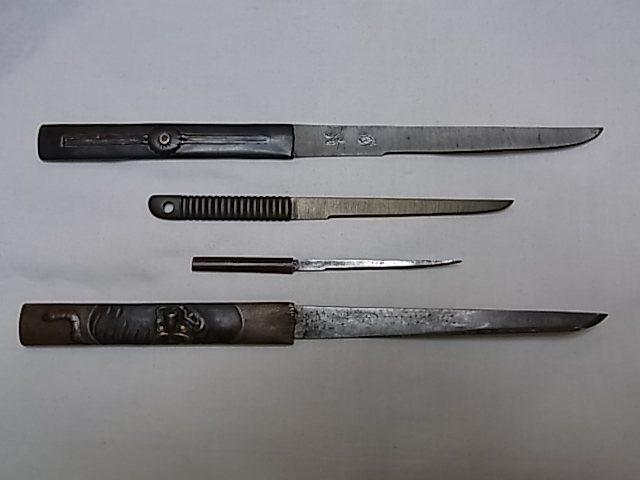
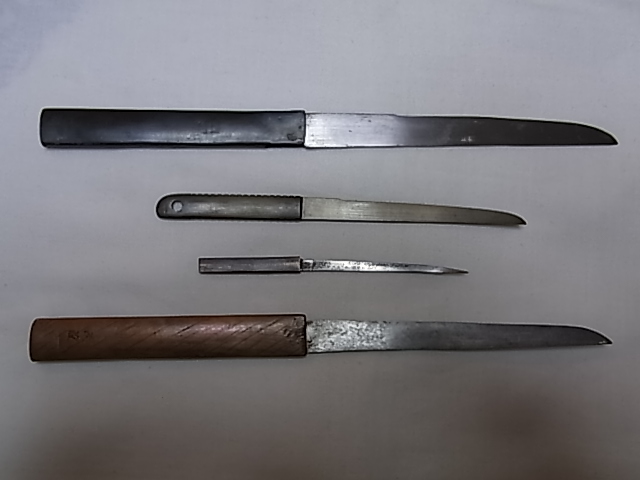
How big is a Kozuka? (On average?)

-
This Week's Edo Period Corner
Bugyotsuji replied to Bugyotsuji's topic in General Nihonto Related Discussion
With supposed Japanese cannons you do have to be super careful. Matchlocks cannot really be reproduced as they would be illegal and would never get the To-roku paperwork. ( NB Having said that, you do see the odd example that has somehow cleverly made it through the net.) Cannons, or the other hand, having no moving parts, are not illegal without paperwork in Japan. So here is a market waiting to be tapped. You can use traditional artisans to make genuine-looking cannon of any size, add a bit of ageing, and Bob's your uncle. They don't even have to conform to any standards of strength as gunpowder is illegal anyway. Many are cast. You will find dealers and customers alike steer a wide passage around them, as it is safer to avoid buying a genuine one than trying to pass on a fake that you might have bought in error. Having just said all of the above, I do like the feel of the two that you have posted, Eric. Whether old or new, they look 'Japanese'. I wish I knew more about J cannon. In the meantime I would be doing extra homework first though, before considering buying them. -
:lol: Thanks, but no thanks!
-
This Week's Edo Period Corner
Bugyotsuji replied to Bugyotsuji's topic in General Nihonto Related Discussion
I am very glad someone is atop the historical accuracy pile. Thanks, Ian. -
This Week's Edo Period Corner
Bugyotsuji replied to Bugyotsuji's topic in General Nihonto Related Discussion
Ian, in the 1835-1836 'Historical Sketches of the Portuguese Settlements in China' by the Swede Sir Andrew Ljungstedt, he says that Portuguese sources and Charlevoin in the Histoire de Japa/on maintain the crew of the Tanegashima Chinese ship as Fernao Mendes Pinto, Christivao Barralho and Diogo Zeimoto. The other Siam to China ship in 'Congoxima' contained Anthony da Mota, Francis Zeimoto, and Anthony Peixolo. What was funny to me what that although they are said to be two unrelated ships, they both arrived around the same time in Satsuma (Tanegashima was very close and under the jurisdiction of Satsuma) and the names of Diogo Zeimoto and Francis Zeimoto are so close as to be brothers, or father and son. Were they Christian Japanese, (traders with Goa even) who were on the two ships as translators, and were they scouting parties to Japan, and had they prepared 'unrelated' shipwreck stories in case anything went wrong? -
This Week's Edo Period Corner
Bugyotsuji replied to Bugyotsuji's topic in General Nihonto Related Discussion
Haha, yes, there are such very different interpretations of that story. Just read a book suggesting that there were two independent ships wrecked in Japan at the same time that year. The Chinese junky one on its way 'to Japan' hit 'Tanixima' and the other one from Siam bound for China sought refuge in somewhere called 'Congoxima' in Saxuma. It took me a while to figure these places out!!! Something fishy about this story though! The object that you call a 'ball starter', Ron, is probably what you imagine, though I am not sure what the English word 'ball starter' strictly refers to. Essentially what you see there is a thick ramrod for loading the large handcannon. We had 35 guns on display over the weekend, each representative of a particular field or area, such as place of manufacture or school of gunnery, and a few really special pieces. -
This Week's Edo Period Corner
Bugyotsuji replied to Bugyotsuji's topic in General Nihonto Related Discussion
Yes, Ron, I found myself watching their faces intently for clues on whether they needed help. Many suddenly lost interest and wandered off, but others looked around perplexed and were glad to see I was eager to be of service. It's so hard to get the tone and the amount of info right for each person, but wonderful to see fascination dawning in their eyes. Some of the questions were totally surprising, like one gent who pointed at the 80 Monme big gun and asked me: "Kore wa nan-ryo desuka?" (How many Ryo is this?) Well, people often ask how heavy it is, or whether they come up on the market, and if so how much it would cost to buy one... so as I kind of doubted my own ears I fudged an answer for him, but he asked exactly the same question again as if it was the most natural thing in the world. Then it dawned on me that he was asking how much it would have cost, at some unspecified time in the distant past, for a castle to have to buy one of these for their armoury, if they were paying in old money such as the Ryo gold oval coins. Our leader laughed at me later when I told him that I had stuttered. You should have made up a figure, of say 80 Ryo, he said! Or you should have quoted what the Lord Tokitaka paid for the first Tanegashima in 1542... equivalent to about 200 million of today's Japanese Yen! hahahaha.....