

Bugyotsuji
-
Posts
15,153 -
Joined
-
Last visited
-
Days Won
325
Content Type
Profiles
Forums
Events
Store
Downloads
Gallery
Everything posted by Bugyotsuji
-
This Week's Edo Period Corner
Bugyotsuji replied to Bugyotsuji's topic in General Nihonto Related Discussion
On Sunday morning at about 6:45 am I was wandering an antiques fair and spotted a dealer carrying an old dusty Tebako 手箱 lacquer box to his pitch. It was full of stuff, and as he dropped it heavily onto the bench I asked him how much the box was. Several other people had also rushed forward and crowded round, so when he told me over his shoulder the price for the box itself, before he could open it, I shouted with maximum restraint: KATTA... Now I just happened to have another box like it at home but covered in gold and silver Maki-e, which I bought perhaps six or seven years ago and I remember the date for that style as Muromachi or Momoyama, or early Edo. The one I bought on Sunday is plain and very slightly smaller, but still about the size of a hatbox. Sadly when I looked at it later one of the ring fittings was missing, but otherwise it was in pretty good nick, and a little spit & polish later, despite the wear of the years it now really looks good. The dealer said I would soon find another ring fitment, but I know I won't, having searched for such previously. A quick search on the internet turned up this 「角赤」 http://www.pref.ishikawa.lg.jp/kyoiku/b ... hin/3.html which is very similar. The description says that there was a fashion from the Momoyama Period of binding these Tebako in cloth and impregnating the cloth with red lacquer and leaving part of the surface in this rough cloth effect. -
Can a Katana Kake be dated by the lacquer colour?
Bugyotsuji replied to Lindus's topic in General Nihonto Related Discussion
In light of what Jean says I think the best we can do with an object like that is to study what was in fashion and from when. Mon can be and often were added later, at a price. The degree of lacquer fade can only be an indication of presence or absence of age, (ie brand new or not) but it will not be accurate. Lacquerware stored in a box may keep a much darker color/colour, whereas something like a Katana-tate may have been exposed to light over the years. Even a very black lacquer will appear brown under a flashlight/torch beam if it is old. New lacquer will appear black even under strong light. I have two manuscript boxes that I believe were made in the Muromachi period. The defining factor is the style as much as or more than the state of the lacquer. Pictures of these should be appearing in This Week's Edo Corner. -
Looks great. I am sure it enhances your wife's reputation and looks too! (Tell her...oh, and that it will guard the house...) Are the lights as bright as that all day through? You may get fade in the lacquer and in the cloth/string colors/colours.
-
Much better pics. Thanks. Not an expert by a long chalk, but that sword seems to ring all the right bells for me.
-
By "Hiroi", and it may be a series, as the subtitle on that one says says (Gijutsu to Ryu-ha) http://books.rakuten.co.jp/rb/%E5%88%80 ... em/149807/
-
Well, this gift I was given is a mighty rare object. Since I would never look a gift horse in the mouth, I will own it in good faith. In the same good faith I will be happy when I give it to someone down the line. :lol:
-
Thanks. I was not familiar with the style of this organization (NTHK) and how they write 正真 to mean that they certify it as genuine. So their reputation now hangs on the blade being what the box says it is.
-
Not getting any information from those pics. (PC is shot) What does the middle line on the paper say?
-
Having read Chris's reply in which he suggested we do our homework, it struck me what a useful thing it would be to have a cheatsheet to hand. Rather like a wine diary giving the best vintage years by region, or when buying a car an awareness of the period of years when Jaguar motors had in place weaker quality control, would it not be nice to have on one page for example in color gradations the relatively stronger years and weaker years for the reputations for each paper-issuing body?
-
Tanegashima Help - Original Matchlock?
Bugyotsuji replied to Windycity's topic in Tanegashima / Teppo / Hinawajū
PS What is written against the name is that Gen-no-Shin Kunihide (however you read his personal name) is progeny of, or descended from Gen-no-Shin, who was the first of a line of Kunitomo smiths using this family name. (Ogasawara and Yasuda, Zenkoku Teppo Kaji...) Further, according to the researcher Uribe, in Nihon no Teppo Kaji, p.38, Gen-no-Shin Kunihide(?), (manufacturer of a 4.5 Monme gun presently in the possession of the Nagahama Historical Museum) descended from Gen-no-Shin, who descended from Gentaro, who may have descended from Gentao, who descended from the founder of Kunitomo Group 3, Kunitomo Zenbei (sp?) who was patronized by the Oda family and has an associated date of Keicho 15 (1610). PPS The mark of the locksmith seems to read Haru, 春 and the surround could be a design incorporating eight, 八 but sadly I could not find such a name in Uribe's Kunitomo locksmith list. -
Tanegashima Help - Original Matchlock?
Bugyotsuji replied to Windycity's topic in Tanegashima / Teppo / Hinawajū
Pat, be prepared for anything. The fact that no-one has replied to this thread tells us something. The main thing is that you have the name on record. There is nothing to translate as it is a place and name and kao mark. How this particular gunsmith liked to read it will only ever be a secondary factor, and it may be that no-one alive today will be able to tell you. Perhaps the best thing for you is to memorize the characters and decide on a personal preference on how to read them, until someone comes along with a more convincing reason to correct you! (For example if you referred to him as "Go-Shu, Kunitomo, Gen-no-Shin, Kunihide", just for your own records, how many people would be able to correct you?) :lol: -
Tanegashima Help - Original Matchlock?
Bugyotsuji replied to Windycity's topic in Tanegashima / Teppo / Hinawajū
Just got back to the place with the books! Your smith is listed in three sources, but unfortunately no 'correct' reading is given for those characters. Next step is to ask 'learned' people here for suggestions as to how 江州国友「源之進 珍英」 may have been read, ...from out of the several possibilities. The alphabetical order within the lists suggests the compilers wanted to read the first part starting with 源 as Gen... as in Gen no Shin, or Gen no Michi, rather than Minamoto no Shin or Moto no Michi/Yuki, etc. -
This Week's Edo Period Corner
Bugyotsuji replied to Bugyotsuji's topic in General Nihonto Related Discussion
Any pictures of you wearing them, Eric? PS Now back in the Land of Wa and perhaps more able to contribute here once more. -
Tanegashima Help - Original Matchlock?
Bugyotsuji replied to Windycity's topic in Tanegashima / Teppo / Hinawajū
Not sure if people do valuations here on this site. Prices are depressed in Japan right now, but you might pay around 300,000 JPY over there. The US or European values/prices will probably vary widely from that. I will be checking my books for an accurate reading of the smith's name when I get back home later this month. (September 23rd... ish, depending on jetlag.) -
Tanegashima Help - Original Matchlock?
Bugyotsuji replied to Windycity's topic in Tanegashima / Teppo / Hinawajū
Thanks for the extra pics, Pat. Yes, Barry, it does look like the serpentine has been bent at some point in its life. It should be possible to track down the mark of the locksmith. To round off the gun, the signature looks very good. As some posters cleverly guessed, especially Ron, yes, it is signed as having been made in Kunitomo. Unfortunately I do not have my book of smiths with me here so I cannot give you a 100% certain reading of the smith's name. Depending on how you read that first character, Kunihide? Takahide? Yoshihide? Norihide? Perhaps someone else can help? -
Tanegashima Help - Original Matchlock?
Bugyotsuji replied to Windycity's topic in Tanegashima / Teppo / Hinawajū
Pat, yes, it looks like a good clean example of a Japanese Tanegashima matchlock. Just for added interest, your pics seem (?) to show a square or rectangular cross-section to the Hibasami (serpentine) and trigger guards, indicating Ki-no-Kuni, ie Wakayama. That area was one of the first places where guns came from Tanegashima, and where a manufacturing base was set up. Negoro-ji was a famous temple there destroyed by Hideyoshi because the 3,000 monks, armed with Tanegashima, were a political threat to Oda Nobunaga. You are missing (?) the pan lid, Pat. Ian told me that they can make such things at the Leeds Royal Armouries workshops in Leeds, UK, but you are located in the USA? -
This Week's Edo Period Corner
Bugyotsuji replied to Bugyotsuji's topic in General Nihonto Related Discussion
The Bake' Kujira is intriguing, Malcolm. -
This Week's Edo Period Corner
Bugyotsuji replied to Bugyotsuji's topic in General Nihonto Related Discussion
Not quite there yet, but you have found a great variety of ghouls there, Lance. Many thanks. -
This Week's Edo Period Corner
Bugyotsuji replied to Bugyotsuji's topic in General Nihonto Related Discussion
From the Ainu to a city recovering from nights of riots. This is a huge stab in the dark, but I have been looking for images of (mythical?) umi no kaibutsu, or sea creatures from the Edo Period. I know that fishermen around the coasts of Japan referred to sharks as Same' and Fuka, yes, but also as "Wani", a word we nowadays know means alligator/crocodile. Wani seems to be a very old word, perhaps illustrating a water creature with rows of teeth. (Wa = Ha?) I remember seeing an illustration once of Wani in a Hyo-ryu-ki or narrative of people washed away from the shores of Japan. It was obvious that the artist had seen neither and had come up with a composite. -
Two Netsuke artists, puzzling Mei
Bugyotsuji replied to Bugyotsuji's topic in Translation Assistance
Thank you Morita San. You may be right. From the age cracks and patina in the ivory block, and the overall condition and nature of the writing, I am thinking late Edo. It could be a practice piece. I agree it is not a great work of art, but neither is much of Western scrimshaw work. The style of writing must be telling you something different. Can you tell me what you see? (There are eight miniature pictures on the other side, the famous views of Ohmi. Netsuke, 3 cm x 4 cm.) PS My wife wants me to give it to her. She is Japanese, with very strong artistic sensibilities! -
Two Netsuke artists, puzzling Mei
Bugyotsuji replied to Bugyotsuji's topic in Translation Assistance
OK I'll get my coat... :lol: -
Two Netsuke artists, puzzling Mei
Bugyotsuji replied to Bugyotsuji's topic in Translation Assistance
This is a Netsuke with Eight Views of Omi on one side, and some long handwritten passages on the other. *****My main question is the signature (?) at the bottom and to the right of center. It looks like Shin or Nobu and then... a Kanji character within a cartouche immediately below it. Question Two (Optional! :lol: ) Would it be possible to understand what the writing says? I am sure that Mr Morita and Mr Moriyama are both very busy gentlemen, so I would not ask for everything to be written out in modern Japanese. There seems to be a Chinese (?) poem on the board at the top. Is the rest mostly a description of the views on the other side? Looks like a donation to the Xmas draw this year might be in order! Thanks in advance.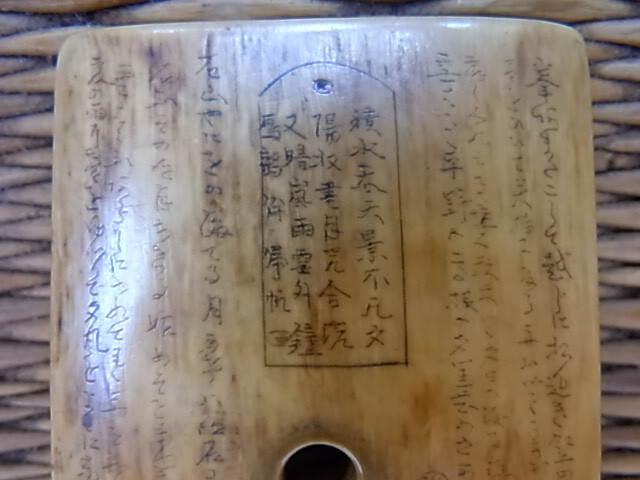


-
Two Netsuke artists, puzzling Mei
Bugyotsuji replied to Bugyotsuji's topic in Translation Assistance
The two who wanted readings are happy now, Mr Morita. I linked them to this thread so that they know it was you who read the Mei for them. -
Two Netsuke artists, puzzling Mei
Bugyotsuji replied to Bugyotsuji's topic in Translation Assistance
Morita san, thank you so much! I will go home and check the books. I know there was a Kinko metalworker who signed with the single character 正 Masa... PS There is a "Haruoki" in Ueda Reikichi... http://www5d.biglobe.ne.jp/~mystudy/kik ... da0120.JPG http://www5d.biglobe.ne.jp/~mystudy/kik ... da0095.JPG -
Two Netsuke artists, puzzling Mei
Bugyotsuji replied to Bugyotsuji's topic in Translation Assistance
Had a trawl through about 2,000 Netsuke artists names. There was one who worked in wood in the mid-Edo Period called Nobuhide. Any good here (no 2)? 信英


