Bugyotsuji
-
Posts
14,357 -
Joined
-
Last visited
-
Days Won
278
Content Type
Profiles
Forums
Events
Store
Downloads
Gallery
Everything posted by Bugyotsuji
-
兼立 can be read Kenritsu in general. How this smith wanted it to be read... ?
-
Eric K, yes, I agree with your observation as to the similarities between the two types of box. Carpenters' boxes are even today traditionally made with that kind of distinctive lid. One end slides under one of the two upper overhanging slats to help lock it in place. Many thanks for the pics. As to the yari mekugi, a good observation. Malcolm's theory makes sense. I wonder if there is more to this, apart from balance and aesthetics? Even a small bamboo pin, especially if made of susu-dake, can be almost as hard as iron, and firmly within the confines of a Kashi yari shaft, with the tip of the nakago resting against the interior back surface, nigh-on impossible to snap.
-
What a wonderful suit, Eric. And Ian, you seem to live in a world where few can enter! Nothing to do with anything really but I was at a sword study meeting last Sunday at Tatsuno Jo. (A lovely little hidden-away castle well worth a visit if anyone is in the area). The swords were laid out and we were ready to go when a young chap turned up late and unwrapped a large Katana in Shirasaya and placed it on the end of the line. As I picked it up to admire it, a voice nearby whispered, 'It's gendai.' Every aspect of this katana was perfect. The hamon was beautiful. They removed the tsuka and the Mei was Myochin. The young fellow it turned out was the 53rd Myochin himself in this particular line of Myochin. He is probably the first in his line to make swords; his father is well-known for making Hibashi (iron 'ohashi' for the hibachi). "Wow", I thought, brushing shoulders, "I get to touch a real living Myochin!"
-
Well, there were 脇楯 wakidate, or waidate, and 脇引wakibiki. I am wondering if they were relics from O-yoroi times, which gradually faded out at some time. Meeting someone more knowledgable this evening...
-
My suitcase to Portugal was 23 kg, the gun case was 12 kg and my back pack with the San-gu in it must have been another 8kg. I wore as much as I could onto the plane and carried only a minimum of a normal change of clothes. I had no gunpowder or bullets and I left my Horagai Triton shell behind. My sword Koshirae contained only a light wooden Tsunagi. So you must be looking at 35-40 kg before food/water.
-
Nice quote. :lol: Actually I think he was expected not to complain. If I have done 70~100 matchlock demonstrations in full armour in all types of weather, then I have heard from the J public gallery 1,000 times, 'That must be heavy!" or "How much does that weigh altogether?"... And when they ask to hold one of the long guns, a pause as they get a grip on it and then suddenly: "It's heavy!"
-
Hmmm... interesting find. I wonder just how common they were. My own experience tells me that there is already too much tied by strings around the neck. The addition of these wakibiki could well have been too much clobber for most people, increasing the time and effort needed to get your armour on. I already dislike the strings for the Kote, and HATE the string for the Nodowa. The cord for the bandolier and the cord for the holster add to the confusion. Sometimes a giant wooden Buddhist rosary necklace goes on top. The two Gyoyo get caught up in the mix. I just cannot imagine adding wakibiki to that lot... :lol: Oh, and the Do is already hard enough to get on and off without asking for help...
-
Some of the best and most unusual examples have found their way into collections abroad. Wonderful to see these, Carlo.
-
How is it explained, Carlo?
-
Quote: I see a square-eyed, broad nosed face in that intertwined mass. But would it not be 'upside down', Peter?
-
Carlo, that's my daughter's bedroom.
-
The packing case had been there for 100 years, I am guessing! :lol: (Unless you are saying 'we' in the Royal sense! ... but still the Yari would have had a tempered edge, right? Here are some pics of the box. I am tempted to use it as a work bench.
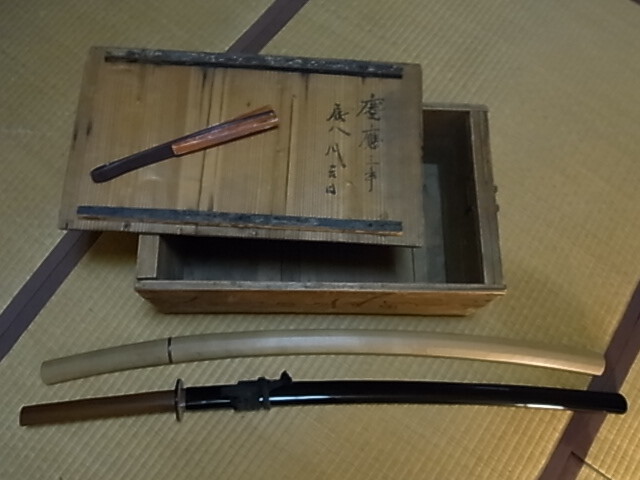
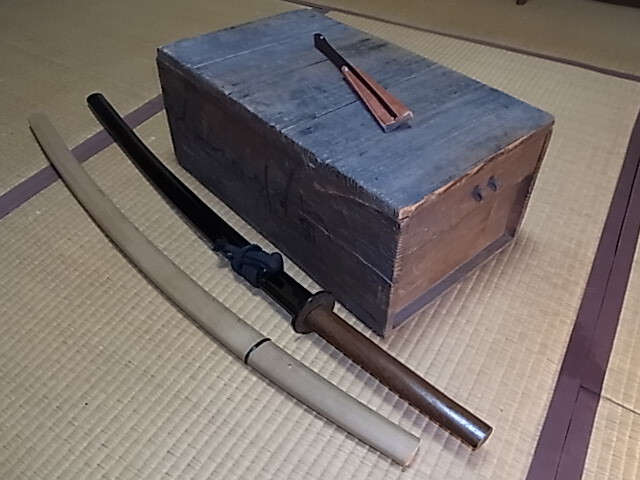
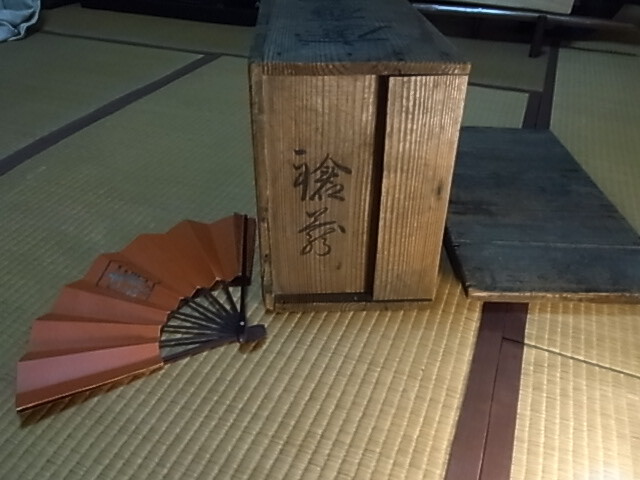
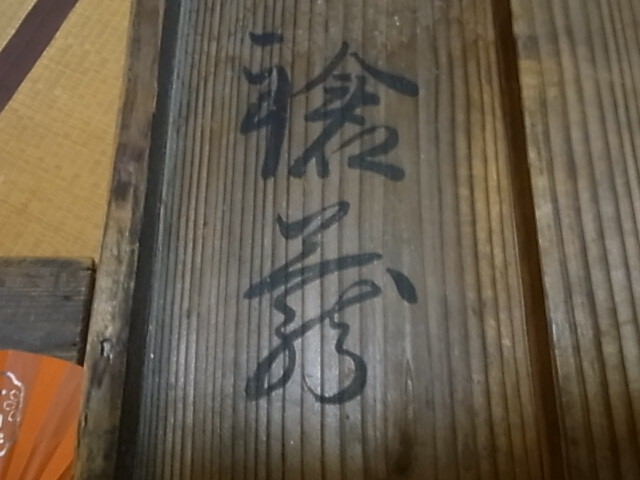
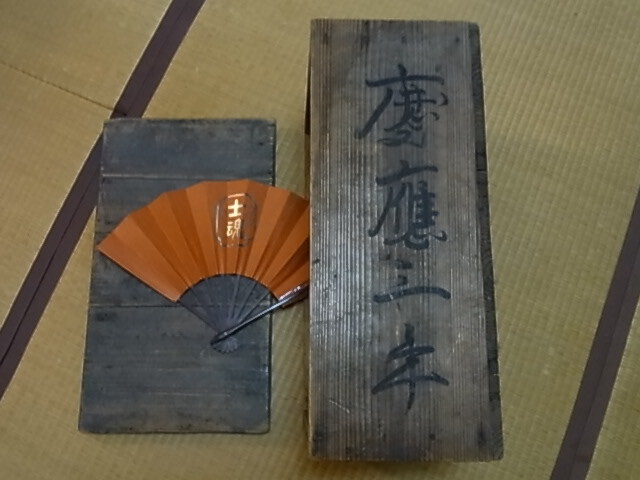
-
Eric, I have posted it before, but despite a search couldn't find it. (May be on the old site.) PS Just found it on this page in the Edo Period corner. Fuzzy shots and the explanation Kanji have gone strange. This part of the thread must have come from the old site and the Kanji were lost. It could be so-so 'Yari nest', 鎗蔵 (?) or Morita San suggested possibly a name, Yorizo? viewtopic.php?f=9&t=2554&st=0&sk=t&sd=a&start=150 It's larger than it looks there. Will get some better shots this evening.
-
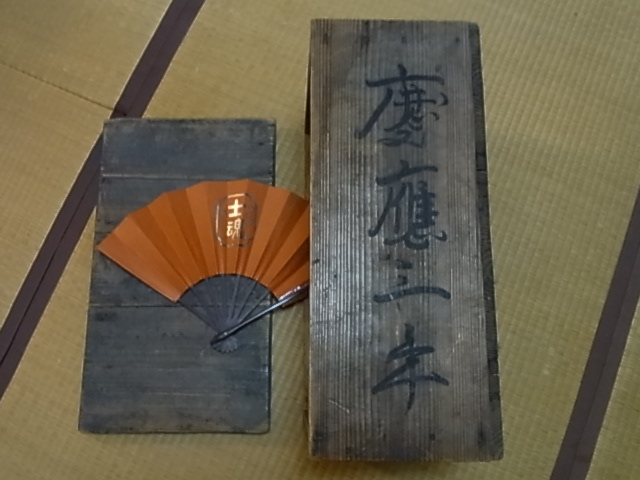
Whoever placed a Kikuchi blade on the end of a bamboo pole and tipped the balance in battle may just have started a trend. The point of a spear, I was told, was to thrust up for the enemies' eyes. From bamboo to wood, and from Tanto, to Yoroidoushi, to dedicated steel spear blade may then have been a logical progression, diverging from Naginata/Nagamaki. Since the handles of Naginata/Nagamaki were oval in cross-section, the idea of a round pole must have been new and outside the box. On a lathe, round cross-section may indeed have been easier to fashion. Wood would have caused fewer splinters than bamboo, but could be made just as slippery for sliding thrusts. As with Kazu-uchi-mono for swords, it must have been easy for smiths to mass produce short spear blades. The straighter they are, the easier they will fit into a box too. In fact I have just such a box at home, with the 'proper' (?) character for Yari written on it, and I can imagine it padded with straw and being gradually filled by smiths roundabout the forge. Most of the above is the product of a modicum of input plus a fertile mind and not much more.
-
Well, you have convinced me. In juxtaposition with your chappie there, then I would say almost certainly yes...
-
Alan, thanks for the reply. I ask because I had a repair done to the iron/steel firing pan of a matchlock. Maybe it was a type of arc welding. (?) It's a good job and very solid, but it looks silver and different, and it refuses to take patination. Please ignore as necessary. In the meantime I'll try and recall what process they called it in Japanese.
-
Nothing to do with the price of fish really, but one so-called knowledgable person, a long-time Japanese collector assured me that looseness was deliberate and to be desired as it was one of the mechanisms absorbing the shock of contact with hard objects. The design of the tsuba, particularly sukashi, was another method of recoil absorption, he was saying.
-
A repaired Tsuka should provide good reinforcement to a cracked Nakago. Can silver solder really be repatinated?
-
Please show us what it looks like!
-
Just read a little article last night before switching out the lights that suggests the adoption of yari had something to do with battle tactics. With a Naginata/Nagamaki, you spun around and slashed in all directions. Old-style fighting. As the battlefield became unidirectional, with the enemy massed and to the front, then ranked use of the long Yari spear against cavalry became essential. Two types of spear were mentioned. Very long plain ones with slippery handles to allow jabbing, ie gripping with the right fist and sliding through the left. The actual Ho or blade did not need to be large, often 5cm was sufficient. Shorter and more decorative high quality spears were carried by cavalry. The long spear gained a new lease of life when matchlocks appeared as they could sandwich and protect gunners whilst they were reloading. (You have a nice life-size display of this in the Royal Armouries, Ian.) The article mentions that the Kanji that we commonly use for Yari 槍 is actually wrong. With the tree 'hen' figure on the left this character should properly be read Hoko. The proper Kanji for what we think of as Yari should be 鑓 or 鎗 with the 'hen' for metal. As an afterthought when I was switching out the lights, this increase of long spears must have coincided with mass breeding of war horses and purpose-built mounted warrior units. The article is in Japanese, but I can post a photo of the page and provide a translation a) if you are interested and b) if I do not contravene copyright. Ikkojin 3 March 2010 'Sengoku Busho Nyumon' Special Edition. KK Best Sellers, Tokyo p.107
-
Carlo, can you provide a closer shot of the writing on the picture of the 'Japanese war crossbow'? It seems to say that this bow was excavated from a Kofun tomb in Pyongyang in Korea, but my eyesight is not good enough to read the fuzzy letters. If I am wrong, forgive me. The other day when the subject of hagire etc in yari came up, and, would this be a bad thing in a spear, I asked a close friend for his opinion. He said that Yari have yaki-ire, because yari were whirled around and used for slashing. So, even when yari succeeded naginata on the battlefield, did old habits die hard? Also, reading this thread (forgive me, but I have been ill recently and I've only just caught up) it struck me that there may be some truth in the idea that straight yari were used by peasants for warding off or surrounding and capturing hostile wild animals. Perhaps there was a cleanliness/purity prohibition bound up in this. One blade for animals, requiring no art, and one for war, requiring great skill. Did a breakdown in the old codes lead to indiscriminate use of previously forbidden weaponry on the field? Did function finally prevail over convention? PS There's quite a good discussion on the history of Yari here, with the Japanese section from 1/3 of the way down the page. They say that Hoko is the old word and Yari took over from hoko. There is also a reference to the earliest depiction of a Yari in a painting in Kamakura times. http://ja.wikipedia.org/wiki/%E6%A7%8D I'll be seeing some sword related people this weekend, so I'll float Ian's question there.
-
Very clever how he has got the ivory to look like copper. Thanks for posting.
-
Help required with translation please
Bugyotsuji replied to ironron's topic in Translation Assistance
Personally speaking, and I am not an expert, I can see why you might question this Mei. On the other hand I accept that there are indications that it might not be Gimei. Armed only with that one limited photograph and no background story, it is like being asked to judge the whole forest from an angled shot of a section of bark. -
Translation of japanese registration document
Bugyotsuji replied to diprivanman's topic in Translation Assistance
Gifu Prefectural Education Committee. The registration certificate itself is very new, ie 2009. -
Ouch, who are these cowboys messing around with the Watanabe Collection?