Bugyotsuji
-
Posts
14,645 -
Joined
-
Last visited
-
Days Won
295
Content Type
Profiles
Forums
Events
Store
Downloads
Gallery
Everything posted by Bugyotsuji
-
Good point Malcolm. 日月 Jitsugetsu, = tsukihi the passing of the days and months. Or the sun and moon design in for example the Emperor's flag, jitsugetsu no hata 日月の旗
-
Unusual design, certainly. Almost Tachi tsuba, almost Namban. What size is it? The nakago-ana suggests a very thick kasane; one hitsu-ana is tiny!
-
Kama, Jingama, Kusari-gama, Kama-yari etc.
Bugyotsuji replied to Bugyotsuji's topic in General Nihonto Related Discussion
Brian, can you rephrase that?! -
No, but I probably know someone who does. There is one at the Osafune Sword Museum which they use to illustrate skin steel and heart steel in the blade cross-section. The spear tip mentioned above:
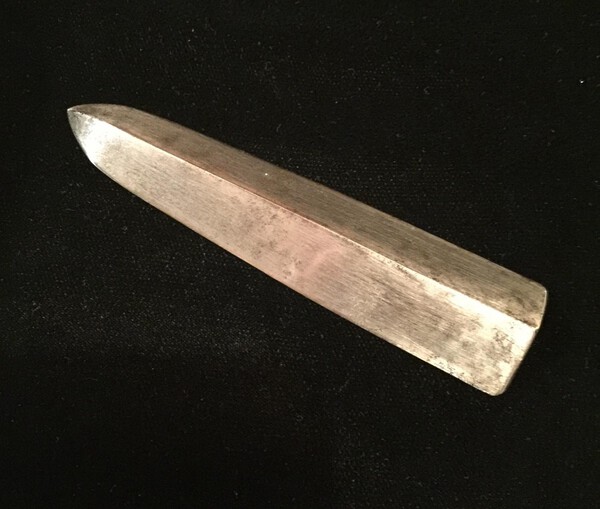

-
It's the word usually used when describing hamon that reach or cross over the shinogi line. Adjectivally used it would be a 'Shinogi ni kakatta' Hamon. (The flowery phrases were just general illustrations of usage that I was trying to come up with for you!)
-
Just had a look in the dictionary and was shocked to see how many subtly different examples were given. "Catching on", or "caught across" the Shinogi...? The shadow of the earth could be 月面にかかっている "partly covering" the face of the moon.
-
There are different Kanji for for the same sound Kakaru depending on meaning, Ken. EG "Kakarinasai", Shigoto ni kakaru means 'Get to work, or start!" In the shinogi case, I am sensing hikkakaru, like something being caught on branches, reached or partly crossed over. Need to check which kanji is which!
-
Thanks for the info, Jean. For Ken. In Three-blade fighting style, in "One Piece" Zoro apparently carries the third blade in his mouth. See end of first paragraph. Quote: "Zoro is uniquely known as an expert of Santōryū (Three Sword Style), where he wields a third sword with his mouth in combat. Throughout the series, his primary sword is Wado Ichimonji, a sword that he inherited from a childhood friend, and is frequently the sword that he wields in his mouth." https://en.wikipedia.org/wiki/Roronoa_Zoro For the cartoon background: ,https://en.wikipedia.org/wiki/One_Piece
-
Just had a chat and was assured that the normal phrase is that the Hamon is 'Shinogi ni Kakaru' (kakatte-iru, etc.).
-
Sosho Translation Confirmation Assistance
Bugyotsuji replied to Tanto54's topic in Translation Assistance
Showed this to a Tsuba collector and he said the meaning or reference would be impossible to judge without context, ie a view of the tsuba. In that single sliver shot above, however, he felt that the word Osoraku is written on the seppa-dai, in which case it is more likely to be the Go art name of the tsuba artisan. -
Correction. A J friend just told me that Daisho means simply two blades pushed into your obi, the Dai being your main blade, but the little sho support blade can be either a Wakizashi or Tanto.
-
Kama, Jingama, Kusari-gama, Kama-yari etc.
Bugyotsuji replied to Bugyotsuji's topic in General Nihonto Related Discussion
Taking everyone's advice concerning the long-handled kama, I went to see the sword Guru with a small and humble present in hand. There was good news and bad news. He opened a massive book devoted entirely to Settsu Sukehiro, and close comparison of the Mei pulled up various flags. The bad news is that he does not trust the Mei, which has been cut too shallow, and some of the strokes are 'wrong'. He felt that it has been done recently, and the nakago repatinated. (So hey! No-one here fell headlong into praising the Mei...!) The good news is that I could see he liked the activity in the blade. The hamon contains an example of Kani no tsume crab pincers, he said. The tobi-yaki, hitatsura 'tama' spot which I pointed out, he felt was just coincidence. I made a little joke, "so, tama-tama, tama, desu ne." He nodded distantly. I asked for his feeling regarding age and location. The work reminded him of Tsunahiro school of Sagami, So-Shu, mid-Edo onwards. He polished out a couple of dodgy rust spots in the ji for me, but advised me against sending it for a general polish, because with this saya construction "it will inevitably lose any benefit once more". He commented on the oval cross-section haft, and loved the quality of the koshirae, agreeing that it has good age to it. Conclusion, a nice little thing, to which someone has probably subsequently thought to add a signature. Sorry to disappoint, but thank you for reading this far. -
Great write-up and shots, placing us on the scene a little. Sounds like a valuable gathering. Wishing I could've been there.
-
Nice composition and shot.
-
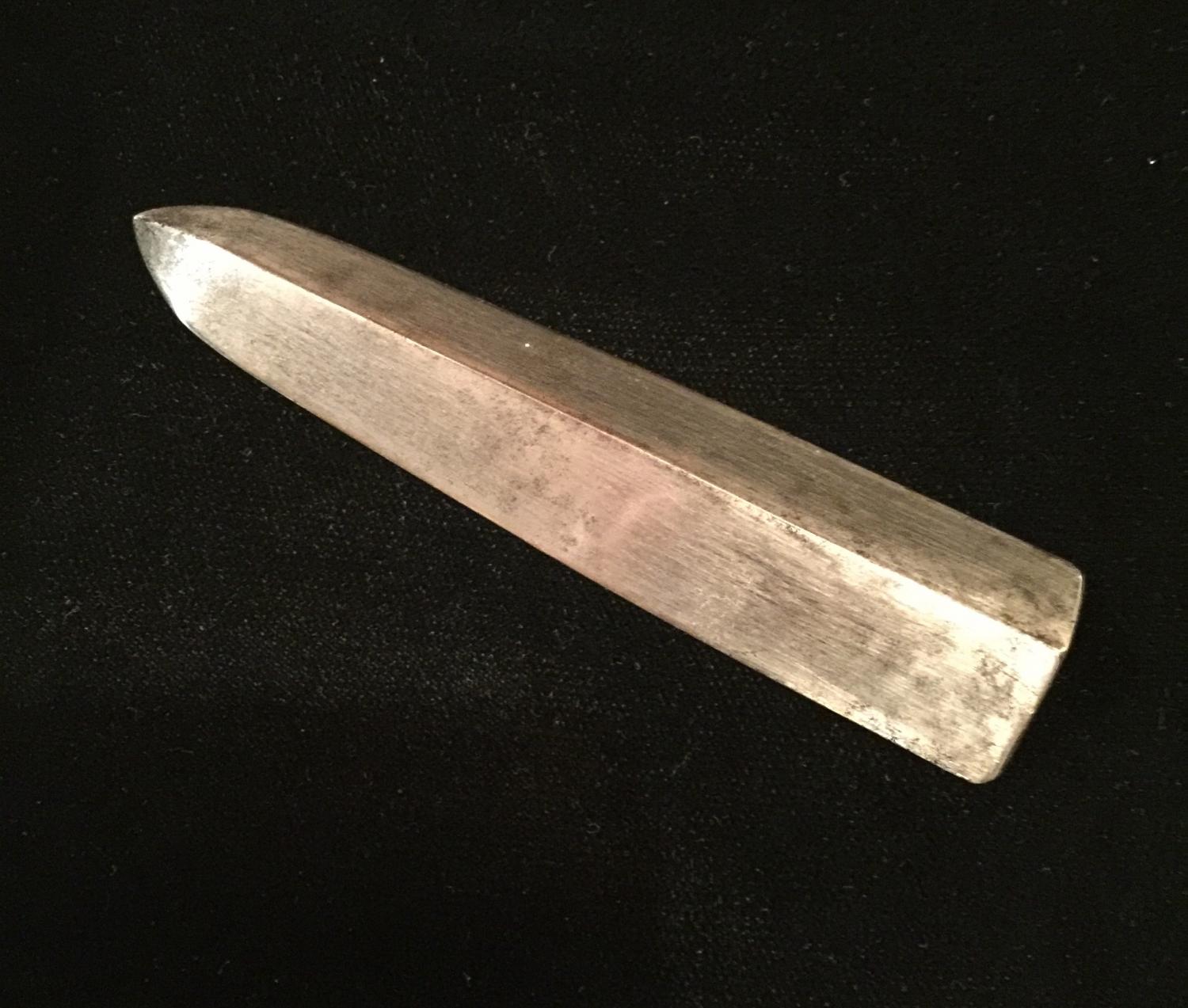
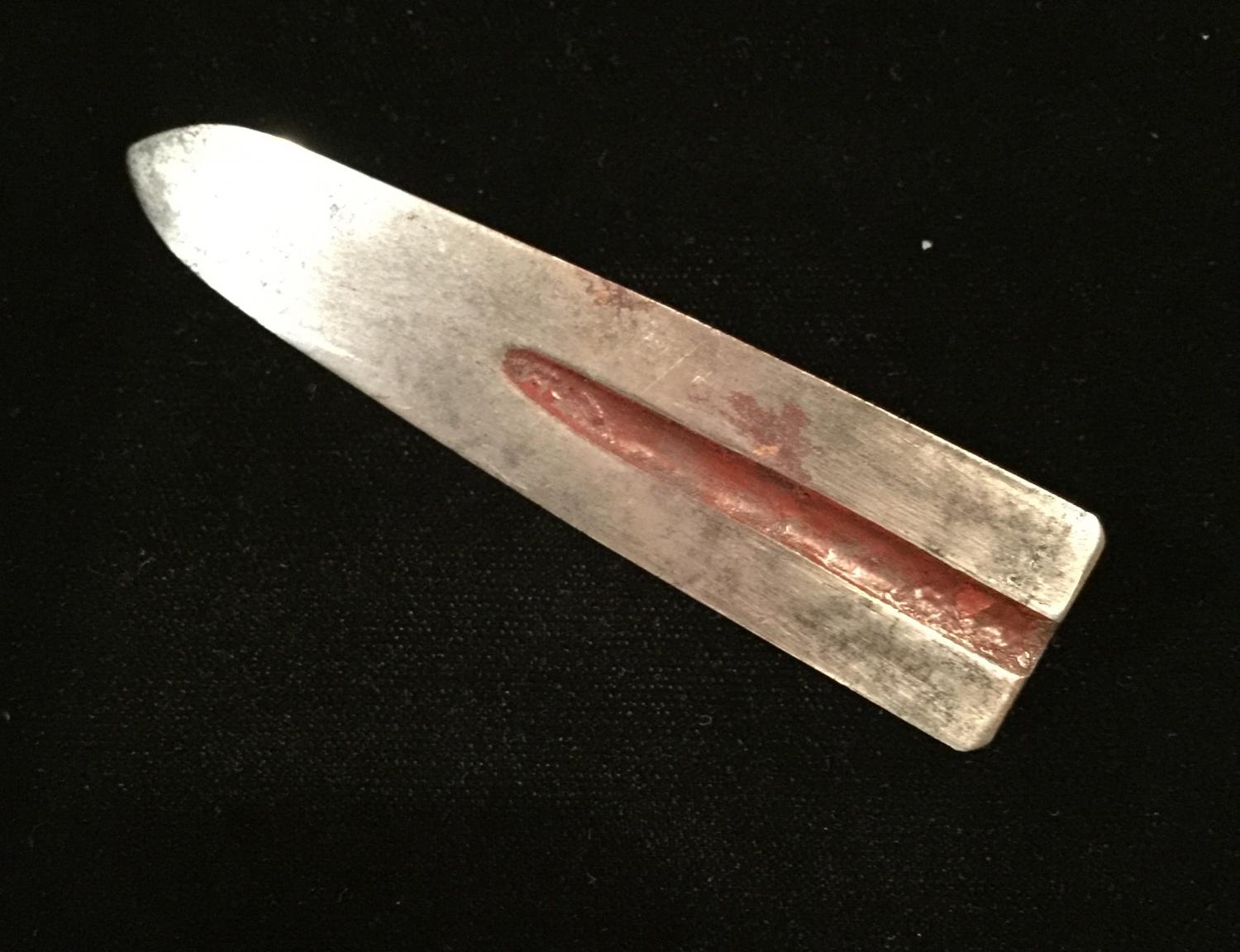
If they are not considered historically or artistically worth preserving, the police will chop them up. Guns too. As far as I know, people are welcome to the pieces. I have half of the blade of a spear, for example. You may often find that a signed Nakago with a short section of blade has been used in Japan for flower arrangement, for example.
-
Grey, Can't read the name of the person who signed the description on the right, (Kawaguchi something) but generally what it says roughly is: Tetsu Ji Maru gata Kaku(?) mimi, Unryu Nikubori, Kin Nunome Zogan, Mei Jakushi & date
-
Just guessing the middle lid, = Nagasaki Jakushi, Tetsu Un-ryu Tsuba.
-
It depends on what you know already. You asked for help, but how much do you want? In your first post you said: "Both of these kozuka are thick solid material, not plated. that's about all I can tell you about them." Then you mentioned that you knew one was copper. So I told you the other was probably iron, but you then said: "Yeah last one is inlaid iron. Mumei." This made me feel stupid. If you already knew that it was iron, why ask, and why not give the information that you already knew? So now, if I add anything more, you might well say that you already knew that, so I am not really feeling generous any more.
-
Ken, 小 means small and can be read as Ko or Sho- . When the samurai started wearing both a large and a lesser large sword, the descriptive phrase 'Daisho' Large & Small was born. The short dagger was always a different kettle of fish and was called Tan 短 meaning really short, whichever way you cut the cake.
-
You could describe them like that, "Dou-Toushou no San-To Hitozoroi." 同刀匠の三刀一揃い = A set of three blades by the same smith. But as there is probably no subconscious understanding or set phrase for it, then explanation mode all the way. Even then it does not make clear 'one of each different size'...
-
A cool thing to have? "Call it", ...from the point of view of the wearer, or the smith? In the cartoon One Piece they talk about Santo-Ryu 三刀流...
-
Online Cursive (Sosho) Character Analyzer
Bugyotsuji replied to Randy McCall's topic in General Nihonto Related Discussion
I read about this being developed. Wonderful if we can use it. -
Online Cursive (Sosho) Character Analyzer
Bugyotsuji replied to Randy McCall's topic in General Nihonto Related Discussion
Have you tried it Randy? -
Sosho Translation Confirmation Assistance
Bugyotsuji replied to Tanto54's topic in Translation Assistance
According to this site, the kanji 恐 has at least five meanings in the original Chinese, and over the years all of these meanings were somehow kept in Japanese usage. https://www.google.co.jp/amp/s/okwave.jp/amp/qa/q902235.html My own first impression is that it may mean 念の為 "Nen no tame", or "just in case" (inferring a future negative, possibly terrible circumstance). -
Sosho Translation Confirmation Assistance
Bugyotsuji replied to Tanto54's topic in Translation Assistance
おそらく造(おそらくづくり) 短刀にみられる造り込みの一名称。横手筋が刀身の中程にあり、刀身の半分以上が切先とされた、反りの深い異様な造り込み。武田信玄が所持した島田助宗作の短刀にはじめてみられる。刀身に『おそらく』の文字が刻まれているところからの命名であるが、その言葉の意味は各説あり定かではない。 According to this despite many theories, no-one is quite sure what it means.