Spartancrest
-
Posts
3,927 -
Joined
-
Last visited
-
Days Won
107
Content Type
Profiles
Forums
Events
Store
Downloads
Gallery
Everything posted by Spartancrest
-
Welcome Jay. I think I would agree with Glen, that is a wide deep mei - I think it would fit in the "In the manner of" Naokatsu/Naoaki. The lighting is a bit harsh. I don't mind the overall design of the piece. The mei may have been added much later. Judge the tsuba foremost, then the signature. This is why. [Taken from another thread https://www.militaria.co.za/nmb/topic/38416-tsuba-casting-molds/page/2/#comments] Terry's Japanese Empire, including Korea and Formosa - 1919 [COPYRIGHT 1914] ...Terry, T. Philip (Thomas Philip), 1864-1945. "The latest art objects to attract the attention of the maker of antiquities are sword-fittings. Kozuka handles have been counterfeited for some years past, but it is only recently, we believe, that the forgery of tsuba (sword-guards) has taken place on really commercial lines. Until two or three years ago the only forgeries met with were those tsuba originally unsigned, but on which an enterprising dealer had chiseled the name of a famous chiseler or inlayer, often disregarding the fact that the work on the tsuba was quite foreign to that of the master whose name had been used."
-
Ken, practical experience always out does speculation - well done! When in doubt try it out! There was speculation in an earlier thread on this same subject, about the total failure of a sword if the tsuba was to be broken and falls off in a fight - it sounds reasonable but in fact the tsuka won't come apart from the blade if the tsuba is lost and the weapon remains totally serviceable. It is not hard to try it out just remove the tsuba and remount the tsuka, I have done it and it still works as a sword. If not, the tsuka is not fitted correctly and the mekugi has suddenly gone missing!
-
There are two extracts from old articles that may help with dates. They don't specifically indicate cast iron guards but do show that copies and 'reproductions' were well under way well before the 20th century. This also has the effect that these copies are now all 'genuine' antiques as defined by being over 100 years old [at least] Japanese ART INDUSTRIES BY ERNEST HART, D.C.L. Delivered May 20 and 27, 1895. London - I regret to say that a very large part of the ingenuity of the most accomplished Japanese art workers in metal and in lacquer is devoted to the reproduction of clever forgeries. When I was in Japan I went to the shop of a very distinguished dealer. He showed me many hundreds of objects, and out of these he guaranteed four hundred to be genuine, and gave a written certificate to this effect. After casually looking the things over, I had them sent to the hotel where I was staying for further examination. I had then a good look at them, and found the result so unsatisfactory, that I sent for two of the greatest experts in the town, with the result that we found only five of the pieces were really genuine. While in Japan we had the advantage of the services of the Governor's secretary, so I arranged that this gentleman should come and meet the dealer and hear what explanation he had to offer, which was very long. We then asked him how it was he had certified that some 400 of the objects were authentic of which only five were genuine ; we pointed out that either he had been going on selling forgeries for years, or else he did not know his business. He replied with characteristic Japanese courtesy that he was much obliged for the information we had given him, and finally made the following concise and comprehensive apology :—“Old objects very few, buyers very many, my eyesight very bad." I communicated with the Minister of the Interior and suggested that it should be made an offence to forge well-known names on curios, but it was explained to me that in Japan there was no such thing as forgery, as a man may use what name he likes. It is however an offence to copy a seal, but that is only an offence against the living and not against the dead. Terry's Japanese Empire, including Korea and Formosa - 1919 [COPYRIGHT 1914] ...Terry, T. Philip (Thomas Philip), 1864-1945. "The latest art objects to attract the attention of the maker of antiquities are sword-fittings. Kozuka handles have been counterfeited for some years past, but it is only recently, we believe, that the forgery of tsuba (sword-guards) has taken place on really commercial lines. Until two or three years ago the only forgeries met with were those tsuba originally unsigned, but on which an enterprising dealer had chiseled the name of a famous chiseler or inlayer, often disregarding the fact that the work on the tsuba was quite foreign to that of the master whose name had been used."
-
Bruno: That is very useful information, thank you very much. With that I was able to find this thread - and the images of the menuki which have many of the features found on my tsuba. once again many thanks.

-
I just received this guard from Japan and was wondering if anyone might have an idea of the School or maker - it is unsigned. I know of a very similar piece in the Cleveland Museum of Art, but that museum has very little by way of information. I am undoubtedly biased but I think mine is in much better condition. Size is 55 mm x 45 mm

-
Dan: Not all cast iron is brittle it can be annealed. https://www.technologystudent.com/equip1/heat3.htm Also as you say there was a long period where the tsuba was purely decorative and as has been discussed before, the tsuba is not solely for defense against an opponents blade but more importantly as a counterweight and to stop the user's hand sliding upwards. The theory that cast iron guards would not stand up under a blow would also apply to most kinko, leather and maki-e guards so from my view point the question is irrelevant. You might also notice in a few cases that though the guard may be obviously a casting [and in iron] that tagane-ato have been punched in after it was made and were not, as in most cases, part of the casting pattern - you can't put punch marks in 'brittle' cast iron so it seems reasonable that they were annealed and more often than we may think. Don't get me wrong there are a huge number of cast iron guards that were made as export ware and most were never fitted to a blade and are intended to deceive a novice buyer, but not all of them by a long shot.
-
I have seen this guard before - stealth bomber!

-
Could it be Okame pelting what she thinks is an oni with soybeans? Instead of chasing off evil she is trying to chase off one of the 'Lucky Gods' by mistake? I just interpret the gold dots and divots around the lower figure as thrown beans or peas. It is an interesting piece and a bit difficult to interpret.
-
There are images of Daruma wearing masks, but I think with the very high forehead it may more likely be Fukurokuju (福禄寿) Though why he might be wearing a mask or hiding his appearance is beyond me.


-
The claws look like those of a 'Spanner Crab' but the rest of the anatomy doesn't fit. The 'Samurai' or Heike crab doesn't have symmetrical claws, so it isn't that species either.
-
THAT'S NOT A BOOMERANG . . . THIS IS A BOOMERANG

-
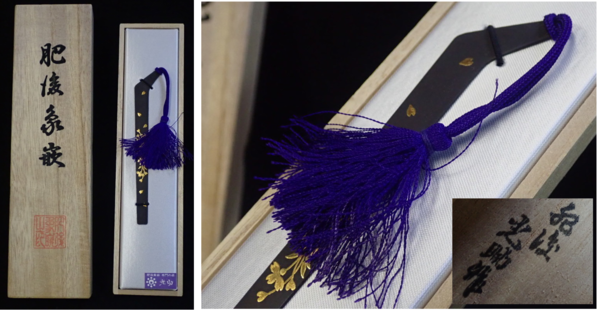
Piers: Not sure if this will help - also listed on - https://buyee.jp/item/yahoo/auction/h1033077981 肥後 象嵌 光助作 未使用品 美品 共箱入りサイズ:全長12.3cm 巾2.3cm 素人採寸に付、若干の誤差はあるかもしれません。 I thought it may be a kozuka but I couldn't work out why it had that bent angle end and tassel? The images don't help much with the other end, is it open or closed? Can you fit a blade to the 'handle' - just odd [and I do like odd!]
-
I spotted this on an auction site - https://www.jauce.com/auction/h1033077981 But what is it?
-
Peter it was nice to see the second guard example with a conventionalized lattice barrier or 'Kakine' (垣根), also used to signify sacred places.

-
Bob. [Glen might be busy?] https://www.bonhams.com/auctions/17816/lot/25/ roughly ten times the price of Yahoo! http://www.connoisseurarms.com/meito.html
-
I am already cringing.
-
Just throwing this little spin of what the vertical 'beams' or bars may also represent. Taken from https://varshavskycollection.com/kamakura-bori-tsuba/ Possible? The Udenuki-ana can also represent water droplets in a design. Once again the original artist is making us speculate and keep guessing - part of the mystique of the art form.

-
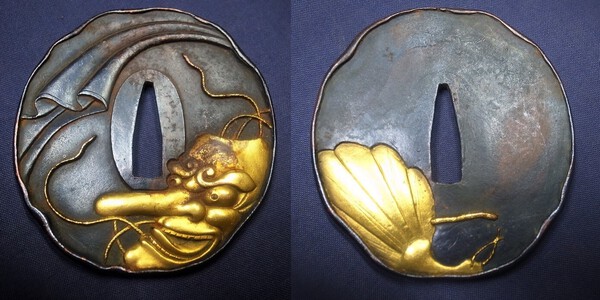
I found Glen's gold highlighted Tengu - it sold back on January the first for ¥ 22,960 or close to $200 US. https://www.jauce.com/auction/s1028555726 It pays some times not to clean out your old watch lists.
-
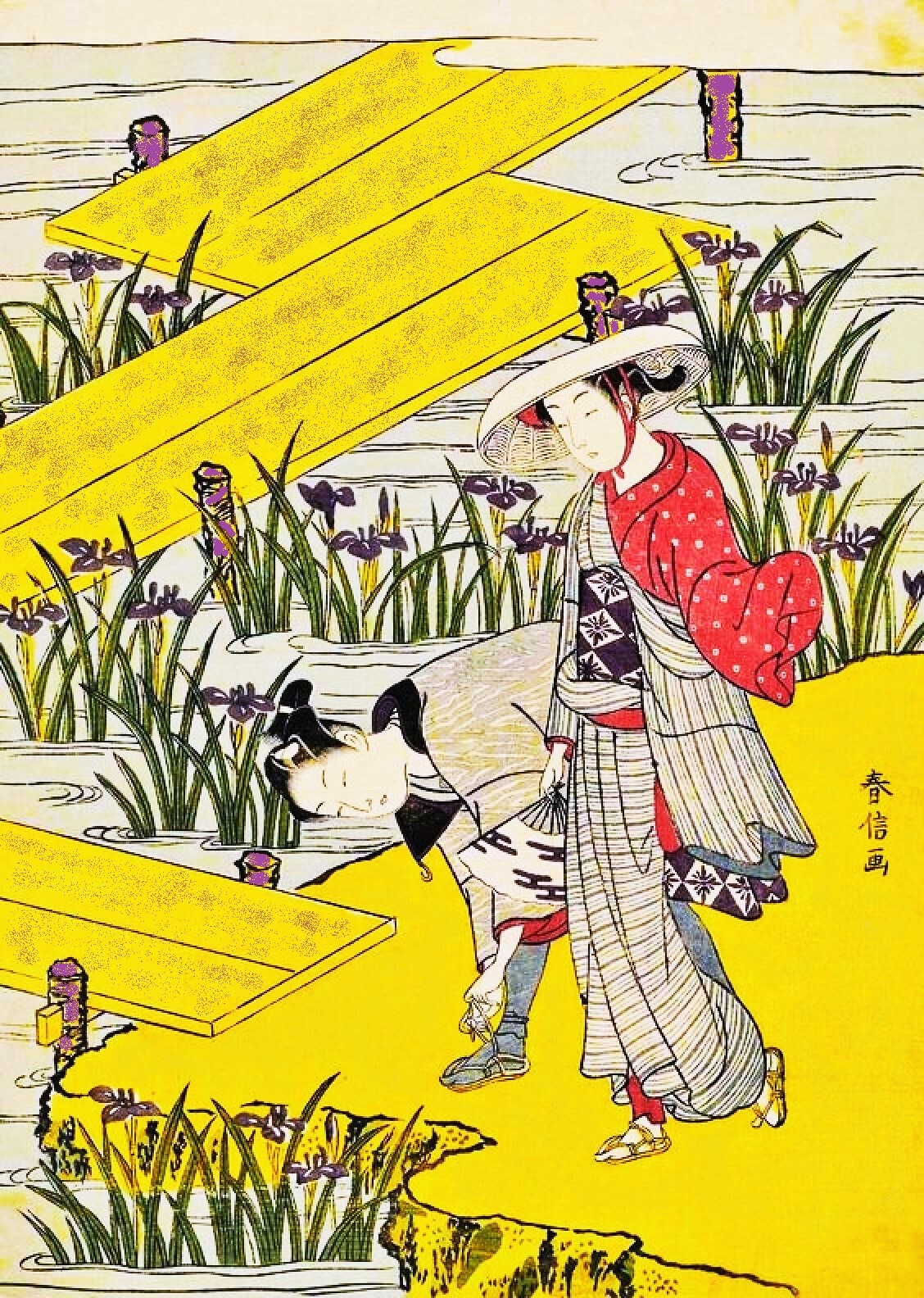
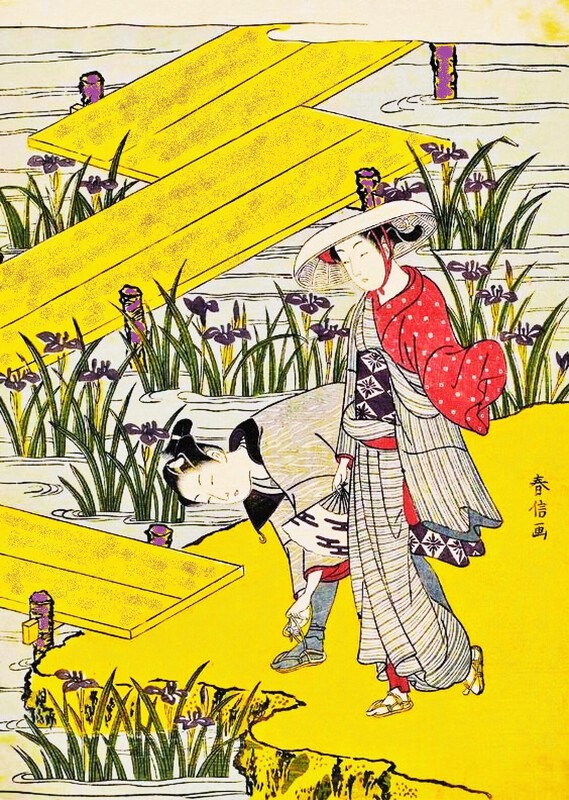
Plank bridges - in paintings usually Yatsuhashi 'eight planks'
-
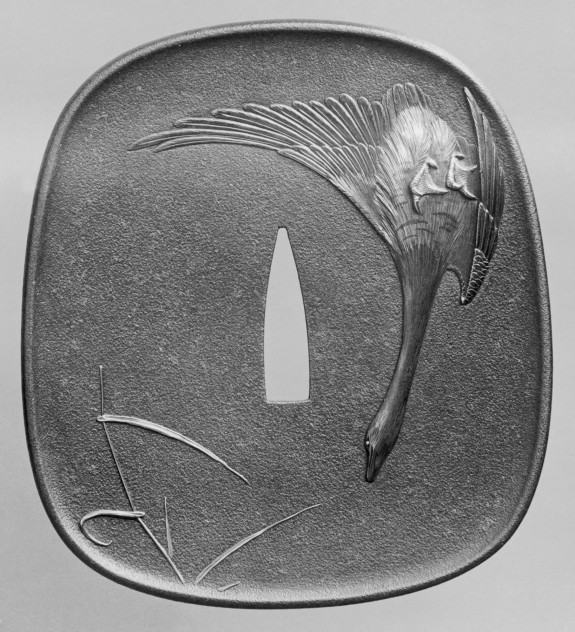
For Roger. Darn good choice to aspire to! Nice one in the Walters Museum as well.

-
Mark S. Who or how can anyone define a 'proper' collection? Two tsuba could be called a collection [albeit a small one]. Basing your collection on is probably the most honest and important way to do it. Go for it!
-
 Sorry but can someone explain why this tsuba would be awarded Juyo status when it was made in some numbers - possible Shiiremono, or may even have been made in Sri Lanka?
-
Michael, where did you find number two? Just noticed it is top row far right, the nakago-ana gives it away. Only two with dimensions which is a pity. [I can't see one being bigger in only one dimension - it may be a typo or bad measurement?]

-
I would tend to go along with Jean & Curran - try getting someone to make a quality tsuba today, the cost of labour would be prohibitive compared to what you would pay for an antique piece. It would seem that the sheer number of tsuba available does factor into it, there are stories that at the turn of the twentieth century tsuba were sold by the barrel load or for pennies apiece. As collections took off and collectors increased in number, demand started to dictate prices a lot more. But I can also see that many pieces particularly in auctions can sell very cheaply one day and almost identical ones can fetch thousands the next. I have yet to see any real consistency with prices or find the rationale of what makes one more expensive than another based on a like for like comparison.
-
Hi Pippo, I think the guard was originally made for a practice sword - sometimes called 'dancing sword' Mozoto 模造刀 The background surface is in a very poor imitation of nanako-ji. The 'sekigane' [if you can call it that] is poorly done and lopsided in the nakago-ana. The rendering of the birds is pretty poor - overall not something collectable unless you are into 'retro reproductions'. I think a lot of swords were stripped of their correct fittings and replaced with sometimes more decorative replacements to catch the eye and sell to the novice. I hope the blade is better, tsuba and fittings were designed to be replaced so it is not a big deal to refit with something better. Good Luck.