Bruce Pennington
-
Posts
14,281 -
Joined
-
Last visited
-
Days Won
170
Content Type
Profiles
Forums
Events
Store
Downloads
Gallery
Everything posted by Bruce Pennington
-
Yes! That's exactly what I did with my collection. The stainless (anti-rust) blades were made all through the war, beginning in the mid/late '30s, so can't tell by that. Looking at the tsuka, it's got lacquered leather or skin of some type. I THINK that was later in the war, but still not definitive. That's the best I can give you on that. It's possible one of the other guys knows more about them.
-
Frank, For my current survey, could you post photos showing the overall fittings, the release button(s), and the mekugi pegs or screws? Thanks!
-

Prototypes or just Variation of Type 3 Rinji?
Bruce Pennington replied to waljamada's topic in Military Swords of Japan
Here's another from the 3rd page of that Rinji Timeline thread: -
Prototypes or just Variation of Type 3 Rinji?
Bruce Pennington replied to waljamada's topic in Military Swords of Japan
山(yama) Matsuyama Branch office of Kokura Arsenal -
Prototypes or just Variation of Type 3 Rinji?
Bruce Pennington replied to waljamada's topic in Military Swords of Japan
Adam, that is a beautiful Hiromasa! Looks like I should have read that old Rinji thread before posting on it. It's got some outdated info that I'll have to update. The Contingency model was designed in 1938 and production and sales began 22 August 1940. Unveiling the Rinji-seishiki Sword in 1940 - Nick Komiya It's taking me a while to find his post revealing the Uniform regulation change that allowed, even required, simplified fittings designs due to war shortages and Allied bombing damage to the industry. I'll post when I find it (or maybe @Kiipu has the reference??) My gut feel is this style was due to that relaxation of the mil specs and request to simplify weapons production. Update: Found it! From Rinji-seishiki to Daiyou-seishiki of Weapon Specs - Nick Komiya It was 1943: "The Daisei-Heiki Era Then by 1943, this kind of choice would no longer be available, as the standard quality stocks ran out. By this time, even primary weapons like rifles were routinely produced in nonstandard specs. Such symptoms were no longer of a "Rinji" nature but a chronic one, expected to get even worse in the future. So they officially coined a new phrase to describe these items of “compromised specs” and called them “Daiyo-Seishiki-Heiki” 代用制式兵器, (Substitute-Spec Weapons), which they abbreviated into the term, “Daisei-Heiki” 代制兵器." "These downgraded spec standards were applied to items that had little impact on military performance, like weapon accessories such as muzzle lids, rifle oilers made of resin instead of brass, belts, holsters and ammo pouches made of rubberized canvass instead of leather, woolen uniform items replaced by cotton, felt or even silk mixed in wool." -
I was reading a page on Doug Austin's, @Austo1, site Gunto Art Swords. He was discussing a custom Type 3/RS with a blade that had no star stamp. It had the double release buttons and 2 steel mekugi screws. His observation was that the blade was likely gendaito as Type 3's with steel screws will contain gendaito blades. I have seen that to be true for fittings with the double chuso buttons, but never noticed the point about the steel screws. I've done a brief survey and found the point to be true. I have loads of RJT, star-stamped blades for the survey, but could use some more standard Type 3s with showato for the data. So, if you have a standard Type 3 with a showato blade, please post for the survey. So far, I have 30 gendaito in the chart and all have steel screws, except 5 with only bamboo pegs. I have 13 standard with showato and all have bamboo pegs, except 3 with screws. In both cases, there is no way to know if the exceptions were original or post-war replacements, as many of our gunto show up missing mekugi altogether. But the overall picture is backing up the idea. Steel or Bamboo Mekugi – Rinji Seishiki Model GENDAITO Source Steel or Bamboo 1 or 2 Chuso Saya Type Standard or Custom Stamps date mei Steel, 1/? 2 Custom Star Dec 1941 Akihisa Windy, NMB Steel, 2 2 Custom Star May 1943 Chikafusa Vajo, NMB Steel, 2 2 Custom None Aug 1943 Kunitada Gunto Art Swords Steel, 1 2 Standard Star Feb 1945 Kunitoshi BWP Bamboo 1/? 2 Custom Star Jan 1943 Kaneyoshi NW, NMB Steel, 1/? 2 Custom Matsu on old blade No Date Kaneyoshi 兼賀 Apollox, NMB Steel & Bamboo 2 Standard Star Mar 1944 Kazunori Showa22, ebay Bamboo 1/? 2 Custom Star Mar 1943 Kiyokatsu Daniel, NMB Steel, 1/? 2 Custom Star Oct 1944 Masaharu ? Bamboo, 1/? 2 Custom Star Jun 1944 Masakuni Volker72, NMB Steel, 1/? 2 Custom Star Aug 1944 Masamichi Poulin Auction Steel, 2 2 Custom Star Sep 1943 Masanaga Bangbangsan Steel & Bamboo 2 Custom Star Mar 1944 Masanaga Bangbangsan Bamboo, 2 2 RS/T98 mix Star 1943 Mitsuhiro Panzerfaust44, Gunboards ?/Bamboo 2 Custom Star May 1943 Nagatoshi Warpathmilitaria Steel, 1/? 2 Custom Star Jul 1943 Munetoshi Pippo, NMB Steel, 1/? ? Custom Star Dec 1944 Nobutake Bangbangsan Steel, 1/? 2 Custom Star Jun 1943 Nobutake Ammad, NMB Steel, 1/? ? Custom Star Jun 1943 Sadakatsu Warpath collectables Steel, 1/? 1 Custom Star Feb 1944 Sadaroku Showa22, ebay Steel, 1/? ? Custom Star Oct 1944 Sadashige Japanesesword.com Steel, 1/? ? ? Star Aug 1943 Shigefusa Cox/ima-usa Steel, 2 2 Custom Star Spring 1943 Sukenobu Hi-revr, NMB Steel, 2 2 Custom Star Feb 1944 Sukenobu Cox/Worthpoint Steel, 1 ? Standard Star Sep 1944 Sukenobu Cox/Worthpoint Steel, 1 2 Custom Star Jul 1944 Tomonari IJASWORDS, NMB Steel, 1 2 Custom Star Mar 1943 Tsuguhiro Adrian S, NMB Steel, 2 2 Custom Star Feb 1943 Tsugunobu Bangbangsan Steel, 2 2 Custom Star 1943 Zuiho Butch, NMB Bamboo 1 Custom Star Aug 1943 Zuiho ebay SHOWATO Steel, 1/? 1 Standard Unknown Numblock, NMB Steel, 1/? 1 Standard Gifu/Seki Feb 1945 Kanemune Lennon, NMB Bamboo, 2 1 Standard Gifu Nov 1944 Kanemune Erwin, NMB Bamboo, 1/? 1 Standard Na Jan 1944 Kanenori Dabedo, NMB Steel, 1/? 1 Standard Gifu 1945 Katsumasa Den70, NMB Bamboo, 1/? 1 Standard Gifu May 1944 Masanori Swordamateurnagoya Bamboo, 2 1 Standard Gifu/Seki/Na Mar 1944 Yoshichika RussellM, NMB Bamboo, 1/? 1 Standard Mar 1945 Yoshichika Sechan, NMB Bamboo, 1/? 1 Standard Mumei, No Date DTM72, NMB Bamboo 1 Standard Unknown Bruno, NMB Bamboo 1 Standard Unknown Bruno, NMB Bamboo, 2 1 Standard Unknown Montrealfan1986 Bamboo 1 Standard ? Apr 1945 Sukekuni BWP
-
Another sign is that the blade is in upgraded fittings with 2 screws (instead of bamboo pegs) and 2 latch release buttons.
-
WW2 Japanese Navy Sword (Takayama )
Bruce Pennington replied to Swords's topic in Swords and Edged Weapons
Sorry Steve, it's been too long and I don't remember who it was that was searching for one. Good luck with the sale, my friend. -
OLD POST RESURRECTED!!! Just noting for the record, in case anyone else comes across this thread - The logo is of the North China Railway, not SMR Mantetsu. Cool tanto!
-
Fuller & Gregory Set of 5 Books
Bruce Pennington replied to Bruce Pennington's topic in Auctions and Online Sales or Sellers
Oops! I just saw $150 and didn't notice it was an auction. It's up to $250 now. -
Thought someone might benefit from this: Ebay sale of F&G book set of 5
-
Thanks John! Corrected.
-
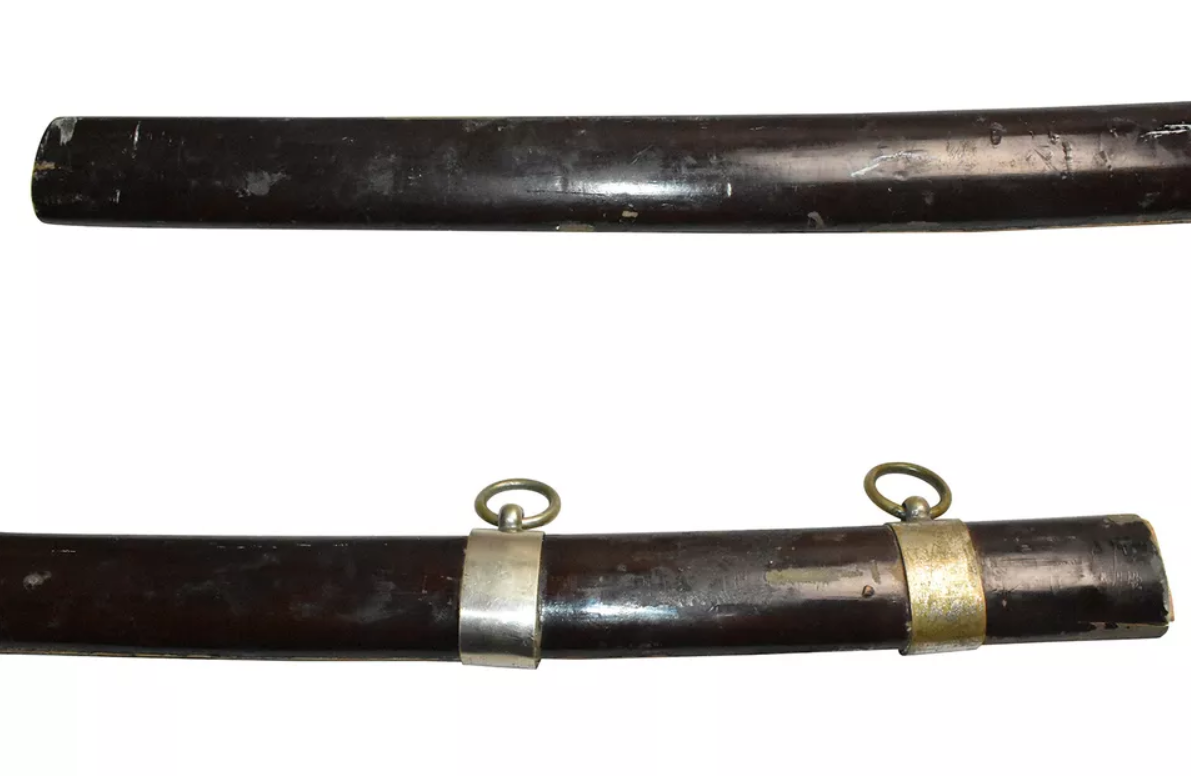
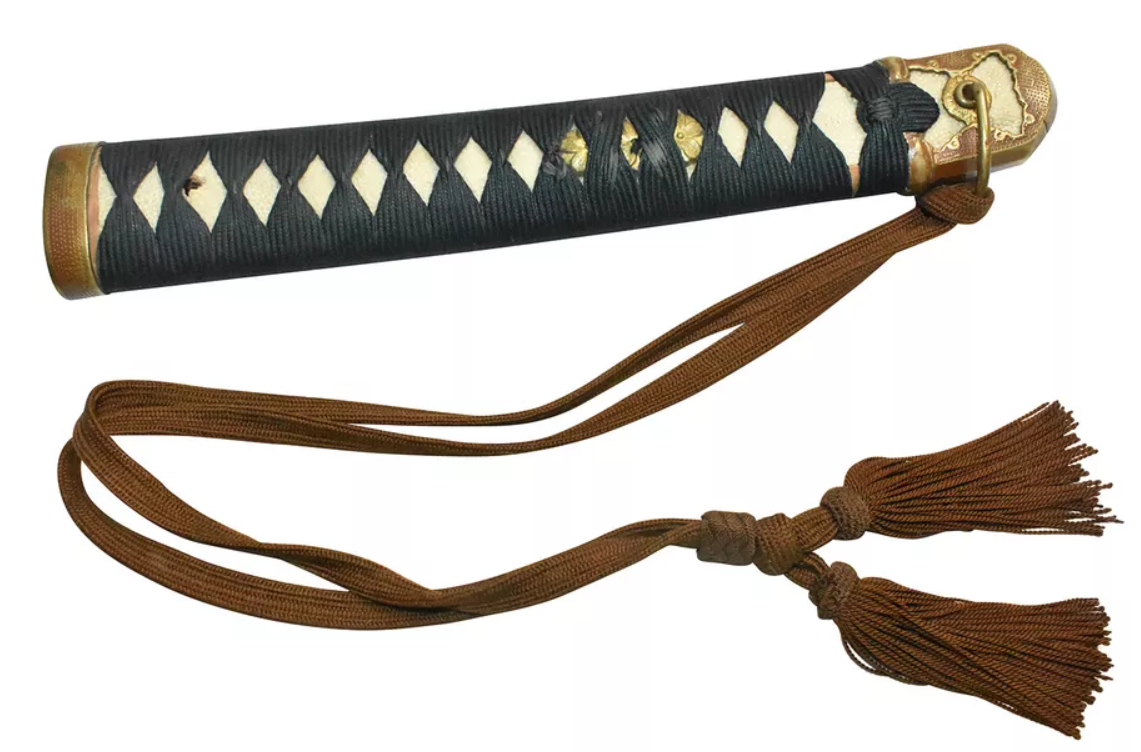
I found this Kanezane Gunzoku sword for sale on this Showa22 ebay page. Sohei swords ebay sale. It's got it all! Large Seki stamp, Kanezane kokuin, Yasugi steel mei, sakura Gunzoku tsuba and brown tassel, and to top it off, a double haikan wooden saya which is the reason for putting it here: It's an army sword with army tsuka: But that saya looks like something we would see on a navy combat saya rig. My first thought was, maybe this was set up during the Type 94 years, but the large Seki stamp should make this no earlier than 1940, so Type 98 era. Maybe the saya was navy, and put there by someone post war.


-
WW2 Japanese Navy Sword (Takayama )
Bruce Pennington replied to Swords's topic in Swords and Edged Weapons
On another note, it's a great looking kaigunto, Steve. I know there are a couple guys out there looking for a nice Takayama-to. -
Passed on this one
Bruce Pennington replied to Brian's topic in Auctions and Online Sales or Sellers
Bohi is a tad too wide for a Nagoya 95. I bet it's half of a cut blade, post war. -
Anything is possible with this one. I personally think it's handmade, and something put there for whatever value or good luck the kikusi brings to the blade/soldier. You can see two horizontal lines under Fuji, like you might see under a kiku, and I have other examples with less than the normal number of petals:


-
I believe @Ray Singer does some selling on consignment.
-
Wow, John, quite unique! I'm posting it with the other kiku in the Stamps doc, though it's fairly likely not tied to shogunate work. Makes me wonder after looking at them all if the kiku with stems and leaves were shogunate work or not as well. That would mean going back to look a the smiths involved and possible dates. Maybe someday.
-
It kills me that they mostly didn't date the early war blades! The showa stamp was used not by an arsenal, but by the civil organization called The Seki Cutlery Manufacturers Association, tasked to inspect showato for quality by the Seki area sword industry. They used the stamp from 1935 to 1942. While most of the dated blades are found to have been made in 1940-'41, your Type 94 fittings likely put the blade more in the 1935-1938 range.
-
Kaigunto with white Rayskin???
Bruce Pennington replied to Bruce Pennington's topic in Military Swords of Japan
Wow, John! A live one! My first impression based off these shots, was late-war; but after seeing the whole thing, it's got both haikan and upgraded eel-skin saya. It's just had a rough life. Thanks for posting that! -
Translation of possible Gunto sword
Bruce Pennington replied to RyanHust's topic in Translation Assistance
Hi Ryan, Like the Treasury Dept detectives that study the real money so that when the fake shows up, they recognize it right away, your best defense is to spend time looking at the real thing. You can start, for free, on Ohmura's excellent site: http://ohmura-study.net/900.html. 65+ pages of pristine Japanese swords. You'll find as you go through, he posts several nakago with mei, that you can compare to the sword in this thread. You can also peruse the various threads here at NMB for examples of nakago and real hamon (temper patterns). The final item I would add to Ray's list is the ito (handle wrap). Japanese always alternate the fold direction of the wrap. Chinese fold it in the same direction across the handle. -
Kai Gunto identification help needed
Bruce Pennington replied to bigred96's topic in Military Swords of Japan
It is quite common to see unstamped blades in kaigunto. Just means the blade was sold to a private sword shop. The photos aren't good enough quality to make a judgement call on whether it was gendaito or showato. Odds are it's a wartime showato, but better photos will tell. -
A nice varitation of the clasped hands sarute, found on this Gunboards Thread.
-
Pinned Kabutogane on Type 94
Bruce Pennington replied to PNSSHOGUN's topic in Military Swords of Japan
John, Found this one on this Gunboards Thread. It's got a mumei older blade, Clased hands sarute, too. -
Kai Gunto identification help needed
Bruce Pennington replied to bigred96's topic in Military Swords of Japan
We'll need a Jedi Master like @Ray Singer or @SteveM for the smith. Could it be: 良重 (Yoshishige)? But the second kanji looks more like a 貞 sada. Sesko lists some 良貞, but doesn't show any Showa era ones. I'm probably way off, though.