Bruce Pennington
-
Posts
14,966 -
Joined
-
Last visited
-
Days Won
180
Content Type
Profiles
Forums
Events
Store
Downloads
Gallery
Everything posted by Bruce Pennington
-
Thanks Sam, good one!
-

Need help found in my grandparents basement.
Bruce Pennington replied to tumbleweed5780's topic in Military Swords of Japan
Hi Charles, The fittings are the Japanese Army officer gunto Type 94 or 98. If you show a shot of the top half of the rig, showing the side with the latch, we might be able to give you an idea of which version it is. Otherwise, you can learn about this sword style on Ohmura's site: Commissioned Officers Gunto - Type 98. -
Adachi identified the officers as: "Here's a bit better version of the photo. The officer on the right is 1st Combined SNLF Commander Rear Admiral Oshima Shiro (大島四郎). Beside him is his staff, Lt. Hirata Haruo (平田春生). The other staff officer should be Cdr. Nagaya Shigeru (長屋茂). I don't know the other two, the three main possibilities would be the Engineer Cdr. Nakajima Ichiro (中島一郎), Medical Cdr. Sakurai Tokuichi (桜井得一), and Supply Cdr. Owada Tsutomu (大和田勉). Personally I think the officer with the glasses is Sakurai." So an SNLF officer wearing an army Type 95 copper.
-
WW2 Japanese sword Marking - Zoheito Discussion
Bruce Pennington replied to Swords's topic in Military Swords of Japan
We don't have a dedicated thread for Zoheito specific discussions, so I thought I'd use this one. After discussing a zoheito blade with Sam, @Scogg, I re-read Ohmura's page on them and found the first item interesting: "1. Common name "Zōhei-tō." The Type 91 noncommissioned officer blade sold to the officer will be said around 1931-2.he next Type 95 blade is also included. The common name of the meaning "the blade made from the arsenal."Army sword steel (C1.0%-1.1%) is used. One-sheet forging. It is forge molding by the rolling roll, a machine hammer, etc. The size and weight of this blade are slightly lightweight and a thin figure compared with "formality Zohei-to." The tempering in oil of this blade was carried out, and it carried out machine finish by dry polish. There is no tempered line (account of Major Bitō recollection). 2. Zōhei-tō (Peculiar formality name) The manufacture command of the new military swords as of September 16, 1938 is the starting point like the bovementioned army formality present age forging sword. The trial production blade was completed by the end of 1940 by the Kokura Army Arsenal. It is imagined as "the ancient rite half forging sword of a Tamahagane" developed behind in Seki, and the approximated blade.However, Major Bitō's (Nagoya Army Arsenal Seki Part Factory manager) account of recollection is as follows. "The shape and the size applied to the forging sword correspondingly in general. A blade uses army sword steel (C1.0%-1.1%)" My question is - What is a "Type 91 noncommissioned officer blade" that is sold to officers? Any ideas? -
This is a cool one posted by @adachi on this Warrelics discussion, You'll notice the ends of the saya are of Type 95 copper handled gunto: "You can look up "Tsingtao City Hall" to see their HQ. I was very lucky to come across a few photos of some of their officers in the field that belonged to one of the probably less than 100 total sailors that served in the HQ. The photos are around 1939 though so I have no idea if Takabata was still with the unit the or not. There is nothing the IJN loved more than rotating officers." Akira Komiya agrees about the saya, but says the officer withe the Sam Brown belt would be an officer or Warrant officer.

-
I don't know about other forums, but Warrelics has the same policy, especially with photos. They recently changed the site software so that authors have only a few minutes to delete photos, and then they become permanent.
-
Thanks Sam! This is a good discussion. I think we can clean up some terminology though. There were sword designs that were specifically made for cavalry. It is fair to call them cavalry swords. The type 95 was designed for senior noncommissioned officers and other enlisted ranks in some specific high-level jobs. But we do not call swords by the job the enlisted man was holding. Or else we would have maintenance swords and transportation swords, etc.
-
Do us a favor and show us a picture of the overall fittings. But what you have is a late war Type 95 NCO sword. Sam - @Scogg - will be along soon to fully fill you in. In the meantime, some good sites to review: NCO Type 95 Gunto - Ohmura and Japanese Sword Care
-
This is an unusual blade for a dress sword. I've only had 4 in-hand over the years (kept one) and was surprised at the variations, in size and in the finer details. Apparently, there were lots of shops making these and consequently lots of variation.
-
Sesko doesn't list a Kanetada using that kanji for 'tada, plus the JSI 'Showa Seki Tosho' page does list the Yoshida name for Kanetada. Plus it matches another blade I have filed under Kanetada with the same kokuin. Got my vote.
-
Thanks David! I've updated the Stamps doc. Definitely looks better. JSI was set up by Richard Stein who passed away a couple years ago. It's kept alive by Brian, but he's not able to make changes to the site. I've found a couple of errors, too. But, such it is with all our top level references, right?
-
Yes, just found it myself. This is a much better example than the only other one I've got. I'll use it to update the Stamps doc, if you don't mind. I looked through both the Kaneaki and Kanekado I have on file, and like Steve said, they are all a bit messy. But the kanji in this one is the same family name as the Kanekado listed on JSI: 兼門 (Kanekado) 吉田 徳市
-
Slow loading today anyone?
Bruce Pennington replied to Matsunoki's topic in Forum Technical Details and Maintenance
8/18/2026 - 6:30pm Pacific Time - 2 to 3 full minutes between pages loads. -
Chris Bowen doesn't post on NMB anymore. He's active on this Military Swords of Japan - Facebook group. Volker is around, unless he's busy with life elsewhere.
-
So far, I have papered blades on: Ichinori, no date, Showa stamp removed Kanemichi, no date, Showa stamp removed Yoshinao, no date, Showa stamp 2 Mantetsu blades And not papered but a Registerd Type 95
-
I only have one Teruhide blade on file that might have a star covered with corrosion. Posted on this Wehrmacht-awards Thread, but the blade is heavily tarnished completely obscuring the hamon. And in the end, it might just be corrosion, not a star. The only documentation I reference is the RJT list on this Japaneseswordindex.com page. Of course there is this from Sesko's list: "TERUHIDE (輝秀), Shōwa (昭和, 1926-1989), Saitama – “Teruhide” (輝秀), real name Ihara Kametarō (井原亀太郎), born 1902, he worked as rikugun-jumei-tōshō, jōko no jōi (Akihide), First Seat at the 6th Shinsaku Nihontō Denrankai (新作日本刀展覧会, 1941)"
-
A Showa stamped Yoshinao, no date, for sale at Samuraimuseum.jp with NTHK paper. The site calls the blade gendaito.


-
Amachi Kanenaga Gendaito Katana
Bruce Pennington replied to pcfarrar's topic in Swords and Edged Weapons
Beautiful sword, Peter. A steal at that price. Good luck with the sale. -
Kanji used in Names problem
Bruce Pennington replied to Bruce Pennington's topic in Forum Technical Details and Maintenance
Soooo,... after switching back to the default (white bacdground) theme, I checked the "Translating Mei" pop-up and all of the topics, when opened, use blade font. Now, I'm puzzled why I couldn't see three of them in the darkened theme, but could see the other four? Edit: I am using Camelieon Dark, when I see this issue. I tried Bravo 6 and all of them were visable, though moderately subdued. In Cameleon Dark, the ones that show up change the print to white! -
Nlf Gunto Discussion
Bruce Pennington replied to Bruce Pennington's topic in Military Swords of Japan
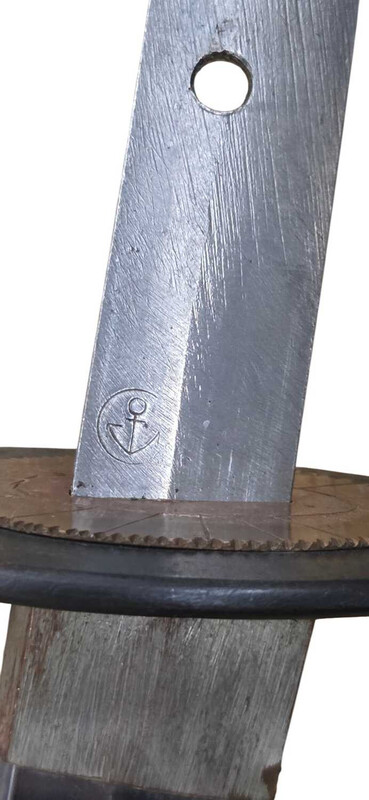
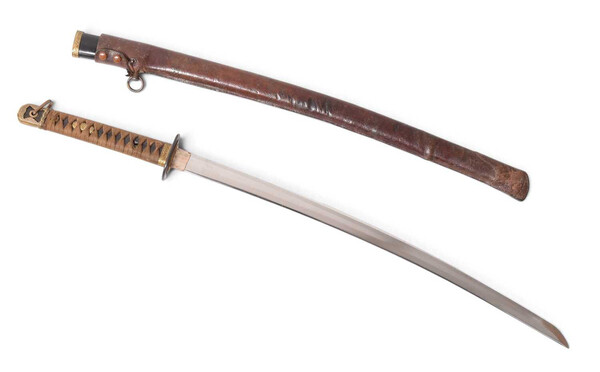
Interesting one shared by Rob @NotANinja HERE. The auction house didn't post a photo of the other side, so it might not have the black painted number. But it's one of a few on file with a stamped number. And some of them use this odd font with large-small-large numbers. So, that, plus sarute, plus leather saya cover. Oh, and the anchor is upside down!: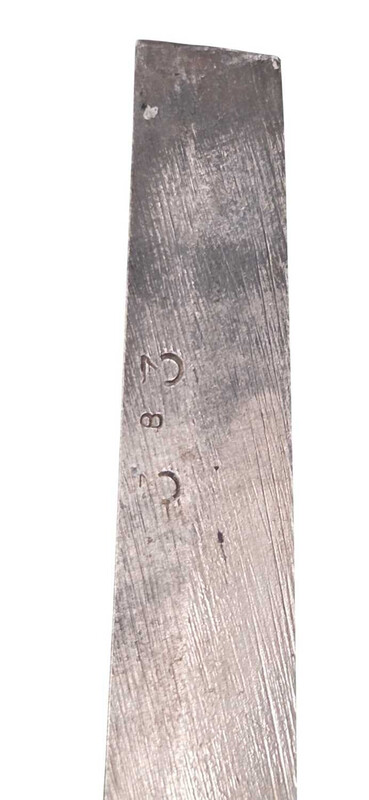

-
Heck yeah, thanks Rob! I wrote to the auction house to see if they would post a photo of the other side. This one is cool as the anchor is stamped upside down. It's also got a surate and a leather saya cover.
-
Kanji used in Names problem
Bruce Pennington replied to Bruce Pennington's topic in Forum Technical Details and Maintenance
I see my problem! I just switched over to a dark screen format, and the type on those pages are in black, while the others are white! -
Here's an example, posted by @JakeNYC. Of course yours won't look like this, but he has a black background, small bright light at an agle, and close enough to show steel texture and hamon:
-
Hi Brian The Kanji used in Names as well as a couple of the others - when I click them, the pop-up window comes up with the title, but there is nothing there. Thanks brother. The other 2 are Provinces used in mei; and Common Kanji...
-
Thanks Mal, I see I mixed the Kosuga shrine up with the forge in Fukuoka. I'll correct my chart.