Bruce Pennington
-
Posts
14,208 -
Joined
-
Last visited
-
Days Won
169
Content Type
Profiles
Forums
Events
Store
Downloads
Gallery
Everything posted by Bruce Pennington
-
Dang, I could go either way. Looking at the haikan, the back edges seem to well defined to be covered with cloth: But then, if painted, why isn't the belt ring painted too? I could go either way on this one.

-

Type 98 sword with unusual mark on tang
Bruce Pennington replied to Butch's topic in Military Swords of Japan
Nice gunto, Gareth! It appears from your photos that the oil is cosmoline. G.I.s coated swords (and I think other weapons) with it when returning home. It can be safely removed and many discussions have taken place about how to do that. You can search 'remove cosmoline' and get 32 pages. Here's one where Zook describes his favorite method: Cosmoline for Showato Blade The writing is in the location where polisher stripes are normally seen. Hopefully someone will translate for you soon! Very curious, indeed. -
Trying to identify maker Shin Gunto
Bruce Pennington replied to deadoscillate's topic in Military Swords of Japan
Chris, I'm the worst guy to ask about shinsa, as it's not something I'm knowledgeable about. To me, it seems to be one of those things, like polishing, that it's value lies in the personal tastes of the collector. -
I just noticed the writing on the leather saya cover! I can say I've never seen that on a fake before!
-
In my early years, I would immediately called the Type 98 a fake, with the poor quality kabutogane, and ito wrapped all in one direction, and poor quality nakago. I've seen enough variation since then, and lengthy debates over island-made gunto, that I'm going to firmly say - I don't know! Could certainly use more clear closeups of tsuba, fuchi, and kabutogane for a better opinion. You haven't shown enough of the Rinji details to begin a guess.
-
Rusty blade...need help
Bruce Pennington replied to Browningguy's topic in General Nihonto Related Discussion
I agree with both Dave and Chris. You are in Wyoming, so likely fairly dry climate which is good to prevent future rust. If you got the sword from somewhere else, recently, simply leave the blade out of the saya (scabbard) for a few days to let the saya air out and dry, if still wet. Sometimes you can remove the saya throat piece and the wooden liners will slide out, for better drying, but they don't always come out. Plus, if yours has pieces falling out, the liners may not be in one piece anymore. I would also appreciate seeing the nakago (tang). It's easy to remove the handle. Sometimes the rust can make it feel stuck, even with the bamboo peg removed, but you can always wiggle the tsuka (handguard), or tap it with a rubber mallet, if stuck, and everything will slide off. -
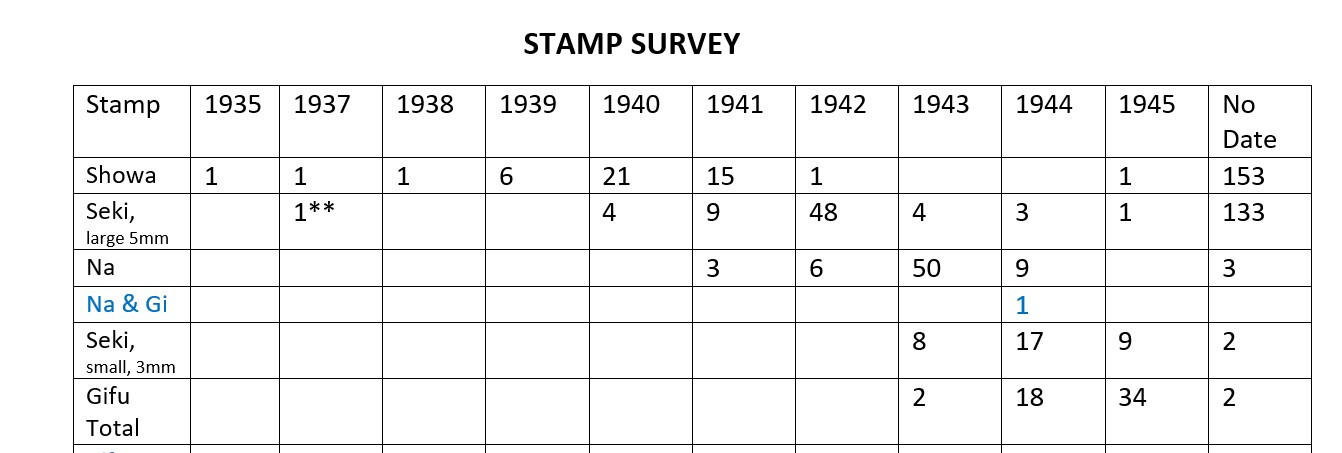
Chris, Just got back from a trip and had a chance to file this in the Stamp Survey. It is only the 4th large Seki stamped blade I have in 1943, compared to 48 blades with it in 1942. The use of the large Seki stamp was rapidly tapering off starting '43. So, in my world, you've got a fairly rare blade there! It is also my first Seki-stamped Kanetatsu. I have one Showa (no date) stamped by him from Slough's book. So in that regard, it is rare also.
-
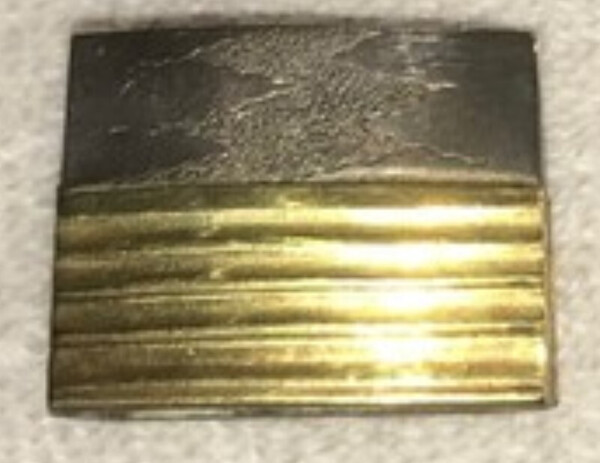
I went back through this whole thread to see if I'd posted one like this, and in the process, have been re-amazed at the beauty, hard work, and skill that goes into so many of these habaki. WOW! But, on to the latest. Found HERE, posted by @kealpe. I've seen that semi-wavy pattern once or twice, but cannot figure out what it represents. A river maybe?
-
What is the difference?
Bruce Pennington replied to Michaelr's topic in General Nihonto Related Discussion
@BANGBANGSAN and @Kiipu have been tracking these, so they would have a more accurate picture, but I would say they are much less common that standard blades. -
What is the difference?
Bruce Pennington replied to Michaelr's topic in General Nihonto Related Discussion
@Brian - might move this over to Military forum. -
Here’s one with a Mantetsu in it:
-
Chris, Any chance of getting a link to the original post? There is a mark near the top of the nakago that I'd like to get a better view of.
-
Mine is the 2002 edition. Didn't know he did a new one (2013). Rats, I just bought mine a couple years ago, too. No wonder it was pretty cheap.
-
Trying to identify maker Shin Gunto
Bruce Pennington replied to deadoscillate's topic in Military Swords of Japan
No, I would, for now, assume it came from the earlier Shigemitsu, made for civil fittings, then re-drilled for the military fittings. But still looking for more photos. -
This has been a great read!!! Francesco - I think the original complaint from your discussion with another guy has been covered pretty well. But it is a complaint of artificial construction. Sure, if someone had just said to him "there are no better swords than a Japanese nihonto" he might have some grounds to argue. I wasn't there, so I don't know what or who he was arguing with. But like mentioned above (I think), I don't think anyone who values Japanese swords would make such a claim. We simply value them for what they are. They were a tremendous improvement over the Chinese swords of the 8th and 9th centuries. They got so good, that when Japan tried to switch to Western styled swords and Western sword manufacturing, and realized how poorly these 'new' tech swords performed in battle (cold Chinese weather), soldiers BEGGED for the old samurai type swords. Ohmura made a concerted effort to argue that SMR Mantetsu blades were just the latest evolution of the ancient art (which I agree with), but in the testing results you can see that they were just equal, not better than, the good ancient blades. But even this says the ancient nihonto were equal to the best 'modern' (1930s-1940s) technology could produce. Long story to say - nihonto didn't come into existence to be better than swords made on the other side of the earth. But, by and large, they are pretty darn great!
-
Eric - love the research! We all profit from efforts like this, and as you are learning, the deep-diving makes you much more knowledgeable, personally, and greatly valuable to the community. Concerning the mon, I have not researched this one, but from my other digs, I can say that these items are hand carved. Even Kao have variation, as do kikusui. In your case, I would look at all the examples and gather the ones that fit the predominant characteristics of one or two that are confirmed examples. Anything that is too divergent (and I see a couple in your examples) are likely imitations. Can't speak to mei, but they can vary in a known smith's work, but you must narrow the focus to a particular man. They mei well vary and change from generation to generation.
-
Trying to identify maker Shin Gunto
Bruce Pennington replied to deadoscillate's topic in Military Swords of Japan
I'll probably be corrected on this - @PNSSHOGUN - Type 98 tsuka ... should I say 'never'??? - don't have 2 mekugi. So, I'd be tempted to say this is an older blade that already had the double ana at near the end of the nakago (not counting the third ana, near the lower one, as this was probably due to a re-fit earlier in it's life), and the second, higher, mekugi was installed simply because the second ana was already there, so ... what the heck, might as well use it! -
Trystan, When I send this to google translate, it says "Metropolitan Police Department" if it's Chinese. When I click on Japanese, it says "Superintendent". Thoughts?
-
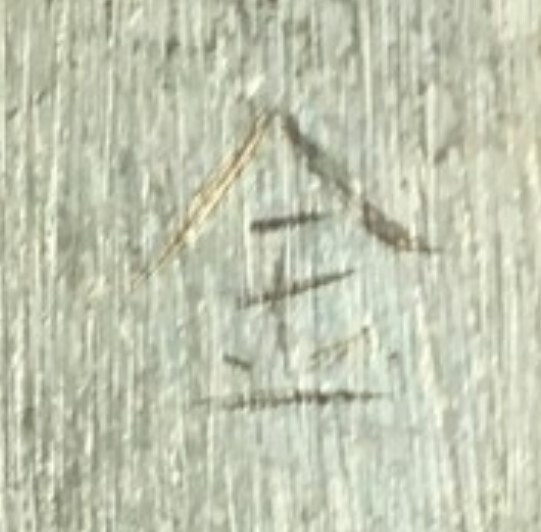
The mark is too undefined to say for sure. I do have one other mark on a habaki, an anchor - styled mark, but don't know what to say about either yours of this other one.
-
That'll go in the Stamps Doc for sure! Thanks!
-
Trying to identify maker Shin Gunto
Bruce Pennington replied to deadoscillate's topic in Military Swords of Japan
Chris, Can you show the full nakago? It helps guessing the age. Plus, this one seems to be using 2 mekugi. -
Doing a web search on this "shi", I found a Wiki translation that said "ancestor veneration". Maybe this is similar to the other religious symbols we see on swords. It would make sense. I've never seen a shop logo on a blade, but I've seen plenty of religious symbology, including horimono on them. This makes 3 of these on file, all police swords. And thanks for the Metropolitan Police Department markings!
-
Translation Assistance please
Bruce Pennington replied to robinalexander's topic in Translation Assistance
Rob, FWIW - I have these dated from 1939-1943. Yours is only the second 1940 blade I have on file, and only 1 1939, so in our online world, a fairly rare item! -
Mei translation assistance please
Bruce Pennington replied to Alban L's topic in Translation Assistance
Interesting! I own another 1943 Yoshishige kaigunto! Large Seki stamp. We have no definitive proof of the purpose of the large Seki stamp. The 2 major sources are: Ohmura, who states that the stamp was used to mark approved showato, and that traditionally made blades were not stamped. He also states the stamp was absconded by the Army, so they stopped using it; and the Seki City website history section states that due to poor quality showato hurting the market during the early years of the war, the Seki Cutlery Manufacturers Association began inspecting and stamping (type of stamp not stated) blades for quality. So there is strong evidence that the Large Seki stamp was used by the Assoc. on good quality showato. You'll find small seki stamps on Nagoya Arsenal blades, mostly in 1943, as it was used by their arsenal inspectors. I am not aware of any traditionally made blades put forth with either large or small seki stamp. But am open to any efforts to do so. -
Royal Nihonto?
Bruce Pennington replied to Misconstrued's topic in General Nihonto Related Discussion
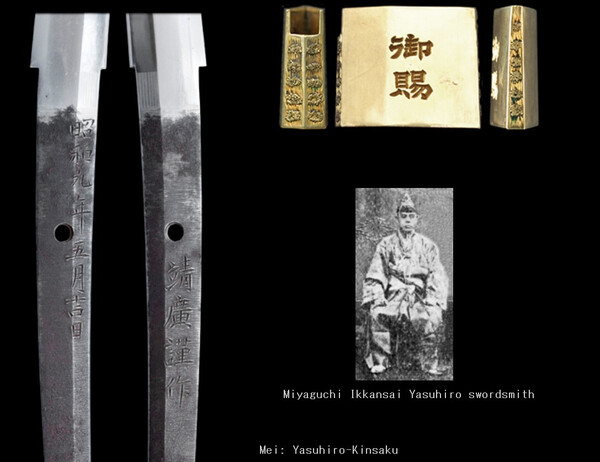
Here's one gone the other way around - An "Imperial Gift" to an officer! On Ohmura's site - Type 94 Royal Gift "Yasuhiro". He doesn't say who it's gifted to, but it has a Company Grade tassel, so it's probably an officer.