Peter Bleed
-
Posts
1,866 -
Joined
-
Last visited
-
Days Won
8
Content Type
Profiles
Forums
Events
Store
Downloads
Gallery
Everything posted by Peter Bleed
-
Noel Perrin's Book "giving Up The Gun"
Peter Bleed replied to estcrh's topic in Tanegashima / Teppo / Hinawajū
Eric’s message doesn’t really ask a question or offer a criticism that needs to be addressed. Still, in citing my comments as a contrast to his own positive assessment of Noel Perrin’s volume, it seems that Eric is wants to discuss firearms technology in Japan. I feel no need to argue about this. My comments about Perrin’s book were not intended to be harsh. “Giving Up the Gun…” was popular because it offered a very simple – and simplistic – treatment of a topic that people found interesting. A major reason this thin book was popular was because – as Eric points out – it dealt with a topic that had been overlooked. Old school Japan-hands ignored technology and material culture. Chado? “Yes, really important. It explained all you need to know about Japan” Budo? “Well, not so much. Ruffians did that stuff, not aesthetes” Haiku and Noh? “Oh, For sure! Really important” Tatara? “What’s that?” Perrine told us a story that was simple and interesting. It also matched the interests of sword collectors. Swords? “Ahh, yes, they’re the soul of the Samurai” Tanegashima? “We see those from time to time, but nothin’s been published on them.” I went back this afternoon and re-read Sir Sansom’s history and it was embarrassingly how little he knew about events like Nagashino. “The muskets were still rudimentary weapons, muzzle-loaded and fired by tinder,” (sanson 1961:287) OMG! This is the level of scholarship that get’s a guy knighted? OMG! I think we know more now because sword students and others have pointed out that solution to real world material problems really matter. Perrine got us thinking about guns, and with thought we have come to know more. Guns were a solution to real world problems. And after 1603/16, those problems changed dramatically in Japan. That is why guns went out of vogue. The Japanese hadn’t forgotten them, they simply didn’t NEED guns as they had. If anyone wants to think about “giving up the gun” in a new way, I suggest these podcasts. http://www.sengokufieldmanual.com/2013/02/giving-up-myths-part-i.html http://samuraipodcast.com/ep05-the-myth-of-samurai-giving-up-the-gun Peter -
Percussion Japanese Pistol
Peter Bleed replied to Ed Hicks's topic in Tanegashima / Teppo / Hinawajū
Ed, Thanks for opening an interesting discussion. I too have been interested in these very late Japanese copies of simple European pistols. As others have said, these weapons deserve serious study. As others have said, regional powers were buying modern firearms in the Bakumatsu era. Clearly modern long guns were being acquires and issued to factional forces. I think the kinds of pistols that Ed has invited us to consider MAY form a slightly different category of weaponry. I have scant information, but I THINK instead of weapons of organized military forces, I suspect that these diverse, hand-crafted Japanese copies of European carry guns might have been personal arms used by individuals who felt the need for concealable guns during the EARLY Meiji era. These guns are Japanese manufactures, but they never seem to have signatures or other makers' information. They often look like one-offs. And they never seem to have ka-mon or others unit marks. They look to me like "Saturday Night specials'. That is to say, carry guns that would even a fight. There were factions and thugs galore at this time in Tokyo and fighter who could afford a sword probably could afford one of these little bangers. They sure are neat! Peter -
Handscroll On Barrel Design / Rifling
Peter Bleed replied to Randy McCall's topic in Tanegashima / Teppo / Hinawajū
Eric, Sorry if I was off-hand or cryptic. In 1979 and thoughtful guy who knew very little about Japan - Noel Perrin - wrote book called "Giving up the Gun..." He said that the Japanese had copied European firearms in the 16th century - very well - but then proceeded to "give them up". For that reason the Japanese had to once again copy European firearms designs after they were forced into the modern world - yahhh dahhhh yahhh dahhh - in the 1850s. This story became very popular suggesting to some folks that 1) the Japanese are copiers or 2) peaceful, or 3) that disarmament can happen or 4) that it can't. It has also been the subject of lots of discussion as to whether or not it is true that the Japanese ever really and truly "gave up the gun." Sources like the one we are discussing here clearly show that the Japanese did not simply or completely 'give up the gun'. Peter -
Handscroll On Barrel Design / Rifling
Peter Bleed replied to Randy McCall's topic in Tanegashima / Teppo / Hinawajū
Thank you Randy. This is an interesting source. Do we know the author or where it was written. The "Giving up the Gun" crowd now have more they have to ignore. Peter -
The blade that Max calls our attention to does seem pretty fresh, but i think that Eric is probably right in calling it "Edo period". I have a nice little kogatana signed Fujiwara Kunikane saku. Like Eric's blade it has been recently polished but I had the mei side left as it was.. I have been kind of assuming that mine was made my the 13th generation. And if that were the case, I suppose that it could have been made in Meiji times. He died in Meiji 36.My signature seems rather difference from Eric's. In any case, I do not believe that a shinsa would attribute these little things to a specific generation. I suppose that they could be "gimei", but mine has a nice masame-hada so it seems like a Kunkane blade - and I like it a lot. Peter


-
Thank you Hamish and Axel. I will have to check Fuller's Surrender Tag volume. In fact, it really seems that right after the War, treatment of swords was highly variable. Certainly lots of weaponry was being destroyed but it is certain that cutting up blades didn't happen everywhere. In fact, I have to wonder if Col. Cadwell's policy statement could really have been presented to standardize treatment of swords. Whenever the post-War treatment of swords comes up, I also have to wonder about who was actually doing the work and handling the swords. Japanese officials had to have been involved and "sword experts" may have helped. Peter
-
A friend and I are working up a paper on the small collection of “tanto” that his father bought as a teenage GI in Japan in 1947. These blades were made of the tips of swords that were roughly cut and then remounted with sayas that were similarly bobbed off. The kodogu are all right, but both the blades and the koshirae are gracelessly stubby. The nakago are – well – very sorry and obviously mumei. Interestingly a couple of the “tanto” have origami with specific attribution. I assume that these pieces are leftovers of swords that were “destroyed” in the post-War years. They may not be “collectible”, but I think they deserve to be described as a part of ‘sword history.’ My question to the Board is if there any literature on when, where, and on whose authority swords in Japan were being cut up in Post-War Japan. We have all heard the stories of swords thrown in the Ocean, but who was cutting up swords? Peter
-
It is a KANESUMI, Which one, I'm not so sure Peter
-
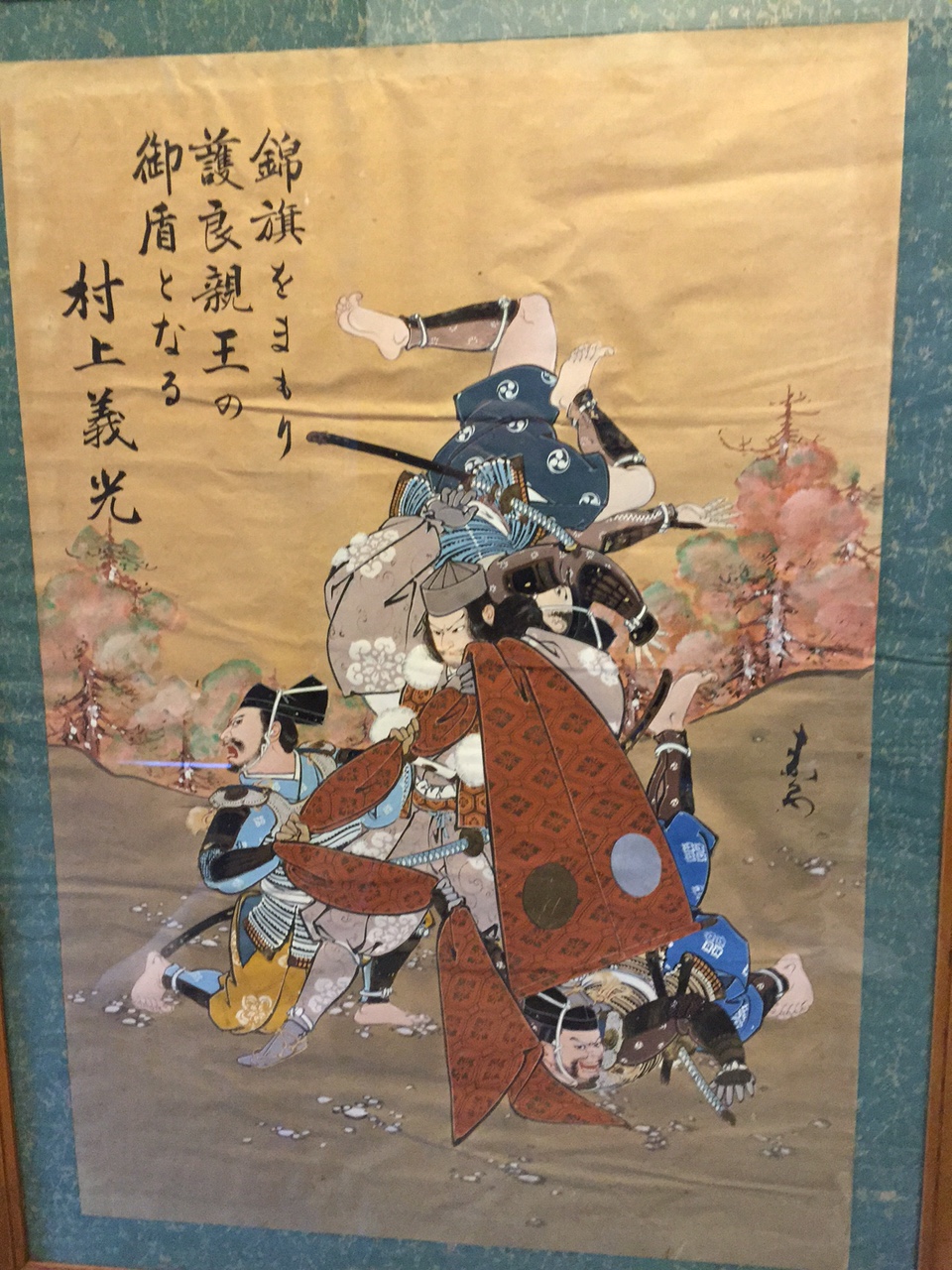
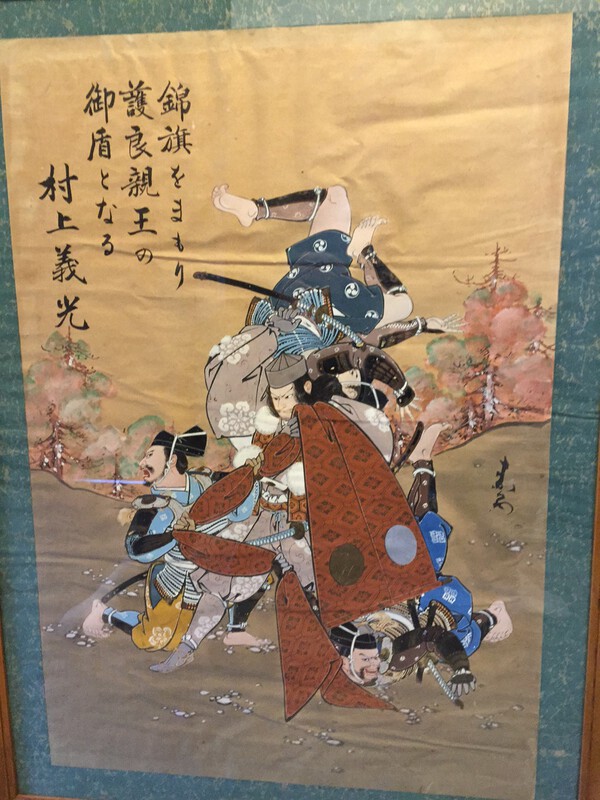
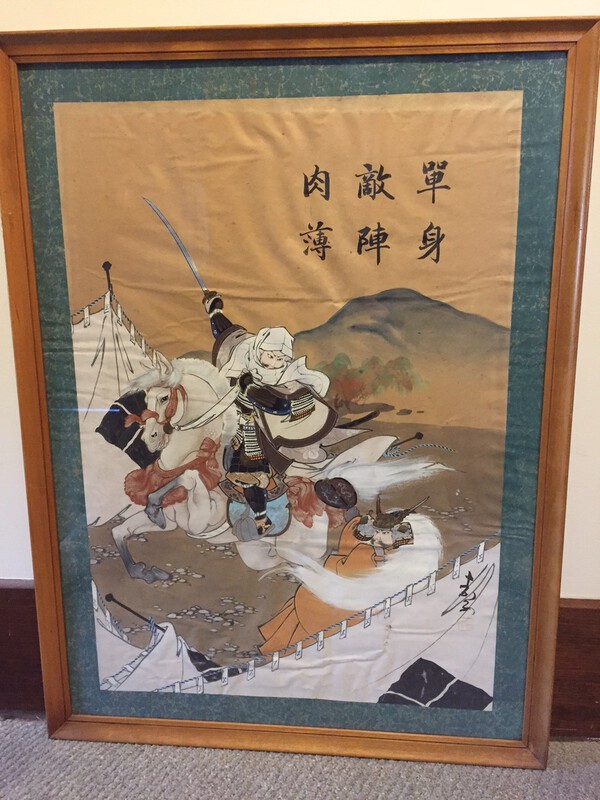
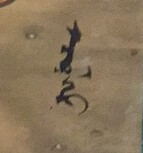
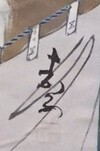
Dear Friends, I write to beg the help of the Board with a couple of "vintage" Japanese paintings. They came together and I believe them to be by the same -artist.They are well-rendered and both show Samurai related scenes. One presents a rather famous story about Murakami Yoshimitsu protecting the family colors. This was a rather popular Meiji/Pre-War patriotic story. Stylistically the images look much like the images we often see as cover art on Token Bijutsu. Both are signed, but I can't make the signatures at all. Can anyone read the signatures or tell me when these pictures were painted. Peter P.S. For the record I plan to bring these items with me to Chicago, should anyone be interested
-
I am interested in museum collections - and collections in general. My general feeing is that collections of all kinds are going to collapse in the near future. This includes - IMHO - a lot of museum collections. It sure looks like this is a museum that has - well- collapsed. The forces that used to encourage and support collections like this have disappeared. And as a result, the collections are being dispersed. If there are good swords in that pile of what looks like 140 nipponto, serious collectors can accommodate them. What I find more interesting to consider is the impact this sale will have on the generic gunto market. What will happen to the gunto market when something like 80 clean Showa-to are now suddenly available? Are there enough militaria collectors to accommodate that bubble? I doubt it, Prices at the low end are going down, friends! Peter
-
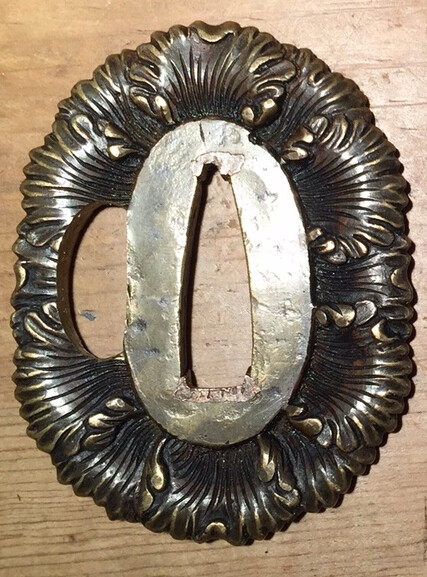
Dear Forumites, I recently acquired this nice little carved tsuba and wonder what this community can tell me about it. It measures 4.6 by 6.2 cm so it would be big but all right for a tanto, perhaps a bit small for a wakizashi. I'm quite sure it is carved not cast and has a bit of history since it wears a couple of copper sekigane. I'd appreciate reactions. Peter
-
Barry, Like everyone else, I await the "bigger story." But for now I will simply relate a story I was told years ago about blades that have been nickle plated. A person who knew a lot about such things said that it was possible to simply "unplate" these swords. That is, outfits who know how to "plate" can undo the process. In addition to saying that this should be easy, my source said ti would also be - dare I say it - cheap! Best of luck! Peter
-
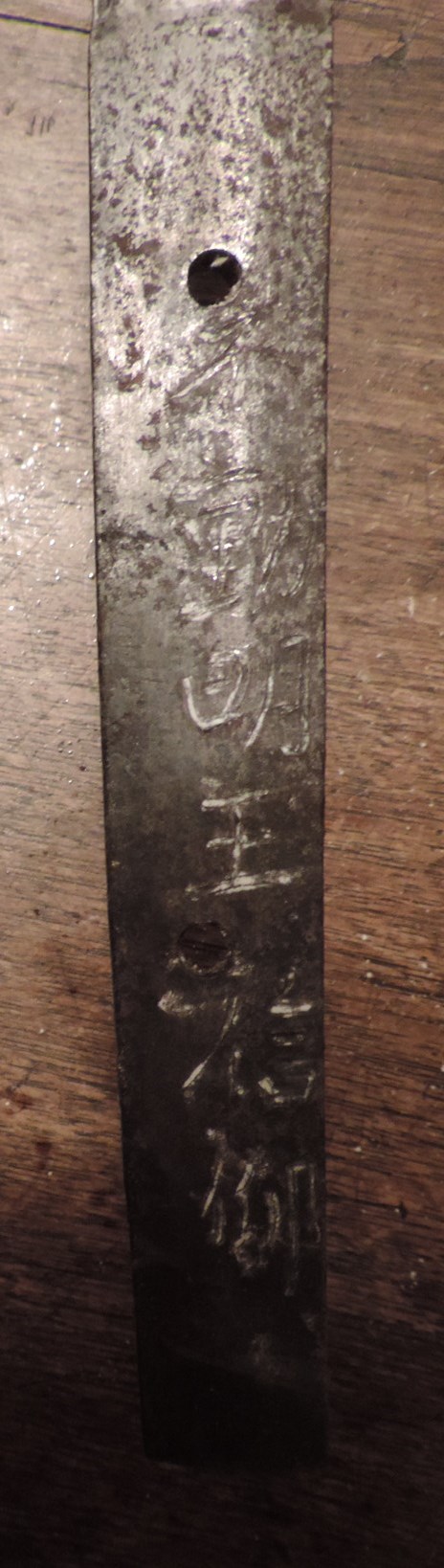
Dear Friends, A couple of days ago, I burdened the Forum with a question about a black gunto tassel. I had never seen one before and apparently no one else had either - so the topic died.There is a bit more to say, however. To review, the sword was NOT for sale, I was just asked for information. Recall, too, that sword had been sent to the current owner who was then 10, by his brother who subsequently was KIA. The brother was a Marine but the current owner was uncertain where the sword was acquired (Saipan, maybe) and also unsure where the brother had been killed (Iwojima seemed likely). This lack of historical and personal appreciation was distressing, so I kind of suggested that I would help the family do research on the sword's history. I've heard nothing - Sempre Fi. The sword is a buke-zukuri Muromachi osuriage mumei that had been equipped with a leather boot and tsuka cover and the black tassel. When I disassembled the sword for the owner and his son, I found a rather fresh inscription on the nakago.Aside from being certain it was NOT a mei, I was not sure what this was so I took a quick snap. With some help I have realized that this inscription says. "Fudo Miyo O Shinko". Now, we have all seen blades with horimono Fudo images, but I have never seen a written dedication like this on the tang. Is this in essence an omamori, a good luck charm? The inscription itself was obviously rather new. Sorry I don't have a better image. Peter


-
John, My luck with juyo is zero so I really don't have any right to enter this conversation, but...I have to ask why you'd want to see if this is a "JUYO." Getting or not getting an expensive paper is not going to change this sword one bit. You won't see anything you can see now. I doubt that you'll get better kantei. There is little more to be told about this sword. Given where this sword has been, I also just bet juyo has been at least discussed. This is a fine sword. Enjoy it! Peter
-
Friends, I just had the pleasure of looking at a sword that was sent home from Saipan (maybe - they weren't sure) by a Nebraska Marine who was killed on. Iwojima. in 1945. The current owner was 9 when his brother sent it home. And it has been in his attic since that time. This will have to be the last time something like this will happen to me so I feel deeply privileged!. The blade was a o-suriage koto of no obvious importance. It was fitted out in re-purposed buke-zukuri koshirae with leather boot and tsuka cover. The only remarkable feature I saw about the rig was a black sword tassel. It seemed rather thinner and more delicate than normal tassels, But I have never seen a pure black one before. Is this a type or a one-off variation? Peter
-
ie (sometimes "iye") Peter
-
Dear Friends, I enter this thread against my better judgement. I assume that New NMB Member Ken opened it with sincere curiosity. Likewise, our friends who researched their books and reported the judgements presented by their preferred Japanese authorities, gave Ken - and the rest of us - some respectable - grist. I also think it is all right for experienced collectors to share their personal judgements of who is "good". Still, I will risk getting myself sent to NMB Solitary Confinement by saying this is all hooey! Ken, go ahead read the lists and use them to look at books and swords. But don't drink any of the Cool-aid. Use these lists to figure out what SORTS of things sword afficianados go for. What variables are approved. While doing that you will gain skills in recognizing flaws and just plane unskilled production. That is the process that builds the ability to see and appreciate "good" stuff." Face it, you are NOT going to own any - well many - swords by smiths on James' koto list. BUT YOU EASILY will come across blades that reflect the work they did. In fact, i think what Ken should have asked for was a list of the highest ranked SCHOOLS of sword making Finally, I think we all have to be free to make our own assessments of what we LIKE. We absolutely do NOT need to accept the aesthetic judgments of the "authorities:". Joey Heatherton is not prettier than Cheryl Tiegs just because she sold more calendars.Unless, of course, you are in the calendar business. Peter
-
Well, gee. This looks like a nice little rig. The signature is a challenge. . .. Kane somebody, but it certainly is the same as the sayagaki which is also illegible to me.The fittings look like a nice little toppei outfit. It seems to deserve a good restoration. Show us the tsuka, please. Peter
-
Troylbww, It sounds like you are a museum professional - and if that is the case, I commend your creative approach to identifying and assessing the stuff in your collection. It is often amazing to me what ignorance is built into museum catalogs. You have now got good assessment of these three objects. Please let me go a step farther. Deaccession this stuff. These things are not and never will have "museum significance." Your institution will never be able to use them for the normal missions of "teaching research or service". Instead you will simply have to pay for storage - - for eternity! Individual collectors, on the other hand, might be able to make these objects of some value. Peter
-
Hamfish said "don't want to be one of these old guys, who we all know who say " I had one of those but sold it" Well, Sonny, I will overlook your gratuitous "ageism" and congratulate you on your impending fatherhood. Indeed, I wish I still had some of the swords I used to own, Fatherhood is pretty wonderful. Let me be the "old guys" who tells you that kids grow up and move away, too. I enjoyed fatherhood - even if my grandsons live in Australia! Peter
-
Nengo is Showa 17, but what do I know? P
-
Maybe I don't know how the system works. And maybe it is because I own a Kunisada that I like a lot. But why is this a "regular saku" blade? and more to the point, at this price, why ain't somebody jumping on it? Peter
-
Yahoo Auction Japan - Ko-Bizen Tomonari ?
Peter Bleed replied to tagheuer's topic in Auctions and Online Sales or Sellers
Dear Tag, I have two reactions to your post. 1) I own a controlling interest in a large bridge in Brooklyn - which I can make available to you..... 2) I have in fact owned two (2!) Tomonaris (one in a great shingunto mount, boy I wish I had that bad boy back). That experience makes me wonder when and why these things were made. The woods are full of blades signed - Sadamune, and Tomonari yahhh-dhhh yahhh-dahh. What was the premodern market for these, ahhhh, fakes? Who bought these swords? Why did they want them? Oh, and by the way, who made 'em. Are these things Edo period or are they Meiji? Heck. could they be older? Where samurai of the Muromachi/Early Edo period aware of Tomonari? In any case, I suggest that you explore this sword for the blade not the signature. Peter -
Steve, I just got a nice little tsuka done by David. He seems alive, well, and still up to a fine standard. Peter
-
All generalizations – including this one – are false. It may be ADHD or something, but I never learned to sit on my hands. The clarifications offered by Arnold and Ed and now Steve are fair and useful. Still, I still find utility in my lawlike statement about papers and gimei. It is worth remembering, too, that many NMB participants are sorting out the differences between Modern Chinese swords, Showato, and Nippon-to. I think Japanese society is 1) wonderful, 2) well organized, and 3) very regular. I certainly understand that there may be some irregularity, but I still think that there is very little disorder to swords in Japan. Advanced collectors – with well-formed tastes and networks – might be able to discover swords in Japan that are less than fully appreciated quality. Still, I think the best advice that we can give to “new collectors” is to assume that easily available swords offered by dealers in Japan have been examined by very knowledgeable people. Furthermore, there are lots of experts in Japan so that shinsa results –below the Juyo level of - are rarely surprising. Tsuruta-san is an expert and quite able to predict shinsa results. For that reason his guarantee is quite good enough for lots of his customers . There are also many dealers who don’t bother with shinsa since they are quite able to decide that a particular sword “ain’t gonna bring home the paper.” So, in addition to skill building, I think the best advice NMB can give to “new collector” is to 1) find expert and honest dealers, 2) work with them, and 3) decide what you like and want. Toward #3, we could also recommend getting to know other collectors and looking at all their stuff. Peter