Peter Bleed
-
Posts
1,865 -
Joined
-
Last visited
-
Days Won
8
Content Type
Profiles
Forums
Events
Store
Downloads
Gallery
Everything posted by Peter Bleed
-
Yes, Pete, that's it. And I think the fellow who had discovered the box 'o tsubas was John Niles, I think, who was also a dentist, Peter
-
Ahh, stories of the complex past of sword collecting. Tom was an early explorer of tsuba - ahhh - "refimishing and repair". I recall visiting him while he had a bunch of seriously burned tsuba from California.(I'm blocking on the dude's name - he was a wheel in the Olympics as i recall). Tom was effectively cleaning some of those guards, but he also made really interesting observations of the loss of IRON insets that had been used to add relief to Kaneie guards. I think these piece were beyond repair, but the technique - iron in iron - is essentially invisible - until the insets had popped out. Looking at the destroyed guards you could see that insets could not have added a great deal of thickness, but in the scrapped condition you see how they subtly added to the appearance of the landscape image. I wish Tom had published those observations. Another story that I recycled in my sword story - National Treasure - involved a small but sturdy wooden box full of rusty iron guards that a fellow had at a Chicago Show, The story was that a this box of fittings had been in storage since well before WWI. They were utility grade stuff but it was interesting to see "experts" pick out tsuba that could be easily enhanced with a bit of easy sukashi or a couple of ude-nuki. As the stories developed and sorting progressed, several pieces were purchased. You have to wonder whatever happened to them. Peter
-
Grey, Fakes? Modern products leaving Japan? I'm shocked, shocked!. Obviously that is sort of what I was wondering about. Care - even suspicion - is always in order/ Your comment does, however, allow me to recall a story that suggests that we must not blame only Japanese for fakes. The famous 1972 Dallas Token-kai featured an NBTHK shinsa. I was honored to work on the line. Owners all took off the tsuka and I had to get them lined up for evaluation. It was a hell of a pile of swords which reduced because - I learned - that GIMEI were easily be sorted out. I did not to the sorting and was mildly shocked that it was so easy... But the Tosho tsuba story involved Tom Buttweiler who submitted a couple of very impressive guards. They were text book example and they really looked good - so they got Green Papers. As soon as Tom got the judgement sheets and picked up his tsuba he presented them to the Shinsa Team and told them that HE HAD MADE ALL OF THEM! Tom was a charmer.
-
Thanks Curran. This may develop slowly, but details will - potentially - follow. P
-
Friends, I am looking at what looks like a nice old tosho guard - sorry no pictures. It is, however, quite thin - like 2mm on the seppa-dai. Is that too thin - and a possible red flag? Peter
-
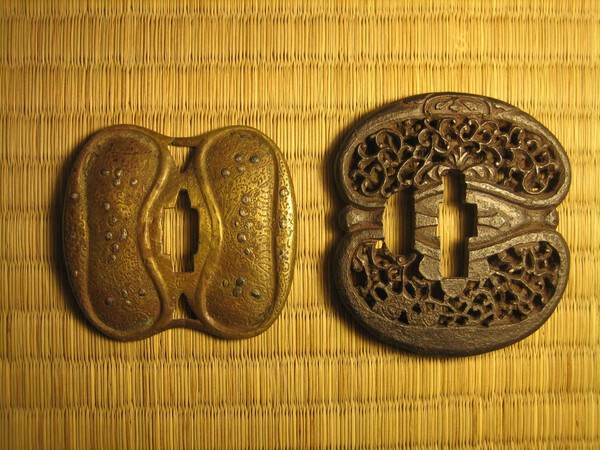
Indeed we have discussed this topic and I even posted a rather clumsy version of the paper that Ron mentions. It is somewhere in the recent NMB files. I LOVE the guard that was referred to above. Here are a couple of other "Japanised European guards" Peter
-
Well, gee! If I had this tsuba, I'd ask Grey about it because it really looks old. I'd also ask about the - ahhh - strange surface finish. Peter
-
I have no dogs in this fight, but if a guy was looking for a kikuchi yari, Daimyo-sama's little tanto seems like something worth a second look. It carries an old "white paper" that I assume means that somebody in 1967 thought it was intact and legit, and not retempered.. . The fullness of the hamon seems more - ahhh - suspicious than the remnant straight grain above the shinogi. Muromachi? If it is a kikuchi-yari it could be older than that. And who was making them after 1603? Peter
-
Looking For An Old Timer In Dc Area
Peter Bleed posted a topic in General Nihonto Related Discussion
Okay, I usually come to the NMB to vent and spout. I love the Board "Bigly"! But this time I am coming to the community to beg help with an OLD sword lead. is there anybody on the Board who is in/around Washington D.C. who might be able to help me with some research a sword I bought in 1984 (or so).I had spent a week (on a Foundation's dime OMG) listening to totally worthless D.C. crap and was on my way home via the Old Chicago Sword Show. Since the foundation was paying for my trip to Chicago, I had responsibly attended all those awful meetings and only got to go to a shop that was just around the corner from where I had been staying near Dupot Circle.as I was on my way out of town.. I believe it was called TROCADERO. . When I finally got there they had just pulled a bunch of stuff out of Alice Roosevelt Longworth's home - - which I guess was just across the street. Yes, Teddy's daughter, of the "Imperial Cruise" Now, all these years later i would like to know if there might be somebody in the D.C. area who could help me research this matter. Does Trocadero still exists? Might there be somebody who could recall this matter? Who got all the rest of that stuff? Peter -
Knowledge Request And Opinions On Hand Cannon
Peter Bleed replied to dale's topic in Tanegashima / Teppo / Hinawajū
I am skeptical and would look for a "modern" explanation. I can't see it functioning as a firearm and it looks like a modern design and manufacture. Could it be the cast iron end of a large lever or adjustment arm. That well formed "handle" looks modern to my eye. I'd show it to a railway or nautical engineer. Peter -
The date looks like 2600th anniversary of the imperial founding -which would be 1940. And it seems to have been made as protective weapon for a a Mr. Matsuyama. The "penmanship" of the mei looks good. A VERY interesting nakago! Peter
-
Once again, I ponder how wonderful it would have been if early Japan had been introduced to writing by the Spanish instead of the the Chinese .In any case I apologize if I erred in rendering this title.It would not be a first for me. I will certainly defer to Piers. But to make this issue more complex, the full title on the title page says something like "An Introduction to Old Style Guns. . . OLD Japanese GUNS" In other words, the word "OLD" appears twice, BUT "Old Style" is pronounced "Koshiki" and, as we have just learned, "Old Guns" is uttered "Furuju." So I suppose this title would be KoshikiI Ju Nyumon Nihon No Furuju" or might it be "Koshiki Tsutsu..."? And I decided to call the author "Sawada" and didn't even take a stab at his first name. Are we sure he doesn't go by "Takuda" Growing up with the name "Peter Bleed" allows me to find othe' peoples' names remarkable
-
Der Friends, Thru the good offices of Grey Doffin I was able to get a nice new edition of Sawada's Koshikju Nyumon Nihon no Koju (Japanese Old Guns) and I am very pleased. This is not a gaijin friendly volume, but it very well presented with great illustrations.. As and "introduction" it emphasizes oddities, but it covered a wide range of both matchlock and 19th century firearms. It shows lots and lots of different19th century imports, Details of when and how imports were obtained seems pretty terse, but the range of imports must be fairly complete. Tables and lists are generally rather easily to approachable for folks with a bit of Japanese. I think this book deserves a spot in a collector's library. Peter
-
How embarrassing is this?!. Am I the last person to discover the books of Jan. E. Culbertson? At least I seem to have not been hanging out with the Chinese sword collecting crowd. Amazon and Google have informed me of the availability of these books, but at approximately $1.00 a page, I have to wonder if they are worth the investment. To put the finest point on this, are these volumes worth adding to a Japanese sword library? Peter
-
I rather like to have a sword with a bit of muneware since they help to explain the flaws that regularly occur in Masame. In gross term, the mune os the "masame side" of itame blades. Muneware, in other words help to understand masame. Peter
-
Thank you Hamfish and Bruce. Once again the NMB has worked, but I think we have also come up against the limits of our knowledge. I have no interest in thsi sword - well none beyond some curiosity about Manchuko and the hope that somebody on the Board might find it of interest. Given the recent appearance of Chinese swords that verge on fantasy or copies of historical types we do have to be careful in trying to sort our things like potential Manchurian or colonial Japanese weapons. I am pretty sure that this sword is authentic. The owner say it has been in his collection for at least 50 years. In general, I hope that "Chinese sword collecting" will open up. We need more publications on 20th Century - Nationalist.Manchukuoan/Etc swords. And we also truly and deeply need to have better reference studies of Continental sword fittings from the Ching dynasty.. Bruce, I appreciated the suggestions on the other lists. I have tried to access them.And I'll keep trying. BUT my expereince with them always make me impressed by how user friendly the NMB is. Go Brian! Go NMB Peter
-
Dear Friends, Once again i beg the help of the Board with a question. I recently noted a Japanese blade that has appeared on eBay, As an on-going auction i will do no more than to use it as a example. We will not discuss its quality or value, altho I will say that it certainly nice. http://www.ebay.com/itm/222427703330?_trksid=p2060353.m1431.l2649&ssPageName=STRK%3AMEBIDX%3AIT I have seen these koshirae before and several time have had them pointed out to me as potential "AINU" blades. They are not uncommon and they seem to forrn a distinct type - plain wood saya/tsuka. antler fittings, and often tightly wound "rattan" wrap in the tsuka and/or the saya. They also rarely have what we might think of as "collectible" blades. As a collector of Ainu stuff, I am SURE (100%) that these are NOT Ainu gear. They have NEVER been shown in any books or catalogs on Ainu Material Culture and I have never seen them in Japanese exhibits of Ainu materials. The rattan wrap doesn't show up on any other Ainu stuff and they do NOT have any of the other classic features of Ainu art - 'bracket' design, 'fish-scale cross hatch' etc.. So what are these? They may be Matagi gear of some kind.- made for an by forest workers. And i suppose they could be gardeners' tools, altho they look way to rustic/crude to be polite bonsai tools. These things do NOT look like samurai weapons. If anyone has insights, I would love to hear them. Peter
-
I sure can't read it all, but it does indeed say that it was made by a resident of Sendai. Neat indeed! Peter
-
I managed to get a couple of more images of the sword I asked the Board about recently. I emphasize that this is "miltaria" rather than an arm and I can present only a couple more phone shots. I hope they will meet the basic needs of the community that might be interested in this piece. It "looks" like a Japanese sword in general terms. It has a habaki and a artifial yakiba. There is a same cover on the hilt which generally looks like the Japanese 1875/86 swords. But the thing is well below Japanese production standards. Note that it also carries a silk knot.. It also has a two digit stamped number - 88 - on both the drag and the hilt.There is NO history on where it was acquired but it has been in its current collection for "at least 40 years." I take that to mean that t it is NOT "recent" Chinese production. Peter


-
Well, Okay, Hamfish. I'll try to get some better images. Peter
-
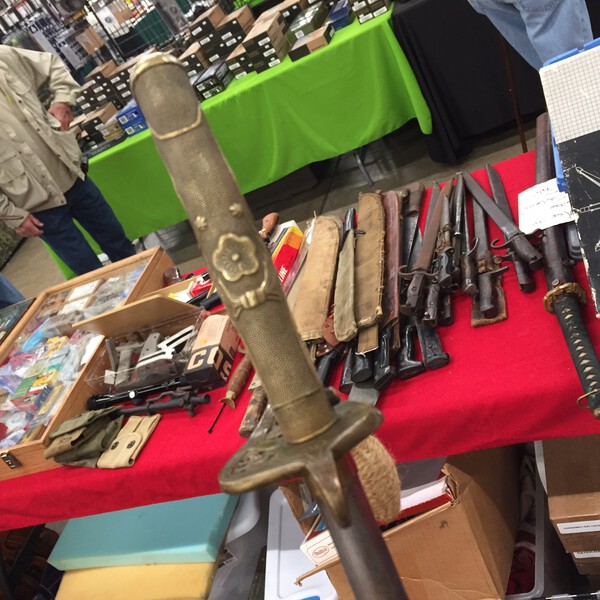
A friend showed me a sword this weekend that I hope will be of interest to some on the NMB.. It is a blade that rather looks like a Japanese parade sword. It has a habaki and a kesho hamon, BUT it is generally cruder than comparable Japanese swords. It also has what I read as a Plum blossom in a sprigs of grass on the back strap. I suppose that it may be Manchukoan, but I do not see a comparable koshirae in Dawson's book - - and I note that he says that " Plum Blossoms" are common on Chinese swords. Any expert reactions? Peter PS. Yes Yes, I see that my image is slight out of focus. Please be assured that this thing didn' look very good in real life! Oh, and that gunto laying on the table in the background was a vert ordinary Seki blade. And a week ago I was in Tampa! P
-
Indeed, THANKS! I was very pleased to see this! peter
-
Tampa 2017
Peter Bleed replied to Grey Doffin's topic in Sword Shows, Events, Community News and Legislation Issues
There is little to add to what Arnold has already said. but I have to agree that the Tampa event was a success. It certainly was a bit smaller than past shows. And there were smaller piles of swords. The presence of two (count'em 2) Japanese television crews added a bit of glamor to the event. It also suggests that swords remain of popular interest in Japan. The range of swords for sale was very large, but it seemed that there were buyers for everything. Stuff was changing hands. It as also great fun to see lots of old friends. I brought home two Sendai Shinto. The first was a recently polished mumei blade in shin-gunto mounts. It has nice masame-hada, but it had not passed shinsa . . . when it had a now erased Kunikane signature. This sword was pointed out to me by Chris Leung who recalled my interest in the Kunikane group. The other is a very short katana signed "Nagashige." This blade is a bit of a puzzle. I have never seen another sword from this line and niji-mei signatures seem rather rare. These smiths seem not to have had connection with the Kunikane groups so I am not sure how to look at it. I am low on the learning curve on this one. Weather in the northeast was not the only challenge to the event. My trip home involved one cancelled flight that had had problems in Mexico! Peter -
Please Show Me Your Displays :)
Peter Bleed replied to md02geist's topic in General Nihonto Related Discussion
It has been two months since we moved into "retirement" and a new home so that this thread has been of great interest to me.So far I really have made NO progress on getting my Japanese swords out, but I am not sure how to present that stuff. As a collector (and an an archaeologist) I have always preferred "discovery". I also tend to prefer looking at Japanese stuff in hand. Very few "behind glass" presentations really work for me. Both blades and fittings require and deserve close inspection. And they tend not to do well in the open air.. Looking at the presentations here have given me some inspirations, but I'm still not at all sure that I want to "display" Japanese arms. By way of contrast, please let me attach a snap shot of some of my "other stuff" Compared to Japanese arms, European arms are rather easily stored in a way that makes it easy to inspect, handle, and clean. For me, the key to collecting is comparison between types and categories. Putting them cleaning on a wall also seems like a reasonable way of managing them. I had kind of thought about shedding my European swords since I really don't view them as "my" collection, but getting them out and figuring out how to show them as been fun - - and easy. Now I have to deal with the Nippon-to! Peter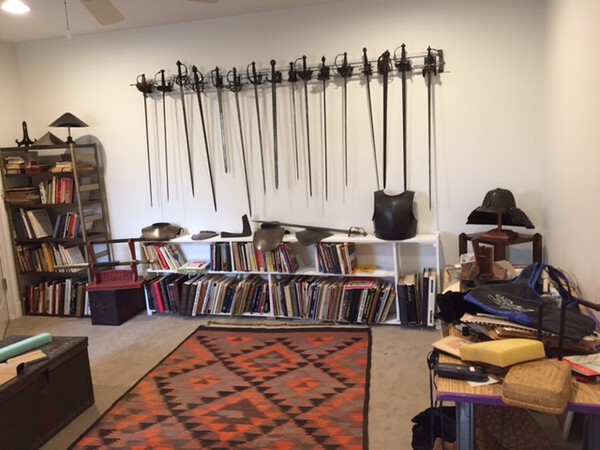
-
Is This Authentic? Japanese Wwii Sword
Peter Bleed replied to alex350gt's topic in Military Swords of Japan
hope it was a garage sale price. Peter