


Peter Bleed
-
Posts
1,863 -
Joined
-
Last visited
-
Days Won
8
Content Type
Profiles
Forums
Events
Store
Downloads
Gallery
Everything posted by Peter Bleed
-
Wim, I began my day - as I usually do - by checking with Aoi-sama. And there i too discovered the blade you described above.. Thank you for calling attention to this sword and for remembering my earlier post. I am sorry for opening this thread in a way that seems not to have been inviting to discussion. I really have to figure out how to post good images. Let me mention two things that I find interesting about these swords. First, it is interesting that Kanetsugu stayed with masame hada while he also seems to have used a number of stylistic features that point away from Sendai.. Note how Tsuruta-san seems to compare him to a wider circle of smiths. My sword offers proof positive that he was active in Edo. He may have been a rather cosmopolitan fellow. Second, the hada of these swords is pretty interesting. Your sword has wonderful masame. I love it. As I said. my newly polish sword has some masame, but it is not apparently as complete as the steel of your blade. That makes me curious about the comment on the Aoi page to the effect that additional polish will bring out more masame on their blade. Is this true? Hmmmm. Peter
-
Collectors In Indian Territory
Peter Bleed replied to echoe's topic in General Nihonto Related Discussion
This is a worthwhile thread and I seriously do wish to offer support. I view sword collecting as a "social activity." Meeting a speaking with other people should be an important part of the experience. I also think there is no replacement for looking at "new" swords. This list offers quick access to translation and typology issues. But collecting has to involve looking at and handling real swords. So, by all means I wish the OklahomaToken-kai all the best. I recently moved on from the Nebraska Token-kai (reducing its charter membership to TWO) to be closer to granddaughters I'd welcome visitors! Peter Bleed -
Collectors In Indian Territory
Peter Bleed replied to echoe's topic in General Nihonto Related Discussion
Hey, Arkansas is close by, Peter -
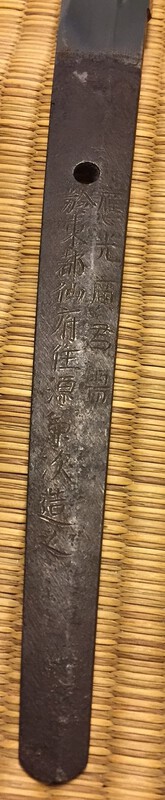
Dear Friends, Please allow me to present for discussion and help the signature of the blade i discussed on Eclipse Day. Since then I have spent several hours with this blade and generally have felt good about it The blade is signed Oite Toto Senfu ju Minamoto KANETSUGU tsukuru kore That part is easy - saying something like In The East Capital by Sendai Resident Minamoto Kanetsugu I am less sure of the rest Ou Mitsuhiro kimi something.. Made for Mitsuhiro - I beg the help of other on this part of the mei. The blade is very nice. It is well made and well controlled. Frankly, give Kanetsugu's reputation I was hoping for more strident masame, but basically the masame is right down along the habuchi with running itame along most of the hada-ji. It is a Sendai-to, but not a screamer. I am also not at all sure why Kanetsugu was down in Edo (or "Toto" 'The Eastern Capital') at this point. ("Who said "I don't think we're in Kansas anymore Toto"). But things were certainly heating up and lots of swords were being ordered. Maybe a guy just had to go where the market was. Thanks for looking Peter
-
Decisions, Decisons!
Peter Bleed replied to Peter Bleed's topic in General Nihonto Related Discussion
Wim, Thanks for your interest. Indeed the sword is a nice one and has given me good satisfaction. I'll try to get some pictures that i will share. Maybe you can post some images too! Peter -
These are around but not common. There is one in the collections of the field Museum, Peter
-
Decisions, Decisons!
Peter Bleed replied to Peter Bleed's topic in General Nihonto Related Discussion
You guys are so literal. I did, of course, wear my NASA approved blinders, but what's the big deal? I decided to go into to look at the sword when we were looking at the crescent-shaped shadows that were being case by the last wedge of sun light. They looked to me like uchi-no-ke and I realized that I was not concentrating on the event! Peter -
Decisions, Decisons!
Peter Bleed replied to Peter Bleed's topic in General Nihonto Related Discussion
Eclipse Schmeclipse! I squinted at the bright spot for a while but then I opened the box . . . And there I found a newly polished Sendai KANETSUGU. Mekugi had broken but the blade had no problems. I'll try to assemble some pictures and work up a treatment. For now I'll just say that but the blade is a special order - signed Oite Toto Senfu ji Minamoto Kanetsugu, and dated on the omote Ansei 2. It shows masame especially in the habuchi. This has to be the 5th generation of the Kumagaya family of smiths. I'm not sure what he was doing down in Edo in 1855, but those were heady times and Kanetsugu was a player in shinshinto time in Sendai. Peter -
The ecplise is starting but the postman just brought a long narrow box from a polisher. What should I attend to first? Peter
-
Teppo Performance Research
Peter Bleed replied to Peter Bleed's topic in Tanegashima / Teppo / Hinawajū
Thank you Malcolm and Ian. These are useful insights. The issues addressed by the Royal Armouries research are very interesting and I will seek to explore them. The katchu forum is also clearly going to be useful. The reality is the the NMB is just so easy to use that it "the place to start." Thanks again! Peter -
My friend Doug Scott has begun to assemble observations of bullets fired by pre-20th Century firearms as baseline data for archeological investigation of pre-modern battlefields and conflict sites. Early this winter I will be taking doing another round of experimental/replicative muzzle loading firearms research. Emphasis so far has been on late 18th century flintlock arms, but this year, Doug has agreed to get some data on the ballistics and performance of matchlocks. I just happen to have one of the modern Dixie Arms tanegashima repros so we will begin with it. For experimental purposes I do not expect to approach historical replication or reenactment behavior. I plan to use standard muzzle-loading procedures as a baseline. We will use a chronograph to get ballistic speed and ballistic gel to address impact behavior. We will also do systematic metal detection to recover slugs. All of which is pretty artificial, but you have to start somewhere! I hope someone in this community can point me to Japanese literature on Japanese matchlock operation and performance. Is research of this type being done in Japan? If so has it been reported? Might there be a Japanese audience for this kind of study? I realize this is a naïve request, but you have to start somewhere! Thanks. Peter
-
Is there a picture of the "Bowie koshirae"? I'd love to see it. Peter
-
Help With Signature And Approximate Date
Peter Bleed replied to doctordotcalm's topic in Translation Assistance
Well, gee. I think it is a KUNIMORI but I'm not at all sure. Oh, he lived somewhere, too. Better pictures? Peter -
This is a busy weekend for folks going to San Francisco, but I bet you that Mark Jones has some of these.He is probably traveling right now, but he accumulates such things and i gave him a couple at the last Chicago show! (In sword collecting as in so many other activities, "timing is everything."). Peter
-
I was unwise to express an opinion regarding arrow shooting. I had seen the image that Eric presented and it certainly does seem to be like Robert's gun. I would like to see a lot more about Edo era artillery. I wonder if lots of what passed for artillery at that time wasn't largely antiquarian ritualism. There was not much actual use of cannons and it truly seems that when artillery was needed in terminal Edo times, arrow shooting was not practiced. The larger point I tried to make is that this is a very neat little gun! Peter
-
This thread presents a number of my "hot button" interests: 1) the general weakness of museum leadership,2) the emerging lack of interest in historical material culture, and 3) the bleak future of sword collecting, Let take these in reverse order. 3) Sword collecting has become very well organized. Throughout history, Japanese swords were always pretty well ordered, but with the changes of the Meiji era and then the collapse of the post-War things got chaotic. The last 50-odd years have re-established order. There are a couple of really pretty well ordered Museum collections, but the major organization has been handled by individual collectors. Sorting thru the jumble of "war souvenirs" collectors made order and decided what is "good". This drove prices up and was a great deal of fun. As a result, the woods are now full of 70 year old collectors have have nice holdings of "good stuff." There is also a fair amount of interest in swords. what is lacking is a cadre of 30 and 40 year-olds able to absorb those "old collections" when they reach "actuarial maturity" - ie. when the old guys die. In this situation I think it is easy to predict that collapsing collections may recreate a bit of chaos as heirs will dump collections carelessly. I also assume that the reduced wealth of the next generation of buyers - even if they are knowledgeable - will cause sword prices to fall. 2) I do not want to be critical of youth. Still, it seems than young folks these days are not very interested in "old stuff" and what used to be called "authenticity." Having a "real______" just doesn't seem particularly important when you can google anything you want - - right now,... for free! This is especially true when it involves dealing with old people who have rigid rules about really expensive stuff. 1) Museum professionals have tended to act like other collectors. They assume the role of "experts" and use law-like rules about what is worthwhile and what is good It is good because THEY say it is. They get money because THEY say they need it. They also get away with errors and inactivity because they operate largely in secret. Those old rules are changing, tho. Detroit very nearly dumped its Museum (and I wonder if they have all of their promised retirements fully funded.) If we are entering an era of small government and tightened budgets, it seems safe to predict that Museums will face hard times and that many Museums will have to jettison old collections. The reality is that museum professionals have not been effectively in making the public aware of why historic material culture deserves preservation. I am quite philosophical about all of this. If WE want to do something, I think serious collectors will have to try something new and different. "Giving" collections to "Museums" seems foolish, unless WE also establish the wherewithal in the museum to do do the right thing with the collection. Peter
-
This is a very neat little shooting iron! I think it is probably a late Edo era noise maker/signal cannon. And I doubt - IMHO - that it for shooting shooting arrows. I think that technology was largely obsolete by Edo times. I also bet that it was forged rather than cast, The only thing I am certain of is that IT IS WAY COOL! Peter
-
Now For Something Different - Ninja Sword
Peter Bleed replied to Surfson's topic in General Nihonto Related Discussion
Well gee. I can't read the inscription, but I bet it does NOT say anything about Amida. I think this is a kata-kiri-ba Kaifu yamagatana - as described in the JSSUS NL 49-1 by Tanner and Coutinho. Those guys made high end bush knives. I doubt that this was ever a "samuirai sword", but whatever this blade started as, I also suspect that it was tarted up in in the rather recent past. Peter -
Finished My First Urushi Lacquer Project...
Peter Bleed replied to PhoenixDude's topic in General Nihonto Related Discussion
Very interesting. Thank you and I admire your adventurous spirit! Peter -
I have found this thread both intriguing AND challenging. It certainly has been interesting, too. I have never been especially lucky with koto swords. My interest has been in the social and historically knowable swords of the shinto era. Koto have been a mystery and I have not been either eager - or able - to learn the details of koto kantei. Basically, kantei is a game that requires 1) careful study and 2) faith in modern experts. It assumes regularity among and within swordsmiths' schools. To play kantei you have to learn to see and recognize these regularities. And then you have to have faith in expert assessment of such patterns. This thread has gotten us thinking about details and specifics and good swords. Thank you Michael, Ray, Arnold et al. Still, I have to say that I hate to see sword collecting as a system of arcane pigeon holes. Peter
-
Dear Friends, Please let me once again post a note that will risk getting me banished from the NMB - or at least cause "serious Japanese collectors" to roll their eyes. This morning I enjoyed a podcast entitled "What is Gold Damascene" and I want to encourage NMB members to give it a look. http://www.forgottenweapons.com/special-presentation-what-is-gold-damascene/ We Nippon-to types tend to be 1) elitist - believing that Japanese stuff is not only the best but also unique, and 2) naive about the rest of the World. In fact Japanese weapons makers addressed basic challenges of arms makers across the world and borrowed lots of foreign ideas. We tend to emphasize how Japanese craftsmen applied those ideas. We like to think that the "Japanese way" is distinctive - if not unique, but looking more broadly can help us understand why that "way" is the way it is.. A case in point is Nunome zogan. We tend to see it as distinctively Japanese since it has that nice Japanese name. The Japanese roots of nunome are pretty obscure,but it sure seems that gotten started in the early Edo period since there is little evidence of it before that time.. There are, to be sure, Korean examples of the technique. And the Indian version is called KOFTGARI, Both of those techniques are - well - not up to the Japanese standard. What the Forgotten Weapons podcast makes clear is that the technique was also being practiced in the recent past in Spain - and at a very high level. I am not about to become a serious collector of pimped out Astra pocket pistols, but I think this discussion is worth our time. Enjoy! Peter
-
Indeed, the caplock conversion is a very interesting. It is also a handsome gun. Are these your now? Peter
-
Great discussion! I've looked closely and tried to keep an open mind. Still, I find it hard to enjoy this tsuba. Peter
-
Yes, Pete, that's it. And I think the fellow who had discovered the box 'o tsubas was John Niles, I think, who was also a dentist, Peter
-
Ahh, stories of the complex past of sword collecting. Tom was an early explorer of tsuba - ahhh - "refimishing and repair". I recall visiting him while he had a bunch of seriously burned tsuba from California.(I'm blocking on the dude's name - he was a wheel in the Olympics as i recall). Tom was effectively cleaning some of those guards, but he also made really interesting observations of the loss of IRON insets that had been used to add relief to Kaneie guards. I think these piece were beyond repair, but the technique - iron in iron - is essentially invisible - until the insets had popped out. Looking at the destroyed guards you could see that insets could not have added a great deal of thickness, but in the scrapped condition you see how they subtly added to the appearance of the landscape image. I wish Tom had published those observations. Another story that I recycled in my sword story - National Treasure - involved a small but sturdy wooden box full of rusty iron guards that a fellow had at a Chicago Show, The story was that a this box of fittings had been in storage since well before WWI. They were utility grade stuff but it was interesting to see "experts" pick out tsuba that could be easily enhanced with a bit of easy sukashi or a couple of ude-nuki. As the stories developed and sorting progressed, several pieces were purchased. You have to wonder whatever happened to them. Peter

