Peter Bleed
-
Posts
1,865 -
Joined
-
Last visited
-
Days Won
8
Content Type
Profiles
Forums
Events
Store
Downloads
Gallery
Everything posted by Peter Bleed
-
In the world of habaki, nothing is common! Peter
-
My assessment is that this is a classic kazeuchi Bizen-to dating from the Muromachi that was found completely suitable for service as an officer's sword. I also agree that it wears a rather blocky umegane repair. These are not desirable but they also are not all that negative. It looks like a nice and very collectible shingunto. Peter
-
Indeed it was fun. This blade truly does look older than Muromachi, but I can also see how all those Kyushu schools could kind of collapse toward one another as time passed. Thanks!
-
Sorry my last piece got interrupted.Please let me add to it. There were, indeed, some members of the samurai class who were based in small communities, during the Edo period, But they would have had to have real katana. There were folks who operated with non-traditional swords - the Matagi and the Ainu, for example, but these swords made of sections of scratched bone are NOT to their style. The other factors that leads me to believe that these sectioned beef bone swords are late is because of the rapid growth of the carved beef bone industry that occurred in early Meiji times. Beef bone is rare on Edo period kodogu, but it blossomed in Meiji time - largely due to the popularity in the US og tooth brushed. This work was the special prerogative of the so-called Buraku-min or Eta. Japan actually imported beef bone to support this industry. I suspect that the sectional bone swords were made by the same folks who were making tooth brushes. One way or the other they don't look like Nipponto. Peter P.S. Let me close with a lesson I have learned since moving here to Arkansas. In these parts, it is widely beleived that the "tooth brush" was invented in Arkansas. Otherwise they would be called "Teeth Brush."
-
Hooey,. These are tourist pieces. If a village "headman" wore a sword , he was a Samurai,but that would have been a feature of Pre-Edo times. Peter
-
Kiyomaro Jūyō Daishō
Peter Bleed replied to Jussi Ekholm's topic in Auctions and Online Sales or Sellers
Sure, this is interesting, and I'm glad to know about the opportunity. Thanks Jussi. But I'm going to stay with my established collecting strategy. One of these will show up at a local gun show. I'm sure. Or maybe an estate sale. Peter -
Please show us the registration card. That should/may have some useful information. Is there a habaki? Peter
-
.. Are there Chinese laws against forgery? From my experience it seems much more like a national sport than a potentially criminal act. Peter
-
One of the great adventures of my life was a trip to northeast Tibet, ending up in the temple at Ladrang. This was in the early 1990s so it was "late". The community seemed very authentic and featured the full range of "Chinese" and "Tibetan" folks. The point I want to make here is that this part of the world was awash in cutlery that was 1) being worn, and 2) copied (to my eye) from Japanese styles. I saw no "non-com swords" but there were LOTS of new bayonets and cavalry swords. Since there were NO other foreigners, I have to assume that all of this stuff was made for and being used by locals. My point is that we should not assume that all of the "fakes" we see today were made for "Western markets". Peter
-
The inscription says Showa 17 year, I wouldn't drive 120 klicks to see this sword P
-
Manuel is correct. KANESADA, - which is Japanese for "John Smith." . Please show us the blade... Peter
-
I feel like I have just listened to a group of sincere parishioners discuss the number of angels that can stand on the head of a pin. Is this what Japanese sword collecting has become? Dwain, you are clearly working hard and learning lots. But I respectfully suggest that you are looking in all the wrong places. You seem to be lavishing attention on potentially nice swords. Obviously, we all should alwasy look at everything. It is all right to look for under appreciated treasures. May I suggest that you might learn more - faster - by focusing on signed ubu blades.. Clearly you can generate discussion, but you - and WE - will make better progress if the questions addressed are likely to have a specific - and concrete - answer. Peter
-
I'll add to the Enju votes - and that was my reaction before I the other assessments. Kanetoki, mebbe.... That long flowing masame with close itame is what leads me to Enju... Peter
-
Looks fine to me. Maybe not to everybody's taste, but certainly not "faked." Peter
-
Arnold, Once again you have brought us to an interesting discussion. I contributed to one of the earlier discussions of Kicho papers, but I’m pretty sure I did not contribute any 8th grade vulgarity. I suppose I could have, but I KNOW I would have fallen short of demonstrating any 8th grade mathematics. I apologize if I was off hand. Your treatment of the topic helped me see that sword collecting has moved in a new direction. Once again, we see that there is a difference between collecting Japanese swords and “Japanese sword collecting.” Japanese collectors (and many of them are not “Japanese”) are now assembling collections of newly certified swords. Japanese culture – since the Muromachi period – has been marked by fads and mania. There have been a couple of these in sword collecting. The mid-Edo Namban craze was one. The need for certified “Masamunes” in Meiji times was another, and there have been others. In sword collecting – as in other social activities - Japanese like to learn the rules and then follow them. It sounds to me like a new set of rules are being promulgated by the NBTHK and the current crop of major sword dealers. And not surprisingly, serious “Japanese” sword collectors are embracing those categories, . . just like Alsop said they would. Peter
-
Hey, relax, experts! Videos like this are the base that the next generation will build. I rather liked this video. And if you did NOT because it contains errors, I wonder if you have ever serious read John Yumoto's little book. It is full of flat out crap.But no one seems to bother wit that reality. Like I said, "RELAX, experts". Let a thousand blossoms bloom!. Peter
-
Wow!. I feel like my dirty dancing in front the cave has truly drawn out some series participants. Thank you all. Geraint, Indeed, I had NOT seen the Mandarin Arms page. I'm on their list now. I have wondered where serious Namban collectors where getting their stuff, Very interesting. I do my searching on a rather small sphere. I still feel like I am basically looking thru the souvenirs of America's colonial and military past. The stuff that shows up in that context is very different from what can be seen in Europe and the original homelands. Guido, I had seen reference to the first of the books you have taught me about, I called it "Chukoku Token" but had never found a way of getting a copy. Mt search image is MUCH better now.Thanx And we're still waiting for word from Melbourne, BAZ. Peter
-
BAZ! Please and BY ALL MEANS, tell us about this book. Peter
-
In making post here on NMB, I often feel like Amatarasu in the Kojiki dancing in dancing in front a cave trying to get Izanagi and the other real gods to come out. Usually, I fall flat and attract much less attention than – say – in depth discussions of copper handle non-com swords. Anytime a post will shake out some great examples and get Ford Hallam involved I have to consider it worthwhile. Mauro, Thank you for showing us those Namban tsuba. I agree that the top one you show is absolutely of “Chinese” origin. It is terrific. Your examples also show the range of tsuba that get assigned to the Namban category. Most Namban guards are, frankly, not very good, but your group illustrates well-crafted pieces that include modified imported and pieces as well as other made in Japan but inspired by “foreign” designs. The beauty of your tsuba is that they illustrate the QUALITY of Japanese metal working. Collecting by types may cause us to emphasize “type” rather then quality. I LOVE your Chinese guard! For what it is worth I will attach images of one of my papered Namban tsuba. I got it because it is – to me – a copy of a European bilobed guard. But it also has pictures of those funny European guys with round eyes and moustaches. Unfortunately, it only has an old “Green Paper” so we can’t be sure it is “good”. Chris, I appreciate your positive comment and encouragement. But I am not sure I can agree that my guard is good and – well – "beautiful”. I think Mauro’s top guard IS both of those things. Obviously, I agree my tsuba deserves to be “preserved.” But I am also willing to view it as an “artifact” that wears its history. Mine is very unlikely to get – or warrant – papers. Ford, I especially appreciated your observation of the potential that my guard might reflect Korean contact. A major problem in trying to assess “Namban” fittings is that we actually know very little about what “Chinese” sword fittings were like. Actually, we probably ought to approach them as “Continental” and expect that there were lots of different kinds of foreign stuff that interested Japanese sword fanciers. I just wish the collectors on the Continent would publish some nicely illustrated guides! Thank you all. Peter

-
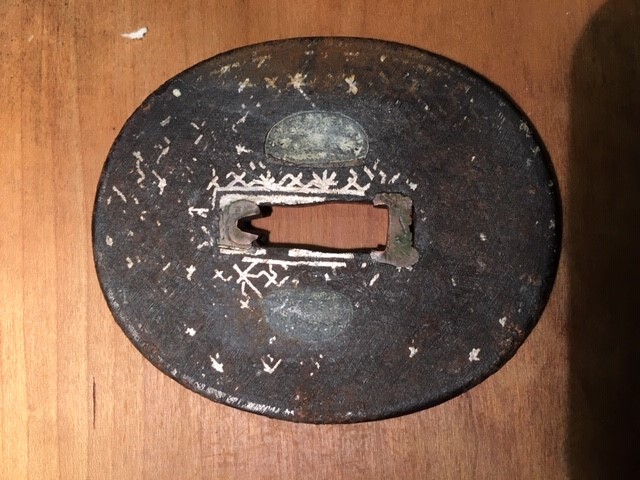
I am writing to show to the NMB community a tsuba that I have just added to my collection. I am as sure as I can be that most of readers who have bothered to open this post will judge this guard harshly. It is in rough condition. It does not fit comfortably into any “school” although most of us would easily call it “Nanban style”. I also assume that many on the Forum will realize that I just bought this fitting from one of the most reviled purveyors Japanese antiques on eBay. I am NOT embarrassed. This guard fits in my collection! I like this guard because I am sure that it is a CHINESE sword guard that found its way to Nippon, probably at a time when the country was supposedly “closed”. I can’t be sure how this guard got to Japan. It might have been the property of a roaming warrior. I am sure that lots of the guys who came home from the terrible fighting that took place in Korean had access to Continental weaponry. Maybe one of them brought it home as a trophy. It is also possible that this was nothing more than a trinket some Chinese trader sold to a minor official who wanted to dress up like a “foreigner”. Once in Japan, this guard was adjusted for use on a katana. The kinko that added the necessary ryo-hitsu or the fellow that later filled them in probably found the nunome zogan embellishments on the guard coarse. And it seems never to have been treated with care. It probably spent most of the last century or two in a kura where it lost lots of zogan and gained ample red rust. Cleaning it will be a chore – that I am looking forward to! I am pleased to have found this guard. It fits with other pieces I have assembled and I found it. I have done my home work and developed my own opinions.Collecting is much more about searching than it is having. Peter


-
Favorite Online Places To Purchase Tsuba?
Peter Bleed replied to lotus's topic in Auctions and Online Sales or Sellers
I like to hunt for things I like. That usually means that i do NOT want the advice of experts. I frankly don't care about the fine points of this or that school. I'd rather make my own judgements, thank you. We used to be able to search places like gun shows, flea markets, and shops, but those sources have dried up. Currently you can scan easily accessible sites to see hundreds of fittings that have names and assessments attached. Some also offer useful information. I love Andy Quirt's presentations but the most accessible spot for searching in the modern world is Ebay. It is a walk thru the modern flea market.Read the books. Listen to the conversation AND LOOK AT STUFF! Peter -
Ron, Thanks for this follow up. The FUSA seems right. The HIDE is a bit more challenging... P
-
Ron, You shouldn't be ignored, but this is unreadable - to me and everybody else apparently. My only reaction is that the tang looks like a Showa period creation. Is it a real sword? peter
-
The fact that a sword "only" has "old" papers does not mean that those papers are BAD. It simply means that it is the papers a sword has. I have a couple of nice old green papered blades. I'm sure those blades are fine and nobody from Yoyogi has ever contacted me asking for the papers to turn in. They are what they are. I see no evidence of any comb filtering. Lets see, what is it the big boys always tell us, . . . buy the sword not the papers. Peter
-
Japanese-Antiques.com
Peter Bleed replied to parfaitelumiere's topic in Auctions and Online Sales or Sellers
There is a certain symmetry in this discussion of Jim Miller just after we remembered Bob Coleman. They were different guys and different kinds of guys, but both reflected the glory days of the Japanese sword explosion. Riding that explosion was an adventure for lots of people, a bonanza for others, and a barely glimpsed event for far too many. Peter