


Peter Bleed
-
Posts
1,866 -
Joined
-
Last visited
-
Days Won
8
Content Type
Profiles
Forums
Events
Store
Downloads
Gallery
Everything posted by Peter Bleed
-
Japanese-Antiques.com
Peter Bleed replied to parfaitelumiere's topic in Auctions and Online Sales or Sellers
There is a certain symmetry in this discussion of Jim Miller just after we remembered Bob Coleman. They were different guys and different kinds of guys, but both reflected the glory days of the Japanese sword explosion. Riding that explosion was an adventure for lots of people, a bonanza for others, and a barely glimpsed event for far too many. Peter -
Bruce, Hiragana is the writing style used for "Japanese." You can write anything you need to is Hiragana. Katakana is the style used for foreign sounds/words. These are all purely Japanese sounds as well, but the fact that something is rendered in katakana may suggest that pronunciation may be a bit "foreign". We all know that katakana was used for the large series of Arisaka rifles so mebbe they would also be used on Mantetsu blades, but I bet they weren't. I am not sure how many Mantetsu blades were produced, but I can't believe that the numbers involved were at all like the volume managed by the rifle arsenals. Can you show us a Mantetsu blade with another kana? In any case, do we know what kinds of units were marked by the kana? They could be series definitors - like A1, A2, A3 etc. OR they could be abbreviations. This sword could be the 450th one made at the Toriyama shop (I'm making that up), or something like that. In any case, I think we can easily overthink these sorts of things. How's the sword? Peter
-
This certainly seems likely to be a worthy sword. Polish and a refit would not be cheap, tho. I don't think it would be a waste of money, but I doubt that you could consider this a wise "investment." At the very least, I think you should consider submitting it to a shinsa. That won't cost vert much and it will also provide useful information. Peter
-
This is a HIRAGANA not a katakana "TO" . Notice that the last cipher is a ZERO. Nice mixing of writing systems. Peter
-
Passing Of Bob Coleman
Peter Bleed replied to Brian's topic in Sword Shows, Events, Community News and Legislation Issues
Bob was indeed an interesting guy. I liked him and he was always good to me. He certainly marked an era in the history of Japanese sword collecting. He had good organizational skills. He was a quick learner and he made good use of his contacts. He certainly rode the crest of the glory times of the whole sword hustle. In that regard, the fact that I find most remarkable about Bob was that he got OUT of Nippon-to when the times changed. It is as if he "got over" Japanese swords when conditions changed. The last time I remember speaking with Bob was at a Chicago Show - where he had all this really high end SS stuff and a Zero propeller. He marked an era. Peter -
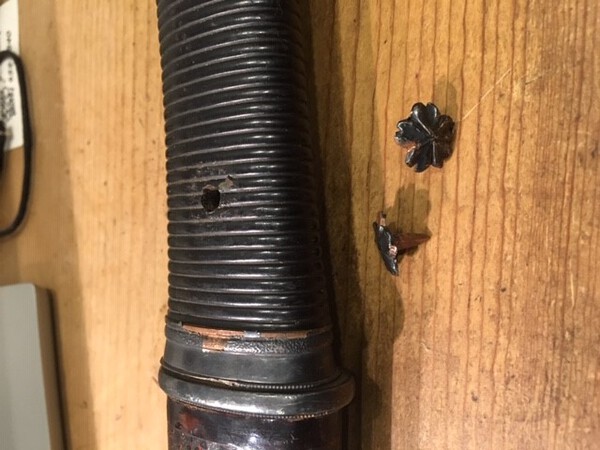
Today I bought - and had to unpack - a totally unimportant little tanto. It had a lacquered tsuka without menuki, but it had rather nice silver foil covered cherry blossoms on what I was sure was the mekugi-ana. I closed the deal assuming/hoping that these were either a threaded or sleeved mekugi. But, NO! They were a matched pair of short nails with silver foil covered sakura-shaped head that had been pounded into the mekugi. They came out - although the mekugi was totally trashed. I have never seen this style of closure before? As anyone else? Peter
-
This certainly is not near tanto length. Lets see, what is it that people say, . . "believe the sword not the paper...." Peter
-
Ron, You have an adventurous sword life!. When I looked at the first sword I saw KANETORA and I went to the books. And there was one (!) but he was MUCH to recent for this sword. - which is a tachi, right. I have no clue on the other one - but it doesn't look very promising, either... Thanks for the conversation. I sure wish that I lived within commuting distance of St Loose. Peter
-
Ivory Objects, I Desire To Learn What These Are
Peter Bleed replied to Chris A's topic in Other Japanese Arts
These cups look to me like Chinese objects and my guess is that they are NOT ivory and not very old. The other vessel is certainly Japanese, but it came with a bottle of Gekkeikan sake. Peter -
Good careful, examination, Patrick. But I think it is okay. Nice looking guard that needs to have some sukashi cleaning...??? Peter
-
Chinese Or Japanese Hand-Cannon Info Needed
Peter Bleed replied to JPGH's topic in Tanegashima / Teppo / Hinawajū
I am not sure what the issue is behind much of this thread. Bannerman serviced American gun collectors - many of whom were interested in the evolution of guns. For that reason there was a market in what were understood to be early stages of firearm development. Bannerman certainly put that simple hand cannon up there in the left corner to show a "primitive" gun. I also bet that he really didn't know the differences between Japanese and Chinese things. I am not familiar with the whole "Powder tester" category. I do recall that in thje old days, Dick Dodge used to come uo with lots of those neat little cast bronze cannons. When I asked about them, he said they were CHINESE and used as fireworks play things. He said that in addition to a small charge, the barrels were packed with confetti to give both a a bang and a burst of stuff. Peter -
Its not kanji and I think it is not "ra". I see it as a scratched SA TO U, as in, SATOU. Do you suppose there was a Lt Sato in the IJA? Peter
-
I do not find this shape particularly interesting, BUT I really wish somebody would explain KUNIHIRO tsuba top me. Usually, that name is found on sewer lid iron discs, but this guy seems rather more refined and - ahhh - interesting. Who where these guys? P
-
I read it as Kaneie P
-
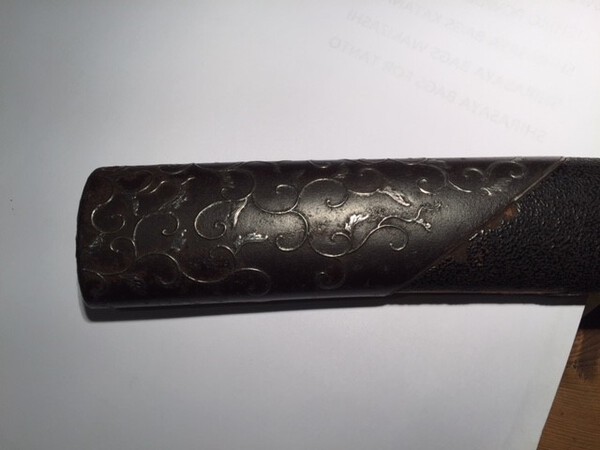
this is a snapshot of the kojiri I'd like to match P
-
With a little luck I will shortly need a nice kurikata. To match the rest of the saya kodogu, I’m looking for a black iron fitting with linear silver “karakusa” zogan. Anybody have anything? Peter
-
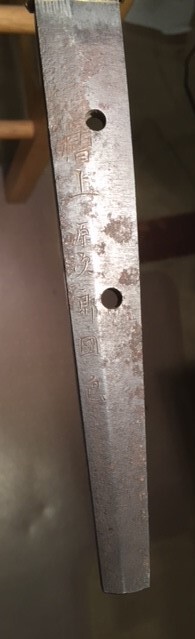
Dear Friends, Please allow me to show a sword that I hope some on NMB may find of interest. This is a 26.5” (67.3cm) katana that I bought at Tampa several years ago. Two other collectors told me about it as I walked into the show. It was waiting there for me and I got it. At that point, it was mounted in nonregulation gunto mounts. The katana-mei says Yamashiro Kami Kunikane. This is the signature of the second Kunikane. Frankly this signature looks okay. It is well cut and the penmanship seems pretty good, although the placement might seem challenging, and there is no question that the machi have been moved up substantially. The sword is still a daito – if just barely. On the other side is an inscription saying Raised/Shortened (I need help with the first kanji - thank you) Genjiro Kunikane. Genjiro was the third KK and the son of the number 2.This signature, also, looks very well cut altho the Genjiro section may be a bit inconsistent. These kanji also seem just a bit small than those on the other side. I sent it to Japan for a polish and shinsa. After paying a lot of money and waiting a long time. It came back with nice new habaki and shirasaya, but NO PAPER! I was disappointed and asked my agent. He said the shinsa team (it was not from the NBTHK) judged it a very good sword but they would not verify the mei. They could not even informally suggest who made the sword or why it had this interesting inscription. Given that the blade was fully visible when it arrived I expressed disappointment that it had not been submitted to shinsa before polish. Getting bad news early would have been an advantage. Obviously, there was no recourse so I chalked this up as another “shinsa story.” There is no question that this IS a good sword, but it wasn’t the good sword I was hoping for. I did not wish to peddle it as a fake. And I certainly did not want to pay to have both meis removed. So it has languished in my collection. I hate when that happens! In looking at this sword again, however, I have become convinced that it deserves a closer look. It has a coarse gonome hamon with a couple of flat sections. It is nie rich and there is ample ji-nie. This may not look like “Kunikane style”, BUT in the Sendai Meikan there is a sword just like this one the second KK. And Markus Sessko even shows a very similar blade by KK2 in his Shinto overview. KK2 did make swords this way. Likewise, if you are expecting masame hada, this sword is a challenge. A fast moving shinsa team would see itame. Looking closely, however, it is apparent that this sword has a masame structure. It has some hari-gane and sunagashi, both of which a features of straight grain. I’m still disappointed with the shinsa results, but this case leads me to an observation and a question. First, this sword may have presented the shinsa team with a problem that was outside their expertise. Shinsa teams deal with the categories and smiths that they consider valuable. The Kunikanes have not been a hot topic. I’m sure that if I could show this sword to fellows up in Sendai, they could tell me for about it and how/why swords were being shortened in Sendai. I think experts in the Kunikane line could make some interesting speculations about this sword. As I said, both signatures look “good” to me, but I am sure that KK3 was working closely with KK2 and in that case, you have to wonder if KK3 may have signed the blade with his father’s signature when he shortened it. The fact that the KK3 mei is just slightly smaller than the KK2 katana-mei may have been appropriately modest. Second, I’m coming to believe that masame hada requires special polish. This sword looks good, but does not advertise its masame. Thanks for listening. Peter

-
The last of my papers from the Chicago shinsa arrived today. Running a shinsa operation has to be wall to wall - ahhh - heartache. I commend and thank Chris Bowen for providing this service. Peter
- 1 reply
-
- 2
-

-
Thank you all for responding to my inquiry about Shinto Bengi. I made the inquiry because of a comment Tanobe-sensai made in 1984 in an English language section of Token Bijustsu. He said that the author of Shinto Bengi claimed that some Yamato swordsmiths went to northern Japan in Oei times. Kunikane claimed to have roots in the Hosho tradition – and he sure demonstrated that style – but I am totally unaware of any koto era swords from the immediate Sendai area. Yes yes, there were the Gassan guys over the mountains in Yamagata. And swords were made up at Hiraizumi (how wonderful that was was). Do we really think that Hosho excellence could be preserved for a couple hundred years by nameless country smiths? Peter
-
Malcolm, You have hit the nail on the head. Now if only I could read it! Thanks peter
-
Hoping For Some Info. On This Sword Please
Peter Bleed replied to bwanapete's topic in Military Swords of Japan
Golly, this does not look like recent Chinese production to me. Looks much for like Mino manufacturing. Hey, there was a War on. Peter -
A long time ago Willis Hawley presented a volume of Edo-era "oshigata" called SHINTO BENGI. I had a copy but got separated from it a long time ago. My recollection is that it was like a lots of the illustrated Edo era references, i.e. not detailed or specific enough to be of modern use. Was there text that went along with the illustrations. And if there was, was that translated? Peter
-
Friends, Can anyone direct me to a discussion on how hitsu were filled? We have all seen guards that have one or both ryo-hitsu plugged with well-formed ume of shakudo or other fine material. I am curious about more commonly used metals. Were histu filled with lead or pewter? And While we're on that topic, maybe somebody can explained why and how hitsu were plugged. Thank you in advance... Peter
- 1 reply
-
- 1
-
-
Let me add my "very cool, Rich." This is an interesting historical document and I suppose that we can be glad that it appears to have focus on a blade that would be described as "expendable." Peter
-
Ron, This looks like a section of one of the banners that were produced and used to dispatch boys to the military. This one looks trimmed since they often had both the soldier name and his home town. The character is "SHU" or congratulations . Notice the spread of fallen cherry blossom across the bottom. Peter


